
Driving Blind? How the Right Projector Lens Solves the Hidden Dangers of Night Driving
Imagine this scenario: It is a rainy Tuesday night. You are driving down a two-lane highway with no streetlights. An oncoming truck passes you, and for a split second, you are completely blind. You grip the steering wheel, hoping the road doesn’t curve, hoping there isn’t a pedestrian or a stalled car in your path. This terrifying moment is a reality for millions of drivers relying on outdated lighting technology.
The problem isn’t your eyesight; it is your equipment. The solution lies in understanding why your stock lights fail and how the Projector Lens price you pay is actually a small premium for essential road safety. This article explores the journey from dangerous darkness to crystal-clear visibility.
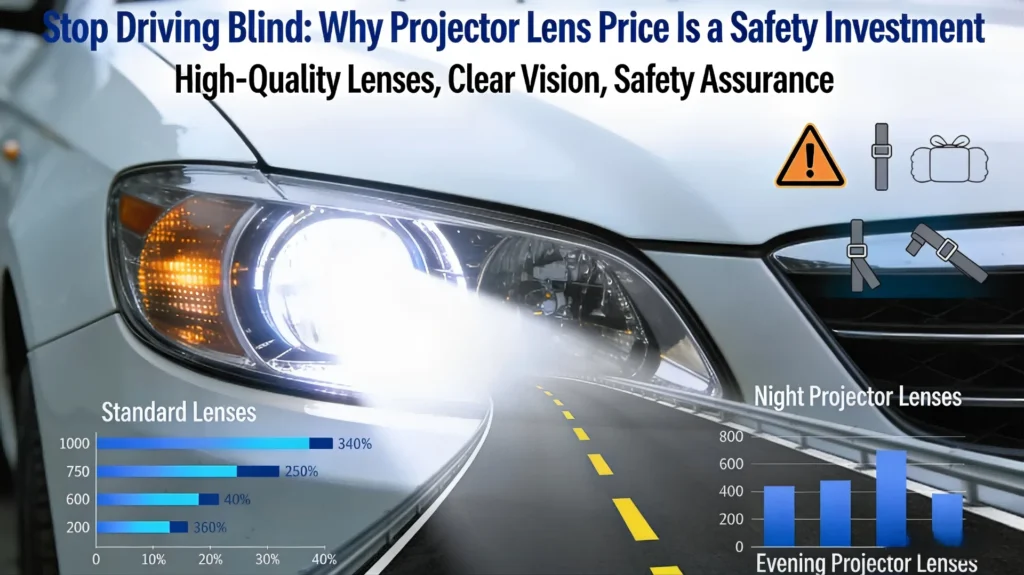
1. The Pain Point: Why Stock Halogens and Cheap LEDs Fail
Most vehicles, especially older models, utilize halogen reflector headlights. These systems are fundamentally flawed for modern driving speeds. They produce a “flood” of yellow light that dissipates quickly. When drivers try to fix this by shoving a cheap, high-power LED bulb into a reflector housing, they create a new problem: Glare.
Discussions on platforms like Reddit’s /r/MechanicAdvice are full of drivers complaining about being “flashed” by others. This happens because the light is scattering everywhere—up into the trees and into other drivers’ eyes—rather than onto the road. You effectively have a high brightness source, but low visibility.
2. The Solution: The Precision of Projector Lenses
The definitive fix for this optical mess is a retrofit Projector Lens. Unlike a standard bulb, a projector lens is a self-contained optical system. It captures 100% of the light produced by the LED chip and forces it through a curved lens.
2.1. How It Works
A metal shield inside the projector cuts off the light beam at a specific height.
- Below the line: Intense, focused light that illuminates the road width-to-width.
- Above the line: Darkness. This protects oncoming traffic from glare.
This “Cutoff Line” is the holy grail of automotive lighting. It allows you to run a much brighter light source without blinding anyone.
3. Analyzing the Investment: Projector Lens price vs. Safety Cost
Many drivers hesitate because of the cost. They search for the lowest projector lens price car parts available. However, we need to reframe this.
Consider the cost of a minor fender-bender due to poor visibility. Deductibles, increased insurance premiums, and repair costs can easily exceed $1,000. In contrast, a premium projector setup might cost between $200 and $400. Whether you are looking at the projector lens price in India or purchasing domestically, the math favors the upgrade. It is a one-time preventative cost.
4. Application: Retrofitting Your Daily Driver
You don’t need a brand new BMW to have this technology. Projector lenses are designed to be retrofitted into existing headlight housings.
Scenario: The Family SUV
Let’s say you drive a 2015 Toyota Highlander. The stock halogen projectors are dim. By opening the headlight and swapping the internal unit for a GTR Bi-LED projector, you instantly gain:
- Width: See into the ditches (spotting deer earlier).
- Distance: High beams that actually reach down the highway.
- Instant On: No warm-up time like old HID Xenon kits.
5. Installation and Maintenance: What to Expect
Implementing this solution requires some effort, which is part of the Projector Lens price consideration.
- Installation: This often involves “baking” the headlight assembly to soften the glue and separate the lens from the housing. While it sounds intimidating, thousands of DIYers do it every weekend. Alternatively, many shops specialize in this service.
- Maintenance: Once installed, a quality LED projector is maintenance-free. Unlike bulbs that need changing, a unit from GTR is sealed and designed to outlast the vehicle.
6. Why GTR is the Logical Solution
If you are going to go through the effort of opening your headlights, you only want to do it once. This is why choosing a brand like GTR matters. Cheap, unbranded lenses found when searching for the lowest bprojector lens price in bangladesh or similar markets often suffer from “peeling chrome” inside the bowl after a year, causing light output to drop drastically.
GTR lenses (viewable at LEDCXR) use high-temperature resistant coatings and high-clarity glass. They solve the problem of darkness permanently, ensuring that the “solution” doesn’t become a new maintenance headache.
7. FAQ: Common Concerns
7.1. Q1: Will this void my car warranty?
Generally, modifying the headlight assembly may void the warranty on the headlight unit itself, but it should not affect the rest of the car’s electrical warranty if installed correctly with a harness.
7.2. Q2: Can I get a projector lens with a "Blue Cutoff"?
Yes, many enthusiasts love the flicker of blue at the cutoff line. This is purely aesthetic and is a feature of high-quality clear lenses used by GTR.
7.3. Q3: What is the difference between 2.5 inch and 3.0 inch lenses?
3.0-inch lenses generally offer a wider and taller beam pattern. However, 2.5-inch lenses are easier to fit in compact headlight housings.
7.4. Q4: Why is the Projector Lens price higher for Bi-LED?
Bi-LED means the unit does both Low Beam and High Beam (via a moving shield). You are getting two functions in one reliable unit, eliminating the need for separate bulbs.
7.5. Q5: Are they waterproof?
The projector lens itself is not waterproof; it must be sealed inside your headlight housing. Ensuring a good seal on your headlight after installation is critical.
8. Take Control of the Night
Don’t let darkness dictate your driving confidence. By acknowledging the limitations of stock lights and investing in quality projector technology, you are choosing safety over risk. The Projector Lens price is small compared to the peace of mind that comes with seeing every inch of the road ahead.