
Navigating the w8 beam size chart can be overwhelming for even experienced buyers. With variations ranging from the lightweight W8x10 to the massive W8x67, selecting the right member requires more than just picking a name off a list. This guide provides a deep dive into w8 beam dimensions and properties, helping you make an informed procurement decision for your next automotive or industrial project.
1. Decoding the W8 Beam: Understanding the Nomenclature
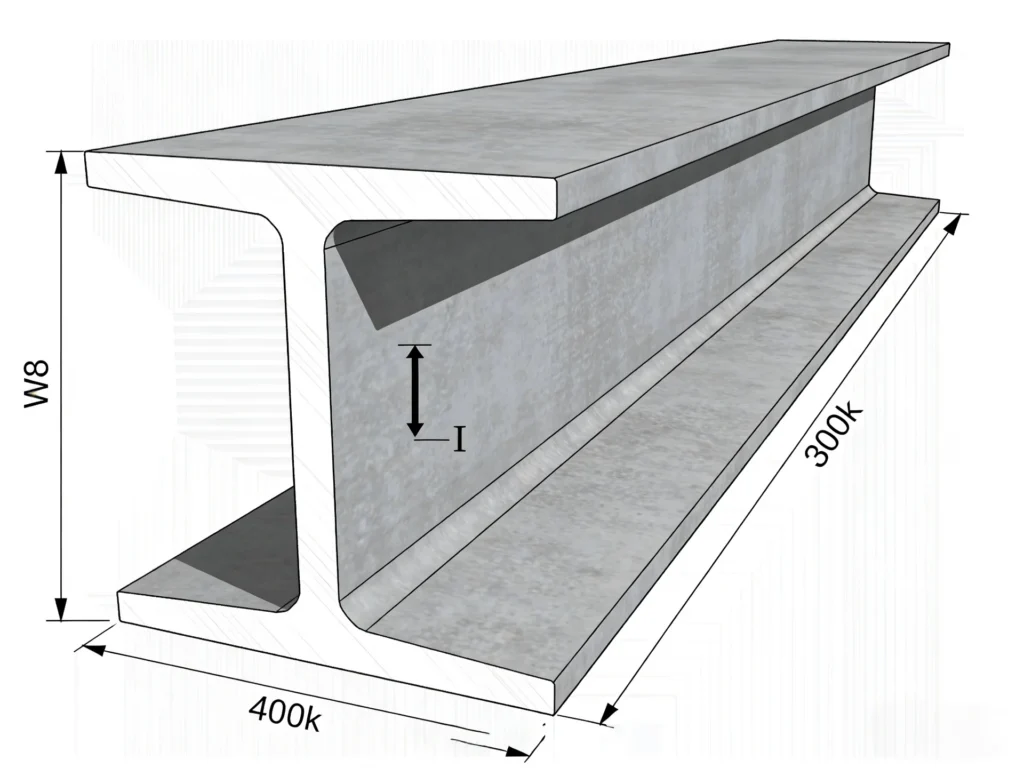
In the steel industry, “W8” refers to a Wide Flange beam with a nominal depth of 8 inches. However, the second number in the designation is equally critical. For instance, in a w8 beam weight per foot calculation, a W8x31 means the beam weighs 31 pounds for every foot of length. At GTR, we emphasize that “nominal” does not mean “actual.” Understanding the w8 beam dimensions in inches for each specific weight is vital for tight-clearance automotive installations.
2. W8 Beam Size Chart: A Comparative Analysis
When comparing w8 beam sizes, the primary factors to consider are the moment of inertia (Ix) for bending resistance and the total depth. While all W8 beams share a similar profile, their load-bearing capacities vary by over 500% between the lightest and heaviest sections.
| Section | Depth (in) | Flange Width (in) | Moment of Inertia (Ix) (in^4) | Section Modulus (Sx) (in^3) |
|---|---|---|---|---|
| W8 x 10 | 7.89 | 3.94 | 30.8 | 7.81 |
| W8 x 18 | 8.14 | 5.25 | 61.9 | 15.2 |
| W8 x 24 | 7.93 | 6.495 | 82.7 | 20.9 |
| W8 x 40 | 8.25 | 8.07 | 146.0 | 35.5 |
3. Key Decision Factors: Which W8 Beam is Right for You?
Based on our years of manufacturing and trade expertise, we recommend evaluating your w8 beam specs against these four critical criteria:
- Structural Clearance: If you are installing LED lighting rigs or overhead tracks, check the actual depth. A W8x40 is nearly 0.4 inches deeper than a W8x10.
- Lateral Stability: Beams with wider flanges (like the W8x31) offer better resistance to twisting (torsion) compared to narrow-flange versions like the W8x10.
- Span-to-Load Ratio: Consult a professional w8 beam span chart to ensure the beam won’t bounce. Excessive vibration can shorten the lifespan of high-end automotive electronics and lighting.
- Corrosion Resistance: For outdoor or wash-bay environments, ensure your w8 beam is hot-dip galvanized or primed to protect the w8 beam properties from degradation.
4. Expert Insider: Avoiding the "Over-Spec" Trap
In our engineering testing at GTR, we often find that clients assume a heavier beam is always “safer.” However, using a W8x48 when a W8x18 suffices adds 30 lbs of dead weight per foot. Over a 20-foot span, that is 600 lbs of unnecessary weight that your columns and footings must support. Always refer to the w8 beam chart to find the most efficient section that meets your safety factor requirements.
5. Why Source Through GTR?
In the competitive B2B landscape of automotive and industrial components, GTR stands out by bridging the gap between raw structural specs and functional application. We understand how w8 beam dimensions impact the installation of specialized lighting and mechanical systems. Our products are engineered to integrate seamlessly with standard structural steel, ensuring that your w8 beam choice supports your vision without compromise.
5.1. Common W8 Beam Technical Questions
5.2. What are the dimensions of a W8x13 beam?
A W8x13 beam has a depth of 7.99 inches, a flange width of 4.00 inches, and a web thickness of 0.230 inches. It is a popular choice for medium-duty bracing.
5.3. Where can I find a complete w8 beam properties table?
Complete tables are provided by the ASTM International standards. However, GTR provides simplified charts specifically tailored for automotive and lighting infrastructure projects.
5.4. What is the difference between a W-beam and an I-beam?
A W-beam (Wide Flange) has flanges that are nearly parallel, whereas traditional I-beams (S-beams) have tapered flanges. W-beams like the w8 beam are generally more efficient for most modern construction.
Ready to optimize your project? Don’t let improper specs hold you back. View our full range of industrial solutions and technical guides at ledcxr.com. Contact our technical team today for a quote that fits your exact engineering needs.