
The automotive lighting industry has evolved far beyond simple halogen bulbs. Today, the demand is for adaptability. Whether you are a marine enthusiast navigating coastal waters, a hunter stalking feral hogs, or a camper setting up a site late at night, a single color of light is often insufficient. Enter the red white led light bar—a sophisticated lighting solution that combines raw power with tactical precision.
This comprehensive guide will walk you through everything you need to know about dual-spectrum lighting. We will cover the physics, the varying configurations, and how to choose the perfect setup for your vehicle from industry leaders like GTR.
1. What is a Red/White LED Bar?
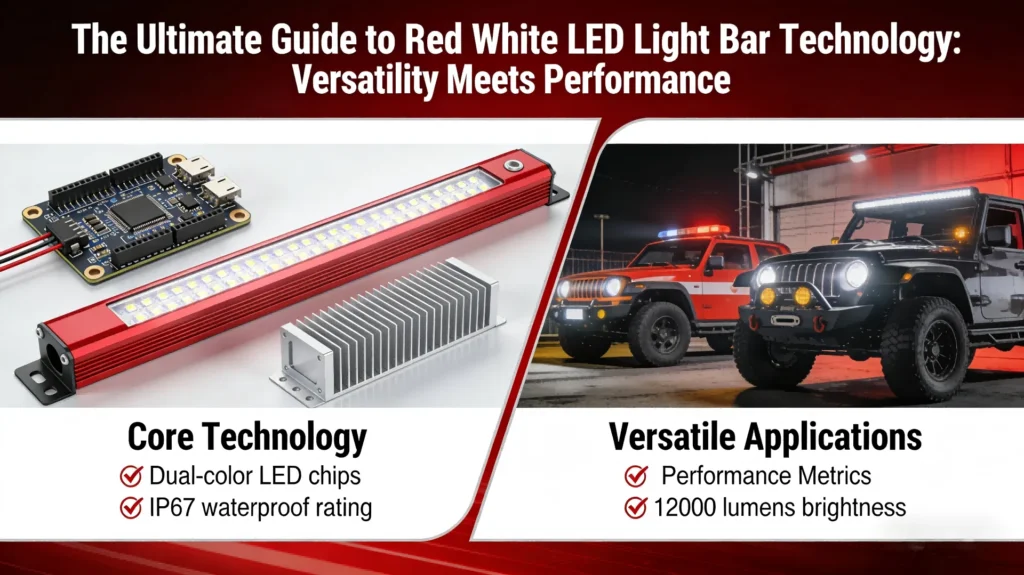
At its core, this product is an LED (Light Emitting Diode) fixture that houses two distinct types of chips on the same circuit board.
1. White Chips: Typically rated between 5000K and 6500K, these provide daylight-simulating illumination for maximum visibility and distance.
2. Red Chips: Emitting light in the 630nm to 660nm spectrum, these provide illumination that is less harsh on the eyes and less visible to certain wildlife.
The innovation lies in the integration. In the past, drivers had to mount two separate bars. Now, a single housing containing led lights black and red aesthetics can perform both tasks, controlled by a multi-function switch or a wireless remote.
2. Scenarios Requiring Dual-Spectrum Light
While standard light bars are ubiquitous, the light bar red and white combination serves specific niches where “brighter” isn’t always “better.”
- Marine and Boating: White light reflects blindingly off the water’s surface and destroys the captain’s night accommodation. Red light allows for navigation chart reading and deck work without losing the ability to spot buoys in the dark.
- Hunting and Wildlife Observation: Many animals, such as hogs and coyotes, are color-blind to the red spectrum. A led red light allows a hunter to scan a field without spooking the game, switching to white only when a target is confirmed.
- Camping and Overlanding: White light attracts bugs. Swarms of mosquitoes and moths are drawn to the high-UV content of white LEDs. Switching to the red mode significantly reduces the number of insects around your campsite, making cooking and relaxing much more pleasant.
3. Key Buying Factors and Comparison
When shopping for a red white led light bar, you will encounter various specifications. Here is how to decipher them to ensure you are getting a quality product.
| Fonctionnalité | Standard Entry-Level Bar | Premium (e.g., GTR) Bar |
|---|---|---|
| Chip Layout | Alternating patterns (White-Red-White). This can create patchy lighting. | Dual-Row dedicated or Multi-Chip technology for smooth, even blending. |
| Lumens (White) | Often exaggerated. May claim 20,000lm but deliver 8,000lm. | True efficiency. High candela rating for actual distance. |
| Red Wavelength | Often uses orange-tinted lenses over white LEDs (fades over time). | True monochromatic led red light diodes for pure output. |
| Housing | Cheap aluminum, prone to oxidation. | Extruded 6063 Aluminum with UV-resistant powder coating. |
3.1. Optics: Spot vs. Flood vs. Combo
You may see terms like “5D Lens” or “Reflector Cup.”
For a dual-color bar, a Flood pattern is often preferred for the red light, as it is used for close-range area lighting or slow driving. The white light benefits from a Spot ou Combo pattern for high-speed visibility.
4. Installation and Wiring Architectures
Installing a dual-color bar involves managing complexity. You are not just connecting positive and negative.
The Wiring Harness:
Ensure your kit comes with a dedicated multi-trigger harness. You should look for high-gauge wiring (12AWG or 14AWG) to handle the current without voltage drop.
Switching Options:
1. Separate Rocker Switches: One for red, one for white. Simple and reliable.
2. Single Cycle Switch: Press once for white, again for red, again for off. This can be annoying if you miss your mode.
3. Wireless Management: Brands like GTR offer compatibility with systems like the Switch-Pros or Garmin PowerSwitch, allowing you to program strobe patterns or dimming features directly from a control panel.
5. The FAQ Vault
Q: Does the red light help in snow?
A: Absolutely. As discussed in enthusiast groups, led light red colour wavelengths do not refract off snowflakes as aggressively as white light, reducing the “wall of white” effect.
Q: Can I run both colors at the same time?
A: On most high-end bars, yes. This creates a pinkish hue. While not standard for driving, it can be useful for artistic photography or specific signaling needs.
Q: How do I clean the lens?
A: Use a mild soap and water solution. Avoid harsh chemicals that could cloud the polycarbonate lens, which would reduce the effectiveness of the led lights black and red contrast.
Q: What size bar do I need?
A: For a roof rack, a 40-50 inch bar is standard. For a bumper or bull bar, a 20-30 inch bar is typically sufficient. Ensure you measure the available space between mounting brackets before ordering.
6. The GTR Engineering Advantage
In a market flooded with generic options, GTR stands out through rigorous R&D. A common failure point in dual-color bars is the circuit board logic—cheap bars often “forget” which color was last used or flicker when switching modes.
GTR engineers their red white led light bar logic boards to be isolated and shielded from electromagnetic interference (EMI). This means turning on your lights won’t cause static on your radio. Furthermore, GTR uses top-tier polycarbonate lenses that are virtually unbreakable, ensuring that whether you are on a construction site or deep in the forest, your light source remains intact and operational.