
When it comes to automotive lighting, few technologies have maintained the prestige and performance reputation of oem hid headlights. Short for Original Equipment Manufacturer High-Intensity Discharge, these lighting systems represent the pinnacle of factory-fitted illumination for premium vehicles. While modern LEDs are gaining traction, the unique spectral output and projection capabilities of factory hid headlights remain a gold standard for many enthusiasts and manufacturers. Understanding the intricacies of these systems is crucial for any driver looking to maintain their vehicle’s safety standards or seeking a meaningful upgrade in nighttime visibility.
1. The Science and Principles of High-Intensity Discharge
To understand why oem hid headlights are held in such high regard, we must first look at the physics of how they generate light. Unlike traditional halogen bulbs that rely on a delicate tungsten filament, HID systems operate via an electric arc between two tungsten electrodes. This arc is housed within a quartz glass tube filled with a mixture of noble gases—primarily Xenon—and metallic salts.
The process is remarkably sophisticated. When you turn on your vehicle, a component called a ballast sends a high-voltage pulse (often reaching 20,000 to 25,000 volts) to “strike” the arc. Once the arc is established, the ballast regulates the power to a much lower, stable voltage. This creates a brilliant, white-blue light that closely mimics natural daylight. On forums like Reddit’s r/cars, users often discuss the “warm-up period” of factory hid headlights, which is the few seconds it takes for the metallic salts to vaporize and reach full intensity. This characteristic is a hallmark of genuine HID technology and contributes to its efficiency, as HID systems produce more lumens per watt than halogen counterparts.
1.1. The Role of the Projector Lens
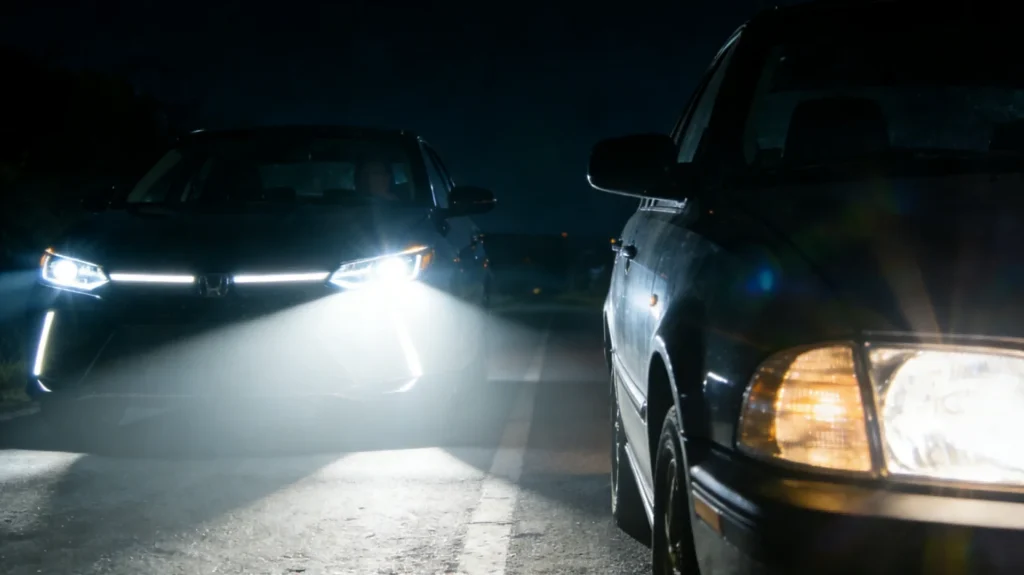
Most oem projector headlights utilize a sophisticated optical assembly to manage this intense light. A projector consists of a reflector bowl, a shutter (for high/low beam switching), and a thick glass lens. This configuration ensures that the light is focused precisely on the road rather than scattered into the eyes of oncoming drivers. This “cut-off line” is perhaps the most critical safety feature of oem hid headlights, providing maximum reach without causing glare.
2. Core Application Scenarios and Manufacturer Adoption
For decades, oem hid headlights were the exclusive domain of luxury brands, but their application has since expanded. The way different manufacturers integrate these systems can vary significantly based on the vehicle’s electrical architecture and aerodynamic design.
- Luxury European Brands (BMW, Mercedes-Benz, Audi): These manufacturers were early adopters. For instance, a BMW 3-Series often utilizes D1S or D2S bulb configurations within its oem projector headlights to achieve the “angel eye” aesthetic combined with superior road coverage.
- Electric Vehicle Pioneers (Tesla): While newer models have transitioned to LED, many Model S and Model X vehicles on the road today rely on factory hid headlights. The efficiency of HID over halogen was a key factor in extending battery range during night driving in earlier EV designs.
- Reliable Commuters (Toyota, Honda): Higher trim levels of the Toyota Camry or Honda Accord frequently feature oem hid headlights to offer a premium driving experience. These systems are designed for longevity, often lasting over 3,000 hours of operation.
According to discussions on Facebook enthusiast groups, owners of these vehicles often prefer sticking with oem hid headlights during repairs because they maintain the vehicle’s “intended beam pattern,” which aftermarket “plug-and-play” LED kits sometimes fail to replicate accurately.
3. Key Factors for Selection and Evaluation
When evaluating oem hid headlights, whether for replacement or a retrofit project, several critical factors must be considered to ensure the system meets modern safety and performance expectations.
- Luminous Flux and Color Temperature: Most factory systems operate between 4300K and 5000K. This range provides the highest lumen output and the best contrast for the human eye. While 6000K (cooler blue) is popular for aesthetics, it may slightly reduce visibility in rainy or foggy conditions.
- Ballast Quality and Compatibility: The ballast is the “brain” of the oem hid headlights. It must be compatible with the vehicle’s CANBUS system to prevent “bulb out” warnings or flickering. GTR ballasts are specifically engineered to provide a stable arc with minimal electromagnetic interference.
- Beam Width and Throw: High-quality oem projector headlights are measured by how wide they illuminate the shoulders of the road and how far the hot spot reaches down the highway. A well-designed HID system could illuminate up to 150 meters ahead clearly.
- Thermal Management: Although HIDs are cooler than halogens in terms of infrared heat sent forward, they generate significant heat at the base of the bulb. Proper housing ventilation is essential to prevent the reflector bowl from peeling or “burning” over time.
4. Professional Installation and Long-term Maintenance
Installing or maintaining oem hid headlights requires a higher level of care than simple halogen swaps. Because the system operates at high voltages, safety is paramount. One should always disconnect the vehicle battery before handling HID components.
Installation Tips:
When replacing a bulb in factory hid headlights, never touch the quartz glass with bare fingers. The oils from your skin can cause “hot spots” on the glass, leading to premature bulb failure. If accidental contact occurs, clean the bulb with isopropyl alcohol. Ensure that the igniter is firmly seated on the bulb to prevent electrical arcing, which may damage the headlight housing.
유지 관리:
HID bulbs don’t usually “burn out” suddenly like halogens; instead, they undergo “color shifting.” If you notice your oem hid headlights turning a pinkish or purple hue, it is a sign that the xenon gas is depleted and the bulb is nearing the end of its life. Experts recommend replacing bulbs in pairs to ensure consistent color and brightness across both sides of the vehicle.
5. Why GTR is the Premier Choice for OEM Solutions
In a market flooded with low-quality imitations, GTR stands out as a beacon of engineering excellence for oem hid headlights. Our commitment to “Lighting the Way Forward” is reflected in our rigorous testing protocols and material selection.
GTR’s HID components are designed to meet or exceed original factory specifications. We utilize high-purity xenon gas and APL metal halide salts from Germany, ensuring that our factory hid headlights provide a crisp, consistent beam. Furthermore, our oem projector headlights are manufactured with precision-molded glass lenses that offer 99% transparency, minimizing light scatter. When you choose GTR, you are not just buying a bulb; you are investing in a system backed by years of research in thermal dynamics and optical engineering. Our diverse selection ensures compatibility with a wide range of makes and models, from domestic trucks to imported luxury sedans.
6. 자주 묻는 질문(FAQ)
6.1. Can I replace my halogen bulbs with oem hid headlights?
While possible, it is not a direct swap. You would need a full conversion kit, including ballasts and potentially oem projector headlights, to ensure the light is properly focused. Putting an HID bulb in a halogen reflector housing may cause dangerous glare for other drivers.
6.2. How long do factory hid headlights typically last?
Most high-quality HID bulbs, such as those from GTR, are rated for 2,500 to 3,500 hours. For the average driver, this could translate to 5 to 10 years of use before a replacement is necessary.
6.3. Why are oem hid headlights flickering?
Flickering is often caused by a failing ballast or a poor ground connection. In some cases, it may be due to the vehicle’s computer system not recognizing the power draw of the HID system, which can be solved with a GTR CANBUS decoder.
6.4. Are oem hid headlights better than LED?
Both have advantages. oem hid headlights typically offer a better “throw” (distance) and a more uniform light spread in projector housings, whereas LEDs offer instant-on capability and longer lifespan. For many, the “depth” of HID light is still preferred for high-speed highway driving.
6.5. Do I need to replace the ballast when I replace the bulb?
Not necessarily. If the bulb has color-shifted but the light is steady, the ballast is likely fine. However, if a new bulb does not fire up, the ballast might be the culprit.
6.6. Is it legal to upgrade to oem projector headlights?
In most jurisdictions, as long as the equipment is DOT or SAE compliant and properly aimed, upgrading to high-quality projection systems is legal. Always check local regulations regarding color temperature.
6.7. Upgrade Your Vision Today
Don’t settle for dim or unreliable lighting. Experience the precision and power of GTR’s oem hid headlights.