
Ultraviolet technology has transitioned from the niche corners of forensic labs and nightclubs into everyday applications ranging from home hygiene to industrial curing. Central to this shift is the compact yet powerful 9w uv light bulb. No longer reliant on fragile mercury vapor tubes, modern UV sources utilize Light Emitting Diodes (LEDs) to deliver precise wavelengths with high energy efficiency.
Whether you are searching for a 9w 400 nm uv light bulb for party effects or a precision uv light bulbs 9w 365nm unit for mineralogy and inspection, understanding the technical landscape is vital. This comprehensive guide explores the physics, applications, and buying criteria for 9-watt UV LED solutions.
1. Module 1: Definition and Working Principle
1.1. What is a 9W UV LED?
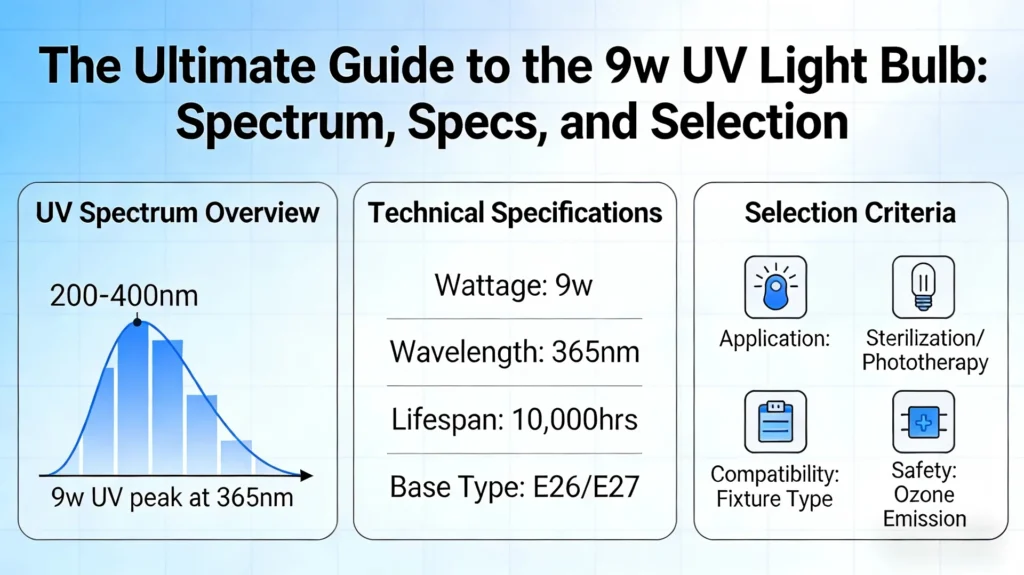
A 9w led light bulb operating in the ultraviolet spectrum converts electrical energy into photons with wavelengths between 100nm and 400nm. The “9W” specification refers to the power consumption of the device. Unlike traditional incandescent bulbs where 9W would be quite dim, a 9W LED is a high-output device capable of intense irradiance.
1.2. How It Works
Inside the bulb, current passes through a semiconductor material (typically Indium Gallium Nitride). As electrons move across the bandgap, they release energy as light. By adjusting the chemical composition of the semiconductor, engineers can tune the light to specific UV wavelengths. This solid-state design makes the bulb resistant to shock and vibration, a massive improvement over glass tubes.
2. Module 2: Core Application Scenarios
ความหลากหลายของ 9w led bulb in the UV range allows it to serve multiple sectors. Below are the most common use cases based on wavelength:
- 395nm – 400nm (Blacklight): This is the most common range for a 9w 400 nm uv light bulb. It creates a visible purple glow.
- Uses: Entertainment venues, curing entry-level UV resins, inspecting hotel cleanliness, and verifying currency.
- 365nm (Pure UV): Often referred to as “Wood’s Glass” territory.
- Uses: Forensic analysis, high-end NDT (Non-Destructive Testing), automotive AC leak detection, and curing specialized industrial adhesives. This wavelength causes fluorescence without the distraction of visible purple light.
- Aquarium & Horticulture:
- Uses: Promoting coral growth in reef tanks or triggering resin production in indoor gardening.
3. Module 3: Comparison and Selection Guide
Choosing the right bulb involves more than just checking the socket type. Refer to the table below to understand the trade-offs.
| คุณสมบัติ | Standard Fluorescent UV (Old Tech) | 9w LED UV Bulb (New Tech) |
|---|---|---|
| อายุขัย | 5,000 – 8,000 Hours | 25,000 – 50,000 Hours |
| Warm-up Time | Slow (requires minutes to reach full brightness) | Instant On/Off |
| Heat Output | High (Radiant heat directed at target) | Low (Heat is dissipated at the rear heatsink) |
| Durability | Fragile Glass | Impact Resistant Solid State |
| Wavelength Precision | Broad Spectrum (Bleeds into visible) | Narrow Band (Precise nm rating) |
3.1. Critical Buying Factors
When browsing specialized lighting retailers or reading reviews, look for:
- Radiant Flux: A 9W power draw is different from optical output. A high-quality bulb should offer high radiant flux (measured in milliwatts).
- Beam Angle: Do you need a spot light (30 degrees) for intense curing, or a flood light (120 degrees) for lighting up a room?
- Heat Dissipation: Look for finned aluminum bodies. UV LEDs are extremely heat-sensitive; without proper cooling, a 9W bulb will quickly degrade to a 5W output.
4. Module 4: Installation and Maintenance
การติดตั้ง 9w uv light bulb is generally straightforward, as many come in standard E26/E27 bases. However, compatibility is key.
Installation Tip: Ensure your fixture is open. Enclosed fixtures (like globes) trap heat. Since LEDs rely on passive cooling, trapping a 9W high-power LED in an enclosed glass fixture can lead to premature failure.
การบำรุงรักษา:
Dust is the enemy of UV performance. UV light has shorter wavelengths and scatters easily. A layer of dust on the bulb acts as a filter, significantly reducing effectiveness. A monthly wipe-down with a microfiber cloth is recommended.
5. โมดูล 5: คำถามที่พบบ่อย (FAQ)
5.1. Is a 9W UV bulb dangerous to eyes?
Yes. Prolonged exposure to high-intensity UVA can cause “welder’s flash” or cataracts over time. Always avoid direct eye contact.
5.2. Can I replace my bug zapper tube with a 9W LED?
Maybe. You must check the voltage. Bug zappers often use ballasts for fluorescent tubes. LEDs usually require bypassing the ballast to run on direct line voltage (110V/220V).
5.3. What is the difference between 365nm and 395nm for pet urine detection?
While a 9w 400 nm uv light bulb works, a 365nm bulb is superior because it shows dried salts without the overwhelming purple visible light, providing higher contrast.
5.4. Do these bulbs get hot?
The beam itself is cool (no infrared), so it won’t melt your resin or burn your skin. However, the base of the bulb will get hot to the touch as it pulls heat away from the diode.
5.5. Can this cure epoxy resin?
Only if the resin is specifically formulated as “UV Cure.” Standard two-part epoxy requires time and chemical reaction, not light.
6. Module 6: Why GTR Sets the Standard
In a market flooded with generic options, GTR stands out by prioritizing component integrity. Our UV solutions are built with verified wavelength chips, ensuring that if you buy a 365nm product, you get true 365nm output, not a 395nm cheap alternative. With rigorous testing for thermal efficiency and driver stability, GTR provides uv light bulbs 9w 365nm and other specifications that professionals can rely on for critical tasks, from automotive restoration to industrial inspection.