
The search for the brightest 9005 headlight bulb often begins with a realization: your stock halogen lights are simply not enough. Whether you are navigating unlit rural highways or trying to cut through heavy rain, visibility is the single most critical factor in automotive safety. However, the automotive lighting market is flooded with exaggerated claims, confusing terminology, and products that might do more harm than good.
In this comprehensive guide, we are moving beyond marketing fluff. We will explore the science of automotive illumination, why the 9005 (HB3) socket is unique, and why modern mini-projector technology from brands like GTR is rendering standard open-die LEDs obsolete.
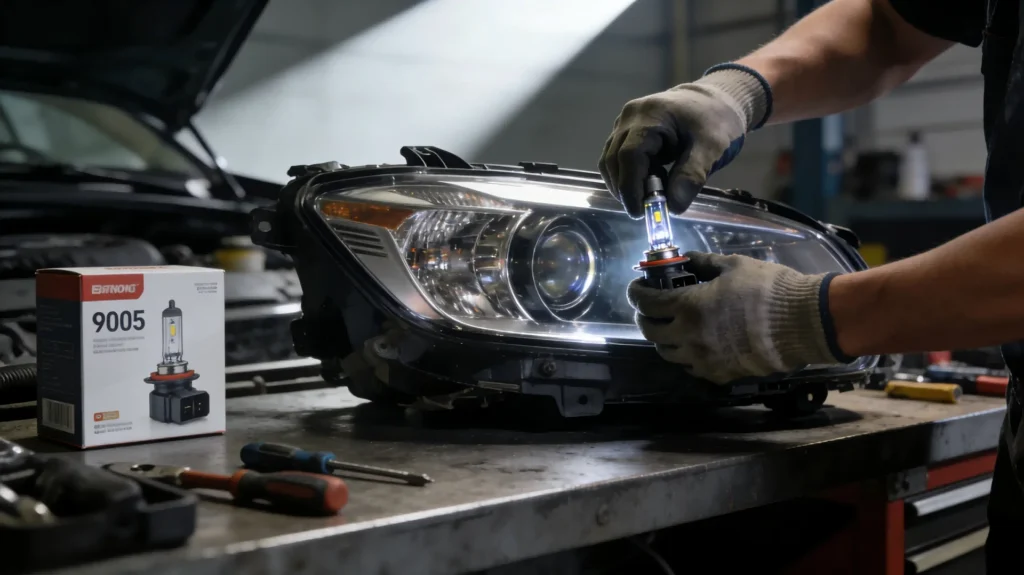
1. Deconstructing the 9005 (HB3) Standard
Before upgrading, it is essential to understand what you are replacing. The 9005 bulb, also known internationally as HB3, is a single-filament bulb. Historically, it was used almost exclusively for high beams due to its high output (typically 65 watts in halogen form). However, modern automotive design has shifted.
Today, many vehicles use the 9005 interface for single-beam projector systems (where a mechanical shutter inside the headlight assembly switches between low and high beam). This versatility makes the best 9005 headlight bulb highly sought after. But here lies the physics problem: halogen bulbs emit light in 360 degrees, while generic LEDs emit light from two flat sides. If this light isn’t captured perfectly by your car’s reflector, you lose visibility.
2. The "Brightest" Myth: Lumens vs. Lux vs. Beam Pattern
If you browse enthusiast discussions on Reddit or Facebook groups, you will see a recurring complaint: “I bought a 20,000 lumen kit, but I still can’t see down the road.” This happens because raw brightness (Lumens) is useless without focus (Lux).
2.1. Understanding the Metrics
- Lumens: The total amount of light emitted by the source. This is what cheap brands advertise.
- Lux: The intensity of light that actually hits the road surface at a specific distance. This is what actually helps you see.
- CRI (Color Rendering Index): How accurately the light reveals colors. Halogens are yellowish (low contrast), while premium LEDs are daylight white (high contrast).
The brightest 9005 headlight bulb halogen options usually cap out around 1,700 lumens. In contrast, advanced LED solutions can technically produce 5-10 times that amount. However, if that light is scattered into the trees or oncoming traffic, it is dangerous. This is where the GTR advantage comes into play.
3. The Projector Revolution: Why Design Matters
The most significant leap in 9005 technology is the integration of mini-projector lenses directly onto the LED bulb. Traditional LEDs rely on your car’s aging chrome reflector bowls, which were designed for halogen filaments, not LED chips. This mismatch causes “scatter.”
GTR’s Mini-Projector Solution: By incorporating a high-definition optical lens at the tip of the bulb, GTR lights act as their own independent headlight system. They do not rely on your car’s reflector. This results in:
- A Sharp Cutoff Line: A distinctive “Z” or flat line that keeps light below the eye level of oncoming drivers.
- Hotspot Intensity: Focusing the majority of the light directly in the center of the lane, maximizing long-range visibility.
- Zero Glare: Solving the number one issue cited by regulators and fellow drivers.
4. Critical Selection Factors for 9005 Upgrades
When shopping for the brightest 9005 headlight bulb, you must evaluate these technical criteria to ensure the upgrade is safe and durable.
| Factor | Why It Matters | What to Look For |
|---|---|---|
| Thermal Management | LEDs hate heat. Overheating causes dimming (thermal throttling). | Look for active cooling fans (10,000+ RPM) and copper substrates, a standard in GTR engineering. |
| CANBUS Integration | Cars monitor bulb resistance. LEDs draw less power, causing errors. | Ensure the kit has a built-in driver or “decoder” to prevent dashboard warnings. |
| IP Rating | Headlights are exposed to moisture and engine bay dust. | IP65 or IP68 ratings are non-negotiable for longevity. |
| Color Temperature | Affects eye fatigue and contrast. | 6000K-6500K (Cool White) provides the best contrast for night driving without the blue tint that causes eye strain. |
5. Installation and Maintenance: A Step-by-Step Protocol
One of the advantages of the 9005 design is its user-friendly installation. However, precision is key when dealing with high-performance LEDs.
5.1. Installation Steps
- Safety First: Ensure the vehicle is off and the lights are cool.
- Quyền truy cập: Remove the dust cover behind the headlight assembly.
- Removal: Twist the old halogen bulb counter-clockwise to unlock it.
- Insertion: Insert the new GTR LED. Crucial Note: If using a non-projector LED, ensure the chips face 3 o’clock and 9 o’clock. If using a GTR mini-projector, ensure the lens is level.
- Connection: Connect the plug. If it doesn’t light up, flip the plug 180 degrees (polarity check).
- Seal: Tuck the driver box inside the housing and replace the dust cover to maintain waterproofing.
5.2. Maintenance
Unlike halogens, LEDs do not burn out suddenly; they fade over thousands of hours. However, check your cooling fans annually. If a fan creates a buzzing noise or stops, the bulb needs replacement immediately to prevent heat damage.
6. Common Questions (FAQ)
6.1. Q1: Will the brightest 9005 headlight bulb melt my housing?
No. While the light is intense, LEDs actually emit less infrared heat (radiant heat) than halogens. The heat is concentrated at the base (heatsink), which is why GTR’s active cooling fans are essential.
6.2. Q2: 9005 led bulb for what car models is this suitable for?
The 9005 is extremely common. It is used in the Toyota Camry, Honda Civic, Ford F-150, Ram 1500, and many others, typically as a high beam or a main projector beam in newer models.
6.3. Q3: Are these upgrades street legal?
Regulations vary by state and country. Generally, the primary legal requirement is beam pattern—you must not blind oncoming traffic. This is why GTR’s projector technology is superior; it controls the light output to mimic compliant patterns, unlike cheap scatter-beam LEDs.
6.4. Q4: Why do my lights flicker?
This is usually a PWM (Pulse Width Modulation) issue from the car’s computer checking for a halogen bulb. A CANBUS decoder resolves this.
6.5. Q5: Can I use this for Day Running Lights (DRL)?
Yes, but DRLs often run on lower voltage. Ensure your LED kit is “DRL Compatible” so it doesn’t flicker when the car runs the lights at 6 volts instead of 12.
7. Why Choose GTR Lighting?
At LEDCXR , we don’t just sell bulbs; we engineer visibility solutions. The market is saturated with generic products that focus on big numbers on the box. GTR focuses on the optical science.
Our commitment to using automotive-grade LED chips, aviation aluminum bodies, and precision-ground mini-lenses ensures that when you install a GTR bulb, you are getting the safest, most reliable, and arguably the brightest 9005 headlight bulb experience available. We test our products against the harsh vibration of trucks and the electrical sensitivity of modern luxury cars to ensure a plug-and-play experience that lasts.