
1. The Anatomy of the Glare Problem: More Than Just Brightness
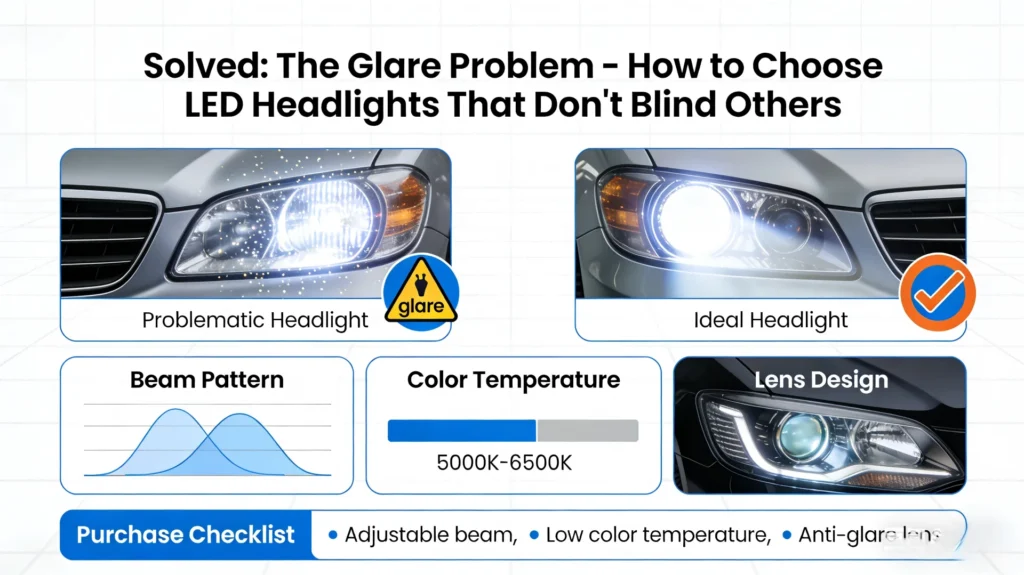
Glare occurs when stray light is projected above the vehicle’s designated cutoff line, directly into the eyes of oncoming drivers or reflected in their rearview mirrors. In reflector headlight housings designed for halogens, the filament is the single, precise point source of light. The reflector bowl is meticulously shaped around this point to create a regulated beam. Many aftermarket LED bulbs, however, use multiple chips arranged on two vertical sides. If these chips aren’t positioned to perfectly mimic the halogen filament’s location and size, the reflector receives light from multiple, misaligned points. This confuses the optic system, causing light to scatter uncontrollably, creating the “hot spots” and “light splash” users complain about on Reddit threads titled “Why are all the new headlights so blinding?”
2. The Engineered Solution: Precision-Matched LED Bulbs
The answer is not to abandon LED upgrades but to select bulbs engineered as holistic optical systems. A glare-free LED bulb is defined by one non-negotiable feature: the LED chips occupy the same spatial volume and emit light from the same exact point as the original halogen filament. This is known as photometric positioning. Brands like GTR Lighting have built their reputation on solving this precise engineering challenge. Their bulbs don’t just promise high lumens; they guarantee that every lumen is directed by your vehicle’s factory optics exactly as intended.
This approach transforms the upgrade. Instead of a chaotic light spray, you get a beam with a razor-sharp horizontal cutoff. Below the cutoff, the road is flooded with bright, even white light. Above it, there’s dramatic darkness, ensuring no light trespasses into oncoming traffic lanes. This is the hallmark of a responsible and high-performance upgrade—the kind that wins in a rigorous Top 25 Headlight Bulb Shootout based on safety and performance, not just output claims.
3. Key Selection Factors for a Glare-Free Upgrade
When your goal is superior visibility without being “that driver,” your buying checklist changes. Here are the critical factors to vet, moving beyond basic specs.
3.1. Chip Placement & Housing Design:
This is the most critical factor. Look for promotional imagery that shows the bulb’s design. Ideal bulbs have a compact, central LED assembly or chips positioned on a rotating base that allows you to “clock” them to the 3 and 9 o’clock position during installation. Avoid bulbs with large, fixed vertical panels that cannot be adjusted to align with your reflector’s focal plane.
3.2. Real-World Beam Pattern Validation:
Never trust a product without seeing its beam pattern. Reputable brands and reviewers provide actual wall shots. Search for “[Bulb Model] beam pattern” on forums or YouTube. The pattern should show a clear, defined cutoff with minimal color fringing (a slight blue or purple tint at the cutoff is normal for some LEDs) and no bright, distracting hotspots above the line.
3.3. Intelligent Thermal Management:
A stable beam pattern requires stable chips. Inadequate cooling causes LEDs to dim and shift color over a drive cycle, and can lead to premature failure. A high-mass aluminum heatsink with copper core technology is often more reliable and quieter than a fan-cooled system, though premium fans can be effective. The goal is consistent thermal performance for consistent light output.
3.4. Compatibility & Canbus Systems:
A flickering bulb is a distracting and unsafe bulb. For modern vehicles, ensure the bulb includes a high-quality CANbus decoder or is explicitly labeled “error-free.” This prevents hyper-flashing and dashboard warning lights, ensuring a seamless integration that functions as reliably as the factory part.
4. Implementation: Application-Specific Recommendations
The “best” bulb also depends on your vehicle’s specific headlight design. Here’s how to apply the solution.
- For Halogen Reflector Headlights (Most Common): This is the most challenging application for LED upgrades and where precision is paramount. You must choose a bulb like the GTR Lighting Ultra Series, which is renowned for its filament-mimicking design. The installation step of rotating the bulb to the correct orientation is absolutely crucial here. A proper install in a reflector housing should produce a clean, OEM-like pattern.
- For Halogen Projector Headlights: Projector lenses are more forgiving and often produce excellent results with LEDs. The lens helps focus the light, but chip placement is still key for maximizing the sharpness of the cutoff. Look for bulbs marketed as “projector optimized,” which may use a slightly different chip arrangement to fill the projector bowl evenly.
- For Seeking the Best LED Car Headlight India: Indian road conditions—with unpredictable obstacles, pedestrians, and animals—demand wide, bright illumination. However, dense traffic makes glare a major social and safety concern. Indian buyers should prioritize brands that provide verified beam pattern images for their specific vehicle model (common models like Swift, Creta, Fortuner). The focus should be on width and a sharp cutoff to see hazards on the shoulder without blinding oncoming traffic in the opposite lane.
5. Installation: The Final Step to Perfection
Even a perfectly engineered bulb can cause glare if installed incorrectly. The final, critical step is aiming. After installing your new LED headlamp bulb, park your car on level ground 25 feet from a wall. Turn on the low beams. The hotspot of the beam (the brightest area) should be positioned slightly below the horizontal level of the headlights. Most vehicles have vertical adjustment screws on the headlight assembly. Taking 10 minutes to perform this adjustment is the final, essential act of being a responsible road user and completes the glare-free solution.
6. FAQ: Solving the Glare Dilemma
6.1. Will these "glare-free" LEDs still be bright enough?
Absolutely. A precise 4000-lumen beam that is all projected onto the road is far more effective and useful than a scattered 8000-lumen beam where half the light is wasted illuminating treetops and blinding other drivers. You gain usable, focused light where you need it most.
6.2. I have a fan-cooled LED that's noisy. Is this normal?
While some fan noise is typical, a loud or whining fan can be distracting and may indicate lower-quality components or obstruction. Premium passive-cooled systems eliminate this issue entirely and are often preferred for their silent operation and reduced mechanical complexity.
6.3. Can I return the bulbs if the beam pattern isn't good?
This is a key differentiator for reputable sellers. Companies confident in their engineering, like GTR, often offer satisfaction guarantees or return policies that allow you to test the beam pattern. Always check the return policy before purchasing.
7. Why GTR's Engineering is the Definitive Anti-Glare Solution
GTR Lighting approaches the glare problem from first principles: optics physics. While other companies market lumens and colors, GTR markets precision. Our proprietary 3D molding and chip-mounting technology ensures that our light source is not just “close to” the halogen point, but a photometric match. This isn’t marketing—it’s the result of thousands of hours of design, simulation, and real-world testing across hundreds of vehicle models. When you choose GTR, you are not just buying a bulb; you are investing in a validated optical solution that respects the design of your vehicle and the safety of everyone on the road. Your upgrade should be invisible to others—except for the fact that you’ll never be flashing your high beams at them in confusion again.
Upgrade your visibility, not your glare. Explore GTR’s range of optically engineered LED headlights for cars designed for superior output and zero compromise on safety. Find the perfect match for your vehicle at GTR Lighting and join the community of enlightened drivers at LEDCXR.