
Driving at night on a poorly lit road can be a nerve-wracking experience. You strain your eyes, trying to peer into the darkness, unsure if that shadow is a pothole or an animal. If this scenario sounds familiar, your vehicle is likely equipped with standard reflector headlights. The solution isn’t just a brighter bulb; it is a fundamental change in how the light is delivered. This brings us to the crucial role of the Projector Lens factory in modern automotive safety.
In this guide, we will move beyond the basics and compare the two dominant technologies, helping you decide why upgrading to a system from a professional projector lens manufacturer is the best investment for your vehicle.
1. The Core Difference: Controlled Focus vs. Scatter
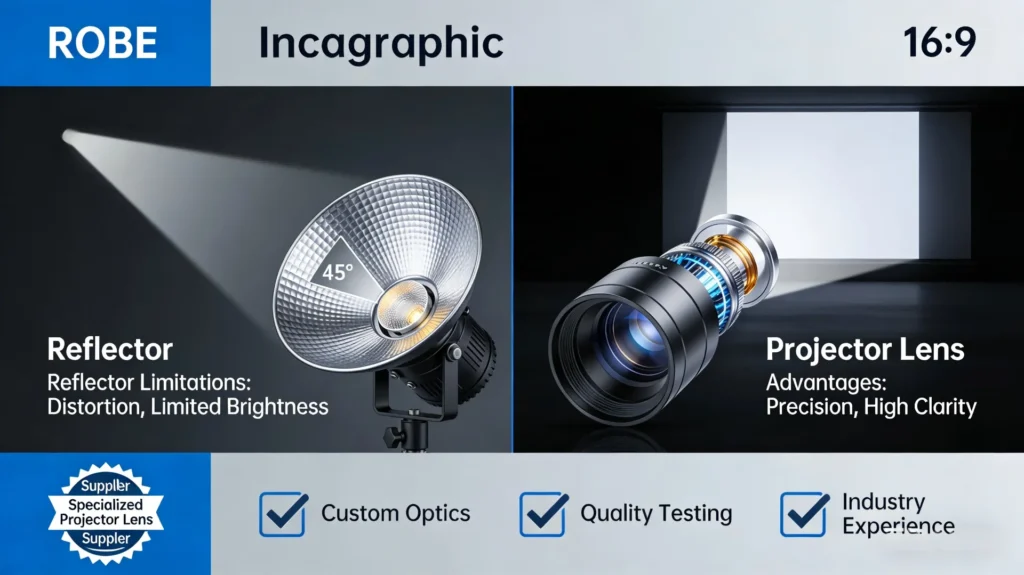
To make an informed purchase, you must understand the mechanics. Traditional headlights work like a flashlight: a bulb sits in a shiny bowl, bouncing light outward. This is efficient but uncontrolled. Light scatters everywhere, often creating “hot spots” on the road and glare for others.
Conversely, a projector lens system uses a focused approach. It captures the light, focuses it through a curved lens, and projects it exactly where it needs to go.
The “Cutoff” Advantage:
If you shine a projector light against a wall, you will see a sharp line. Below the line is bright light; above it is darkness. This protects oncoming traffic. A standard reflector cannot achieve this precision. This capability is why sourcing from a skilled projector lens supplier is vital—precision manufacturing is required to create that perfect cutoff.
2. Comparative Analysis: Projector vs. Reflector
Let’s break down the performance metrics to see why enthusiasts on Facebook groups and forums advocate for projectors.
| 特點 | Standard Reflector | LED 投影機鏡片 |
|---|---|---|
| Light Distribution | Uneven, potential hot spots | Uniform, even spread across the road |
| Distance | Short to Medium range | Long range with focused throw |
| Glare Control | Poor (often blinds others) | Excellent (Sharp cutoff line) |
| 美學 | Dated, basic look | Modern, high-tech appearance |
| 效率 | High light loss | High efficiency (More light on road) |
3. Buyer’s Guide: How to Select the Right Lens
Not all projectors are created equal. When browsing catalogs from a projector lens manufacturer, keep these three critical factors in mind to avoid low-quality imitations.
3.1. The "Z" Pattern Quality
Look for the step in the cutoff line (often called the “Z” pattern). It should be sharp and defined, not fuzzy or blue-blurred (unless intentionally tuned for color). A fuzzy line indicates poor optical glass quality or misalignment at the Projector Lens factory.
3.2. Lumen Efficiency and Transmittance
Ask the projector lens supplier about the transmittance rate of their glass. High-definition (HD) glass lenses allow 98-99% of light to pass through. Cheaper materials block light, reducing the actual brightness regardless of how powerful your LED chip is.
3.3. Integration Ease
Are you looking for projector lenses explained as “plug-and-play,” or do they require heavy modification? Some threaded-shaft projectors are designed to fit directly into older reflector bowls, making installation much easier for the average user.
4. Why GTR is the Superior Choice for Projectors
When comparing suppliers, GTR emerges as a leader due to a relentless focus on optical precision. Unlike generic trading companies, GTR operates with the mindset of a dedicated Projector Lens factory, ensuring that every unit leaving the line meets strict photometric standards.
GTR’s Advantages:
- Advanced Materials: We use automotive-grade aluminum for heat sinks, ensuring that the LED chips remain cool and bright for years, not just months.
- Strict Quality Control: Every lens undergoes a beam pattern test to ensure no dark spots exist in the critical viewing area.
- Support: We provide technical data and support to help you understand exactly how many lens used in projector setups for your specific car model.
For a deeper look at our product lines, check out GTR’s LED solutions.
5. Installation & Maintenance: Protecting Your Investment
Once you have selected your lens, proper installation is the final hurdle.
Pro Tip: When installing, ensure the rotation is perfectly level. Even a 1-degree tilt will be very noticeable on the road at night.
Maintenance: Modern LED projectors are sealed units. The best maintenance is simply keeping the outer headlight plastic clean and clear of oxidation. If the outer plastic is foggy, even the best projector cannot perform well.
6. Conclusion
The choice is clear. While reflectors served us well in the past, the safety, aesthetic, and performance benefits of a projector system are unmatched. By partnering with a reputable projector lens manufacturer like GTR, you ensure that you aren’t just buying a light; you are buying vision, safety, and confidence for every night drive.