
The spirit of Adventure (ADV) touring is defined by the unknown. It is about taking a heavy machine like a BMW R1250GS or a Kawasaki KLR650 into terrain that would challenge a mountain goat. However, the difference between an epic expedition and a stranded nightmare often comes down to preparation. In this deep dive, we explore the critical role of lighting and electrical motorcycle accessories specifically tailored for the grueling demands of off-road and long-distance touring.
When you are miles from the nearest street lamp, and the trail turns into a technical rock garden, your stock equipment is insufficient. This guide dissects the specific gear needed to conquer the dark and the dirt.
1. Module 1: The Principle of Off-Road Illumination
In an urban environment, lighting is about signaling presence. In the ADV world, lighting is about “terrain reading.” The principle here is depth perception. Standard headlights tend to wash out the texture of the ground, making a 6-inch rut look like flat dirt.
Specialized ADV lighting uses mixed beam patterns. A “Driving Beam” punches far down the trail to warn of obstacles, while a “Flood Beam” fills the immediate periphery. This combination allows the rider to see the texture of the terrain, judge corner entry speeds, and spot wildlife leaping from the brush.
2. Module 2: Deep Dive into the ADV Application
Let us analyze the specific ecosystem of a fully-equipped Adventure bike. This isn’t just about bolting on parts; it is about system integration.
2.1. The "Crash Bar" Auxiliary Setup
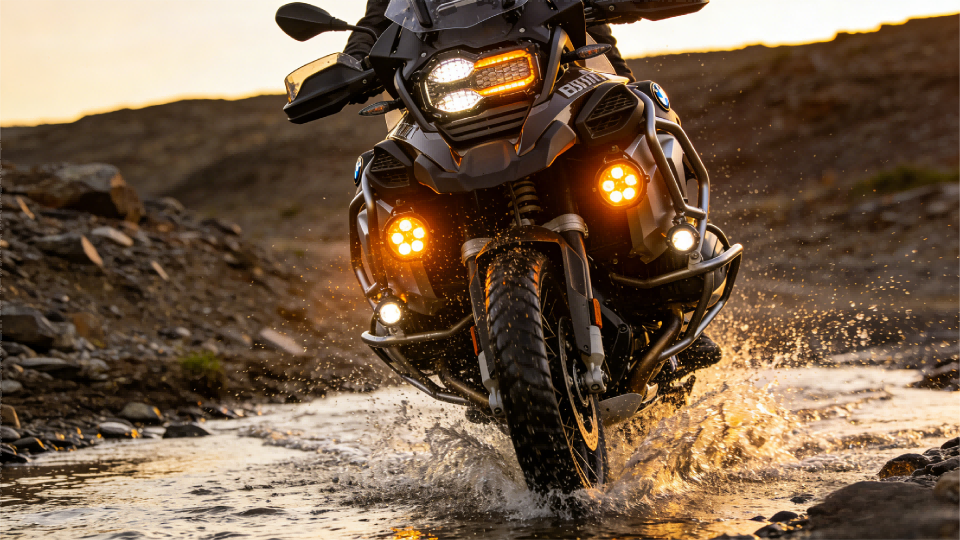
Most ADV bikes are equipped with crash bars. These are the prime real estate for mounting auxiliary lights.
- Low Mounting: Mounting fog lights low on the crash bars maximizes the “shadow effect,” highlighting dips and rocks in the road surface.
- Triangulation: This setup widens the visual footprint of the motorcycle, making it appear larger to oncoming trucks on narrow mountain passes.
2.2. The Handlebar/Cowl Spotlights
For high-speed desert runs, you need light that moves with the handlebars. Mounting compact LED spots near the mirrors ensures that when you turn the bars into a switchback, the light follows your intended path, rather than pointing into the void like a frame-mounted fairing light would.
3. Module 3: Selection Criteria for Rough Terrain
An ADV rider cannot simply buy generic parts from a random motorcycle accessories shop. The demands of off-road riding require specific engineering attributes.
3.1. Vibration Resistance (G-Force Rating)
Corrugations (washboard roads) can destroy electronics. A standard filament bulb can shatter in minutes. Even cheap LEDs can suffer from component fatigue where solder joints crack. You must look for accessories tested for high-frequency vibration. GTR lights utilize heavy-duty brackets and internally reinforced circuitry designed to withstand the G-forces of hard landings.
3.2. Dust and Water Ingress
Adventure riding involves river crossings and silt beds. A rating of IP67 is the minimum requirement. This means the unit can be submerged in 1 meter of water for 30 minutes. If water enters the lens, it steams up the inside, rendering the light useless and potentially shorting the system.
3.3. Lens Material
Glass lenses can crack from stone impacts (roost) from other riders. Polycarbonate (PC) lenses are virtually unbreakable. However, cheap PC yellows over time. High-quality ADV lights use hard-coated Polycarbonate that resists both impact and UV degradation.
4. Module 6: Why GTR Fits the Adventure Profile
在 GTR, we understand that an adventure rider’s equipment is their lifeline. We do not just re-label generic street lights; we engineer for the extremes. Our LED products available through ledcxr.com feature military-grade breathers. These small valves allow the pressure inside the light housing to equalize with the atmosphere during rapid altitude changes (like riding over the Rockies) without letting water in.
Furthermore, GTR offers modular lens covers. You can snap on an amber filter for a dusty trail ride to cut through the silt, and swap back to clear for the highway ride home. This versatility is the hallmark of a premier motorcycle accessories brand.
5. Module 4: Installation for Reliability
On an ADV bike, wiring hygiene is paramount. Loose wires get snagged on branches.
- Use Loom and Shrink Wrap: Never leave raw wires exposed. Use abrasion-resistant sheathing.
- Waterproof Connectors: Use Deutsch or Superseal connectors. Do not rely on cheap bullet connectors or electrical tape, which will fail after the first river crossing.
- Switched Power: Always wire your accessories to a “switched” power source (one that turns off when the key is off). There is nothing worse than waking up at a campsite in the middle of nowhere with a dead battery because you forgot to flip a switch.
6. Module 5: FAQ for the Adventure Rider
6.1. Q1: Should I connect my lights to a separate battery?
No, the bike’s alternator charges the main battery. Adding a second battery adds immense weight. Instead, monitor your voltage. If you are running heated grips, a GPS, and 4 auxiliary lights, ensure your stator output can handle the total load.
6.2. Q2: What is the difference between Flood, Spot, and Combo beams?
Flood is wide and short (good for slow, technical riding). Spot is narrow and long (good for highway/high speed). Combo lenses mix both optics in one housing, often the best choice for a general-purpose ADV setup.
6.3. Q3: Can I run my auxiliary lights in traffic?
Flood lights? No, they will blind drivers. Spot lights? Only if aimed very low. Generally, auxiliary off-road lights should be wired to your high-beam switch or a separate toggle so they can be killed instantly when facing traffic.
6.4. Q4: How do I protect my headlight?
In addition to better bulbs, consider a headlight guard (grill or clear shield). A single rock from a truck can crack a $1,000 OEM headlight assembly.
6.5. Q5: Is yellow light actually better for off-road?
Yes. White light reflects off dust particles, creating a “white wall” effect. Yellow/Amber light penetrates dust clouds better, allowing you to see the trail through the roost of the rider ahead.