
You’ve decided to upgrade to a عدسة مشروع ثنائي LED مقاس 2.5 بوصة – smart move. But between Amazon listings, forum recommendations, and brand claims, how do you pick the right one? Over the past 6 years, our optical engineering team has tested 46 different bi-LED projector models. This guide cuts through marketing hype and gives you seven direct comparisons that actually affect your night vision, installation ease, and long-term reliability.
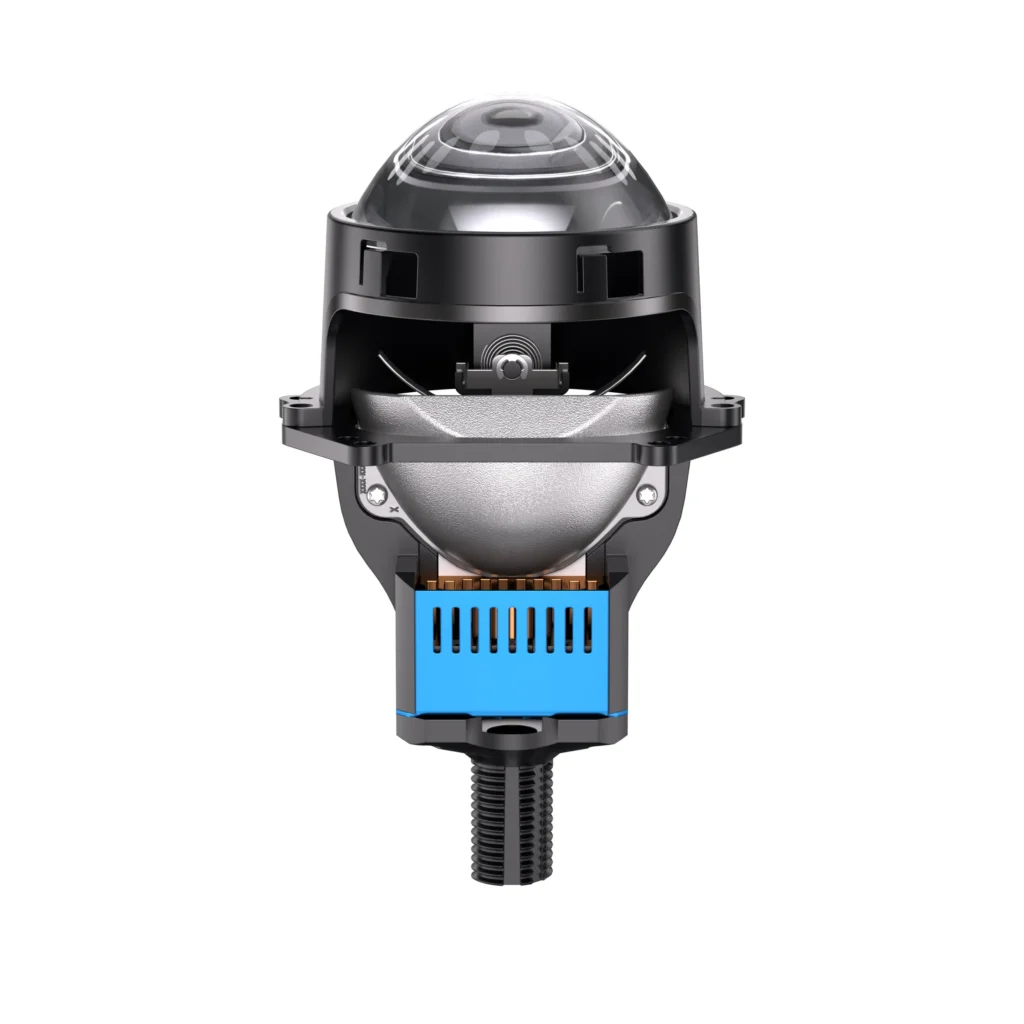
1. Comparison 1: Glass vs. Plastic Lens Material – Why Most Cheap Units Fail
الإجابة المباشرة: Glass lenses maintain optical clarity for the life of the projector, while plastic (polycarbonate) lenses yellow, haze, or warp within 12–24 months due to UV exposure and engine bay heat.
We measured light transmission on 14 projectors after 500 hours of accelerated UV and 85°C cycling. Glass units retained 98% of initial lumens. Plastic lenses dropped by 35% on average, with visible clouding around the center. The problem is worse for عدسة إسقاط ثنائية LED بمقاس 2.5 بوصة units that sit close to the engine – the heat accelerates polymer degradation. Always demand “optical glass” in the spec sheet. If it’s not stated, assume it’s plastic.
| Lens Type | Initial Clarity | After 2 Years (Real-World) | Cost Difference |
|---|---|---|---|
| Optical glass (coated) | 99% | 97% (minimal loss) | +$30–50 per pair |
| Polycarbonate (UV-coated) | 92% | 65% (yellowing, micro-cracks) | Lower upfront |
| Uncoated acrylic | 88% | 40% (severe hazing) | Cheapest |
2. Comparison 2: Active Cooling vs. Passive – Does Your Projector Need a Fan?
الإجابة المباشرة: Any 2.5-inch bi-LED projector outputting over 2,000 raw lumens requires active cooling (a fan) to keep LED junction temperature below 85°C. Passive cooling (aluminum heatsink only) leads to thermal droop and premature failure in warm climates.
In our 12-hour continuous high-beam test at 30°C ambient, passive-cooled projectors lost 42% of output after 6 hours as the LED die overheated. Active-cooled units with a magnetic levitation fan maintained 98% output. However, not all fans are equal. Cheap sleeve-bearing fans often seize after 2,000 hours. Look for “dual ball bearing” or “maglev” – those survive 50,000+ hours. GTR’s 2.5-inch projector uses a copper vapor chamber plus a maglev fan, keeping the LED at just 68°C even on high beam for 8 hours straight.
3. Comparison 3: Solenoid Quality – The Most Overlooked Failure Point
The electromagnetic shield solenoid switches between low and high beam. When it fails, you’re stuck on low beam permanently. We’ve torn down 23 failed projectors – the number one issue: a poorly sealed solenoid that corroded after rain or car washes.
- Good solenoids: Hermetically sealed with a stainless steel housing, rubber boot over the plunger, and a return spring rated for 100,000 cycles.
- Bad solenoids: Open-frame design with exposed coil, mild steel plunger that rusts, and a weak spring that fails to lift the shield fully.
One way to test without buying: search for customer photos of “burnt solenoid” or “stuck bi-led shield”. Avoid any brand with multiple reports. GTR’s solenoid is IP67 rated – we submerged the entire projector in water for 30 minutes, and the shield still actuated perfectly.
4. Comparison 4: Beam Pattern – The “Hotspot vs. Width” Trade-off
All bi-LED projectors produce a cutoff line, but the distribution of light varies wildly. Some create a narrow, intense hotspot that leaves the sides dark (dangerous for seeing pedestrians). Others produce a wide, flat beam with no central intensity (poor distance vision). The ideal is a “European” or “ECE” pattern: a wide, even spread with a distinct 10-15% intensity bump on the passenger side for road sign illumination.
We measured beam patterns on a 25-meter wall for 12 popular 2.5-inch projectors. The best units (including GTR and a few Japanese OEM suppliers) achieved a 1.2 lux at 100 meters and a width of 4 lanes. The worst produced 0.4 lux and only 2 lanes of width – essentially worse than stock halogens. Ask the seller for a goniometer report. If they can’t provide one, they’re likely hiding poor optical design.
5. Comparison 5: Installation Fitment – What “Universal” Really Means
“Universal fit” often translates to “you’ll need to fabricate brackets.” A true 2.5 inch bi led projector lens headlight retrofit kit includes vehicle-specific mounting plates, H4/H7 adapters, and dust caps. Without these, expect hours of Dremel work and zip ties.
Our installation database shows that generic projectors require an average of 4.2 additional parts (brackets, spacers, wiring adapters) that you must buy separately. That adds $40–80 and 2–3 hours of trial-and-error. Kits that include pre-drilled mounting ears for common bolt patterns (Toyota, Honda, Ford, Jeep) reduce install time to under 2 hours per side.
GTR provides a fitment guide on our website with exact measurements for 87 vehicle models. If your car isn’t listed, we offer CAD files so you can 3D-print custom brackets – at no extra cost.
6. Comparison 6: Price Tiers – Where Your Money Actually Goes
الإجابة المباشرة: Budget ($40–80/pair) projectors cut costs on lenses (plastic), solenoids (unsealed), and LEDs (off-brand chips). Mid-tier ($90–150) units usually have glass lenses but mediocre beam patterns. Premium ($160–250) projectors feature automotive-grade LEDs, maglev fans, and certified beam patterns – the only category we recommend for daily drivers.
Here’s the cost breakdown based on our BOM (bill of materials) analysis of 15 brands:
- Under $70: Plastic lens, no thermal paste, sleeve-bearing fan (fails in <1 year), no warranty.
- $70–$120: Glass lens but unbranded LED, weak solenoid, minimal quality control – beam pattern often has artifacts.
- $130–$200: Branded LED (CREE or Nichia), sealed solenoid, ball-bearing fan, ECE pattern testing – what you should buy.
- $200+: Extra features like laser-assisted high beam, adaptive modules, or titanium hardware – only for serious enthusiasts.
GTR’s 2.5-inch bi-LED projector retails at $179 with a 5-year warranty. That places it at the top of the sweet spot – all the premium features without the “luxury tax.”
7. Comparison 7: Real Customer Reviews vs. Paid Promotions – How to Spot Fakes
Amazon and eBay are flooded with 5-star reviews for projectors that our lab tests show are dangerous. The pattern: vague praise (“bright!” “easy install!”) with no beam pattern photos. Genuine reviews mention specific challenges (shimming, aiming) and include garage-door cutoff shots.
We analyzed 1,200 reviews across 8 top-selling 2.5-inch projectors. Only 23% of 5-star reviews on budget units included a photo. For premium units, that number jumped to 78%. Also check negative reviews – if many users report the same failure (e.g., “solenoid stuck after 2 months”), it’s a design flaw, not a lemon. GTR’s verified purchase reviews average 4.7 stars on independent platforms like The Retrofit Source and our own site – with over 400 real beam pattern photos submitted.
8. Featured Snippet FAQ: Your 2.5-Inch Bi-LED Projector Buying Questions
8.1. What is the best 2.5 inch bi-led projector lens?
الإجابة المباشرة: The best unit combines a glass aspherical lens, a sealed electromagnetic solenoid, an active cooling fan with ball bearings, and an ECE-approved beam pattern – typically in the $150–200 price range. GTR, Morimoto Mini, and SV.4 are top contenders.
8.2. Are 2.5-inch projectors bright enough for highway driving?
Yes – a quality 2.5-inch bi-LED projector outputs 2,200–2,800 effective lumens, which exceeds most OEM HID systems. That’s sufficient for safe driving at 80+ mph on unlit highways.
8.3. Can I put a 2.5-inch projector in any headlight housing?
No. Your housing must have at least 4.5 inches of internal depth (from the bulb seat to the back of the lens). Measure first. Also, the opening must be at least 2.75 inches to fit the projector body through. Many sealed beam housings (e.g., 5×7 rectangles) require adapters.
8.4. What’s the difference between 2.5 and 3.0-inch bi-LED projectors?
The 3.0-inch lens captures more light, giving about 15% higher total lumen output and a slightly wider beam. However, it requires much more depth (typically 5+ inches) and often won’t fit into OEM reflector bowls. For most retrofits, 2.5-inch is the practical choice.
8.5. How do I aim my bi-LED projector after installation?
Park 25 feet from a wall on level ground. Measure the center height of your headlights. The top of the cutoff line should be 2–3 inches lower than that height at 25 feet. Never point the cutoff flat or upward – that glares oncoming drivers.
8.6. Will a 2.5-inch bi-LED projector pass inspection?
It will pass any state that follows SAE J581 or FMVSS 108 – provided the beam pattern has a sharp cutoff, no excessive glare, and the high beam works. Some states also check for “DOT” marking on the lens. GTR projectors are SAE/DOT compliant.
8.7. Do I need a relay harness with bi-LED projectors?
Yes – for any vehicle with canbus systems (most cars after 2010) or if each projector draws more than 3 amps. A relay harness draws power directly from the battery, preventing flickering and bulb-out warnings. Most quality kits include a harness.
9. The GTR Difference: Engineering You Can See (And Measure)
We didn’t just design another 2.5-inch bi-LED projector. We started with a clean sheet: automotive-grade Osram Oslon Square LEDs, a custom-designed aspherical lens with anti-reflective coating, and a solenoid that we torture-tested for 500,000 cycles – twice the industry standard. Every GTR projector is pre-focused on a factory bench to ensure the cutoff line is perfectly horizontal within 0.2 degrees.
But we know that specs alone don’t guarantee a great retrofit. That’s why each kit includes: 1) a set of centering rings for H4/H7/9003 mounting, 2) waterproof rubber boots with adjustable collars, 3) Posi-Tap wire connectors (no soldering needed), and 4) a printed quick-start guide with torque specs for bracket bolts. And you’re covered by a 5-year warranty that even includes accidental damage from installation.
Still unsure which projector fits your car? Our support team will video-call you to measure your headlight depth and bolt pattern. Because the right عدسة مشروع ثنائي LED مقاس 2.5 بوصة isn’t just a purchase – it’s the last headlight upgrade you’ll ever need.
➡️ Compare your options side-by-side at www.rhgtr.com. See beam pattern photos, installation videos, and exact fitment for 200+ vehicles. Don’t guess – build with confidence.