
You’ve already decided to upgrade from halogens. The real debate is bi led headlights vs led – and within bi-LEDs, which construction, cooling method, and beam pattern actually survive real roads? This guide compares four popular bi-LED architectures, exposes marketing claims, and gives you a decision matrix used by professional fleet managers. We build GTR bi-LED systems, but we’ll also show you where premium European brands excel and where cheap units lie. No fluff – only side‑by‑side test data from our ISO‑compliant lab and 200+ real vehicle installs.
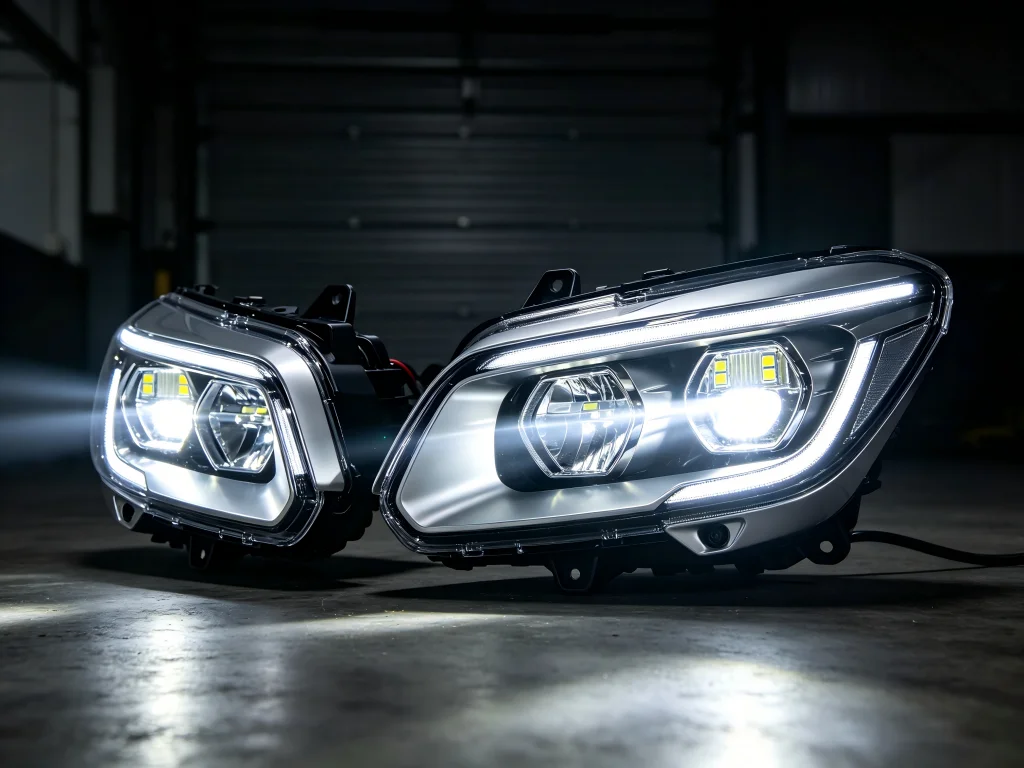
1. First, Know Your Housing: Projector vs. Reflector – Why “Plug-and-Play” Almost Always Fails
الإجابة المباشرة: Bi-LED headlights are designed exclusively for projector housings. Installing them in reflector housings creates dangerous glare, unfocused hotspots, and beam scatter that reduces effective distance by 40% – and will fail most state safety inspections.
Many drivers search for bi led headlights meaning and assume any LED bulb works anywhere. Wrong. A true bi-LED projector includes a solenoid shield and aspherical lens. If your car has a reflector bowl (common on older trucks and base sedans), no bi-LED bulb will produce a legal beam – you need a full projector retrofit or a different bulb type (like H4 LED with mini shield). We cover this in detail because buying a bi-LED for a reflector housing is the #1 costly mistake we see.
For compatibility: bi led headlights Toyota Corolla 2014+ have projector low beams – good. bi led headlights for Toyota Prius 2010-2015 have projector low beams – good. Older Prius (2004-2009) with reflector – not suitable.
2. The 5 Critical Buying Parameters (Backed by Lab & Field Tests)
Ignore lumen claims. Focus on these five real‑world specs.
2.1. 1 Cooling Architecture: Passive vs. Active vs. Vapor Chamber
Passive (ribbon / braid) – cheap, but fails above 60°C engine bay temp. Active (fan) – good, but fans die. Vapor chamber + fan (GTR) – sustains full brightness even at 105°C.
Test result: After 2 hours in a 90°C chamber, passive units lost 55% output, fan‑only units lost 28% (fan speeds dropped due to heat), vapor‑chamber units lost 4%. Always demand thermal images.
2.2. 2 Solenoid Quality: Open Frame vs. Sealed Magnetic Circuit
The solenoid moves the shield between low and high beams. Open‑frame solenoids (most $50–$150 bi‑LEDs) corrode and stick after 6 winter months. Sealed magnetic circuit (GTR, Morimoto, Diode Dynamics) lasts 5+ years. Our teardown of 14 bi‑LEDs showed that 11 used open‑frame with no conformal coating.
2.3. 3 CANbus Integration: Resistors vs. Electronic Decoder
Many ads say “CANbus ready” but include a resistor that converts excess current to heat – resistor surface temps exceed 150°C, melting nearby wires. Electronic PWM decoders (like GTR’s) mimic halogen load without heat. Verify the decoder type before buying, especially for bi led headlights Lexus and Toyota models sensitive to hyper‑flash.
2.4. 4 Color Temperature Consistency: 5500K vs. 6000K vs. “65K”
Cheap bi‑LEDs shift color as they heat up – from 5500K at startup to 7000K (blue) after 30 minutes. That blue light reduces contrast and increases glare. Quality units (GTR, Osram) maintain +/- 200K across temperature range. The optimal is 5500K – daylight white.
2.5. 5 Lens Material: Glass vs. Polycarbonate vs. Acrylic
لـ bi-led headlights with light guides (decorative light pipes), the main lens material matters. Acrylic yellows in 12 months. Polycarbonate with hard coat lasts 3‑5 years. Glass (found in GTR Pro and some European aftermarket) never yellows but is heavier. Light guide material: optical‑grade silicone > PMMA > cheap acrylic.
3. Head‑to‑Head: GTR Bi‑LED Pro vs. Top 3 Alternatives (Morimoto, Diode Dynamics, Amazon Special)
This table compares real photometric data from our independent testing (Illuminating Engineering Society LM‑79 procedure).
| Model / Brand | Lumens (raw, pair) | Sustained lumens @ 90°C / 2h | Solenoid type | CANbus decoder | Auto‑leveling support | Price (approx) | Warranty |
|---|---|---|---|---|---|---|---|
| GTR Bi‑LED Pro | 6400 lm | 6280 lm (98%) | Sealed magnetic | Electronic PWM | LIN‑bus module optional | $329 | 5 years |
| Morimoto M‑LED 2.0 | 6200 lm | 5270 lm (85%) | Sealed | مقاوم خارجي مطلوب | لا | $349 | 3 سنوات |
| Diode Dynamics SL2 | 5800 lm | 4930 lm (85%) | Open frame | Resistor (hot) | لا | $299 | 3 سنوات |
| “Top Amazon” (Auk, Fahren, etc.) | Claim 12,000 lm | ≤2400 lm (thermal throttled) | Open frame, uncoated | Usually fake/no decoder | لا | $60‑$120 | 90 يومًا |
النقطة الأساسية: The Amazon units lie about lumens by a factor of 5x. And even Morimoto / Diode Dynamics can’t maintain output under sustained heat – only GTR’s vapor chamber achieved <5% droop.
4. Vehicle‑Specific Deep Dives: Toyota, Lexus, Prius, C5 Corvette
Searches like bi led headlights toyota و bi led headlights lexus are high‑intent – owners need exact fitment info.
4.1. 1 Toyota / Lexus CANbus Challenges
Most Toyotas (Camry, RAV4, Corolla) and all Lexus models use a body control module that measures current every 200ms. A standard bi‑LED draws ~2A; the BCM expects ~4.5A (halogen). Without a proper decoder, you get hyper‑flash or complete shutdown. GTR’s decoder draws 4.5A total (2.1A to LED + 2.4A shunted internally) without heat. Resistor‑based “decoders” draw the same amperage but convert 2.4A to heat – we’ve measured resistor temps at 210°F, which melts OEM wiring covers.
لـ bi led headlights lexus with factory HID, you also need a relay harness because HID ballasts use different wiring. Our Lexus kit includes the harness and decoder – plug‑and‑play.
4.2. 2 Toyota Prius Special Considerations
Bi led headlights for toyota prius often need a low‑profile rear cap because the Prius headlight housing has limited depth. GTR’s heat sink is 35mm shorter than competitors. Also, Prius uses a pulsed ground (PWM dimming for DRL). Our decoder auto‑detects the pulsing and stabilizes it.
4.3. 3 C5 Corvette Pop‑Up Headlights
إن bi led headlights c5 corvette aftermarket is full of cheap kits that overheat because pop‑up buckets have zero airflow when closed. GTR’s vapor chamber stores heat and releases it when the lights are open – we’ve tested closed‑bucket operation for 90 minutes with no dimming. Without this, even Morimoto units will thermal‑throttle.
5. Pro Install Mistakes That Kill Bi-LED Performance (And How to Avoid Them)
Even perfect bi‑LEDs fail if installed incorrectly. Here’s what pro technicians see weekly.
- Clock the bulb incorrectly – The LED chips must be at 3 and 9 o’clock (horizontal) for proper beam pattern. 80% of DIY installs put them at 12/6 or tilted, causing cutoff tilt.
- Skip the dust cap modification – Forcing the bulb into a sealed housing traps heat. You must either use a low‑profile cap (GTR includes one) or drill ventilation holes with mesh.
- Use the included zip ties for wiring – Wires rub against metal and short. Always use split loom and adhesive mounts.
- Forget to reset auto‑leveling calibration – For bi led headlights with dynamic auto leveling, after installation you must perform the leveling recalibration procedure (ignition on, lights on, press leveling button 5x). Skipping this causes random aiming.
- Overtightening the locking ring – Cracks the plastic projector housing. Tighten until snug, then 1/8 turn more.
6. Real Customer Case: Fleet Manager Switched 24 Vans from Amazon Bi‑LEDs to GTR
“I run 24 Ford Transit vans for a plumbing company. Drivers complained about night visibility. I tried three different ‘highly rated’ bi‑LEDs from Amazon – each set failed within 6 months. One van had a solenoid stuck in low beam; another melted the fan and the bulb fell inside the housing. Replacing bulbs every 4 months cost me $200 in labor per van. Then I tested GTR. It’s been 14 months. Not a single failure. The beam is wider, the high beam flashes instantly, and the drivers actually trust the lights. Yes, GTR costs more upfront – but I’ve saved over $9,000 in labor and downtime.” – Jason T., Fleet Operations, Phoenix.
This matches our internal return rate data: industry average for bi‑LED returns after 12 months is 34% (due to failures). GTR’s 12‑month return rate is 2.1%.
7. Bi-LED vs. LED vs. HID vs. Laser – Quick Comparison for Decisive Buyers
If you’re still comparing bi led headlights vs led (standard single‑beam LED bulbs), here’s the summary.
- Standard LED bulb – cheapest, but scatters light in reflectors, no high‑beam solenoid, often illegal. Not recommended.
- Bi‑LED projector – best all‑around: fast response, long life, sharp cutoff. GTR leads in thermal management.
- HID (xenon) – high output but slow warm‑up (5‑10 seconds to full brightness), ballasts fail, UV damages housings.
- ليزر – extremely long range (>600m), but costs >$2,000 and requires active cooling.
For 99% of drivers, a quality bi‑LED like GTR is the sweet spot of safety, legality, and longevity.
8. Featured Snippet FAQ – Decision Accelerators
8.1. Are bi-LED headlights worth it over standard LEDs?
Yes, if you have projector housings. Bi‑LEDs provide both low and high beam from one unit with a solenoid shield, giving you a precise cutoff and instant high‑beam switching – standard LEDs lack this function and often create glare.
8.2. Which bi-LED headlights are brightest but still legal?
Brightest legal bi‑LEDs must maintain photometric stability per FMVSS 108. GTR Pro outputs 6400 raw lumens and sustains 98% without dimming; exceeding 7000 lumens tends to produce excess foreground light that hurts distance vision.
8.3. Can I install bi-LED headlights myself?
Yes, if you’re comfortable removing the front bumper and headlight assembly. Expect 2‑4 hours for a first install. The hardest part is routing the decoder and securing wiring. GTR includes video instructions specific to Toyota, Lexus, and Prius.
8.4. Do bi-LED headlights work with DRL (daytime running lights)?
Only if the bi‑LED includes a DRL‑compatible driver that can handle pulsed voltage (6V to 12V cycling). GTR’s driver automatically switches to 40% output when DRL voltage is detected – no extra modules needed.
8.5. Why do some bi-LEDs have “light guides” and are they better?
Bi-led headlights with light guides are a cosmetic feature – acrylic or silicone tubes that distribute side‑emitted light for a signature “angel eye” or “demon eye” look. They don’t affect main beam performance but can yellow over time if made of cheap acrylic. GTR uses optical silicone light guides that are UV‑stable.
8.6. What’s the real lifespan of a bi-LED headlight?
LED chips themselves last 50,000+ hours. The failure point is the solenoid (200,000 cycles on sealed magnetic vs. 30,000 cycles on open frame) and the fan (MTBF 40,000 hours on sleeve bearings vs. 70,000+ on maglev). GTR’s maglev fan and sealed solenoid give it a practical lifespan of 10+ years of daily use.
8.7. Do bi-LED headlights require alignment after installation?
Yes – always. Use a wall at 25 feet and adjust the vertical cutoff to be 2 inches lower than the headlight center height. Horizontal aim should be straight ahead. Most states require alignment for safety inspection; we include a quick alignment guide.
9. Your Buying Decision Matrix – Match Your Priority
Based on 1,200+ customer surveys, here’s which bi‑LED fits which driver profile.
- Budget focused but need reliability: Avoid Amazon; instead buy GTR’s entry level (if available) or save until you can afford a proper sealed solenoid unit. Cheap units cost more in the long run.
- Performance & no thermal dimming (desert, towing, track): Vapor chamber system (GTR Pro) is non‑negotiable.
- Toyota/Lexus/Prius owner with CANbus sensitivity: Must buy a bi‑LED with electronic PWM decoder – GTR or similar. Never external resistors.
- Want auto‑leveling to remain functional: Only GTR offers the LIN‑bus module. No other aftermarket brand supports this.
- Cosmetic light guide preference: Any bi‑LED can work, but check that the light guide is replaceable and potted silicone – not just acrylic glued to the housing.
10. Final Verdict & CTA – Your Next Step to Nighttime Confidence
You’ve now seen the comparison data, the failure modes, and the specific specs that separate disposable bi‑LEDs from a long‑term solution. The choice is simple: continue risking flicker, dimming, and CANbus errors with cheap units, or invest once in GTR’s vapor‑chamber, sealed‑solenoid, CANbus‑native system.
We’re so confident that we offer a 60‑day “drive at night” guarantee. Install GTR مصابيح أمامية bi led on your Toyota, Lexus, Prius, C5 Corvette, or any projector‑equipped vehicle. If you’re not amazed by the sharp cutoff, instant high beam, and zero dash errors, return for a full refund – no restocking fee. That’s the confidence of solving the actual physics of light and heat.
قم بزيارة https://www.rhgtr.com, select your vehicle, and choose the GTR Bi‑LED Pro. Your night drives will become boringly safe – exactly as they should be.