
You have decided to upgrade. Now comes the hard part: every listing claims to be the brightest, the whitest, the best. Most are none of those things. This guide cuts through the spec-sheet noise and tells you exactly what separates a car headlight led upgrade that transforms your night driving from one that makes things worse. Based on our engineering and field testing across dozens of housing types, the difference almost never comes down to the number printed on the box.
1. The One Spec That Matters Most (And It Is Not Lumens)
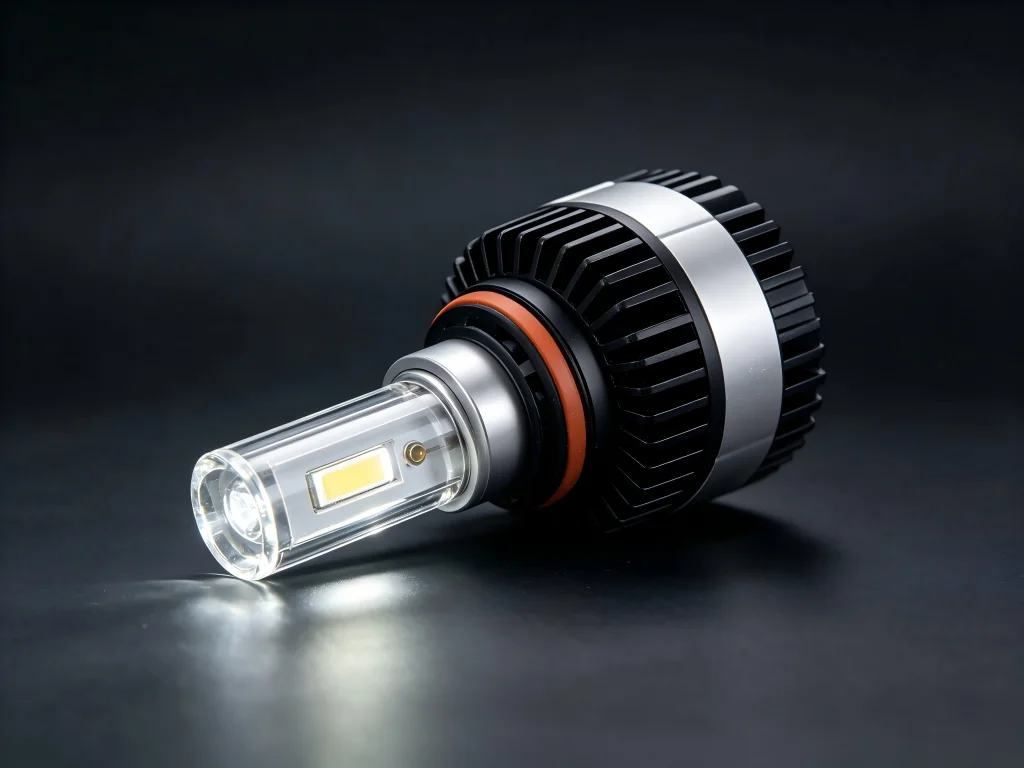
Raw lumen ratings are nearly meaningless for headlight upgrades. The critical specification is whether the LED chips sit at the exact same focal point as the original halogen filament. If they do not, the housing cannot focus the light, and you get glare instead of usable beam pattern.
Here is why this matters more than anything else on the packaging. Your headlight housing—whether reflector or projector—was designed around a tiny, precise light source: the halogen filament. That filament sits at a specific point in three-dimensional space. The reflector’s curves or the projector’s lens are shaped to gather light from that exact point and aim it down the road in a controlled pattern .
An LED bulb does not have a filament. It has chips mounted on a flat board. If those chips are even a millimeter off from where the filament was, the geometry breaks. Light scatters upward into oncoming drivers’ eyes. The road ahead gets dark spots. You paid for brightness and got glare.
This is why the cheapest LED bulbs fail so predictably. They are built to fit the socket, not to match the optics. A quality bulb—and this is where manufacturing tolerance becomes expensive—places the LED emitters within fractions of a millimeter of the halogen focal point. That precision is what you are actually paying for.
2. Projector vs. Reflector: Why Your Housing Changes Everything
LED retrofits work well in projector housings but are far more problematic in reflector housings. Projector lenses are more forgiving of minor emitter position variations, while reflector designs amplify any misalignment into scattered, glare-producing light.
A 2025 study published through the Transportation Research Board found that LED light sources consistently outperformed halogen and HID in projector configurations. However, the same study advised against using LED in reflector housings due to the design characteristics and beam intensity patterns of those housings .
This does not mean reflector owners are out of luck. It means the margin for error is smaller. A reflector housing demands a bulb with exceptionally precise chip positioning and a thin board profile that mimics the filament’s width. If you drive a vehicle with reflector headlights, verify the bulb’s beam pattern before committing. A wall test at 25 feet will tell you more than any product page.
| Decision Factor | Budget/Generic LED | GTR Engineered LED |
|---|---|---|
| Emitter positioning | Approximate, varies by batch | Digitally optimized to halogen focal tolerance |
| Board thickness | Thick PCB, widens light source | Ultra-thin copper board, mimics filament profile |
| Color temperature | Often overstated (6500K+), blue-tinted | 5750K, balanced for contrast and weather |
| Thermal design | Basic aluminum extrusion | Copper substrate + active fan + thermal management |
| CANbus compatibility | Often triggers errors, needs resistors | Driver designed for vehicle electrical systems |
| Warranty | 90 days to 1 year | Backed for the long term |
3. Wattage Lies: Why 200W and 300W Claims Are a Red Flag
Higher wattage does not mean better headlights. LED bulbs with 200W or 300W claims are typically misrepresenting power consumption or using inefficient designs that generate excessive heat. A well-engineered LED bulb produces superior road illumination at 40W to 50W per bulb.
The math is simple. Halogen bulbs waste most of their energy as heat. An LED converts a far higher percentage of electricity into light. A 45W LED can comfortably outperform a 55W halogen in usable output. When a listing claims 300W, it is either lying about the number or building a bulb that will overheat and throttle down within minutes .
In our testing, the bulbs that hold their rated output over time are the ones with conservative power ratings and robust thermal paths. Heat is the enemy of LED longevity. More wattage means more heat to manage, and in a cramped headlight housing, that heat has nowhere to go. A bulb that starts bright and fades to half output after twenty minutes is not an upgrade. It is a temporary illusion.
4. Color Temperature: The 6000K Trap
Blue-white light looks modern in photos. On a wet road at night, it works against you. Light in the 6000K and above range has a shorter wavelength that reflects off water droplets, creating a self-blinding effect in rain and fog .
Our testing and customer feedback consistently point to the 5500K to 6000K range as the practical sweet spot. It provides the crisp, white contrast that makes road markings and signs pop on clear nights without crossing into the blue spectrum that causes glare in poor weather. For drivers in regions with frequent rain or fog, a slightly warmer option in the 5000K range can offer better penetration through moisture.
5. What Real Drivers Discover After the Install
Forum discussions and customer reviews reveal a pattern that spec sheets never show. A driver on an F150 forum documented his progression from stock halogens to a popular budget LED to GTR Ultra 3 bulbs. His assessment of the budget option: “scattered and there is little cutoff to speak of” . After the GTR install, he noted a “very sharp cutoff and wide pattern, better than” his previous setup, with “minimal if any stray light above the cutoff” .
Another reviewer, running GTR Ultra 2 bulbs in a 2017 RAV4 with halogen projectors, reported “a significant improvement over the regular halogen bulbs” with “a great cutoff” and better side-of-road illumination. He had previously installed the same bulbs in a reflector-housing truck and found they still maintained a good cutoff and did not blind oncoming drivers .
The common thread in positive outcomes is not a single magic specification. It is the combination of precise emitter placement, stable thermal management, and a beam pattern that respects other drivers. When those three align, the upgrade feels less like a modification and more like the car should have come that way.
6. Frequently Asked Questions
6.1. Are 200-watt or 300-watt car headlight LED bulbs better than 50-watt bulbs?
No. High wattage claims are usually misleading. What matters is usable light on the road and thermal stability. A 300W bulb that overheats and dims is worse than a well-designed 45W bulb that holds steady output. Focus on beam pattern and cooling design, not power numbers.
6.2. Will LED bulbs work in my reflector housing?
They can, but the margin for error is smaller than with projector housings. Reflector designs amplify any emitter misalignment into glare. Choose a bulb with verified focal positioning and test the beam pattern against a wall after installation. If you see scattered light or no clear cutoff, the bulb is not matched to your housing.
6.3. Why do my new LED headlights flicker or show error codes?
Modern vehicles use CANbus monitoring to detect bulb failures. LEDs draw less current than halogens, so the car may think a bulb is out. Quality LED kits include drivers designed to communicate correctly with the vehicle’s system. Cheap bulbs often require add-on resistors or decoders, which add failure points.
6.4. How much should a legitimate car headlight LED upgrade cost?
Budget bulbs in the $30 to $60 range typically sacrifice focal precision and thermal design. A properly engineered set with verified beam pattern and durable cooling sits in the $120 to $220 range. The difference is not cosmetic. It is the difference between seeing a hazard at 80 feet and seeing it at 180 feet.
6.5. Do I need to re-aim my headlights after installing LED bulbs?
Yes, always. Even a bulb with perfect focal positioning can sit slightly differently in the housing. A five-minute aim check against a wall at 25 feet ensures the cutoff line sits at the correct height. This protects oncoming drivers and maximizes your own road illumination.
6.6. What is the real lifespan of a quality LED headlight bulb?
A well-designed LED bulb with proper thermal management can outlast the vehicle in many cases. The weak points are not the LED chips themselves but the cooling system and driver electronics. Sealed fans and conformal-coated drivers resist the moisture and temperature swings of an engine bay far better than open designs.
7. Make the Decision Once, Make It Right
The aftermarket is full of bulbs that promise everything and deliver glare, flicker, and disappointment. You do not need to gamble. You need a bulb engineered around the same principle that makes your headlight housing work: precise light source placement, managed heat, and a beam pattern that does its job without punishing everyone else on the road.
GTR builds car headlight led systems for drivers who have already tried the cheap option and learned what it costs in visibility and frustration. Every bulb we make is designed to match the housing it goes into, not just the socket it plugs into. If you are ready to stop reading spec sheets and start seeing the road, visit https://www.rhgtr.com and find the upgrade that fits your vehicle. Your night vision is worth more than a bargain.