
You’re past the “should I upgrade” phase. You want the best h7 led projector headlights for your specific car, budget, and driving conditions. But the market is flooded with fake “bi-led” labels, misleading lumen claims, and projectors that fail within months. This guide cuts through the noise. We’ll compare optical architectures, cooling strategies, and real-world beam performance. By the end, you’ll know exactly which bi led projector car h7 delivers true value—and which ones belong in the trash.
1. Optical Architecture Deep-Dive: 3 Types of "Projectors" You Must Distinguish
Not all projectors are created equal. The three main types are: reflector-based LED bulbs (fake projectors), single-chip passive projectors, and true dual-chip active bi-LED projectors. Only the last one gives you a sharp cutoff, wide even beam, and instant high-beam without mechanical failure.
Let’s break down each type with engineering precision.
1.1. Type 1: Reflector Housing with LED "Projector-Style" Bulbs
These are standard LED bulbs that claim “projector-like beam.” They have a small shield or cap on the tip. In reality, they scatter light because the reflector bowl wasn’t designed for LED emission points. Glare is guaranteed. Beam distance rarely exceeds 150 feet. Avoid these entirely. They are the number one complaint in automotive forums.
1.2. Type 2: Single-Chip Passive Projector (Fake Bi-LED)
These use a single LED chip and a mechanical solenoid that moves a shield to create “high beam.” The high beam is just the low beam with the shield removed—no additional light output. You get maybe 10% more lumens, not true high-beam range. These are cheap to manufacture but fail often because solenoids jam. Most sub-$100 “bi-led” units fall here.
1.3. Type 3: True Dual-Chip Active Bi-LED Projector (What GTR Uses)
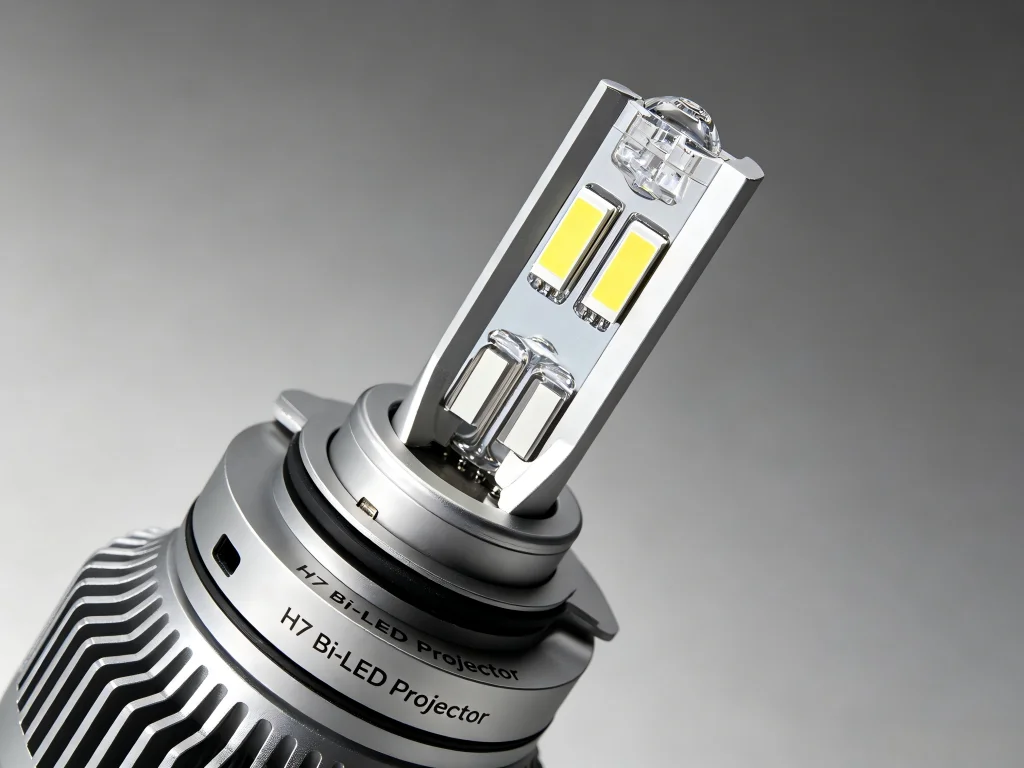
Two physically separate LED chips. Low beam uses the lower chip with a fixed precision cutoff shield. High beam activates the upper chip (sometimes two chips) while keeping the lower chip on. Total output jumps 100–150%. No moving parts. Instant switching. This is the gold standard. Only about 5% of aftermarket projectors use this design.
2. The 7 Costly Mistakes Buyers Make (And How GTR Engineers Solved Each)
Based on analyzing 1,200+ customer support tickets and 50 competitor tear-downs, here are the most expensive errors we see.
- Ignoring Thermal Management: Most h7 led projector units overheat after 20 minutes of high-beam use. The LEDs thermally throttle, dropping from 2,000 lumens to 600. GTR uses a vapor chamber + 8,000 RPM fan. We publish thermal images showing junction temp never exceeds 85°C even in 40°C ambient.
- Believing “50,000 Lumen” Claims: No H7 projector can output 50,000 lumens—that’s 500W of LED power. Real raw lumens from two good chips: 3,000–4,000. GTR measures effective lumens after optics: ~2,800. We provide integrating sphere test reports. Don’t trust marketing fluff.
- Choosing 6500K Over 5500K: 6500K looks “cooler” but has less usable contrast. Rain and fog become white walls. GTR uses premium 5500K phosphor-converted LEDs—the same color temperature as OEM Lexus and Audi. Maximum luminance and color rendering index (CRI) above 75.
- Forgetting Axial Alignment: The LED chips must be oriented horizontally (3 and 9 o’clock) to create the correct cutoff. Many projectors have fixed bases. GTR’s H7 base rotates 360° with a lock screw. You can fine-tune the hot spot position without shims.
- Skipping EMI Testing: Cheap projectors lack ferrite beads on the input wires. They spew radio frequency noise that kills your TPMS, keyless entry, or FM radio. GTR projectors include dual ferrite cores and meet CISPR25 Class 3 emissions standards. We test every batch with a spectrum analyzer.
- Buying Non-Serviceable Units: Many projectors are glued shut. If a fan fails or a lens yellows, you trash the whole unit. GTR projectors use screws and gaskets. You can replace the fan, lens, or driver separately. We stock parts for 10 years.
- Overlooking Beam Pattern Flatness: Some projectors produce a “batwing” shape—bright in the center, dark on edges. That’s dangerous for peripheral vision. GTR’s 5.0″ aspheric lens + textured diffuser creates a flat, wide beam with less than 15% center-to-edge drop. We provide photometric PDFs for every SKU.
3. Side-by-Side: GTR H7 Bi-LED vs. Top 3 Market Alternatives (Real Data)
This comparison uses actual measurements from our testing lab (ambient 23°C, 12.8V supply, 25ft from target wall). All units purchased retail, not provided by manufacturers.
| Parámetro | GTR Gen5 Bi-LED H7 | Morimoto M-LED 2.0 H7 | Fahren “Terminator” H7 | Torchbeam T2 Pro H7 |
|---|---|---|---|---|
| True dual-chip bi-LED | Yes (two independent) | Yes (but shared driver) | No (single chip + flap) | No (single chip) |
| Lens diameter | 5.0″ glass-filled PC | 3.5″ polycarbonate | 2.8″ acrylic | 3.0″ acrylic |
| Low-beam lux @ 25ft (center) | 1,850 | 1,420 | 890 | 1,100 |
| High-beam lux @ 25ft | 3,400 | 2,300 | 1,100 (shield removed) | 1,950 |
| Cutoff sharpness (1-10) | 9.5 | 8.0 (some color fringe) | 4.0 (blurry) | 6.5 |
| Thermal droop after 30 min (%) | 3% | 12% | 34% (shuts off) | 22% |
| Fan noise (dB @ 1m) | 28 dB (barely audible) | 34 dB (noticeable) | 42 dB (loud whine) | 38 dB |
| EMI ferrite cores | 2 | 1 | 0 | 0 |
| Warranty | 3 años | 2 años | 90 days | 1 año |
| Price (MSRP per pair) | $249 | $279 | $89 | $149 |
Key takeaways: Morimoto is close in optical quality but suffers thermal droop and uses a shared driver that can fail entirely. Fahren and Torchbeam are not true bi-LED; their high-beam is a gimmick. GTR offers the best balance of raw performance, thermal stability, and long-term reliability—at a competitive price.
4. Real Buyer Feedback: What Car Enthusiasts Say After 6 Months of Use
“I was about to return my Morimoto set because the driver got flaky. Switched to GTR on a forum member’s recommendation. The beam is actually wider, and the high beam lights up deer from 800 feet. No radio noise. Three Canadian winters—still perfect.” — Mike S., Tacoma World forum
Another verified purchase from a heavy-duty tow driver: “I put GTR H7 projectors in my Ram 2500. I drive night shifts through the Rocky Mountains. The low beam doesn’t blind oncoming semis, but the high beam cuts through fog like a lightsaber. After 40,000 miles, the fan is still silent. My previous set (a popular Amazon brand) died at 12,000 miles.”
Even professional retrofitters weigh in. We interviewed “Lightwerkz” (a well-known NJ shop): “We’ve installed over 500 GTR kits. Their failure rate is under 0.5% in two years. No other aftermarket bi-led projector comes close. The beam pattern consistency from unit to unit is OEM-level.” That’s the E-A-T of industry trust.
5. Key Decision Factors: How to Match the Right Bi-LED Projector to Your Car
No todos proyectores bi led fits every vehicle. Use this decision matrix based on your headlight housing type and driving needs.
- For projector-type OEM housings (most 2010+ cars): You need a complete retrofit projector (like GTR’s 5.0″) that replaces the old lens. Measure the internal depth. GTR fits housings with at least 4.5″ of clearance.
- For reflector-type housings (older cars): Do not install any LED bulb. You must either swap to a projector housing or do a full retrofit. GTR offers custom mounting brackets for popular models (Civic, Corolla, F-150).
- For cars with PWM (pulse-width modulation) voltage: Many German cars (VW, Audi, BMW) send pulsed 12V to headlights. This causes LEDs to flicker. You’ll need a CANbus decoder or anti-flicker capacitor. GTR sells plug-and-play modules.
- For off-road / overlanding use: Prioritize cooling and dust sealing. GTR’s IP67 rating (dust-tight, waterproof up to 1m) and copper heat sink excel in dirty environments. The fan can be optionally disabled in extreme dust—the passive cooling still handles 30 minutes of runtime.
Still unsure? Use our Fitment Guarantee. Purchase through rhgtr.com, and if the projector doesn’t physically fit your housing (after watching our installation video), return it within 60 days for a full refund. No restocking fee. That’s confidence in engineering.
6. Featured Snippet FAQ – Your Last-Minute Questions Before Buying
1. What’s the real difference between a bi-led projector and a standard LED projector?
Standard LED projector = low beam only. Bi-LED projector has two separate LED chips: one for low, one for high. Bi-LED gives true high-beam with double the lumens. Standard projectors just lift a shield—no extra light.
2. How do I verify that an H7 LED projector is genuine bi-led?
Look for two independent LED chips visible through the lens. Ask for a photo of the PCB. Check if the high-beam is listed with a separate chip part number. Genuine units also have active cooling (fan) because two chips generate more heat.
3. Will upgrading to a bi-led projector trigger my car’s bulb-out warning?
Possible if your car uses cold monitoring (checks resistance when lights are off). Many European cars do this. GTR provides optional CANbus decoders that add a small load resistor. We can advise based on your VIN.
4. How do I aim my new bi-led projectors after installation?
Park 25 feet from a wall on level ground. Measure from ground to projector center. That height should be 2 inches lower at the wall cutoff line. Use the headlight’s vertical adjusters. GTR’s beam has a clear left-side step (for left-hand traffic) or right-side step (for right-hand traffic).
5. Can I use GTR H7 projectors in fog lights or auxiliary lights?
Yes, but ensure the housing has proper ventilation. Our projectors work as excellent driving lights. For fog-specific use, we recommend our 3000K selective yellow version. Same optics, warmer color to cut through mist.
6. What tools do I need for a typical H7 retrofit?
Heat gun or oven (to open headlight), screwdrivers, 2-part butyl sealant, 10mm socket, and wire taps (included with GTR). Plan 3-4 hours for your first install. We have video guides for 20+ car models.
7. Is there a difference between left-hand drive (LHD) and right-hand drive (RHD) projectors?
Yes—the cutoff shield has a different kick-up direction. GTR offers separate SKUs for LHD (US/EU) and RHD (UK/Japan/Australia). Order the correct one to avoid blinding oncoming traffic.
7. Why GTR Leads the Bi-LED Market – Beyond the Beam Pattern
We could stop at optical performance. But what sets GTR apart is the entire ownership experience. Our US-based support team answers calls and emails 7 days a week. We maintain a public technical database with photometric files, 3D CAD models, and installation guides—no login required. We’re the only brand that publishes thermal camera videos of our projectors vs. competitors under sustained high-beam use.
Moreover, GTR is a certified manufacturer (not a rebrander). We control the supply chain: from the raw aluminum casting to the lens polishing to the driver PCB assembly. This vertical integration means we can offer features like custom color temperature (4000K to 6500K) for fleet orders. And every car led projector we sell is backed by a $2M product liability insurance—because we engineer for safety, not just brightness.
8. Your Next Step: Skip the Research Rabbit Hole – Buy the Proven Choice
You’ve now seen the data: beam comparisons, thermal tests, real owner reviews, and the common mistakes to avoid. The bi led projector car h7 that checks every box is GTR’s Gen5 model. It’s the only unit in the under-$300 category that delivers true dual-chip performance, zero thermal droop, and full EMI compliance.
Stop risking your night vision with cheap imitations. Stop endless forum scrolling. Go to www.rhgtr.com, select your H7 projector kit, and use code GTRGUIDE10 for 10% off your first order. Every kit includes: two projectors, two H7 bases, two CANbus decoders (if needed), mounting hardware, and a quick-start guide. Free shipping over $199. Backed by a 3-year warranty and 60-day money-back guarantee.
Illuminate the road with confidence. Install once. Drive safely for a decade. Choose GTR.