
You have decided to upgrade. Now the real work begins. The headlight halogen vs LED question seems simple until you start reading product listings, forum arguments, and conflicting advice about legality, beam patterns, and whether that 10,000-lumen claim on a generic kit means anything at all. This guide exists for the buyer who wants to make one informed decision and move on with their life. No fluff. No affiliate-driven rankings. Just the engineering and the tradeoffs that actually determine whether your upgrade works.
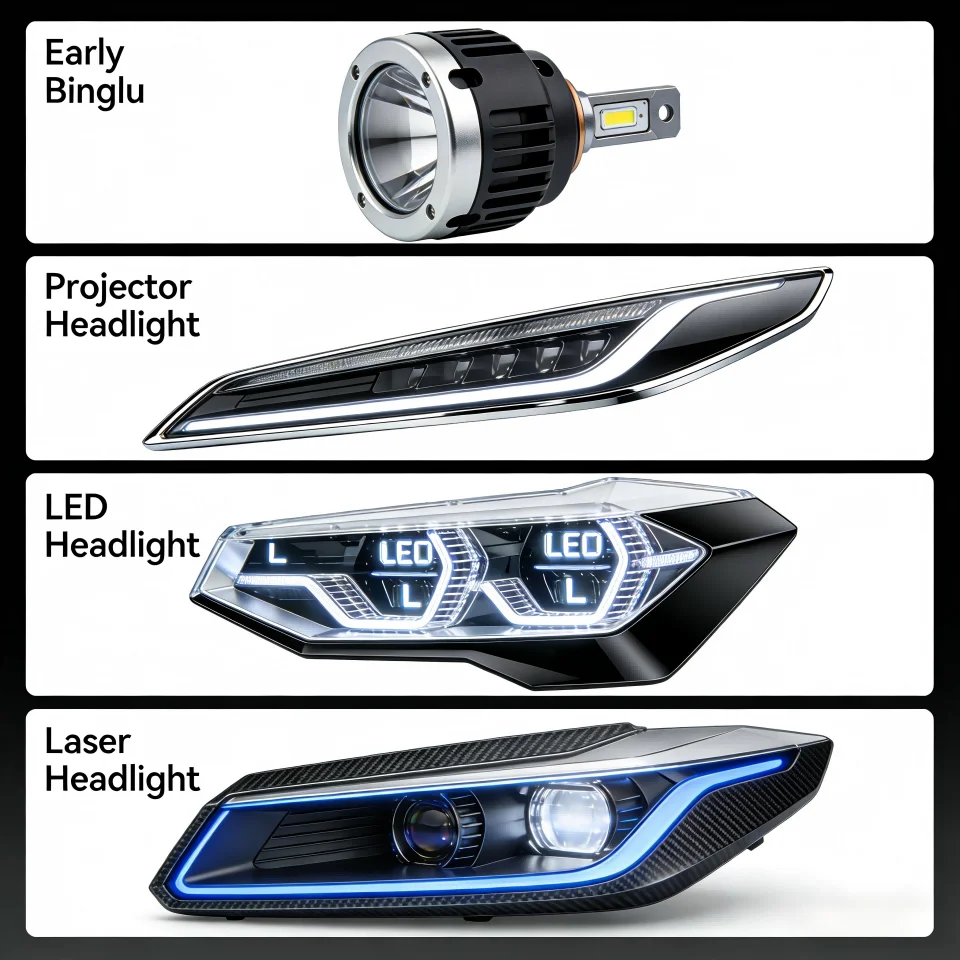
1. Direct Answer: What Actually Determines a Good Headlight Outcome
The single biggest factor in headlight performance is not the bulb type—it is the match between the light source and the housing optics. A well-matched halogen can outperform a poorly matched LED. A properly engineered LED system, matched to its housing, is the best option for most drivers seeking a meaningful upgrade.
That principle should guide every decision that follows. Everything else—lumens, color temperature, price—is secondary to whether the light goes where you need it.
2. The Three Contenders (And Why One Is Mostly Irrelevant)
Most comparison articles frame this as halogen versus LED versus HID. That framing wastes your time. HID (xenon) systems produce excellent light in factory projector housings, but retrofit HID kits in halogen reflector housings are notoriously problematic and increasingly restricted. For the buyer evaluating a halogen-to-LED upgrade, HID is a distraction. The real decision is between staying with halogen and moving to a properly executed LED solution.
2.1. Halogen: The Known Quantity
Halogen remains the baseline because it is predictable. A fresh halogen bulb in a housing designed for it produces a beam with a defined cutoff and reasonable spread. It costs little. It is universally available. The downside is not mystery or marketing—it is physics. Halogen wastes energy as heat, produces limited usable light, and degrades gradually until you replace it. A standard halogen bulb lasts roughly 450 to 1,000 hours . Output in the 700–1,200 lumen range is typical for automotive applications.
If you drive almost exclusively in well-lit urban areas and replace your bulbs on schedule, halogen is not broken. You do not need to fix it.
2.2. LED: The Upgrade That Requires Precision
LED technology offers genuinely better efficiency, longer life, and higher usable output. The catch is that LED emitters are directional—they produce light from a small surface area in a specific orientation. Halogen filaments radiate in all directions from a tiny point. When you install an LED bulb in a housing designed for a halogen filament, the optics see a different light source geometry than they were built for. The result is scattered light, hot spots, and glare.
This is why the aftermarket is full of LED kits that disappoint. The technology is sound. The execution is often careless. In our engineering testing, the difference between a matched LED system and a generic “drop-in” kit is visible on a wall at twenty-five feet within seconds. One has a crisp cutoff. The other looks like a flashlight covered with a smear of petroleum jelly.
3. The Specifications That Matter (And the Ones That Don’t)
| Spec | Por qué es importante | What to Ignore |
|---|---|---|
| Emitter Position | Determines whether the beam pattern matches the housing. This is the single most important variable. | “Universal fit” claims. If a kit claims to fit everything, it is likely optimized for nothing. |
| Temperatura de color | 4000K–6000K balances visibility and weather performance. Above 6500K trends blue and reduces usable contrast. | “Super white” or “diamond white” marketing language. Look for the Kelvin number. |
| Thermal Design | LEDs concentrate heat. A metal heatsink or active fan prevents output fade and premature failure. | Lumen claims without a thermal solution. High output in a plastic body is a short-lived product. |
| Cutoff Verification | A sharp horizontal line with a stepped rise on the right means the beam is controlled. | “DOT approved” stickers on unbranded products. Compliance is documented, not stickered. |
| Vida útil (horas) | 15,000+ hours is realistic for quality LED. Halogen’s 450–1,000 hours means repeated replacement. | “50,000 lumens” claims from no-name brands. Lumens measured at the emitter are meaningless without beam data. |
A pattern emerges when you look at this table. The specifications that determine whether an upgrade works are almost never the ones printed in large font on the product box. Emitter position and thermal design are engineering decisions, not marketing bullet points. They are also the first things compromised when a manufacturer races to hit a price point.
4. The Pitfalls That Cost Real Money
Forum posts from owners of older vehicles tell the story better than any spec sheet. One recurring theme: the “cheap LED experiment” that ended with the driver putting the halogens back in. The light output was technically higher, but the beam was unusable. Scattered light lit the treetops and the ditch but left the lane ahead darker than before. Oncoming drivers flashed their high beams. The experiment was a net loss.
Another pitfall: ignoring the housing itself. A cloudy, yellowed lens can reduce light output by 50–80% regardless of what bulb sits behind it . If your headlight lenses look hazy, a restoration kit or replacement lens will do more for visibility than any bulb swap. This is the unglamorous advice that most upgrade guides skip because it does not sell products. It is also true.
The third trap is legality. Some regions permit specific LED replacement bulbs for specific vehicle applications, provided the product has documented photometric compliance. Others prohibit retrofit conversions in halogen housings entirely (SAE International standards) . A seller’s assurance that a product is “road legal” is not the same as your jurisdiction’s actual regulations. Verify before you buy.
5. What to Look For Instead
- A manufacturer that publishes beam data, not just lumen numbers. If the product page shows a cutoff pattern or references photometric testing, that is a signal of engineering discipline.
- Application-specific fitment. A kit designed for your housing type is inherently more trustworthy than a “fits all” universal bulb.
- Visible thermal engineering. Metal construction, adequate surface area, and—where necessary—active cooling indicate the product was designed to sustain output rather than peak for five minutes.
- Clear compliance documentation. Not a sticker. Not a badge. Actual documentation that references recognized standards for the intended application.
6. Preguntas frecuentes
6.1. Is LED always better than halogen?
No. A poorly matched LED retrofit can perform worse than a fresh halogen bulb. LED is better when the emitter geometry matches the housing and the thermal design is adequate. Without those conditions, the advantage disappears.
6.2. Can I put LED bulbs in my existing halogen housing?
Physically, often yes. Optically, it depends entirely on whether the LED emitter position matches the original filament location. Some vehicles and some LED products align well. Many do not. Testing the beam pattern against a wall after installation is the only reliable way to know.
6.3. Are LED headlights worth the extra cost?
For drivers who spend significant time on unlit roads, yes. The combination of higher usable output, longer lifespan, and lower power draw creates a better ownership experience over time. For occasional urban drivers, a fresh set of quality halogen bulbs may be sufficient.
6.4. ¿Por qué algunos faros LED causan deslumbramiento?
Glare results from light escaping above the intended cutoff line. This almost always stems from emitter-housing mismatch. When the LED chips are not positioned at the housing’s designed focal point, the optics cannot control the beam. The solution is not aiming the lights lower—it is using a properly matched system.
6.5. How long do LED headlights actually last?
Quality LED systems rated for 15,000 to 50,000 hours are realistic . Heat is the primary enemy. A system with adequate thermal management will retain usable output far longer than a budget kit with minimal cooling.
6.6. ¿Necesito una carcasa de proyector para LED?
Projector housings are more forgiving of LED retrofits because the lens focuses light from a broader source area. Reflector housings are less forgiving and require more precise emitter positioning. That said, a well-designed LED system can work in either type if the geometry matches.
7. The GTR Standard
We do not sell “universal” solutions because the physics does not support universality. Every housing has a designed focal point. Every LED emitter has a specific geometry. A product that ignores this relationship is a product that will eventually disappoint someone.
GTR’s approach starts with the housing. We measure. We test beam patterns. We verify cutoff sharpness and off-axis glare at multiple angles before a product reaches a customer. The certifications we maintain exist because professional installers and informed buyers deserve to verify compliance rather than trust a claim. And our customization capability exists because “close enough” is not a standard worth accepting when the consequence is visibility on a dark road.
If you are ready to make a decision based on engineering rather than marketing, the next step is straightforward. Visita https://www.rhgtr.com, identify your housing type and application, and choose a system that was designed for your vehicle—not for a generic shelf. The road ahead is dark enough. Your headlights should not make it darker.