
Elegir una luz de cruce por clasificación de lúmenes es una de las formas más fáciles de comprar el producto equivocado. Una comparación seria de faros debe examinar el patrón del haz, la compatibilidad óptica, el control térmico, el diseño eléctrico, el espacio de instalación, el deslumbramiento, la durabilidad y el rendimiento en carretera. Esto importa aún más cuando compras cientos o miles de unidades.
For distributors and professional retrofit businesses, the cheapest mistake is the one you catch before the purchase order.
1. What makes a good low beam light?
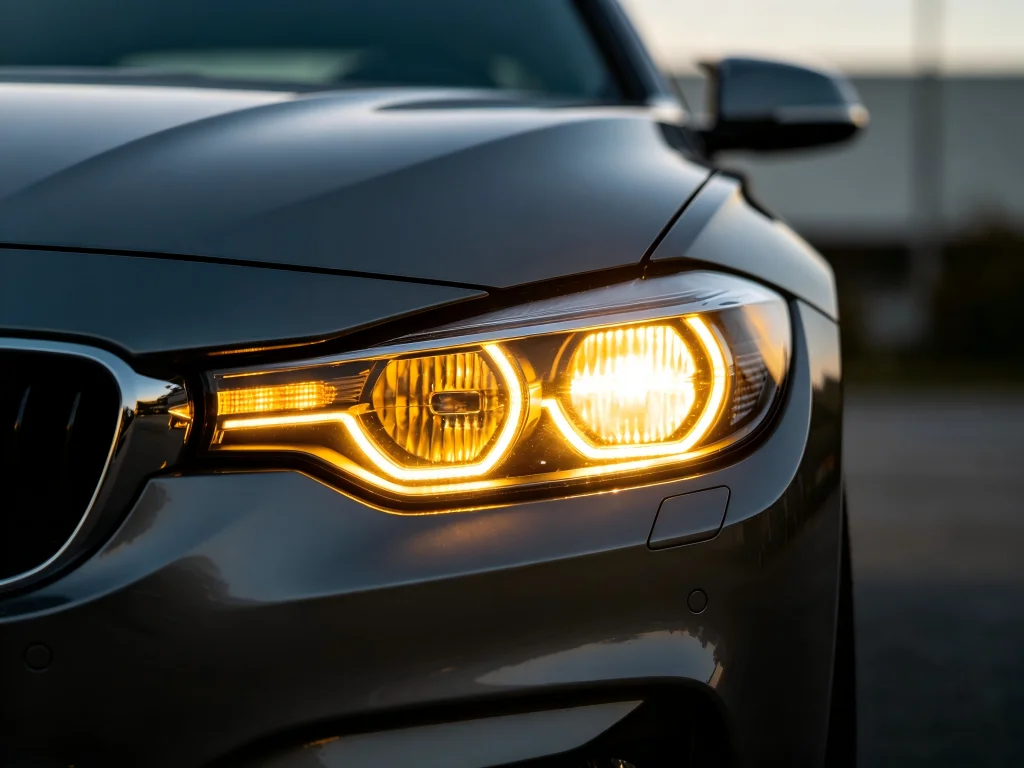
A good low beam light should produce controlled road illumination with adequate width and distance, limiting glare above the cut-off line. Its light source must work correctly with the headlight optics, maintain stable output as temperature rises, fit properly in the vehicle, and operate reliably within the electrical system.
That definition immediately eliminates a common purchasing method:
“Supplier A says 20,000 lumens and Supplier B says 30,000 lumens, so Supplier B must be better.”
Not necessarily.
Those figures tell you very little about where the light goes.
2. Low beam vs high beam
Low beams prioritize controlled illumination and reduced glare during normal nighttime traffic. High beams prioritize long-range visibility when the road is dark and traffic conditions allow their use. Because their optical functions differ, the best low beam product cannot be selected solely with high beam brightness expectations.
| Purchase factor | Low beam | High beam | Why buyers should care |
|---|---|---|---|
| Beam purpose | Controlled road illumination | Long-distance illumination | Different optical goals require different evaluation methods |
| Cutoff control | Critical | Less dominant | A poor low beam cut-off can create glare |
| Foreground light | Must be balanced | Secondary concern | Excessive intensity in the foreground can impair distance perception |
| Distance | Moderate and controlled | Longer | The high beam range should not become the goal for low beam design |
| Typical use | Frequent | Conditional | Low beams need high reliability for daily use |
3. Halogen vs LED vs HID: Which low beam is better?
There is no universally better technology. Each one has advantages and limitations.
3.1. Halogen low beam
Halogen technology is simple, mature, and economical. More importantly, an original halogen headlight is designed around a very specific filament geometry.
Advantages:
- Low replacement cost
- Simple electrical design
- Predictable compatibility with optics designed for that bulb
- Widely available
Limitations:
- Lower luminous efficiency than modern LED systems
- More energy converted to heat
- Typically shorter lifespan than a well-designed LED system
- Limited freedom for advanced optical packaging
3.2. LED low beam
LED technology gives manufacturers more control over packaging, energy usage, color characteristics, thermal design, and optical engineering.
But there is an important distinction between a purpose-designed LED headlight and an LED replacement installed in optics originally designed around a halogen filament.
That distinction should never be ignored.
Advantages:
- High efficiency
- Compact light source possibilities
- Fast response
- Potentially long lifetime
- Strong potential for projector-based controlled systems
Potential disadvantages:
- Poor matching geometry can distort the beam
- Thermal management quality varies widely
- Driver electronics add another possible point of failure
- Oversized heat sinks or fans can cause installation issues
3.3. HID/Xenon low beam
HID systems can provide powerful light output and have been widely used in projector applications.
They also require compatible ballasts and optics. Heating behavior, system complexity, component aging, and replacement cost should be considered.
| Tecnología | Efficacy | System complexity | Sensitivity to adaptation | Better purchase context |
|---|---|---|---|---|
| Halogen | Lower | Low | Low when replacing with an equivalent | Economical replacement and OEM-style applications |
| LED | Alta | Medio | High if optics do not match | Modern upgrades and designed projector systems |
| HID | Moderado a alto | Higher | Alta | Compatible projector and xenon systems |
4. Purchase factor #1: The beam pattern exceeds lumen claims
If you only remember one section of this buying guide, let it be this one.
Do not approve a low beam based solely on the specification sheet.
Ask the supplier for evidence of the beam pattern.
4.1. ¿Qué debes inspeccionar?
- Definición del corte
- Punto caliente central
- Anchura horizontal
- Intensidad del primer plano
- Zonas oscuras
- Luz ascendente dispersa
- Consistencia izquierda-derecha
- Rendimiento después de la estabilización térmica
Un haz de luz hermoso fotografiado inmediatamente después del encendido no cuenta toda la historia.
La temperatura del LED aumenta durante el funcionamiento. Si el sistema térmico no puede eliminar el calor de manera efectiva, el controlador puede reducir la potencia para proteger los LED.
Eso significa que la salida después de 30 minutos puede importar más que la salida durante los primeros 30 segundos.
5. Factor de compra #2: Pregunte por lux, no solo por lúmenes
Los lúmenes describen el flujo luminoso total. El lux describe la iluminación en una superficie.
Ninguno de los dos números debe usarse solo, pero las mediciones de lux en posiciones definidas pueden decirle más sobre la distribución del haz que una afirmación de lúmenes totales.
Therefore, a useful acquisition test asks:
Where is the light measured?
Without distance, position, test conditions, voltage, temperature, and measurement method, a large number can have very little purchasing value.
6. Buying Factor #3: Distance of Low Beam Headlights
Search results often provide simple answers to questions like “low beam headlights should illuminate objects at a distance of at least how far?”
Procurement teams should be more careful.
Regulations vary by country and vehicle category. Technical standards may define photometric performance through multiple measurement points rather than a simple visibility distance.
In the United States, relevant vehicle lighting requirements can be researched through NHTSA. Other markets may follow their own national standards or requirements based on UNECE.
Therefore, do not print a universal statement of “low beam distance” on packaging unless you can support it for the intended market and test method.
7. Buying Factor #4: Cut-off Quality
The cut is not just a visual feature for enthusiasts taking photos against a wall.
It serves a safety function.
Low beams must place useful illumination on the road while controlling light directed toward oncoming drivers.
However, a sharp cut alone does not prove that a headlight is excellent.
You must also evaluate what happens below it.
One product may have a clean cut but weak road width. Another may have a dramatic central hot spot but poor shoulder illumination.
Professional evaluation needs the entire beam.
8. Purchase factor #5: Thermal management
LEDs are efficient, but they still generate heat.
If heat remains concentrated around the LED junction and circuit board, temperature rises. That can affect output stability and component lifespan.
8.1. Fan cooling vs. passive cooling
| Design | Advantages | Potential risks |
|---|---|---|
| Fan cooling | Strong heat transfer in compact designs | Fan quality, noise, dust, and mechanical wear must be considered |
| Passive heat sink | No moving cooling component | May require more space and sufficient airflow |
| Integrated thermal structure | Can provide compact packaging | Performance depends heavily on material quality and engineering |
There is no reason to declare one system automatically superior.
The better question is whether the thermal solution can maintain acceptable LED operating conditions within the intended headlamp environment.
9. Purchase Factor #6: Color Temperature
Very white light sells well because consumers often associate whiteness with brightness.
That creates another purchasing trap.
Color temperature and brightness are not the same thing.
Extremely cold light may look striking, but practical visibility on the road involves contrast, weather, optics, pavement characteristics, and the driver's visual response.
For B2B buyers, choose color specifications based on product positioning and actual application, rather than selecting the highest Kelvin number in a supplier's catalog.
10. Buying factor #7: Electrical compatibility
A bulb that fits physically may still be electrically incompatible.
Modern vehicles can monitor lighting circuits. Replacing the original load with an LED system can sometimes produce warnings, flicker, or abnormal behavior.
Before placing a wholesale order, test:
- Start-up behavior
- Low-voltage performance
- Flicker
- Error messages
- Dimming behavior when applicable
- Electromagnetic interference
- Driver temperature
This is particularly important for distributors selling across multiple vehicle platforms.
11. Buying factor #8: Installation space
Some LED products work well on a test bench but become difficult to install inside actual headlight housings.
The cooling fan can hit the dust cover. The controller box may have nowhere to be placed. The wiring can interfere with the original retaining clip.
Each additional installation step increases labor time.
For a consumer, that is inconvenient.
For a retrofit chain performing hundreds of installations, it becomes a cost.
12. Purchase Factor #9: Do not blindly trust a fitment list
The search low beam for 2015 Chevy Equinox is a good example.
A catalog may show a particular bulb fitment. That is useful as a starting point, not always as a final check.
Vehicle lighting configurations can vary by market, trim level, headlight package, and prior modification.
Professional buyers should verify the actual headlight before guaranteeing compatibility.
13. Purchase Factor #10: Test hot, not just cold
In our engineering tests, one of the most useful comparisons is performance over time.
Imagine two products.
Product A: Extremely high initial output but poor thermal control.
Product B: Slightly lower startup output but stable thermal performance.
If Product A significantly reduces output as temperature rises, Product B may become the stronger product in the real world during a long night trip.
That's why a serious buyer should request stabilized test data when available.
14. Low beam symbol: a small detail that prevents confusion
The low beam symbol is usually a green headlight icon with several rays angled downward. The high beam symbol is usually blue with straighter rays. Drivers should know the difference because daytime running lights, automatic lighting, and high beams have different functions.
This also has value for retailers.
Educational packaging can reduce customer confusion and support calls.
15. When should low beams be turned on?
Regulations vary by market.
Normal night driving is the primary use case, while many jurisdictions also require or recommend headlights during reduced visibility conditions.
High beams require extra caution because they can cause severe glare to other road users. For example, driver guides may require switching to low beams at specific distances from oncoming vehicles.
Always refer customers to applicable traffic regulations rather than presenting one country's requirement as a global standard.
16. How to compare two LED low beam suppliers
Suppose Supplier A offers a very cheap light bulb with a huge advertised lumen rating.
Supplier B costs more but provides optical testing, stable driver design, better thermal engineering, dimming support, and controlled production.
Which is cheaper?
For a one-time transaction, Supplier A.
For a distributor managing warranty claims, installation complaints, returns, negative reviews, and repeat orders, the answer may be Supplier B.
| Supplier evaluation | Basic low-cost product approach | Professional lighting approach |
|---|---|---|
| Main selling point | Price and highlighted specifications | Performance and application adjustment |
| Beam evaluation | May be limited | Central development consideration |
| Thermal stability | A menudo secundario | Evaluado como parte del rendimiento del sistema |
| Compatibilidad con el vehículo | Enfoque de ajuste genérico | Verificación enfocada en la aplicación |
| Soporte B2B | Orientado a transacciones | Orientado a la línea de productos a largo plazo |
| Mejor comprador | Mercado centrado en el precio | Canal de marca, distribuidor y retrofit profesional |
17. Un mejor proceso de evaluación de muestras para compradores B2B
Antes de confirmar una orden de compra grande, establezca un proceso de muestras repetible.
- Confirmar los vehículos objetivo. Definir las aplicaciones exactas y los tipos de faros originales.
- Inspect the mechanical adjustment. Check connectors, dust covers, retaining clips, and available cooling space.
- Record beam patterns. Use the same distance to the wall, vehicle position, camera configuration, and test environment.
- Measure illumination. Compare defined points rather than relying only on visual impressions.
- Perform thermal testing. Observe performance after the product reaches a stable operating temperature.
- Test drive safely. Compare lane center, shoulder visibility, distance, traffic signs, and glare.
- Check electronics. Look for warnings, flickering, radio interference, or abnormal behavior at startup.
- Repeat on multiple samples. One excellent sample does not prove batch consistency.
18. The problem of batch consistency
This last point is often overlooked.
A manufacturer can send an excellent engineering sample.
Your company receives thousands of production units.
The real question is whether those units perform consistently.
For professional B2B purchases, evaluate manufacturing control in addition to prototype performance.
Ask about:
- LED component consistency
- Driver component control
- Assembly tolerances
- Optical positioning tolerances
- Thermal interface consistency
- Water and dust protection where applicable
- Final inspection procedures
- Batch traceability
Small positioning errors can be significant in an optical product.
This is one of the reasons why automotive lighting should not be purchased as a generic electronic accessory.
19. Common purchasing mistakes
19.1. Mistake 1: Buying the highest wattage
Power consumption is not the same as useful road illumination. Higher power also creates additional thermal demand.
19.2. Mistake 2: Buying the highest lumen count
Total light output does not describe the beam distribution.
19.3. Mistake 3: Evaluating only against a white wall
A wall test is useful for beam shape. It does not fully reproduce wet asphalt, traffic signs, curves, elevation changes, or real driving distances.
19.4. Mistake 4: Ignoring glare
More upward scatter can make a lamp seem powerful while creating discomfort for oncoming drivers.
19.5. Mistake 5: Ignoring thermal performance
Initial output may not represent stabilized performance.
19.6. Mistake 6: Assuming one bulb fits all headlights
The same bulb base can appear in different optical systems. Compatibility must include optical behavior, not just mechanical fit.
20. FAQ: Low beam purchasing questions
20.1. ¿Hasta qué distancia deben iluminar las luces de cruce?
No existe una distancia global universal porque los estándares de vehículos y las guías de conductores varían. Muchas referencias generales describen aproximadamente 130-200 pies de visibilidad de luz de cruce, pero el cumplimiento técnico debe verificarse utilizando las reglas y requisitos de prueba del mercado previsto.
20.2. Las luces de cruce deben ser lo suficientemente brillantes para ver cuántos pies?
La respuesta depende de la jurisdicción y de la fuente del requisito. No trate una respuesta de examen de conducir de una región como una especificación internacional de iluminación automotriz.
20.3. ¿Son mejores las luces bajas LED que las halógenas?
Los LED pueden ofrecer mayor eficiencia, mayor vida útil y un fuerte rendimiento óptico cuando se diseñan adecuadamente. Sin embargo, un retrofit LED mal emparejado puede funcionar peor que una bombilla halógena dentro de ópticas diseñadas específicamente para el filamento original.
20.4. ¿Por qué algunos faros LED causan deslumbramiento?
Las causas comunes incluyen geometría incorrecta del emisor, compatibilidad inadecuada con el reflector, instalación incorrecta, mal diseño del haz y mal ajuste del faro.
20.5. ¿De qué color es el símbolo de las luces bajas?
El indicador de luces bajas o de cruce en el tablero es comúnmente verde. El indicador de luces altas es generalmente azul.
20.6. ¿Qué es más importante: vatios, lúmenes o lux?
Ninguno debe considerarse por separado. Los vatios describen la potencia eléctrica, los lúmenes describen la salida total de luz y el lux describe la iluminación en una superficie. El rendimiento del faro también depende de la geometría del haz y de dónde se coloca esa iluminación.
20.7. ¿Deben los mayoristas solicitar muestras antes de hacer un pedido?
Sí. Las muestras permiten a los compradores verificar el patrón del haz, la estabilidad térmica, el ajuste mecánico, la compatibilidad eléctrica, el tiempo de instalación y el rendimiento específico del vehículo antes de escalar la compra.
20.8. ¿Cómo debo comparar las luces bajas con las luces altas?
Compare them by purpose rather than just by brightness. Low beams prioritize controlled road illumination in daily use. High beams prioritize additional distance when traffic conditions allow their use.
21. Why Professional Buyers Work with GTR
The aftermarket doesn't need another lighting product with a bigger number printed on the box.
It needs lighting products that distributors can sell with confidence.
GTR focuses on automotive aftermarket lighting and understands the requirements of wholesalers, distributors, professional retrofit shops, and private label customers.
Our manufacturing perspective begins with a simple question:
Will the customer see a significant difference on the road?
That takes product evaluation beyond wattage and marketing specifications into optics, heat management, installation, consistency, and application.
For B2B customers, product competitiveness can also depend on market positioning, packaging, vehicle applications, customization requirements, and the ability to maintain a steady supply.
22. Your Next Purchase Order Should Start with a Beam Test
Before choosing your next low beam supplier, stop comparing products by the biggest number in the catalog.
Compare the beam.
Compare performance after heat builds up.
Compare installation time.
Compare optical compatibility.
Then compare how many complaints, returns, and warranty claims the product could generate after you put your brand behind it.
If you are sourcing low beam headlights, LED projector solutions, or automotive lighting products for wholesale, distribution, retrofit chains, or private label programs, bring your target vehicle applications and market requirements to GTR. Visit www.rhgtr.com to evaluate a lighting solution designed for repeat business rather than a specification sheet designed for a quick sale.