
You’re shopping for an h11 led headlight upgrade. You’ve seen the lumen claims — 20,000, 50,000, even 100,000 “lumens” from some brands. You’ve seen the price range: $20 on Amazon, $200 from specialty retailers. And you have no idea which one is actually worth your money.
Here’s the truth that nobody tells you: 80% of H11 LED headlight bulbs on the market are complete garbage. This guide cuts through the marketing noise and gives you the engineering-backed criteria that actually separate a great H11 LED headlight bulb from an expensive paperweight.
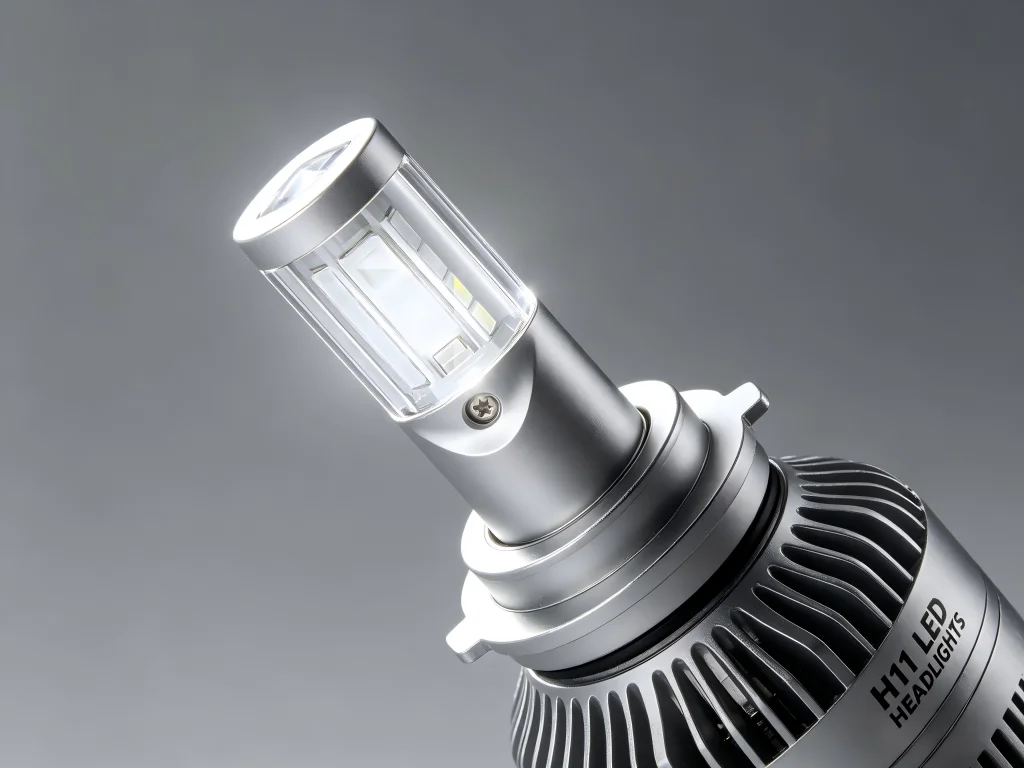
1. Halogen vs. LED vs. HID: What You're Actually Getting
Before we dive into specific H11 LED headlight bulbs, let’s establish the baseline. Here’s how the three technologies compare:
| Caractéristique | Standard Halogen H11 | Premium LED H11 | HID H11 (Conversion) |
|---|---|---|---|
| Typical Lumens | ~1,350 | 3,000 – 7,000+ | 2,500 – 3,500 |
| Wattage | 55W | 30 – 50W | 35 W |
| Température de couleur | ~3 000 K (jaune) | 5,000 – 6,500K (white) | 4,300 – 6,000K |
| Durée de vie (heures) | 320 – 500 | 30,000 – 50,000+ | 2,000 – 3,000 |
| Modèle de faisceau | Optimisé en usine | Varies wildly by quality | Requires projector housing |
A premium H11 LED headlight produces 3-5 times more light than a halogen while lasting 100 times longer. But — and this is critical — only if the beam pattern is correct. A high-lumen bulb with a scattered beam is worse than a halogen. Period.
2. The 5 Critical Factors That Separate Quality From Junk
2.1. Beam Pattern Accuracy (The #1 Most Overlooked Factor)
A quality H11 LED headlight bulb replicates the halogen filament position exactly.
Your headlight housing was designed around a specific light source location. Move that source, and the reflector or projector throws light in the wrong direction. The result: glare for oncoming traffic and dark spots on the road ahead.
Premium manufacturers use 1:1 design — matching the dimensions of the factory halogen bulb exactly. Budget brands just stuff in LEDs wherever they fit and call it a day. You can spot the difference in the beam pattern: a sharp cutoff line with even distribution vs. a scattered, uneven mess.
2.2. Thermal Management: The Hidden Failure Point
The best H11 LED headlight bulbs use high-quality aluminum or copper heat sinks with active cooling fans.
LED chips generate heat at the junction point. If that heat isn’t pulled away, the chip degrades. Output drops. Color shifts. The bulb fails. But cheap fans create another problem: noise. Multiple customer reviews note that some H11 LED headlight bulbs have cooling fans loud enough to hear inside the cabin when the car is off.
What to look for: balanced thermal design. Copper or aluminum construction. Fans that move enough air without sounding like a drone taking off.
2.3. CANbus Compatibility: Eliminating the Flicker
A good H11 LED headlight bulb includes CANbus compatibility built in.
Modern vehicles monitor electrical systems. When you replace a 55W halogen with a 30W LED, the computer sees lower power draw and may interpret it as a burnt-out bulb. The result? Flickering, error codes, or bulbs that randomly turn off.
Some brands sell separate “CANbus decoders” or “anti-flicker modules.” These add complexity and failure points. Quality bulbs integrate the decoder directly into the driver module.
2.4. Real Lumens vs. Marketing Lumens
Premium H11 LED bulbs produce 3,000-7,000+ usable lumens. Marketing claims of 20,000+ lumens are almost always measured at the chip level, not what reaches the road.
Here’s how the math works: a 55W halogen produces about 1,350 lumens. A quality LED producing 3,000-5,000 lumens is already 3-4 times brighter. Claims of “800% brighter” or “100,000 lumens” are mathematically impossible from a 30-50W LED. They’re measuring raw chip output in ideal conditions, not real-world performance.
2.5. Build Quality and Certifications
Quality H11 LED headlight bulbs carry certifications like CE, FCC, RoHS, and ISO9001.
These aren’t just stickers. They mean the manufacturer has passed third-party testing for safety, electromagnetic interference, and environmental compliance. Brands that skip these certifications are cutting corners — and you’ll pay for it in performance and longevity.
3. Où acheter des phares LED H11 : Comparaison des détaillants
Not all purchasing channels are equal. Here’s what you’re getting at each:
| Retailer Type | Advantages | Disadvantages | Best for |
|---|---|---|---|
| AutoZone / NAPA | Immediate availability, easy returns | Limited selection, often mid-tier brands | Emergency replacement |
| Amazon / eBay | Wide selection, low prices | Wildly varying quality, counterfeit risk | Budget buyers (with research) |
| Specialty Retailers | Expert guidance, tested products | Higher prices, shipping time | Performance-focused drivers |
| Direct from Manufacturer | Authentic products, warranty support | Limited marketing presence | B2B buyers, fleet operators |
For B2B buyers and fleet operators, buying direct from the manufacturer ensures product authenticity, warranty support, and bulk pricing. Retailers like AutoZone or NAPA are convenient for individual consumers but often carry limited H11 LED headlight bulb selections.
4. What Fits Your Vehicle: H11 Compatibility Guide
H11 is one of the most common bulb sizes, but compatibility varies. Here’s what you need to know:
- Standard H11: Used in most Japanese and European vehicles for low beams
- H11B: Different base configuration, found primarily in Hyundai, Kia, and Ford vehicles — not interchangeable with standard H11
- H8/H9/H16: Share the same fitting as H11 and differ mainly in wattage
- Check your owner’s manual or inspect the back of your headlight assembly for the bulb marking
Always verify your vehicle’s specific bulb size before purchasing. A 9005 looks similar to an H11 but they’re not interchangeable.
5. Reddit and Community Feedback: What Real Drivers Are Saying
“I’ve tried multiple H11 LED brands. The ones with 1:1 design and proper heat sinks actually work. The cheap ones? They either flicker, scatter light, or die within months.” — r/cars contributor
“For H11 low beams, GTR Lighting Ultra 3 is premium performance. Morimoto 2Stroke 4.0 is best value.” — HID Nation testing
“Fan noise is a real issue. Some H11 LED bulbs have fans loud enough to hear in the cabin when the car is off.” — Amazon reviewer
The consensus across forums, reviews, and professional testing is clear: H11 LED headlight quality varies dramatically. The difference between a $20 bulb and a $150 bulb isn’t just branding — it’s engineering, materials, and testing.
6. H11 LED Headlight FAQ: Your Buying Questions Answered
How much should I spend on an H11 LED headlight?
Premium H11 LED bulbs range from $50 to $200. Below $50, you’re almost certainly compromising on beam pattern, thermal management, or CANbus compatibility. Above $200, you’re paying for branding more than performance.
How long do H11 LED headlights last?
Quality units are rated for 30,000 to 50,000 hours. Real-world lifespan depends on thermal management — bulbs that run hot degrade faster.
Will H11 LED bulbs work in my car without modifications?
Most quality H11 LED bulbs are plug-and-play, requiring no modifications. However, some vehicles may need CANbus decoders or specific mounting adapters depending on the headlight housing design.
Do H11 LED bulbs cause glare?
Only if the beam pattern is wrong. A quality bulb with 1:1 chip placement produces a sharp cutoff line that doesn’t blind oncoming traffic.
Quelle température de couleur dois-je choisir ?
5,000K to 6,000K provides pure white light that balances visibility and comfort. 6,500K leans blue and may reduce visibility in rain or fog. Below 5,000K starts looking yellow like halogens.
Can I use H11 LEDs for fog lights?
Yes — H11 is commonly used in fog light applications. Yellow or amber options (around 3,000K) provide better contrast in poor weather.
Why do my H11 LED headlights flicker after installation?
Most likely a CANbus compatibility issue. Quality bulbs include built-in decoders. If yours don’t, you may need to add external decoders or resistors.
7. Making Your Final Decision: The H11 LED Headlight Shopping Checklist
- Verify your vehicle’s bulb size — H11, H11B, or something else?
- Check the beam pattern — Does the manufacturer show actual road tests or just bulb photos?
- Examine the heat sink — Copper or aluminum? Active cooling with balanced fan noise?
- Confirm CANbus compatibility — Built-in or external decoder?
- Look for certifications — CE, FCC, RoHS, ISO9001?
- Read real reviews — Not just 5-star ratings, but detailed feedback from actual users
- Compare warranty — Quality brands stand behind their products with multi-year warranties
8. Why GTR Stands Apart in H11 LED Headlight Manufacturing
We’ve spent 18 years in automotive lighting manufacturing. We’ve seen the shortcuts that cheap brands take. We’ve seen the bulbs that fail in months. And we’ve built our H11 LED headlight lineup to address every single failure point we’ve identified.
Every GTR H11 LED headlight bulb features:
- 1:1 chip placement for factory-correct beam patterns
- Premium thermal management with copper heat sinks and balanced cooling
- Integrated CANbus compatibility — no external modules required
- International certifications including CE, FCC, RoHS, ISO9001, and ISO14001
- Global availability in over 50 countries with dedicated support
When you’re buying for a fleet, a dealership, or a B2B operation, you need more than a bulb. You need consistency, reliability, and supply chain you can count on. That’s what GTR delivers — not marketing hype, just engineering that works.
Explore GTR’s H11 LED headlight solutions for your business →