
Choisir la bonne ampoule de phare LED H7 signifie regarder au-delà des revendications de lumens gonflées et comprendre cinq facteurs critiques : la compatibilité CANBUS, l’ajustement physique, la précision du faisceau lumineux, la gestion thermique et la qualité de fabrication.
The H7 is one of the most common single-filament bulb sizes in European and Asian vehicles — found in thousands of models from Volkswagen, BMW, Mercedes-Benz, Audi, Hyundai, and Ford. Unlike dual-beam H4 bulbs, the H7 serves a single purpose per unit: either low beam or high beam. This single-use design allows for better optical focusing in reflector or projector housings — but only if the replacement bulb matches the original specifications.
Here's the problem: the H7 LED headlight bulb market is flooded with products that look identical on paper but perform radically differently in real-world conditions. Based on our engineering tests on dozens of H7 LED bulbs and thousands of real-world installations, we've identified exactly what separates a true upgrade from a disappointing purchase.
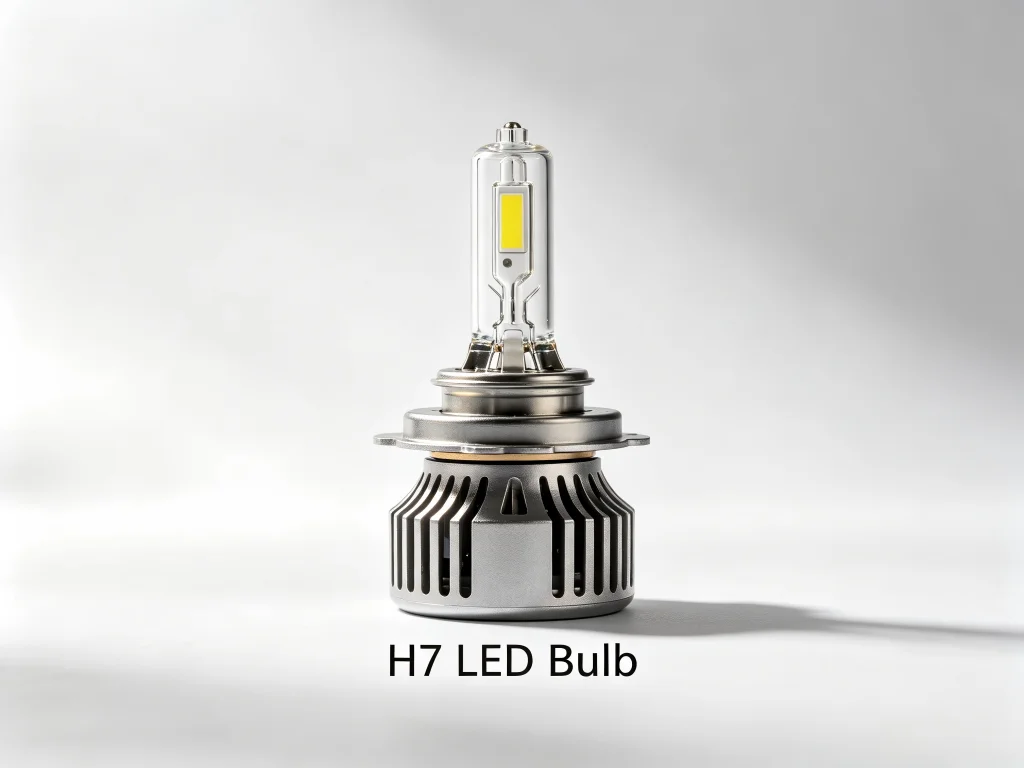
1. H7 LED vs. Halogen vs. Xenon: The Real Data
Before diving into what makes a great H7 LED bulb, understand what you're replacing and what's actually possible.
| Paramètres | Halogen H7 | Xenon (HID) H7 | LED H7 |
|---|---|---|---|
| Lumens | ~1,200–1,550 lm | ~3,000–5,000+ lm | ~3,000–6,000+ lm |
| Durée de vie | 300–500 h | 2 000–3 000 h | 30 000–50 000 h |
| Température de couleur | 3,200K–3,500K (yellow) | 4 300K–6 000K | 5,000K–6,500K (white) |
| Consommation électrique | 55W | 35 W | 20–40 W |
| Temps d'échauffement | 0,1–0,2 s | 3–5 s | Instantané |
| Plug & Play ? | Oui | Non (nécessite un ballast, câblage) | Oui (dans la plupart des cas) |
Les données sont claires : la LED offre une luminosité supérieure, une durée de vie nettement plus longue, un allumage instantané et une consommation d'énergie inférieure par rapport au halogène et au HID. Mais ces avantages ne sont réalisés que lorsque l'ampoule est correctement conçue. Une LED mal conçue peut en réalité être moins performante qu'un halogène standard.
2. Cinq facteurs critiques qui déterminent le succès ou l'échec des LED H7
La plupart des acheteurs se concentrent sur la luminosité et le prix. L'acheteur intelligent se concentre sur la compatibilité et l'ingénierie — car la luminosité ne signifie rien si l'ampoule ne fonctionne pas dans votre véhicule.
2.1. Compatibilité CANBUS : le facteur décisif
Si votre véhicule est équipé d'un système CANBUS — et c'est le cas de la plupart des véhicules européens et asiatiques — vous avez besoin d'une ampoule LED H7 avec décodage intégré, sinon vous rencontrerez des avertissements d'erreur sur le tableau de bord.
Les véhicules modernes surveillent la résistance des ampoules pour détecter les pannes. Les LED consomment beaucoup moins d'énergie que les halogènes, donc l'ordinateur pense qu'une ampoule est grillée et déclenche un avertissement ou un hyper-flash. Un pilote CANBUS intégré trompe le système en lui faisant croire que le courant correct circule.
Certains fabricants annoncent “sans erreur CANBUS” mais livrent des produits qui provoquent encore des erreurs. Les résistances externes peuvent fonctionner, mais elles génèrent une chaleur importante — jusqu'à 50 watts d'énergie gaspillée qui se transforme en chaleur à l'intérieur de votre boîtier de phare. Pour un fonctionnement vraiment sans erreur, choisissez des ampoules de phare LED H7 avec décodage intégré plutôt que des kits de résistances externes.
Véhicules les plus sensibles aux problèmes CANBUS : Les marques allemandes (BMW, Mercedes-Benz, Audi, VW), les marques japonaises haut de gamme et de nombreux véhicules coréens. Si vous conduisez l'un de ces véhicules, la compatibilité CANBUS est obligatoire, pas optionnelle.
2.2. Adaptation physique : conception 1:1 vs alternatives encombrantes
Les boîtiers de phares H7 ont un espace limité. Le jeu du cache anti-poussière n'est souvent que de quelques centimètres. De nombreuses ampoules LED utilisent de grands dissipateurs thermiques ou des boîtiers de commande externes qui ne s'adaptent tout simplement pas.
The ideal H7 LED bulb uses a mini 1:1 design that replicates the dimensions of the original halogen. The driver must be integrated into the base of the bulb, eliminating external housings. Installation should take five minutes without any tools.
Common fitment issues reported by real users include bulbs too thick to pass through the socket, bulbs too long for the locking mechanism, and bulbs with oversized heat sinks that cannot clear the dust cover. These issues turn a simple upgrade into a frustrating modification project.
2.3. Beam accuracy: where the light actually goes
This is the most overlooked factor in H7 LED selection — and the most important for your safety and that of others on the road.
The halogen filament of your original H7 bulb is precisely positioned — at 27.5 mm from the base. If your LED chips are not exactly in the same place, the optics cannot focus the light. The result is scattered light that creates dark zones in your field of vision and dangerous glare for oncoming traffic.
A high-quality H7 LED replicates the halogen filament position with an ultra-thin board (0.03 to 0.05 inch) so that the light source is at the same focal point as the original bulb. This preserves the manufacturer's cutoff line and avoids glare. Bulbs with thick boards or poorly positioned chips project scattered light that reduces your own visibility while disturbing every driver in front of you.
In projector headlights especially, well-designed LEDs can fully outperform the original halogen. But only if the chip geometry matches the geometry of the halogen filament light source.
Look for H7 LED bulbs with 360° rotatable adjustment that allow you to rotate the LED chip array to fit your specific housing. This feature is essential for getting the correct beam pattern in reflector and projector headlights.
2.4. Thermal management: the silent killer of performance
LEDs generate heat at the semiconductor junction where the chip meets the board. If this heat is not dissipated quickly, the bulb will permanently dim within a few weeks.
Look for an aluminum or copper base with a specified fan speed — 12,000 rpm is the benchmark, while high-end units reach 23,000 rpm. A bulb that advertises over 50,000 hours without disclosing the cooling mechanism is almost certainly cutting corners.
Aerospace-grade aluminum heat sinks and high-speed cooling fans are the hallmarks of proper thermal engineering. Passive cooling (fanless designs) can work for low-power bulbs, but generally cannot handle the heat generated by high-lumen H7 LEDs without significant lumen depreciation over time.
2.5. Build quality: what you can't see matters most
Automotive-grade multi-core LED chips, non-plastic connectors, and robust driver circuits distinguish premium H7 LED bulbs from budget alternatives that fail within months.
Connectors matter more than you think. A Mercedes owner reported: “The H7 adapters that buyers have to purchase separately from a third-party seller were of poor quality, made of soft metal that bent easily and were impossible to install”. High-end bulbs use durable materials that withstand vibrations, extreme temperatures, and repeated handling.
The IP68 waterproof rating is another indicator of build quality. Your headlight housing is exposed to moisture, water splashes, and temperature variations. A bulb that cannot withstand these conditions will fail prematurely.
3. Comparison of H7 LED headlight bulbs: what the market offers
Here is how the main H7 LED options compare to each other on the critical factors that really matter.
| Fonctionnalité | Budget H7 LED | Mid-range H7 LED | High-end H7 LED (GTR Ultra) |
|---|---|---|---|
| Intégration CANBUS | External resistor required | Basic decoding (may still generate errors) | Integrated, error-free |
| Physical design | Bulky, often requires modifications | 1:1 design, no external driver | Mini 1:1, fully integrated |
| Beam adjustment | Fixed position | Fixed or limited adjustment | 360° rotation |
| Thermal system | Base heat sink, no fan specifications | Aluminum heat sink, 12,000 RPM fan | Aerospace-grade aluminum, high-speed fan |
| Gross lumens (per bulb) | Inflated claims, actual ~1,500-2,000 | ~3,000-3,500 | 4,700 |
| Durée de vie | Unspecified or exaggerated | ~30,000 hours | 30,000+ hours with constant output |
| Installation time | 30+ minutes (des modifications sont souvent nécessaires) | ~10 minutes | ~5 minutes, sans outil |
4. Cinq erreurs à éviter lors de l'achat d'ampoules de phare LED H7
- Chercher des nombres de lumens gonflés : Une seule ampoule LED H7 ne peut physiquement pas produire 50 000 lumens bruts. Ces nombres sont soit calculés par paire, soit mesurés au niveau de la puce avant l’optique, soit fabriqués. Ce qui compte, ce sont les lumens utiles — la lumière qui atteint réellement la route dans un faisceau focalisé.
- Ignorer le motif du faisceau : Si vos puces LED ne sont pas là où se trouvait le filament halogène, l’optique échoue. La lumière dispersée crée de l’éblouissement et des points sombres. Recherchez des ampoules avec des colliers réglables qui vous permettent de faire pivoter le réseau de puces.
- Négliger la gestion thermique : La chaleur dégrade les puces LED. Sans refroidissement adéquat, vos ampoules “50 000 heures” s’affaibliront en quelques semaines. Vérifiez le mécanisme de refroidissement — la vitesse du ventilateur et les matériaux comptent.
- Supposer que “plug and play” signifie “s’adapte à tout” : Les boîtiers de phares H7 varient considérablement. Vérifiez les dimensions physiques de toute ampoule par rapport au dégagement du cache anti-poussière et à la profondeur de la douille de votre boîtier. Une ampoule qui s’adapte à un véhicule peut ne pas s’adapter à un autre.
- Ignorer la compatibilité CANBUS : Si votre véhicule dispose d’un système CANBUS, vous avez besoin d’un décodage intégré. Les résistances externes génèrent de la chaleur et peuvent tomber en panne. Le décodage intégré est la seule solution fiable à long terme.
5. Pourquoi la série GTR Ultra H7 LED se démarque de la concurrence
GTR occupe le niveau haute performance des ampoules LED H7. Nous offrons le ” juste équilibre ” entre une luminosité extrême et la fiabilité, sans les problèmes des unités sans marque. Voici pourquoi :
- Real and verifiable output: The GTR Ultra 3.0 produces 4,700 raw lumens per bulb — not inflated marketing numbers. The GTR Ultra 3.0 produces 4,700 raw lumens per bulb — a real, verifiable figure that translates into exceptional road lighting when properly focused.
- Integrated CANBUS decoding: No external resistors. No dashboard warnings. No heat-generating boxes inside your headlight housing.
- 360° rotatable adjustability: Total control of beam alignment for any housing — reflector or projector.
- Premium thermal engineering: Automotive-grade multi-core LED chips with aerospace-grade aluminum heat sinks. Consistent brightness that lasts — not a gradual dimming into darkness.
- Mini 1:1 design: Fits where bulky alternatives cannot. Five-minute installation, no tools required.
GTR stands out by offering CANBUS decoder technology for H7 LED bulbs in both of its product lines. Whether you need a direct replacement for your original halogens or a complete retrofit solution, GTR provides the engineering that makes the upgrade work.
6. Frequently asked questions about H7 LED headlight bulbs
6.1. What is the difference between H7 and H4 headlight bulbs?
An H7 bulb is a single-beam bulb with one filament, designed for low beam or high beam. An H4 bulb is a dual-beam bulb with two filaments that provide both high beam and low beam functions in a single bulb. They are not interchangeable.
6.2. How many lumens do I actually need in an H7 LED bulb?
Quality H7 LED replacements produce 3,000 to 5,000+ raw lumens per bulb. Ignore inflated numbers above this range. The GTR Ultra 3.0 produces 4,700 raw lumens per bulb with exceptional beam focus — more than enough for superior road lighting without the reliability issues of overdriven chips.
6.3. Will H7 LED bulbs work in my reflector headlights?
Yes, but only if the bulb is designed to precisely replicate the halogen filament position. Poorly designed LEDs in reflector housings cause glare and are not compliant with federal standards. Look for bulbs with 360° rotatable adjustment to set the correct beam pattern.
6.4. Do I need a CANBUS decoder for H7 LED bulbs?
If your vehicle has a CANBUS system — most European and Asian vehicles do — you need either built-in decoding or external load resistors. Built-in decoding is the better solution; external resistors generate heat and can fail. GTR Ultra Series bulbs include built-in decoding.
6.5. How long do H7 LED headlight bulbs actually last?
Quality LED replacements last 30,000 to 50,000 hours — 30 to 50 times longer than halogen. But this lifespan is only achievable with proper thermal management. Poorly cooled LEDs can dim or fail within weeks.
6.6. What vehicles use H7 headlight bulbs?
H7 bulbs are common in European and Asian vehicles, including Volkswagen, BMW, Mercedes-Benz, Audi, Hyundai, Kia, and Ford. They are used for low beam, high beam, or fog lights depending on the vehicle.
6.7. Are H7 LED headlight bulbs legal in the United States?
FMVSS 108 does not approve LEDs as a light source in replaceable-bulb headlights, making aftermarket LED bulbs technically non-compliant at the federal level. Enforcement varies by state. Complete certified LED headlight assemblies are the fully compliant solution for OEM applications. For B2B and aftermarket applications, GTR provides products that meet rigorous international standards.
7. Make the right choice for your H7 LED upgrade
Choosing an H7 LED headlight bulb is not about picking the highest lumen count or the lowest price. It's about understanding what actually works in your vehicle — and investing in engineering that delivers real, reliable performance.
GTR Ultra Series H7 LED bulbs are designed for professionals who demand performance, reliability, and compatibility. Whether you're a fleet manager upgrading multiple vehicles, a shop owner recommending products to customers, or an individual driver who simply wants to see the road clearly at night, GTR provides the solution that works.
Visit www.rhgtr.com to explore our full range of H7 LED headlight bulb solutions. Contact our technical team for compatibility verification, installation support, or B2B partnership inquiries.
Because the road ahead deserves more than guesswork. It deserves engineering you can trust.