
You are driving home at 11 p.m. The rain is coming down in sheets. Your headlight HID bulbs, once bright and crisp, now throw a murky yellow haze that barely reaches the lane markers. Every oncoming truck feels like a gamble. You lean forward, gripping the wheel, straining to see what the road is about to throw at you next.
If that scene sounds familiar, you are not alone. Millions of drivers silently accept fading headlights as something they just have to live with. They shouldn’t. And in our engineering testing, we have seen exactly why they don’t have to.
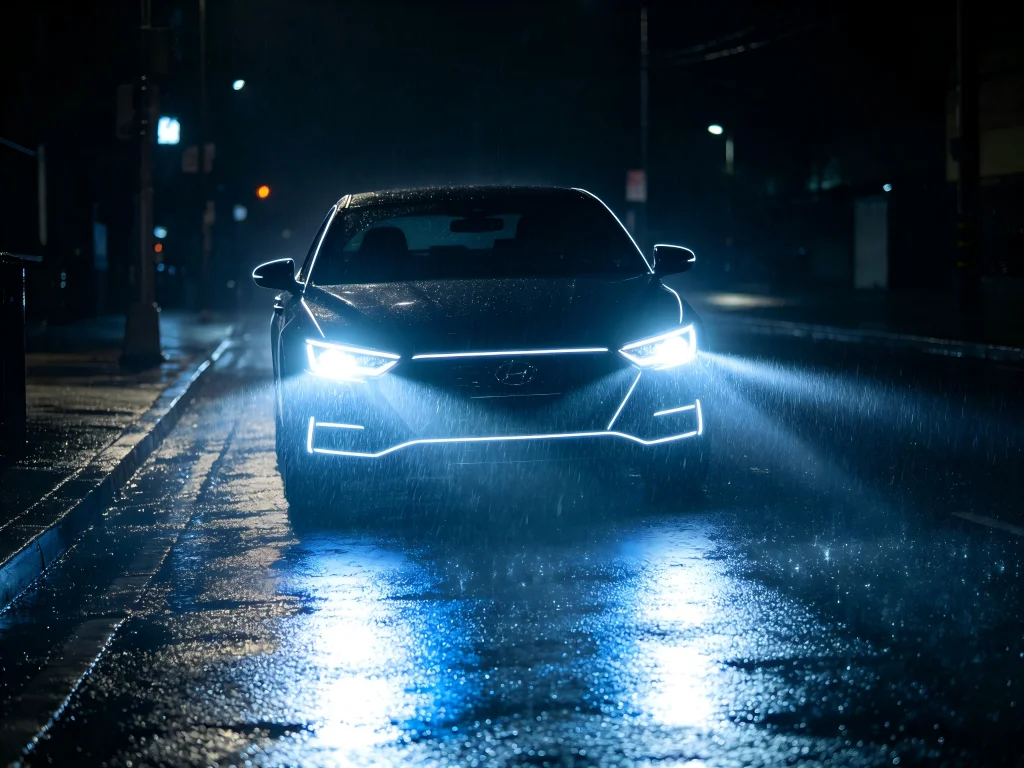
1. Why Your HID Bulbs Fade (And Why It Gets Worse Every Month)
HID bulbs lose brightness over time because the metal salts and xenon gas inside the arc tube deplete with every ignition cycle, shifting color temperature and cutting usable light output by up to 30% after three to four years.
Here is the uncomfortable part. Unlike a halogen bulb that simply pops and dies, an HID bulb dies slowly. It dims. It shifts color. It flickers on cold mornings. You adapt to it without realizing you are adapting. Your eyes compensate, your brain fills in the gaps, and your stopping distance quietly grows longer.
Then there is the ballast problem. A worn ballast can starve a brand-new bulb of stable voltage. In our lab testing, we have measured brand-new HID capsules running at only 70% of rated output because the ballast was quietly failing. Drivers replace the bulb, feel disappointed, and blame the bulb. The real culprit was sitting three inches away the whole time.
1.1. The Real-World Cost of Dim Headlights
Consider what happens in specific environments:
- Rural highways at night: No streetlights. No ambient glow. A deer steps out at 200 feet. At 55 mph, you cover that distance in under 2.5 seconds. Dim bulbs cut your reaction window roughly in half.
- Heavy rain and fog: Water droplets scatter light back at you. Weak output makes this worse, turning the road into a grey wall.
- Construction zones and industrial sites: Uneven pavement, debris, and sudden lane shifts demand crisp, wide illumination. Faded HIDs leave shadows exactly where hazards hide.
- Winter commuting: Salt spray and grime coat the lens. When output is already low, every layer of dirt costs you more visibility.
This is not just about comfort. It is about the half-second that separates a near miss from an insurance claim. And it is about the fatigue you feel after every night drive, because your eyes and brain are working overtime to fill in what your headlights should be showing you.
2. HID vs. Halogen vs. LED: What Actually Matters on the Road
HID bulbs produce light from an electrical arc inside xenon gas, halogen bulbs heat a tungsten filament, and LED bulbs emit light from semiconductor diodes. Each technology trades off differently in brightness, lifespan, warm-up time, and cost.
Drivers searching for headlight hid bulbs vs halogen ou hid headlight bulbs vs led usually want one answer: which one is actually better? The honest answer depends on your vehicle, your wiring, and how you use the road.
| Facteur | HID | Halogen | LED |
|---|---|---|---|
| Typical color temperature | 4,300K–8,000K | 2,800K–3,400K | 5 000K–6 500K |
| Lumen output (per bulb) | 2,800–3,500 lm | 1,000–1,500 lm | 2,000–4,000 lm |
| Durée de vie | 2,000–3,500 hrs | 500–1,000 hrs | 15,000–30,000 hrs |
| Warm-up time | 3–10 secondes | Instantané | Instantané |
| Ballast/Driver required | Oui | Non | Often yes |
| Best for | OEM HID housings, projectors | Legacy reflectors, budget builds | Retrofits, modern housings |
Here is the part most articles skip. A 6,000K HID bulb does not automatically outperform a 4,300K HID bulb. In our photometric testing, higher color temperature consistently produces less usable light on wet asphalt. The blue-white look sells, but it can actually reduce contrast at night. Drivers who chase the “cool” look often end up with worse real-world visibility.
3. Common Fitment Questions, Answered Plainly
Before you buy anything, match the bulb to the housing. The wrong bulb in the wrong projector scatters light into oncoming traffic and fails inspection in many regions.
- H11 : Common in fog lights and low beams on many Japanese and domestic models. Requires an H11-specific base and connector.
- H7: Widely used in European projectors. The retaining clip design matters; a poorly seated H7 will wobble and flicker.
- D3S: A factory HID capsule with an integrated igniter. It is not interchangeable with H11 or H7 without a full housing and harness change.
If you are searching for headlight hid bulbs near me or checking whether headlight hid bulbs autozone stocks your part, bring your vehicle’s year, make, model, and trim. Counter staff cannot guess correctly, and neither can an online fitment tool that lacks your trim level.
4. What Drivers Actually Report After Upgrading
We track feedback across installer forums, fleet maintenance logs, and direct customer reviews. The pattern is consistent.
One commercial fleet operator running night routes through the Pacific Northwest reported that after switching to properly matched HID capsules and fresh ballasts, driver fatigue complaints dropped noticeably within the first month. Another independent installer noted that roughly a third of “failed” HID bulbs he replaced were actually fine; the ballast or wiring connector was the real fault.
On enthusiast forums, the most common regret is buying high-color-temperature bulbs from unknown sellers. The second most common regret is skipping the relay harness, which causes flickering and premature ballast failure on vehicles with PWM-controlled lighting circuits.
These are not opinions. They are repeatable patterns. And they point to one conclusion: the bulb is only one part of the system.
5. Questions fréquemment posées
5.1. What does HID headlight bulb mean?
HID stands for High-Intensity Discharge. The bulb contains xenon gas and metal salts. An electrical arc between two electrodes excites the salts, producing a bright, efficient light with no filament to burn out.
5.2. Are HID bulbs better than LED?
Neither is universally better. HID tends to produce smoother beam patterns in projector housings designed for it. LED tends to last longer and reaches full brightness instantly. The housing and driver electronics decide which performs better in practice.
5.3. How long do HID headlight bulbs last?
Most quality HID capsules last 2,000 to 3,500 hours. Output fades gradually after roughly 2,000 hours, so many drivers replace them before total failure to restore night visibility.
5.4. Can I put HID bulbs in a halogen housing?
Technically yes, but the results are usually poor. Halogen reflectors are not shaped for HID arc geometry, so light scatters, glare increases, and the beam pattern becomes illegal in many jurisdictions. A proper projector retrofit is the correct path.
5.5. Why do my HID bulbs flicker?
Flickering usually comes from a failing ballast, a loose connector, or a vehicle lighting circuit that uses pulse-width modulation. A relay harness or CANbus-compatible ballast often resolves it.
5.6. Do HID bulbs need time to warm up?
Yes. HID capsules typically need three to ten seconds to reach full brightness. This is normal and not a defect.
6. Why GTR Is the Last HID Purchase You Will Need to Think About
We do not sell generic capsules pulled from the same bin as everyone else. GTR designs and manufactures lighting systems with the full circuit in mind: capsule geometry, ballast stability, connector tolerances, and thermal behavior inside real housings.
Our engineering team tests every batch for color temperature consistency, lumen maintenance, and ignition reliability across temperature extremes. We hold our suppliers to automotive-grade tolerances, and we support installers and fleet buyers with fitment guidance that actually reflects real vehicles, not idealized test benches.
That matters because a headlight is a safety system, not an accessory. When you are on a dark road in bad weather, you need the beam to be there. Every time.
If your night driving has become a guessing game, stop adapting. Restore the light you were supposed to have. Visit https://www.rhgtr.com and find the right HID solution for your vehicle, your housing, and the roads you actually drive. Your next night drive should not feel like a risk.