
Choosing H4 headlight bulbs looks simple until you compare what is actually available. Standard halogen, performance halogen, white halogen, 100W bulbs, LED conversions, fan-cooled LEDs, fanless LEDs, OSRAM products, retail-store options, and dozens of high-lumen aftermarket kits can all appear under the same search. Yet they can produce very different results once installed.
This guide is built for buyers who have moved beyond “Which bulb is brightest?” and want to know what separates a good H4 product from an expensive mistake.
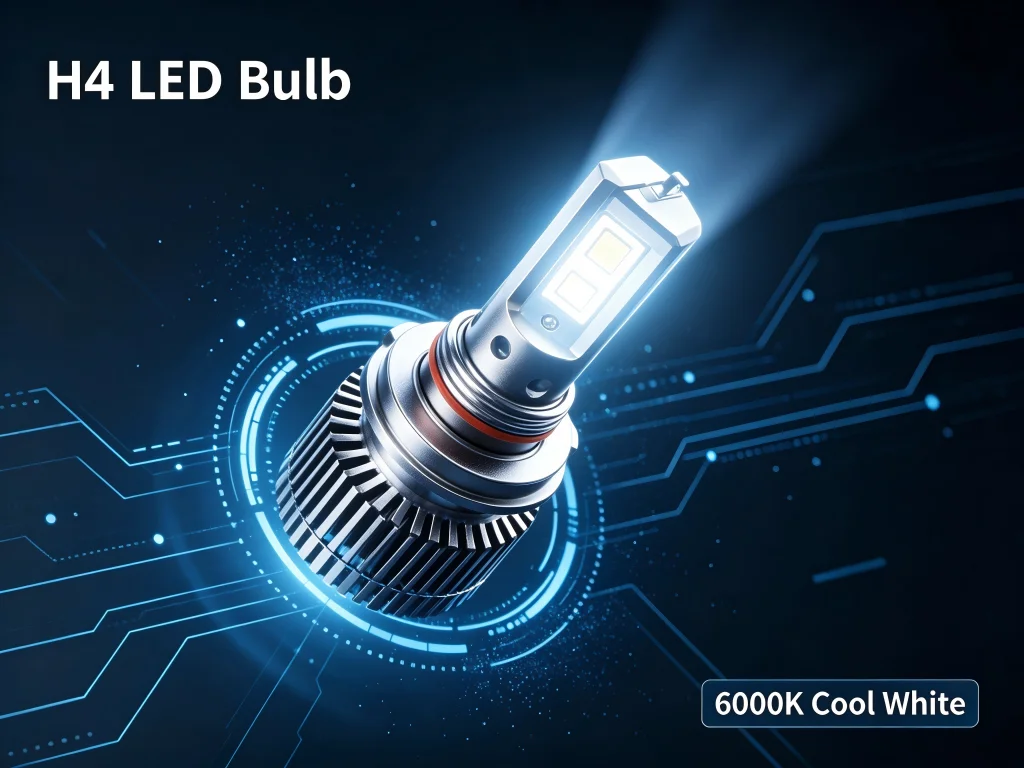
1. What Are the Best H4 Headlight Bulbs?
The best H4 headlight bulbs are the ones that match the vehicle’s optics, electrical system, operating environment, and legal requirements while delivering controlled low-beam distribution and useful high-beam distance. For LED upgrades, accurate light-source positioning, thermal stability and fitment are usually more meaningful than extremely high advertised lumen figures.
There is no single winner for every vehicle.
A high-quality halogen bulb may be the smartest choice for one headlamp. A carefully engineered H4 LED may transform another. A 100W competition-style bulb could be inappropriate for both.
So instead of ranking bulbs by marketing claims, professional buyers should evaluate the system.
2. Start With the H4 Standard
A conventional automotive H4 is a dual-filament lamp. The format allows one bulb to produce both passing and driving beams. Standard 12V H4 filament specifications commonly use a P43t base with nominal 60W/55W ratings.
For example, published specifications for a standard OSRAM H4 list 12V nominal voltage, 60/55W nominal wattage and nominal luminous flux figures of 1650/1000 lm for its respective filament functions.
That gives buyers something extremely valuable: a reference point.
When an unknown aftermarket product claims extraordinary output from an H4-sized package, do not immediately ask, “How bright is it?”
Ask, “How was that figure measured?”
3. H4 Halogen vs H4 LED vs 100W: Which Should You Buy?
Standard halogen offers simple fitment and predictable optical geometry. Performance halogen improves output while retaining the original light-source format. H4 LED can provide higher efficiency and a whiter appearance but requires careful optical and thermal engineering. High-wattage halogen increases system load and should only be used where the wiring, housing and regulations permit it.
| Decision Factor | Standard H4 Halogen | Performance Halogen | H4 LED | 100W-Class H4 |
|---|---|---|---|---|
| स्थापना जटिलता | कम | कम | Low to Medium | मध्यम |
| OEM Optical Similarity | Excellent | Excellent | Design dependent | Generally similar filament concept |
| Efficiency | कम | कम | उच्च | कम |
| White-Light Appearance | मध्यम | Moderate to High | उच्च | Depends on product |
| Heat at Lamp/Wiring | Normal | Normal | Requires LED thermal management | उच्च |
| Beam Quality | पूर्वानुमेय | पूर्वानुमेय | Highly design dependent | Optically predictable if geometry is correct |
| Electrical Load | मानक | मानक | Usually lower | अधिक |
| Upgrade Potential | Limited | मध्यम | उच्च | Application specific |
4. Buying Criterion #1: Beam Pattern Beats Box Lumens
This is the most important rule in this entire guide.
Do not buy an H4 bulb based on lumens alone.
Why?
The reflector cannot use light effectively unless that light originates from the correct area.
A halogen filament is small and precisely positioned. The headlamp reflector was designed around that location.
When an LED replacement uses oversized chips, thick circuit boards, or poorly positioned emitting surfaces, the optical relationship changes.
The result may include:
- weak cutoff definition;
- excessive foreground illumination;
- dark spots;
- scattered light;
- poor high-beam concentration;
- glare above the intended low-beam region.
This is why professional H4 LED evaluation should include wall-pattern testing and road testing.
4.1. A Simple Test for Distributors
Install the original halogen bulb in a reference headlamp and mark the major beam features on a wall.
Then install the LED candidate without changing the headlamp aim.
Compare:
- low-beam hotspot location;
- upper light control;
- foreground intensity;
- left/right distribution;
- high-beam center intensity;
- high-beam reach;
- stray light.
This test will tell you more about the bulb’s optical design than a giant lumen number on a marketplace listing.
5. Buying Criterion #2: Do Not Confuse Wattage With Performance
Searches for H4 headlight bulbs 100W often come from drivers who assume 100W must outperform 55W.
Electrically, however, doubling down on wattage creates consequences.
Higher current can increase stress on:
- H4 connectors;
- wiring harnesses;
- relays and switches;
- reflector surfaces;
- plastic housings;
- nearby seals and components.
Some specialty catalogs do list higher-wattage H4-format bulbs, but availability does not mean every vehicle can safely or legally use them.
For normal road applications, verify the vehicle specification and relevant lighting regulations before increasing wattage. Buyers selling across multiple countries should also remember that regulations are market-specific.
Technical H4 filament requirements can be reviewed through UNECE vehicle lighting regulations.
6. Buying Criterion #3: Evaluate Thermal Stability
A cold-start photograph is not an LED durability test.
Run the bulb.
Let temperature stabilize.
Then measure again.
In our engineering testing, this distinction matters because LED output and component life are closely linked to temperature management.
6.1. Fan-Cooled H4 LED
लाभ:
- high cooling capacity in a compact structure;
- supports higher-performance LED packages;
- can maintain lower heat-sink temperatures when designed correctly.
Potential disadvantages:
- moving components introduce another failure point;
- dust may affect long-term fan performance;
- poor-quality fans can create noise or instability.
6.2. Fanless H4 LED
लाभ:
- no moving fan;
- quiet operation;
- potentially simpler long-term mechanical reliability.
Potential disadvantages:
- requires enough passive surface area;
- compact designs may struggle with high thermal loads;
- performance can depend strongly on airflow around the rear of the headlamp.
Neither architecture is automatically superior. Engineering execution matters more than the label.
7. Buying Criterion #4: Check Actual Installation Space
A technically impressive H4 LED is useless if the dust cover cannot close.
This sounds obvious, yet it remains one of the most common retrofit problems.
Before selecting a product, measure or confirm:
- overall rear depth;
- heat-sink diameter;
- driver-box dimensions;
- connector clearance;
- retaining spring access;
- dust-cap depth;
- required adapter rings.
Some vehicles may also require CANbus-related accessories or vehicle-specific adapters. Compatibility therefore needs to be checked at vehicle level rather than assumed from “H4” alone.
8. Buying Criterion #5: Understand White Light Properly
Searches for H4 headlight bulbs white are heavily influenced by appearance.
But Kelvin is not a brightness measurement.
| Color Range | Typical Appearance | Practical Character |
|---|---|---|
| ~3000K | Yellow/Warm | Distinctive warm appearance; used in some adverse-weather applications |
| ~3200–4000K | Warm to neutral white | Common halogen/performance-halogen territory |
| ~4300–5000K | Neutral white | Balanced modern appearance |
| ~5500–6500K | Cool white | Common LED retrofit appearance |
| Above ~6500K | Increasingly blue | Appearance becomes more dominant; not automatically better for visibility |
The buyer’s mistake is assuming that a bluer bulb must be more powerful.
It is not.
Choose the optical performance first and color preference second.
9. H4 Headlight Bulbs OSRAM vs Aftermarket LED
H4 headlight bulbs OSRAM are a useful benchmark because established halogen manufacturers publish detailed electrical, photometric, dimensional, and lifespan specifications.
For example, a standard OSRAM Original Line H4 is specified at 12V, 60/55W with a P43t base. Performance-oriented OSRAM H4 products can alter factors such as beam performance, color appearance, or service-life positioning while retaining the H4 architecture.
An aftermarket LED should therefore not be compared to a branded halogen on “brightness” alone.
Compare the complete proposition:
| Question | Established Halogen | Professional H4 LED | Low-Cost LED |
|---|---|---|---|
| Published electrical specification? | Usually clear | Should be clear | Often inconsistent |
| Light-source geometry controlled? | Yes | Should be engineered carefully | Variable |
| Thermal system required? | No LED cooling system | Yes | Often under-designed |
| Color options? | Limited | Broad | Broad |
| Beam consistency? | Generally predictable | High when properly designed | Variable |
| Supplier customization? | Limited for distributors | Potentially extensive | Often packaging-focused only |
10. H4 Headlight Bulbs Halfords vs Specialist Suppliers
A search for H4 headlight bulbs Halfords usually indicates strong transactional intent. The customer wants a bulb quickly and values convenience, fitment guidance, and a familiar retailer.
That is a perfectly reasonable consumer buying route.
A B2B buyer has different priorities.
Wholesalers and automotive retrofit chains should additionally evaluate:
- batch consistency;
- OEM/ODM capability;
- private-label packaging;
- production lead time;
- warranty structure;
- technical documentation;
- application support;
- market-specific product planning;
- supplier capacity;
- long-term model continuity.
A retail product solves today’s replacement need. A supplier relationship must solve thousands of replacement needs consistently.
11. H4 Headlight Bulbs Near Me vs Direct Manufacturer Sourcing
If one bulb fails tonight, search H4 headlight bulbs near me.
If you need 5,000 pairs for a distribution program, ask completely different questions.
Commercial buyers should calculate total product risk rather than unit purchase price.
Consider:
True sourcing cost = purchase price + defect cost + warranty cost + freight + inventory risk + customer complaints + technical support + lost reputation.
A bulb that saves $2 at purchase but generates repeated warranty claims can become the more expensive product.
12. What About H4 Headlight Bulbs South Africa?
For buyers researching H4 headlight bulbs South Africa, vehicle mix and operating conditions deserve special attention.
A product intended for a dense European city may face a different duty cycle when used across long-distance roads, dusty environments, high ambient temperatures, commercial fleets, or off-road applications.
For these markets, ask suppliers for information about:
- high-temperature operation;
- thermal protection;
- vibration resistance;
- dust protection strategy;
- driver stability;
- extended runtime performance.
13. Seven Red Flags When Buying H4 LED Headlight Bulbs
- Huge lumen claims with no measurement method. Numbers without test conditions are difficult to compare.
- No beam-pattern evidence. An automotive headlight product should demonstrate more than free-air brightness.
- No hot-state testing. LED output after thermal stabilization matters.
- Oversized LED chips. Large emitters can make precise optical control more difficult.
- No dimensions. Fitment problems create avoidable returns.
- No electrical specification. Voltage, power and driver information should not be mysterious.
- One product claimed to be perfect for every vehicle. Headlamp systems differ. Professional suppliers acknowledge compatibility limits.
14. How Professional Buyers Should Test H4 Bulbs
Based on our manufacturing experience, a serious distributor qualification process should go beyond looking at samples on a desk.
14.1. Stage 1: Mechanical Inspection
Check machining quality, base dimensions, connector strength, assembly tolerances, heat-sink construction, fan movement, cable strain relief, and installation clearance.
14.2. Stage 2: Electrical Testing
Measure actual input power and current across relevant operating voltages.
14.3. Stage 3: Optical Comparison
Use the same reference headlamp and compare candidate bulbs without changing aim between tests.
14.4. Stage 4: Thermal Soak
Run the product until temperature and output stabilize.
14.5. Stage 5: Repeated Switching
Cycle high and low beam repeatedly to expose driver, switching, or thermal weaknesses.
14.6. Stage 6: Vehicle Installation
A laboratory result should be confirmed in representative vehicles. Check warning lights, radio interference, dust-cap fitment, connector access, and real road distribution.
15. Where GTR Fits Into the H4 Market
GTR is positioned for buyers who need more than another generic H4 bulb in different packaging.
Our automotive lighting development approach focuses on the variables that determine whether a product can succeed after it leaves the catalog:
- optical matching;
- controlled beam distribution;
- thermal management;
- electrical stability;
- mechanical fitment;
- production consistency;
- application development;
- B2B customization support.
For wholesalers, distributors, retrofit chains, and regional automotive brands, this approach matters because your reputation is built after the sale.
The customer does not care how impressive the supplier’s specification sheet looked. They care whether the headlights work correctly six months later.
16. FAQ: H4 Headlight Bulb Buying Questions
16.1. What is an H4 headlamp bulb?
An H4 headlamp bulb is a dual-beam automotive light source that provides both low and high beam functions from one bulb. Conventional H4 halogen bulbs use two filaments.
16.2. What wattage is a normal H4 bulb?
A common 12V H4 road-use halogen specification is 60/55W. Different voltage and specialty versions exist, so always verify the vehicle and product specification.
16.3. Can I use a 100W H4 bulb instead of 60/55W?
Do not assume so. Higher-wattage bulbs increase current draw and heat. Wiring, connectors, housings and local regulations must be checked before using a higher-power bulb.
16.4. Which is better: H4 LED or halogen?
Neither is universally better. Halogen offers predictable optical compatibility. A properly engineered LED can offer greater efficiency and a modern white appearance, but fitment, beam control, cooling and regulatory approval must be considered.
16.5. What makes an H4 LED bulb bright?
LED chip output matters, but useful headlight brightness also depends on emitting-surface size, chip position, reflector compatibility, thermal management and driver stability.
16.6. Why do some bright LED bulbs perform badly on the road?
They may generate plenty of raw light but place it outside the reflector’s intended focal region. This creates scattered illumination instead of useful intensity down the road.
16.7. Should H4 bulbs be replaced in pairs?
Replacing both sides together is often sensible because bulbs of similar age may have similar wear, and matched products help maintain consistent color and output.
16.8. What should a distributor ask an H4 supplier?
Ask for optical testing, actual power data, thermal performance, dimensions, compatibility guidance, quality-control procedures, warranty terms, production capacity, customization options, and market-specific support.
17. Choose the H4 Supplier, Not Just the H4 Bulb
Consumers buy a pair of headlights.
Distributors buy the consequences of thousands of pairs.
That changes the decision.
A slightly cheaper product with unstable cooling, inconsistent beam geometry, poor connectors, or unreliable drivers can erase its initial price advantage through returns and customer complaints.
If you are developing an H4 range for an automotive aftermarket brand, wholesale network, retrofit chain, or regional distribution business, evaluate the product as an optical, thermal, electrical, and commercial system.
Explore GTR automotive lighting solutions and bring us your target vehicle applications, market requirements, current product problems, and positioning strategy. Instead of choosing another H4 bulb from a catalog, build a lighting program designed to give your customers a reason to come back.