
Shopping for h11 led lights looks simple until you compare dozens of bulbs claiming extreme lumens, long lifespans, perfect beam patterns, advanced chips, and plug-and-play installation. For professional buyers, these claims create more questions than answers.
This guide takes a different approach. Instead of asking which H11 LED has the biggest number on the box, we will examine the engineering factors that separate a serious automotive lighting product from a commodity bulb.
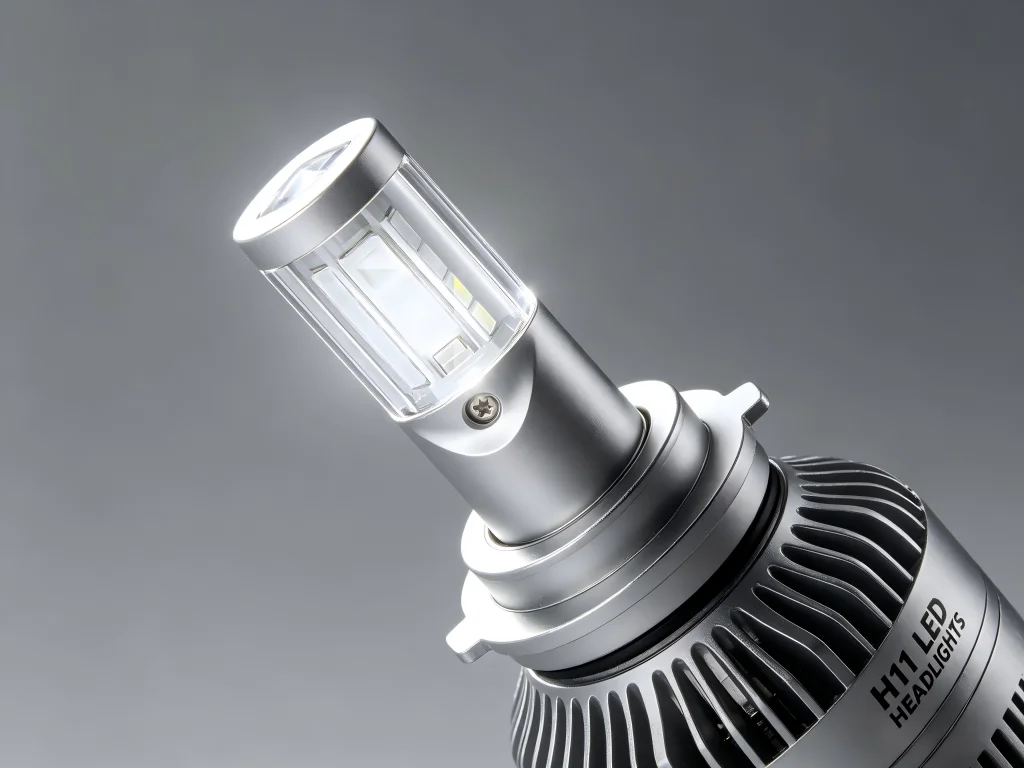
1. What Should You Look for When Buying H11 LED Lights?
The most important factors when buying H11 LED lights are correct fitment, accurate LED chip positioning, controlled beam distribution, thermal management, stable driver electronics, installation clearance, and supplier quality control. Lumen output should be treated as only one performance indicator rather than the primary basis for choosing a bulb.
Whether you search h11 led lights for sale, h11 led lights Amazon, h11 led lights AutoZone, or Walmart h11 led lights, you will quickly encounter products competing through specification numbers.
That makes comparison difficult because two bulbs with similar advertised output can behave very differently inside the same headlamp.
2. H11 Halogen vs H11 LED: What Actually Changes?
An H11 LED replacement changes both the light-generation technology and the physical characteristics of the light source. Halogen uses a heated filament, while LED bulbs use semiconductor emitters and electronic drivers. This can improve efficiency and brightness, but optical performance depends on how closely the LED source matches the lamp’s intended focal geometry.
| 特徴 | H11ハロゲン | H11 LED | Buyer Consideration |
|---|---|---|---|
| 光源 | Tungsten filament | Semiconductor LED | LED position affects optical focus |
| Color Appearance | Warmer | Usually whiter | Whiter does not automatically mean better visibility |
| Electronics | Simple circuit | Requires LED driver | Driver quality affects stability |
| サーマルシステム | Heat concentrated around bulb | Requires heat removal from LED junction | Cooling design matters |
| Optical Geometry | Defined filament position | Depends on chip and PCB layout | One of the most important LED design factors |
| 車両適合性 | Original specification | Vehicle-dependent | Check fitment and electronics |
3. Buyer Trap #1: Choosing H11 LEDs by Lumens Alone
Lumens describe total luminous flux. They do not tell you where that light lands.
For automotive headlights, distribution is crucial.
Imagine two H11 bulbs.
Bulb A generates higher raw output but scatters a significant amount of light outside the useful beam. Bulb B produces slightly less total light but concentrates more illumination into useful road zones.
Bulb B could provide the better driving experience.
3.1. Ask for Beam Data, Not Just Lumen Data
Professional buyers should evaluate:
- beam shape;
- hotspot location;
- cutoff behavior where applicable;
- foreground distribution;
- distance illumination;
- consistency between left and right bulbs;
- performance after extended operation.
This provides a much clearer picture than lumen claims alone.
4. Buyer Trap #2: Ignoring LED Chip Position
The optical system inside a headlamp is designed around the location of its intended light source.
Change that position and the beam changes.
For this reason, the dimensions of the LED emitting surface, PCB thickness, distance between opposing emitters, and vertical and horizontal placement deserve serious attention.
4.1. Why Thin LED Geometry Can Matter
A thick LED board increases the separation between the emitting surfaces on each side of the bulb.
That may make it more difficult to approximate the compact geometry of a halogen filament. A carefully engineered thin structure can help create a more concentrated effective light source.
However, thinness alone is not enough. Mechanical strength and heat transfer must also be maintained.
5. Buyer Trap #3: Comparing Peak Power Instead of Sustained Output
An LED bulb may look impressive immediately after startup.
Then temperature rises.
If the thermal system cannot remove enough heat, the electronics may reduce power or the components may operate under greater thermal stress.
That means a short demonstration can favor products optimized for initial brightness rather than sustained performance.
5.1. A Better Test
- Measure or record initial illumination.
- Operate the bulb continuously under representative conditions.
- Observe temperature and electrical behavior.
- Measure illumination again after thermal stabilization.
- Compare the percentage change rather than only the initial number.
For distributors, this type of testing is especially useful because customers experience the product over hours and months, not during a 30-second sales demonstration.
6. Buyer Trap #4: Assuming Every Cooling Fan Is Better
Cooling design should be judged as a system.
An active fan may allow compact, high-performance heat dissipation, but fan design, airflow path, bearing quality, dust exposure, and installation space matter.
Passive cooling eliminates the fan but may require more surface area or a different thermal structure.
| Cooling Type | Potential Advantage | Potential Limitation | Best Evaluation Method |
|---|---|---|---|
| Active Fan | High airflow in compact space | Adds moving components | Long-duration thermal and fan testing |
| Passive Heat Sink | No fan mechanism | May require more space | Measure stabilized operating temperature |
| Flexible Heat Dissipation | Installation flexibility | Performance depends on deployment | Test in actual lamp installation |
7. Buyer Trap #5: Assuming “Fits H11” Means “Works Perfectly”
Socket compatibility is only the first step.
Before ordering h11 led light bulbs, confirm at least four dimensions of compatibility: mechanical, optical, electrical, and regulatory.
7.1. Mechanical Compatibility
Will the bulb lock correctly into the socket? Is there enough room behind the housing? Can the dust cover close?
7.2. Optical Compatibility
Does the resulting beam remain useful when the LED is installed in the intended lamp?
7.3. Electrical Compatibility
Does the vehicle accept the LED’s electrical behavior without flickering or warning messages?
7.4. Regulatory Compatibility
Automotive lighting rules differ between markets. Professional buyers should verify requirements in every target country rather than treating mechanical fitment as proof of road legality.
8. Retail H11 LED vs Manufacturer-Direct H11 LED
Search behavior reveals two very different buyer groups.
A consumer searching h11 led lights near me, h11 led lights nearby, or h11 led lights Sylvania may need one pair today.
A distributor purchasing 5,000 pairs has completely different priorities.
| Requirement | Retail Buyer | B2B Distributor |
|---|---|---|
| Quantity | Usually one or two sets | Hundreds or thousands |
| Main Concern | Fit, price, reviews | Quality, margin, consistency |
| Packaging | Standard | May require private label |
| Product Specification | Fixed | May require customization |
| Supply | One-time purchase possible | Continuity is critical |
| Quality Control | Evaluates individual product | Must evaluate production batches |
| Support | Return policy | Technical and commercial support |
9. How Professional Buyers Should Evaluate an H11 LED Supplier
A professional H11 LED supplier should be evaluated on engineering capability, production consistency, quality-control procedures, thermal and optical testing, customization support, communication, supply capacity, and after-sales handling. B2B buyers should judge total product risk and long-term value rather than comparing factory quotations only by unit price.
9.1. Ask About Product Development
Can the supplier explain why the bulb was designed in a specific way?
Engineers should be able to discuss chip position, thermal transfer, driver configuration, mechanical structure, and optical testing without hiding behind marketing terms.
9.2. Ask About Batch Consistency
One golden sample proves very little.
For wholesale programs, ask how incoming materials, assembly processes, electrical performance, and finished products are controlled.
9.3. Ask About Customization
Markets differ.
A distributor may require branded packaging, private labeling, market-specific product positioning, different product combinations, or OEM/ODM support.
A manufacturer with development capability can provide more flexibility than a supplier simply reselling a finished generic bulb.
10. Where GTR Fits Into the Buying Decision
GTR focuses on automotive lighting for the aftermarket and professional distribution channels.
Our manufacturing perspective changes the conversation from:
“How bright can we claim this bulb is?”
to:
“How can we build a product that distributors can sell repeatedly with confidence?”
Based on our years of manufacturing experience, the second question tends to create more sustainable products.
That requires attention to optical structure, thermal management, electronic stability, manufacturing tolerances, quality control, packaging, market positioning, and commercial support.
11. A Practical H11 LED Purchasing Checklist
- Verify the target vehicle and H11 application.
- Compare LED emitter geometry with the original light-source position.
- Inspect beam patterns in representative lamp housings.
- Compare measured illumination instead of marketing lumens alone.
- Run sustained thermal tests.
- Evaluate driver stability.
- Check physical installation clearance.
- Test relevant vehicle electrical compatibility.
- Review production quality-control procedures.
- Check warranty and after-sales processes.
- Evaluate OEM, ODM, branding, and packaging capability.
- Calculate total landed and warranty cost instead of unit price alone.
12. FAQ: H11 LED Buying Questions
12.1. What are the best H11 LED lights?
There is no universal best bulb for every vehicle. A strong H11 LED should combine accurate optical geometry, useful beam distribution, stable thermal performance, reliable electronics, correct fitment, and consistent manufacturing.
12.2. How many lumens should an H11 LED have?
Do not select an automotive LED solely by a lumen figure. Total light output does not show how much illumination reaches useful areas of the road.
12.3. Are expensive H11 LED bulbs always better?
No. Price can reflect engineering, branding, distribution, packaging, warranty, or marketing. Compare measurable performance and supplier capability rather than assuming price proves quality.
12.4. Can H11 LEDs damage a headlight housing?
A correctly engineered product should manage heat appropriately for its intended application. Poorly designed or incorrectly installed products may create thermal or mechanical problems, so installation and product design both matter.
12.5. Can H11 LED lights cause dashboard errors?
They may on certain vehicles because LED replacements have different electrical characteristics from halogen bulbs. Vehicle-specific compatibility should be checked.
12.6. Should I buy H11 LED lights online or from a manufacturer?
Individual consumers may prefer established retail channels. Distributors, importers, and retrofit chains may benefit more from manufacturer-direct sourcing when they need volume pricing, stable supply, customization, and technical support.
12.7. Are H11 and H11 LED bulbs the same fit?
An H11 LED may use an H11-style mounting interface, but socket fit alone does not prove full optical or electrical compatibility.
12.8. What should wholesalers test before placing a bulk order?
Test representative samples for fitment, beam pattern, illumination, thermal stability, electrical performance, construction quality, and consistency. Then confirm that mass-production controls can reproduce the approved sample.
13. Do Not Buy the Specification Sheet. Buy the Engineering.
The H11 LED market is crowded because specifications are easy to copy.
Reliable engineering is harder to copy.
If you operate an automotive lighting wholesale business, retrofit chain, distribution network, or aftermarket brand, your biggest cost may not be the bulb’s purchase price. It may be returns, customer complaints, inconsistent batches, lost installer confidence, and replacement inventory.
Before committing your next H11 LED order, compare beam quality, sustained performance, construction, production consistency, and supplier capability—not just lumens and FOB price.
Explore GTR’s automotive lighting manufacturing capabilities through the :contentReference[oaicite:1]{index=1}. If your market needs a more competitive H11 LED product line, use engineering, product differentiation, and manufacturing consistency to build the advantage before your competitors do.。