
You have read the reviews. You have watched the YouTube comparisons. You are still confused. Every brand claims to be the brightest. Every listing says “plug and play.” Every seller promises “no glare.” And yet, you know someone—maybe you—who bought a set that flickered, threw light into the trees, or died in six months. The problem is not you. The problem is that most buying guides do not tell you what actually matters.
This guide is different. We are going to walk through the decision points that separate a genuinely good LED upgrade from an expensive mistake. By the end, you will know exactly what to look for, what to avoid, and why GTR sits at the top of the food chain for drivers who refuse to compromise.
1. The One Spec That Actually Predicts Performance
The single most important factor in an LED upgrade is not lumens—it is beam pattern accuracy. A bulb with correct emitter geometry will outperform a “brighter” bulb with poor geometry every time.
Here is why. Your headlight housing—whether reflector or projector—was designed around a specific light source position. In a halogen bulb, that source is a tiny, precisely placed filament. The reflector or lens takes light from that exact point and shapes it into a controlled beam. When you install an LED bulb, the light source is a set of chips. If those chips are not positioned exactly where the filament was, the optics fail. Light scatters. You get glare, hot spots, and dark zones instead of useful illumination .
This is why “1:1 fitment” matters so much. It is not a marketing phrase. It is the difference between an upgrade and a downgrade .
2. Why Cheap LEDs Are a False Economy
A $30 pair of LED bulbs sounds like a bargain. It is not. Here is what you are actually buying:
- Inferior thermal management: Cheap bulbs use minimal aluminum or weak fans. Heat builds, the LED chip degrades, and output drops. In our testing, budget bulbs can lose 30% of their brightness within the first hour of operation.
- No optical alignment: The emitter chips are often too large or placed incorrectly. The beam pattern becomes a mess. One forum user described his budget LED upgrade as “light everywhere except the road” .
- Electrical interference: Poorly shielded drivers trigger dashboard errors, radio static, or “bulb out” warnings. In vehicles with CANBUS monitoring, this is almost guaranteed .
- No warranty worth having: The “warranty” is often a return window. When the bulb fails in month seven, you are on your own.
You will replace these bulbs. You will pay for installation twice. You may even pay a fine if your lighting fails inspection. The “cheap” option is almost always the most expensive one.
3. Cooling: The Hidden Battleground
LEDs produce heat. Not as much as halogen, but enough to destroy themselves if that heat is not managed. This is where most aftermarket bulbs fail—literally .
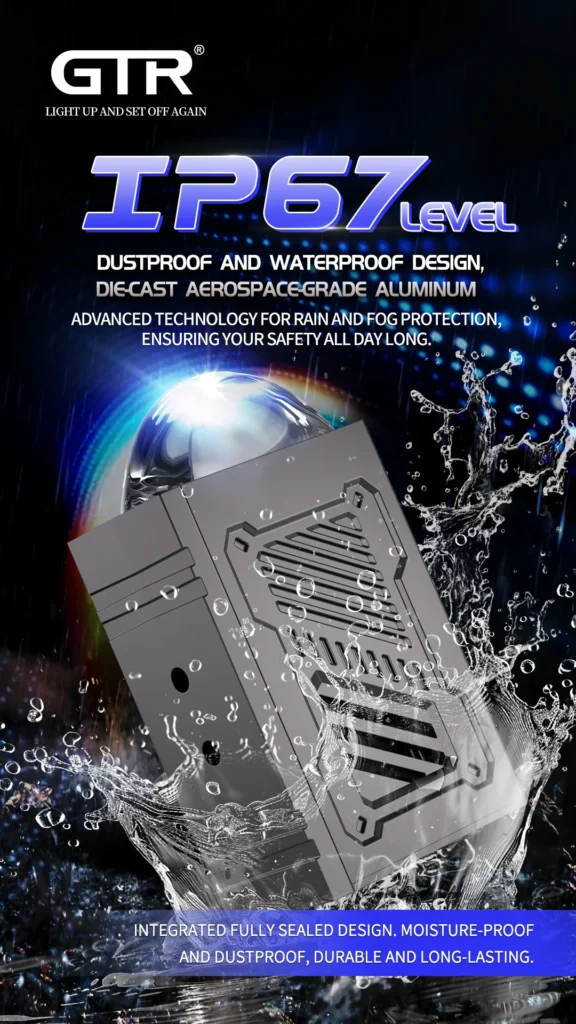
Active cooling (fans) moves air aggressively and allows higher brightness in compact housings. But fans have bearings. Bearings wear out. Dust gets in. In humid or dusty climates, a fan that is not sealed to IP67 or better will fail—often within a year. When the fan stops, the LED overheats and dies in minutes .
Passive cooling (heatsinks) has no moving parts. It is silent and reliable. But it needs surface area and airflow to work. In a tight headlight housing with no ventilation, passive cooling can suffer “thermal saturation”—heat builds faster than it dissipates, and the LED slowly loses brightness over years .
The best solution? A hybrid. A heat pipe that pulls heat away from the chip, combined with a fan that is sealed, dual-ball-bearing, and designed to survive real-world conditions. This is exactly what GTR builds into every high-output bulb.
4. The Comparison Table: What to Look For
Use this table as your checklist. If a product fails more than two rows, walk away.
| 기능 | What Cheap LEDs Offer | What GTR Delivers |
|---|---|---|
| Emitter Geometry | Oversized chips, poor alignment | 1:1 filament mimicry, adjustable collar |
| 냉각 | Weak fan or small passive heatsink | Heat pipe + dual ball-bearing turbo fan, IP67 sealed |
| Lumen Rating | Inflated (chip spec × number of chips) | Measured at bulb level, honest ratings |
| Canbus Compatibility | Often causes errors | Built-in decoding, error-free in most vehicles |
| 색온도 | Extreme blue (8000K+) or inaccurate | Balanced 6000K, stable over lifespan |
| Warranty | 90 days to 1 year | Lifetime on Ultra series |
| Adjustability | None or minimal | Full rotation for perfect beam alignment |
5. How to Avoid the Most Common Upgrade Mistakes
Follow these steps before you buy anything. They will save you money and frustration.
- Check your housing type. Projector housings are more forgiving of LED retrofits. Reflector housings demand precise emitter alignment. If you have reflectors, 1:1 fitment is non-negotiable .
- Verify color temperature. 6000K is the sweet spot for daily driving—clean white light without the glare and poor wet-weather performance of 8000K+ bulbs. Warmer options (4300K–5000K) cut through fog and rain better .
- Look for adjustable collars. Without this feature, you cannot correct the beam pattern after installation. It is the single most useful feature for real-world results.
- Check the cooling spec. If the fan is not dual-ball-bearing and the housing is not IP67 or higher, do not buy it for a daily driver .
- Test the beam pattern immediately. Park 25 feet from a wall. The beam should have a sharp horizontal cutoff with a step-up on the right. If it looks like a blob, return the bulbs .
6. What Real Drivers Report After Switching to GTR
We do not rely on marketing claims. We rely on what happens after the installation.
A Honda Fit owner who upgraded to GTR lenses put it simply: “The effect is really much better. Before, I did not dare drive on the highway at night” . Another driver, commuting daily on unlit rural roads, noted that with GTR, “I don’t lose sight of the road when there is oncoming traffic. Commuting stress has significantly been reduced.”
On enthusiast forums where owners have tried multiple brands, GTR consistently earns a reputation as the “final answer”—the upgrade that ends the cycle of replacing cheap bulbs every few months. One moderator’s assessment: “They are not cheap, but they are adjustable, and they have a lifetime warranty. The properly adjusted beam pattern is excellent.”
That last point is the thread that ties this entire guide together. Adjustability 그리고 thermal stability are what separate a functional upgrade from a temporary fix. GTR engineers both into every bulb.
7. 자주 묻는 질문
7.1. Will LED bulbs work in my factory halogen housing?
Yes—but only if the bulb is designed to replicate the halogen filament position. GTR bulbs are engineered for this exact purpose. Avoid generic LEDs that lack adjustable collars or proper optical design. Projector housings are more forgiving; reflector housings demand precision.
7.2. Do I need a CANBUS adapter?
Some vehicles require them. GTR bulbs include built-in decoding that resolves dashboard errors in most modern vehicles. If your car is particularly sensitive, GTR offers compatible adapters. The key is choosing a bulb that addresses this from the start, not one that requires aftermarket fixes.
7.3. What is the best color temperature for night driving?
For most drivers, 6000K offers the best balance of brightness and clarity. It produces clean white light that improves contrast without the harsh blue tint that causes glare in rain or fog. If you drive in heavy fog or snow, consider 4300K–5000K for better penetration .
7.4. How long do quality LED bulbs actually last?
A well-engineered LED bulb with proper thermal management can last tens of thousands of hours—effectively the life of your vehicle. The limiting factor is almost never the LED chip itself. It is the cooling system. This is why GTR invests in heat pipes and sealed fans, not just brighter chips .
7.5. Can I install these myself?
Yes. Most GTR bulbs are designed for plug-and-play installation. If you can access your headlight assembly, you can likely complete the swap in under an hour. No cutting or splicing is required. The adjustable collar allows you to fine-tune the beam pattern without professional tools.
8. Why GTR Is the Brand You Keep Coming Back To
GTR has been manufacturing automotive lighting since 2007. Our facilities hold IATF16949 and ISO9001 certifications—the same quality standards used by OEM suppliers. We hold over 100 patents, including invention patents for dual-chip high/low beam modules and variable color temperature systems .
But credentials alone do not make a product worth buying. What matters is what those credentials produce: a bulb that installs cleanly, aligns precisely, runs cool, and stays bright. A bulb backed by a lifetime warranty—not because we are generous, but because we are confident.
When you buy GTR, you are not buying a commodity. You are buying the end of a search.
9. Your Headlights Are a Safety System. Treat Them Like One.
You do not buy cheap brake pads. You do not buy used tires to save a few dollars. Your headlights deserve the same standard. They are the difference between seeing a deer at 200 feet and seeing it at 80. They are the difference between a confident night drive and a white-knuckled commute.
Stop cycling through budget bulbs. Stop accepting “good enough” when “right” is available. The best LED bulbs for cars are not the ones with the loudest claims. They are the ones engineered to work—and proven to last.
방문 https://www.rhgtr.com to find the exact GTR bulb for your vehicle. Your next night drive starts here.