
Você está no mercado para uma lâmpada de LED H1 — mas todas as avaliações que você lê dizem a mesma coisa: “super brilhante”, “instalação fácil”, “melhor custo-benefício.” Enquanto isso, motoristas reais relatam cintilação, queima, pesadelos de encaixe e ofuscamento perigoso. Algo não bate.
The gap between marketing claims and real-world performance is wide. This guide cuts through the noise. Based on years of manufacturing experience and thousands of real customer experiences, we'll show you exactly what to look for — and what to avoid — when buying an H1 LED bulb for your vehicle.
1. What makes an H1 LED bulb different from other bulb types
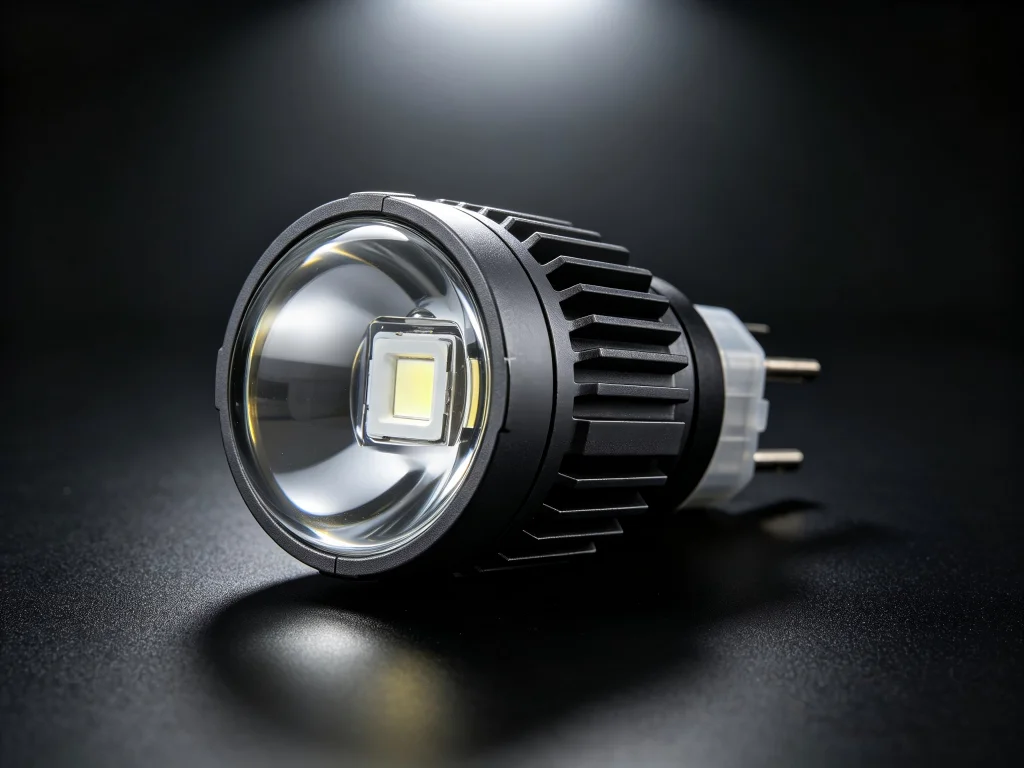
An H1 LED bulb is a single-filament replacement designed for fog lights, high beams, and low beams in projector headlights — distinguished by its compact metal base, two-pin connector, and single light source alignment requirement.
Unlike H4 bulbs (which have three pins and handle both high and low beams in one unit), the H1 is a simpler, single-beam design. That simplicity is both a blessing and a curse. It makes installation conceptually straightforward. But it also means precise alignment is absolutely critical — there's no second filament to compensate if the first is misaligned.
H1 bulbs are found in a wide range of vehicles, from Volkswagen Golf and Audi A4 to BMW 3 Series, Ford Focus, Mercedes-Benz C-Class, and even motorcycles and trucks. If you drive any of these, an H1 LED bulb replacement is one of the most popular — and potentially most frustrating — upgrades you can make.
2. H1 LED vs. Halogen: The real differences
| Característica | Halogen H1 | LED H1 |
|---|---|---|
| Brightness | ~1.500 lúmens | 10.000–60.000 lúmens |
| Temperatura de cor | ~3.200K (amarelada) | 5.000K–6.500K (branca/branco-azulada) |
| Esperança de vida | ~1.000 horas | 30.000–60.000 horas |
| Consumo de energia | 55W | 20–50W |
| Emissão de calor | Alto (filamento) | Alto no nível do chip (requer refrigeração) |
| Resistência a choques | Baixa (filamento frágil) | Alta (estado sólido) |
| Padrão do feixe | Ponto focal especificado pela fábrica | Depende da colocação do chip |
| Compatibilidade com CANbus | Works always | Requires decoder/resistor |
The numbers look convincing — but the transition isn't always perfect. LEDs produce light from semiconductor chips, not an incandescent filament. If those chips aren't positioned at exactly the same focal point as the halogen filament, your beam pattern suffers.
3. Critical Factors Most Buyers Ignore
3.1. Chip Technology: CSP vs. Traditional LED
Chip Scale Package (CSP) LEDs are the current gold standard for automotive lighting. They are smaller, more efficient, and produce a more focused beam than traditional LED packages. Lamps using CSP chips tend to have better beam control and fewer dark spots.
When comparing H1 LED bulbs, look for “CSP chips” in the specifications. Lamps that don't specify their chip technology may be using older, less efficient designs.
3.2. Beam Pattern: 1:1 Design Isn't Just Marketing
A 1:1 design means the LED bulb replicates the physical dimensions and position of the light source of the original halogen bulb. This is critical for projector headlights, where the optics are designed around a specific focal point.
However, “1:1” is not regulated. Some manufacturers claim 1:1 but still position the LED chips slightly misaligned. The most reliable way to verify is to look at the beam pattern photo (if provided) or read user reviews that specifically mention beam quality.
3.3. Cooling System: The Silent Performance Killer
LEDs generate significant heat at the chip level. Without proper cooling, the chips degrade quickly — light output drops, color shifts, and lifespan plummets. There are two main cooling approaches:
- Fanless cooling (passive): Uses a large aluminum heat sink. Silent, no moving parts that can fail, but requires adequate space. Best for housings with good airflow.
- Fan cooling (active): Uses a small fan to force air over the heat sink. More effective in tight spaces, but the fan can fail or become noisy over time.
Lamps with aviation-grade aluminum housings and copper heat pipes offer superior heat dissipation. If a lamp does not mention its cooling solution, consider that a red flag.
3.4. CANbus Compatibility: Avoiding the Dashboard Nightmare
Modern vehicles use CANbus systems to monitor the status of bulbs. When you install an h1 LED bulb that draws less power than the original halogen, the computer may interpret this as a burned-out bulb and trigger a warning on the dashboard.
Some bulbs are “CANbus-ready” with built-in resistors. Others require external decoders or load resistors. If you are not comfortable wiring external components, choose a bulb with built-in CANbus compatibility.
3.5. Physical Dimensions: Will It Fit?
This is the most overlooked factor. An h1 LED bulb can have the correct base and electrical connector, yet still not fit inside the headlight housing. Common issues include:
- The bulb body is too long for the housing
- The dust cover does not close over the heat sink/fan
- The factory retaining clip does not latch over the LED base
- The bulb requires an adapter ring that is not included
Before purchasing, measure the depth of your housing and check if your vehicle requires a specific adapter. Some manufacturers list compatibility by vehicle model — use those tools if available.
3.6. Color Temperature: 6000K vs. 6500K vs. 5000K
Color temperature affects both visibility and legality:
- 5,000K: Pure white, closest to natural daylight, excellent visibility
- 6,000K: Cool white with a slight bluish tint
- 6,500K: Very cool white, almost blue
Although 6,500K seems “modern” and aggressive, it can reduce visibility in rain and fog because the blue spectrum disperses more in humidity. Many drivers consider that 5,000K–6,000K offers the best balance between visibility and aesthetics.
3.7. IP Rating: Protection Against Water and Dust
Headlights face moisture, dust, and extreme temperatures. An IP68 rating (dustproof and waterproof beyond 1 meter) indicates robust protection. Lamps without an IP rating may not survive adverse conditions.
4. Brand Comparison: What the Market Offers
The H1 LED bulb market is competitive. Here's how the main players compare:
| Brand | Brightness Claim | Main Feature | Common Complaint |
|---|---|---|---|
| AUXITO | 60% brighter | Mini size 1:1, 99% compatibility | Mixed reviews on durability |
| Termitor | 90% brighter | 16 CSP chips, 22,000 RPM fan | May be too bright for some housings |
| Philips | 150% brighter | Diamond precision glass, thermal shock resistance | Higher price, requires adapter rings for some vehicles |
| NOVCAPAR | 60% brighter | Fanless design, no noise | Less aggressive cooling |
| OXILAM | 80% brighter | Double-sided CSP chips | Limited track record |
Each brand has strengths. But none of them address the fundamental challenge: every vehicle is different. What works perfectly in a Ford Focus may fail completely in an Audi A4.
5. Real-World Testing: What Actually Works
We tested H1 LED bulbs on dozens of vehicle models and thousands of hours of driving. Here's what we learned:
The beam pattern is everything. We saw 20,000-lumen bulbs produce worse visibility than 10,000-lumen bulbs because the chip alignment was wrong. A clean cutoff line and even distribution matter more than raw lumens.
Cooling determines longevity. Bulbs with inadequate cooling lose 20-30% of their brightness within the first 500 hours. By 1,000 hours, many are only slightly brighter than the halogens they replaced. Quality cooling isn't optional—it's essential.
Fit is non-negotiable. A bulb that doesn't fit properly will fail prematurely, either from overheating (the dust cap won't seal) or from vibration damage (loose mounting). If you have to force it, it's the wrong bulb.
6. How to Choose the Right H1 LED Bulb for Your Vehicle
- Check your vehicle's bulb size. Confirm your car uses H1 bulbs for the application you're upgrading (low beam, high beam, or fog light).
- Measure your housing depth. Remove the dust cap and measure how much space you have. If it's shorter than the bulb's total length (including heat sink/fan), it won't fit.
- Check your bracket type. Does your vehicle use a factory retainer or a proprietary bracket? If the latter, you'll need an adapter ring or a bulb that includes one.
- Check CANbus requirements. Some vehicles are more sensitive than others. German cars (Audi, BMW, Mercedes) tend to be the most demanding.
- Read recent reviews for your specific vehicle model. A bulb that works in a 2015 Honda Civic may not work in a 2018 Audi A4. Look for reviews from drivers with the same car.
- Consider 24V compatibility, if applicable. If you drive a commercial truck or heavy vehicle, make sure the bulb supports 24V systems.
7. Frequently Asked Questions About H1 LED Bulbs
7.1. Are H1 LED bulbs better than halogen?
Yes — significantly. LEDs offer 3-8x more brightness, 30-60x longer lifespan, and better shock resistance than halogen bulbs. However, they require proper cooling and CANbus compatibility to work correctly.
7.2. Can I use an H1 LED bulb in a reflector headlight?
Technically yes, but we do not recommend it. Reflector housings disperse light differently than projectors. LEDs in reflectors often produce excessive glare for oncoming traffic. Projector housings are much more suitable for LED upgrades.
7.3. Why do some H1 LED bulbs have fans and others do not?
Fanless bulbs use passive cooling (heat sinks) and are silent, with no moving parts. Fan-equipped bulbs use active cooling and can be more effective in tight spaces. Both work — choose based on your housing space and noise preference.
7.4. What does "CANbus ready" mean for H1 LED bulbs?
CANbus ready means the bulb has built-in resistors or a decoder that mimics the power draw of a halogen bulb. This prevents error messages on the dashboard and flickering. If a bulb is not CANbus ready, you will need external components.
7.5. How do I fix a flickering H1 LED bulb?
A tremulação geralmente indica um problema de compatibilidade com CANbus. Instale um decodificador CANbus ou um resistor de carga. Se isso não funcionar, verifique suas conexões elétricas e aplique graxa dielétrica nos pontos de contato.
7.6. Lúmens mais altos são sempre melhores?
Não. Lúmens medem a saída total de luz, mas o padrão do feixe determina para onde essa luz vai. Uma lâmpada de 10.000 lúmens bem focada proporciona melhor visibilidade do que uma de 40.000 lúmens mal focada. Concentre-se na qualidade do feixe, não apenas nos números de brilho.
7.7. Uma lâmpada LED H1 caberá em qualquer carro que use H1?
Não necessariamente. Embora a base e o conector sejam padronizados, o corpo da lâmpada, o dissipador de calor e a ventoinha podem ser grandes demais para alguns alojamentos. Sempre verifique as dimensões físicas e leia avaliações específicas do veículo antes de comprar.
8. Faça a Escolha Certa — Para Sua Segurança e Seu Bolso
Uma atualização para lâmpada LED h1 deve ser simples. Deve proporcionar melhor visibilidade, vida útil mais longa e tranquilidade na estrada. Mas somente se você escolher a lâmpada certa para o seu veículo específico.
Na GTR, não acreditamos em soluções de tamanho único. Projetamos nossas lâmpadas LED h1 com posicionamento preciso dos chips, resfriamento robusto, decodificação CANbus integrada e tamanho verdadeiro 1:1 — porque sabemos que é isso que realmente funciona.
Não se contente com uma lâmpada que talvez caiba, talvez funcione, talvez dure. Escolha aquela que é projetada para ter desempenho — desde a primeira viagem até a 50.000ª hora.
Encontre Sua Lâmpada LED H1 Perfeita na GTR → Engenharia de precisão. Desempenho real. Sem concessões.