
A indústria automotiva passou por uma mudança massiva na forma como a visibilidade é entregue. Já se foram os dias em que um simples refletor de vidro e uma lâmpada halógena eram suficientes para dirigir em rodovias. Hoje, o padrão de segurança e estética é o farol de projetor. Este componente passou de um recurso de luxo em sedãs europeus de alto padrão para um item essencial no design de veículos modernos, incluindo veículos elétricos e caminhões off-road.
Para entusiastas e atacadistas, entender a aplicação intrincada dessa tecnologia é vital. Seja analisando as mais recentes soluções de iluminação GTR or considering a fleet upgrade, this guide explores why the projector headlight has become the cornerstone of automotive lighting.

1. Defining the Projector Headlight Assembly Projector
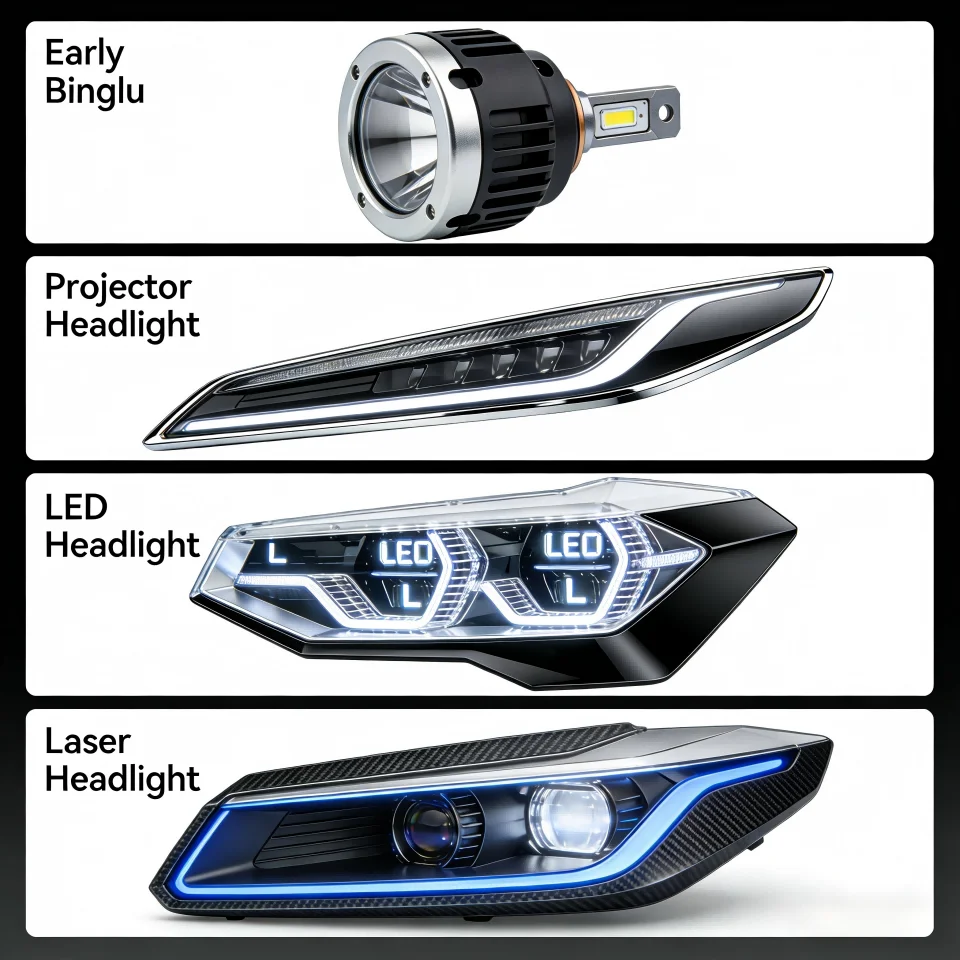
At first glance, a projector headlight may resemble a robotic eye. Technically, it is a sophisticated optical system designed to manage high-intensity light. Unlike traditional reflector headlights that scatter light onto the road in a somewhat uncontrolled manner, a projector system uses a precise combination of three components:
- The Ellipsoidal Reflector: A specially shaped piece that collects light from the source (LED or HID).
- The Cutoff Shield: A physical barrier within the assembly that blocks upward light, creating the sharp “cutoff line” famous in automotive forums.
- The lens: A convex glass piece that magnifies and projects the focused beam onto the asphalt.
When you hear mechanics discussing automotive projector headlight applications, they are referring to this fully enclosed unit. The main goal is efficient photon management—getting the maximum amount of light onto the road without dazzling oncoming traffic.
2. Main Application Scenarios: From Passenger Cars to Supercars
The versatility of the projector headlight allows it to be deployed in various vehicle categories, each using the technology for different reasons.
2.1. The Luxury Segment (BMW, Mercedes-Benz, Audi)
European manufacturers were pioneers of this technology. In vehicles like the BMW 5 Series or Audi A6, the projector headlight is often combined with adaptive motors. This allows the lens to rotate left or right based on steering wheel input, illuminating curves before the driver enters them. Discussions on platforms like Reddit often highlight how these “active” projectors reduce nighttime accidents on winding roads.
2.2. Electric Vehicles (Tesla, Rivian)
For EVs, energy consumption is everything. A standard reflector headlight wastes light (and therefore energy) by scattering it onto trees or the sky. A projector headlight high-quality one focuses almost 100% of the generated light exactly where it is needed. This efficiency reduces the load on the vehicle's electrical system, marginally contributing to range preservation.
2.3. Heavy-Duty and Off-Road Use (Toyota Tacoma, Ford F-150)
Off-road enthusiasts often replace factory halogen reflectors with aftermarket projector assemblies. In this scenario, the durability of the projector headlight is fundamental. The sealed nature of the unit protects the light source against dust and water ingress, which is critical when crossing rivers or driving in desert sand.
3. Key Selection Factors for Automotive Applications
When purchasing or selecting a projector headlight for a vehicle, several technical metrics must be evaluated to ensure safety and compliance.
3.1. Lumen Density and Lux
While “lumens” measure total light output, “lux” measures light intensity at a specific distance. A superior projector concentrates lumens into high lux at the “hot spot” (the center of the beam). This allows the driver to see further down the road.
3.2. Beam Pattern and Cutoff Sharpness
The hallmark of a projector headlight premium is the sharpness of its cutoff line.
Low Quality: A blurred line with yellow halos.
High Quality: A sharp transition from bright light to total darkness, often with a subtle blue band (color flicker) at the edge, which is highly valued by car enthusiasts.
3.3. Thermal Dissipation
Modern projectors use high-power LEDs. These chips generate significant heat. A projector headlight robust must feature an integrated heat sink or cooling fan. Without this, the projector lamp lifespan will be drastically reduced due to thermal stress.
4. Installation and Maintenance: The Professional View
Integrating a projector headlight em um veículo que não veio originalmente com um é conhecido como “retrofit.”
- O Processo de “Assar”: Para acessar o alojamento interno, os faróis são frequentemente aquecidos para amolecer a vedação de fábrica.
- Alinhamento: Uma vez instalado, o projetor deve ser alinhado rotacionalmente. Se a linha de corte estiver inclinada, pode ser perturbadora e insegura.
- Vedação: Após a instalação, borracha butílica de alta qualidade deve ser usada para re-vedar o farol para evitar condensação de umidade—um assassino comum da eletrônica do farol.
A manutenção é mínima em comparação com tecnologias mais antigas. No entanto, a lente externa de policarbonato do alojamento do farol deve ser mantida livre de oxidação (amarelamento) para garantir que o projector headlight possa transmitir luz efetivamente.
5. Por que a GTR Define Padrões da Indústria
No mercado lotado de iluminação automotiva, GTR destaca-se por preencher a lacuna entre a qualidade OEM e a flexibilidade do mercado de reposição. Escolher a GTR significa investir em transparência de engenharia.
O processo de fabricação da GTR para cada projector headlight envolve testes fotométricos rigorosos. Ao contrário de fornecedores genéricos que podem exagerar nas especificações, a GTR fornece dados verificados sobre gerenciamento térmico e largura do feixe. Se você precisa de um módulo Bi-LED (capaz de farol alto e baixo) ou de um projetor de farol de neblina especializado, o estoque da GTR garante compatibilidade e longevidade. Seu compromisso com a qualidade garante que o preço da lâmpada de projetor representa valor ao longo do tempo, em vez de uma solução barata e de curto prazo.
6. FAQ: Lâmpadas de Projetor Automotivo
P: Como uma lâmpada de projetor difere de um refletor padrão?
R: Um refletor reflete a luz em uma superfície espelhada, muitas vezes criando ofuscamento. Um projector headlight usa uma lente para focar a luz, criando um feixe controlado, sem ofuscamento e com maior alcance.
P: Qual é a vida útil média de uma lâmpada de projetor em um carro?
R: Se for um projetor baseado em LED, pode durar entre 30.000 a 50.000 horas, superando significativamente as contrapartes de halogênio ou HID.
P: Posso instalar uma lâmpada de projetor em qualquer carro?
R: Sim, mas requer retrofit. Você pode precisar abrir o alojamento do farol para montar a unidade. Kits universais estão disponíveis e se encaixam nos orifícios existentes das lâmpadas.
P: A cor da lâmpada do projetor afeta a visibilidade?
R: Sim. Uma temperatura de cor de aproximadamente 5000K a 6000K (branco puro) é a melhor para a visão humana. Ir muito azul (8000K+) reduz a visibilidade em chuva e neblina.
P: Por que a linha de corte é em degraus?
A: O degrau é mais baixo no lado do tráfego que se aproxima para evitar ofuscar outros motoristas, e mais alto no lado do meio-fio para iluminar as placas de trânsito.
Para mais insights sobre a tecnologia de iluminação automotiva, você pode consultar estudos de segurança da NHTSA sobre a eficácia dos faróis.