
Ao dirigir em uma estrada secundária sem iluminação à noite, a qualidade da iluminação do seu veículo é o fator de segurança mais crítico. Muitos entusiastas olham para os padrões de engenharia estabelecidos na Europa Central como referência de precisão. Assim como uma lanterna tática de alta qualidade da Alemanha é renomada por sua construção robusta e feixe extremamente focado, sem dispersão desnecessária, a iluminação automotiva deve aspirar ao mesmo nível de controle óptico. Este guia explora como a tecnologia moderna de lentes de projetor LED permite que os veículos alcancem esse padrão de ouro de iluminação, transformando fótons dispersos em uma ferramenta de direção precisa e tática.
1. Entendendo a Óptica Automotiva: Refletores vs. Projetores
To understand why many LED upgrades fail to impress, we must first understand the basic principles of automotive optics. It is not enough to simply generate light; that light must be directed.
1.1. The Traditional Reflector
For decades, cars relied on reflector headlights. A bulb (usually halogen) sits in the center of a chrome reflector. The light shines 360 degrees, hits the reflector, and is reflected forward. This system depends entirely on the precise location of the bulb's filament. When you replace a halogen bulb with a standard LED bar with chips in a slightly different position, the optical geometry is broken. The result is often a flood of unfocused light—bright near the car, but with no reach, and creating significant glare for oncoming traffic.
1.2. The Projector Lens Revolution
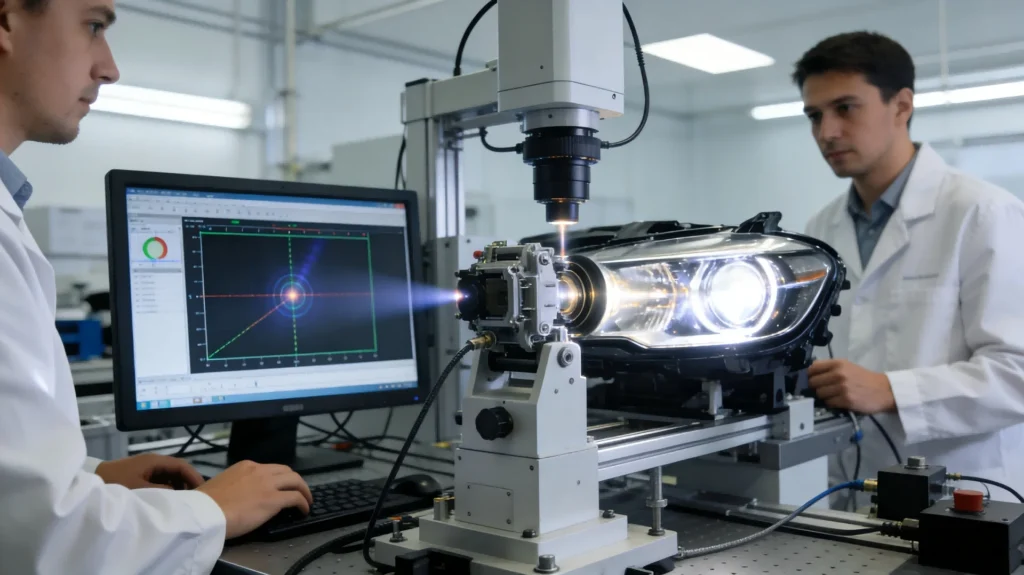
Going back to the analogy of a flashlight from Germany or similar precision tools, the secret lies in the lens. A projector headlight system works like a slide projector.
- **The Light Source:** A powerful LED chip generates the light.
- **The Reflector:** A smaller elliptical reflector collects this light and directs it to a focal point.
- **The Cutoff Shield:** This is crucial. A physical metal shield sits between the reflector and the lens, blocking the lower half of the light beam. This creates the sharp horizontal “cutoff” line you see on modern luxury cars, keeping light out of the eyes of oncoming drivers.
- **The Lens:** A convex glass lens magnifies and projects this perfectly shaped beam onto the road.
The advantage of companies like GTR is that they focus on this entire optical system. By using integrated mini projector LED bulbs, you are not just upgrading the light source; you are upgrading the entire optical engine of your headlight assembly to achieve a standard often associated with precision flashlight made in Germany engineering.
2. Main Application Scenarios for High-Precision LEDs
Although all vehicles benefit from better lighting, certain scenarios demand the optical superiority that only lens technology can provide. High-performance lighting is not merely cosmetic; it is a functional necessity in demanding environments.
2.1. High-Speed Highway Driving (The Autobahn Scenario)
At speeds exceeding 60 mph (100 km/h), your reaction time depends entirely on how far you can see down the road. Standard reflector LEDs often suffer from “foreground flooding” — they make the ground right in front of the car too bright. This causes your pupils to constrict, actually reducing your ability to see into the darkness ahead. A precision projector beam throws light hundreds of feet further, giving you crucial seconds to react to obstacles. This long-range reach without blinding others is the hallmark of quality engineering.
2.2. Adverse Weather: Fog, Rain, and Snow
This is where the “tactical” aspect comes into play. In fog or heavy rain, bright, uncontrolled light hits water droplets and reflects directly back into the driver's eyes — a phenomenon known as backscatter. A scattered beam from a cheap LED worsens visibility in fog.
A high-quality LED projector, particularly in fog light applications, creates a flat, wide light bar that stays low to the ground, cutting *under* the fog layer. The sharp cutoff prevents light from scattering upward into falling rain or snow, significantly improving contrast and visibility. This controlled output is akin to the difference between a cheap spotlight and a tactical flashlight Germany designed for specific operations.
3. Module 3: Key Buying Factors – Going Beyond the Lumen Hype
The automotive lighting market is saturated with misleading specifications. Navigating forums and Reddit threads reveals immense confusion about which specs truly matter. To make an informed choice, you must look beyond the marketing numbers on the box.
3.1. Lux vs. Raw Lumens (The Truth About Brightness)
This is the most important concept to understand. “Lumens” is the total amount of light emitted by the source in all directions. It's easy for manufacturers to inflate this number. “Lux” is the amount of usable light that actually reaches a specific point at a specific distance.
You could have a 20,000-lumen bulb in a reflector housing that scatters light into the trees, putting very little lux on the road 100 feet away. Conversely, a precision-engineered 6,000-lumen GTR projector lens can focus nearly all of its output exactly where it's needed, resulting in a much higher lux reading on the asphalt. You want usable lux, not theoretical lumens.
3.2. Beam Pattern and Cutoff Sharpness
The beam pattern determines safety. A proper low beam pattern must have a distinct “step” or “Z line”. It should be lower on the left side (in right-hand traffic countries) to avoid blinding oncoming drivers, and higher on the right side to illuminate road signs and pedestrians. Only projector lenses achieve this with absolute consistency. If an LED upgrade doesn't produce a sharp cutoff, it's dangerous.
3.3. Gestão Térmica (Ativa vs. Passiva)
LEDs de alta potência geram calor significativo. Se esse calor não for dissipado, o chip de LED irá escurecer ou falhar rapidamente.
- **Resfriamento Passivo:** Usa grandes dissipadores de calor de alumínio ou cobre ou fitas trançadas. Confiável, mas limitado em quanta potência pode suportar.
- **Resfriamento Ativo:** Usa micro-ventoinhas de alta velocidade (hidráulicas ou com rolamento de esferas). Isso permite maior potência e saída mais brilhante, mas introduz uma peça móvel. Unidades de alta qualidade usam ventoinhas robustas projetadas para o ambiente do compartimento do motor.
3.4. Temperatura de Cor (Kelvin)
Embora muitos busquem o visual azul frio de 6500K+, a luz mais eficaz para a visão humana à noite está entre 5000K e 6000K (branco puro diurno). Ir muito azul (acima de 6500K) na verdade reduz a visibilidade na chuva e causa fadiga ocular. Para faróis de neblina, temperaturas mais baixas como 3000K (amarelo dourado) são frequentemente preferidas, pois os comprimentos de onda da luz amarela refratam menos na umidade, cortando melhor a neblina.
4. Breve Guia de Instalação e Manutenção
Avanços modernos tornaram mais fácil alcançar o desempenho de nível de projetor do que no passado.
Instalação: Anteriormente, obter um feixe de projetor significava “assar” seus faróis para abrir e fisicamente adaptar uma unidade de projetor—uma tarefa difícil e arriscada. Hoje, as empresas oferecem lâmpadas de LED “mini-projetor”. São conjuntos completos de projetor miniaturizados para caber diretamente no orifício padrão da lâmpada do alojamento do seu farol existente. Muitas vezes é uma operação plug-and-play que instantaneamente converte um farol refletor em um farol de projetor.
Manutenção: A etapa de manutenção mais crítica é frequentemente negligenciada: a lente externa do farol. Não importa quão sofisticado seja seu projetor LED interno, se a lente de plástico externa do conjunto do farol do seu carro estiver embaçada, amarelada ou oxidada, ela difundirá a luz e arruinará o padrão de feixe preciso. Polimento regular e vedação UV das lentes dos faróis são essenciais para manter o desempenho de nível tático.
5. Perguntas frequentes (FAQ)
P: Atualizar para LEDs mais brilhantes ofuscará outros motoristas?
R: Se você usar uma lâmpada LED padrão em um alojamento refletor projetado para halógenas, sim, é muito provável. No entanto, se você usar um sistema de lente projetora (como os mini-projetores da GTR), a proteção de corte nítida impede que a luz brilhe acima da linha do capô do tráfego em sentido contrário, tornando-os mais seguros do que halógenas desalinhadas.
P: Why do some German cars have such distinct blue/purple lines at the top of their headlight beams?
R: That's called a “color band.” It's an optical effect caused by light diffraction over the edge of the sharp metal cutoff shield inside the projector. It's a sign of high-quality optics and sharp focus, often seen in premium lighting systems.
P: Are these upgrades legal for road use?
R: Regulations vary significantly by region and country. In many places, modifying the primary light source affects compliance. However, from a practical safety standpoint, a properly aligned projector beam that produces no glare is far less likely to attract negative attention from authorities than a replacement LED in a reflector housing with scatter.
P: My car warns that a bulb has burned out after installing LEDs. Why?
R: LEDs consume significantly less power than halogen bulbs. The car's computer (CANBUS system) thinks the bulb has burned out. You may need to ensure your LED kit has a built-in CANBUS decoder, or add an external resistor to prevent dashboard errors.
6. Why GTR Means Optical Precision
In a market flooded with generic rebrands, GTR has carved a niche by focusing intensely on optical engineering, not just raw power. GTR understands that the end goal is not just brightness, but the *control* of brightness.
Their development of mini-projector LED technology directly addresses the flawed nature of standard reflector housings. By delivering the entire optical stack—chip, shell, shield, and lens—in a single compact unit, GTR ensures that light output meets the kind of rigorous, defined standards one would expect from high-level precision engineering disciplines. They provide the tools to transform standard vehicle headlights into precision visibility instruments.