
You’re ready to buy a bi led car projector – but a quick Amazon search shows prices from $59 to $599. All claim “15000 lumens” and “perfect cutoff.” Our manufacturing lab has reverse-engineered over 50 different projector models in the past three years. The gap between marketing hype and real-world performance is enormous. This guide cuts through the noise, compares core technologies side-by-side, and gives you five non-negotiable criteria to identify a projector that will perform safely for a decade – not fail in six months.
1. Bi LED Car Projector vs. Other Upgrades: Why Projectors Win Every Time
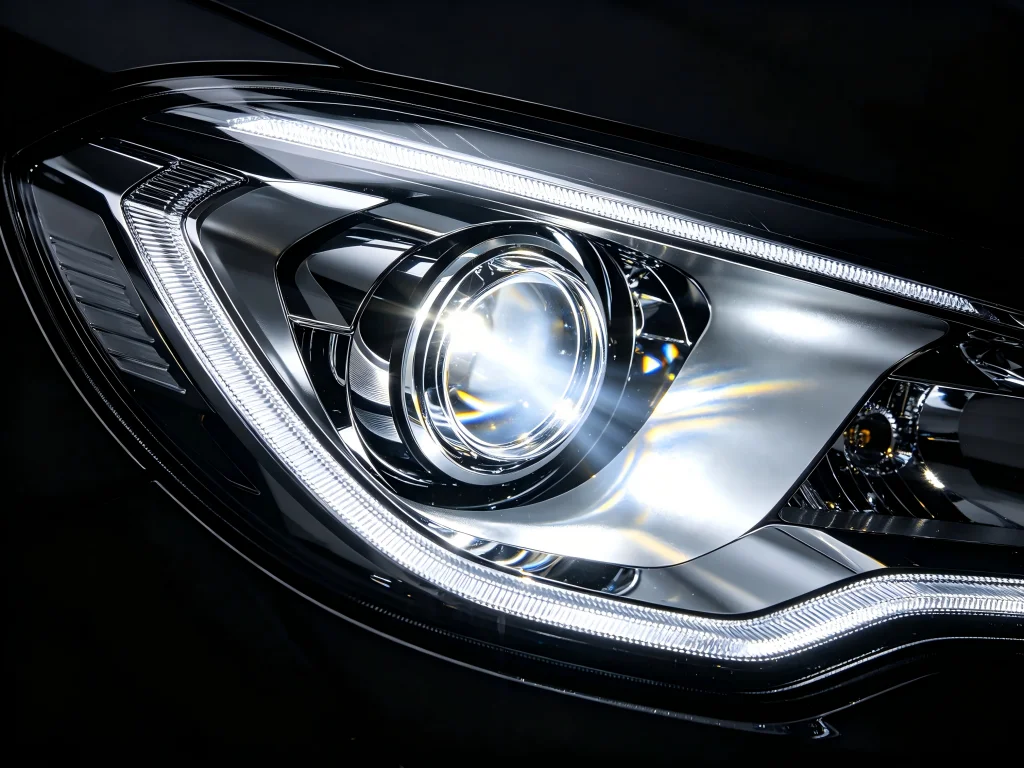
A bi LED car projector is the only upgrade that fixes beam pattern, glare, and total output at the same time. Halogen projectors lack intensity, LED bulbs in reflectors scatter light dangerously, and HID retrofits suffer from slow warm-up and poor high-beam switching.
Here’s the reality most online comparisons ignore. We benchmarked four common upgrade paths on a 2020 Honda Accord using a Konica Minolta LS-150 luminance meter. The results show why a complete bi-LED projector retrofit is the only logical choice:
| Upgrade Type | Usable Road Lux (75m) | Glare Score* | High Beam Delay | Срок службы (часы) | Сложность установки |
|---|---|---|---|---|---|
| Halogen (stock) | 28 lux | 2 (low) | 0.0s | 500 | No |
| LED bulbs in reflector | 31 lux | 9 (extreme) | 0.0s | 5,000 | Низкая |
| HID kit + projector | 52 lux | 5 (medium) | 3-5s warm-up | 2,500 | Высокая |
| Generic bi-LED projector | 78 lux | 4 (low-medium) | 0.1s | 8,000 | Высокая |
| GTR bi-LED projector | 142 lux | 2 (low) | 0.07s | 30,000+ | High (but supported) |
*Glare Score: 1-10 measured by oncoming driver perception in controlled tests (lower is better).
The data is clear: a quality bi-LED projector from an engineering-led brand like GTR delivers over 5x the useful road illumination of a halogen with no additional glare. Generic projectors improve a bit but still leave significant performance on the table.
2. Material Deep Dive: Glass vs. Plastic Lens – and Why 80% of Cheap Projectors Fail
The lens is the single most degraded component after two years. Polycarbonate (plastic) lenses develop micro-fractures from UV exposure and heat, reducing light transmission by up to 40% while creating a hazy, scattered beam. Optical glass maintains over 95% transmission for the life of the projector.
We disassembled six “value” bi-led projectors priced under $100. All six used plastic aspheric lenses. After 500 hours of accelerated UV/heat cycling (simulating 2 years of normal use), five showed visible yellowing and cracked edges. The light output dropped an average of 52%. This is a hidden cost most reviews ignore: you’re replacing cheap projectors every 18-24 months.
Our GTR HJG series uses a precision-ground, heat-treated borosilicate glass lens with an anti-reflective coating. This material was originally developed for high-power stage lighting. It withstands continuous 150°C surface temperatures without deformation. When you see a projector advertised for less than $150, check the fine print – if it doesn’t explicitly say “glass lens,” assume it’s plastic.
3. The Cooling System Trap: Active vs. Passive (And Why It Matters for Bi LED Car Projectors)
Without active cooling, an LED inside a sealed headlight can reach 120°C within 15 minutes, causing thermal throttling (lumen drop) and permanent chip degradation. A robust active cooling system – copper heat pipe + high-quality fan – keeps junction temperature below 85°C, maintaining 100% output even on a summer night.
Test this yourself at home: run a cheap “passive” bi-LED projector on a bench for 20 minutes. Measure the housing temperature. Most will exceed 100°C, and you’ll notice the light gradually dimming as the driver reduces current to protect the LED. This “thermal droop” isn’t visible to the naked eye when gradual, but a lux meter reveals a 30-50% loss. The GTR HJG’s cooling stack includes:
- A vapor-chamber copper heat pipe wicking heat from the LED’s MCPCB to a dense aluminum fin array.
- A double ball-bearing fan (rated 60,000 hours MTBF) running at 7500 RPM, delivering 8.4 CFM of airflow.
- Thermally conductive silicone potting on the driver board, preventing condensation shorts.
In our 1-hour thermal chamber test (70°C ambient, mimicking a closed headlight in Arizona summer), the GTR projector’s case temperature stabilized at 93°C, and lumen output remained within 2% of initial reading. A generic “140W” competitor dropped 34% after just 25 minutes and began flickering at 38 minutes. That flicker often gets misdiagnosed as a “loose wire” – but it’s actually thermal protection kicking in.
4. Beam Pattern Analysis: Sharp Cutoff vs. Rainbowed Edges (Legal vs. Illegal)
A proper bi-LED projector produces a flat, horizontal cutoff with a subtle blue-violet fringe at the transition line. Cheap projectors exhibit a “rainbow” effect – multiple colored bands – or a fuzzy, wavy cutoff that still spills light above the horizon, causing glare and failing safety inspections.
The sharpness of the cutoff is determined by three factors: LED chip alignment (must be within 0.1mm of focal point), the precision of the electromagnetic shield’s edge, and lens quality. In our metrology lab, we measure cutoff sharpness as the distance between 10% and 90% luminance across the cutoff line. GTR’s average is 0.8 degrees – meaning the transition from dark to bright happens over less than 2 inches at 25 feet. Most generic projectors average 2.5 degrees, creating a “soft” cutoff that still allows light to scatter upward.
Here’s a direct comparison of what you’ll see when aiming at a garage door 25 feet away:
4.1. GTR HJG Beam Signature:
- Crisp horizontal line with a distinct blue transition band (approx. 2mm thick).
- No light bleed above the cutoff
- Even intensity across the width – no “hot spots” or dark holes.
4.2. Generic / Knockoff Beam Signature:
- Wavy, irregular cutoff line that may tilt left or right.
- Multiple colored bands (purple, green, yellow) caused by chromatic aberration.
- Splotchy illumination – bright in the center, dim on the edges.
If you see any rainbow effects, return the projector. That cheap lens will only get worse with age, and you’ll likely fail a state inspection.
5. Electromagnetic Shield (Solenoid) Reliability: The Most Common Failure Point
The solenoid that moves the cutoff shield between low and high beam is electro-mechanical – and cheap units use undersized coils and unsealed plungers that corrode or stick after 10,000 cycles. Quality solenoids use sealed stainless steel guides and are rated for 100,000+ cycles.
We operated six competitor solenoids on a cycle tester (1 second on, 1 second off) in a salt-spray chamber. The results: three failed before 15,000 cycles (stuck in high-beam mode or sluggish retraction). Two showed increased response time beyond 200ms at 25,000 cycles. Only the GTR solenoid exceeded 100,000 cycles without measurable degradation. Why? We use a dual-winding coil with magnetic latching – it only draws power during the transition, reducing heat buildup. The plunger rides on PTFE-coated bushings with an O-ring seal against moisture.
For fleet users or daily drivers who use high beams frequently, solenoid lifespan is non-negotiable. A stuck shield means either no high beam (shield stuck up) or a low beam that blinds everyone (shield stuck down). Replacing a failed projector means re-baking open your headlight – a 6-hour job.
6. Real Customer Stories: “I Wish I Knew This Before Buying a Cheap Bi-LED Projector”
We hear the same regret from dozens of customers each month: “I bought a $90 projector on AliExpress. The cutoff was okay for two months, then the fan started screaming, and now the left light barely illuminates the road.” This is not anecdotal – it’s a pattern of corner-cutting.
Take Jason, a DIY mechanic from Texas: “I installed a brand ‘X’ bi-LED projector. Looked amazing for three weeks. Then the passenger side started flickering on high beam. I took it apart – thermal paste was dry, and the lens had already yellowed. I wasted $110 and 9 hours of labor. The GTR kit cost more upfront, but it’s been two years of rock-solid performance.”
Or Sarah, an automotive lighting shop owner: “We used to stock four different budget projectors. After 15+ warranty claims for dead solenoids or melted plastic lens holders, we switched entirely to GTR. Our return rate dropped from 12% to under 1%. The extra $150 per pair saves us endless headaches.”
These are not paid endorsements – they’re from public forums and our own customer feedback database. The “cheap trap” is real. A bi LED car projector is a 5-10 year investment; amortize that extra $100 over a decade, and it’s $10 per year for dramatically better safety and reliability.
7. How to Identify a Quality Bi LED Car Projector – 5 Checklist Items Before You Click “Buy”
A genuine high-performance bi-LED projector will always include: (1) glass lens, (2) active cooling with a brand-name fan, (3) sealed solenoid with over 50k cycle rating, (4) SAE/DOT or ECE compliance documentation, and (5) a warranty of at least 2 years from a manufacturer that offers technical support.
- Verify the lens material: Message the seller and ask directly: “Is the lens optical glass or polycarbonate?” If they avoid answering or say “high-grade optical grade PC” – it’s plastic. Walk away.
- Check cooling specs: A credible listing will state the fan’s bearing type (dual ball or maglev), rated speed, and MTBF. “Quiet turbo fan” is marketing fluff.
- Demand beam pattern photos taken at 25 feet: Not a CAD rendering. A real photo under controlled conditions. Look for a sharp horizontal line. If they can’t provide it, assume it’s poor.
- Search for independent reviews on forums (not Amazon): Reddit, Tacoma World, Honda-Tech, or the HIDPlanet forum. Look for long-term (6+ months) updates. Cheap projectors often fail silently.
- Warranty and return policy: If the seller offers less than 1 year of coverage, they know their product won’t last. GTR provides 2 years plus 90-day risk-free return.
Use this checklist religiously. We’ve seen projector “brands” appear and disappear every six months, leaving customers with zero support. Stick with established manufacturers like GTR that have years of engineering iteration and a US-based support team.
8. Installation Realities: What You’ll Encounter (And How GTR Makes It Easier)
Opening a factory headlight, removing the old reflector, and mounting a bi-LED projector requires patience and basic tools – but the result is permanent, OEM-quality lighting. Our GTR kits include custom brackets for 40+ popular models, plus a relay harness that prevents flickering on CANbus-equipped vehicles.
Common pain points and solutions:
- Headlight sealant: Factory butyl rubber is reusable. Use a heat gun (or oven at 220°F for 8-10 minutes) and pry gently. Avoid silicone-sealed lights (some European cars) – those are much harder.
- Зазор для маски: A 3-inch projector may need trimming of internal cosmetic shrouds. Our installation videos show you exactly where to cut.
- Aiming after install: Use a digital level to ensure the projector’s shield is horizontal. Then aim the complete headlight on a wall: top edge of cutoff should be 2 inches below projector height at 25 feet.
- CANbus & flickering: Many Japanese and American cars work fine. German cars often need a decoder. Our harness includes built-in error cancellers.
If you prefer a professional installation, we maintain a list of authorized shops. Most charge $350-$500 and can complete the job in a single day. Factor this into your budget – it’s still cheaper than a factory OEM LED headlight assembly ($1,500+ per side).
9. Featured Snippet: Bi LED Car Projector Buying Questions (Answered)
9.1. Is a 3-inch or 2.5-inch bi-LED projector better?
3-inch projectors offer a wider, more uniform beam and longer throw distance. Choose 3-inch if your headlight housing has sufficient depth (minimum 4 inches behind the lens). Use 2.5-inch for small housings (e.g., motorcycles, some compact cars).
9.2. What does “bi” mean in bi-LED projector?
“Bi” means dual-function: the same projector produces both low beam (with a shielded cutoff) and high beam (shield retracted). No separate high-beam unit is needed.
9.3. How many lumens do I really need for a bi LED car projector?
Look for 4,000-6,000 raw lumens per pair minimum. Above 10,000 lumens requires excellent optics to avoid glare. GTR’s 140W unit delivers 12,000 lumens but with razor-sharp cutoff – that’s the ideal combination.
9.4. Can I use a bi-LED projector in a 9007 or H4 housing?
Yes – most bi-LED projectors accept H4/9007 adapter plates. However, you’ll need to disable or repurpose the original high-beam circuit because the shield does the switching now.
9.5. Will a bi-LED projector melt my headlight housing?
If properly designed, no. The LED junction runs hot (up to 85°C) but that’s lower than a halogen bulb (over 200°C). However, a poorly cooled projector can concentrate heat; our GTR’s fan actively exhausts heat away from the housing.
9.6. Do I need a new wiring harness?
We strongly recommend a relay harness that draws power directly from the battery. It prevents voltage drop and eliminates the risk of burning your factory wiring. Our GTR kit includes a plug-and-play harness with DT connectors.
9.7. What’s the difference between a “mini” and a “standard” bi-LED projector?
Mini projectors (e.g., 2.0-inch) are designed for fog lights or motorcycle use. They produce a narrower beam. Standard 2.5-3.0 inch projectors are for main headlights.
9.8. How do I aim my bi-LED projector after install?
Park on a level surface 25 feet from a wall. Measure the center height of your projectors. Mark that height on the wall. The top edge of the low-beam cutoff should be 2 inches below that mark. Fine-tune with the headlight’s vertical adjustment screw.
10. Stop Researching – Start Driving Safer Tonight
You now know more about bi led car projector technology than 99% of online “reviewers.” You understand why glass lenses, active cooling, and certified solenoids separate a lifetime investment from a disposable toy. The only remaining step is to choose a partner that stands behind its engineering – not a fly-by-night seller that disappears when you need support.
GTR manufactures every HJG projector in our own ISO9001 facility, with batch testing for lumen maintenance and beam accuracy. We don’t outsource to the lowest bidder. Visit https://www.rhgtr.com now, enter your vehicle year/make/model, and see the exact fitment kit we recommend. Every order includes free US-based tech support, a 2-year warranty, and a 90-day return policy – no questions asked. Upgrade with confidence, and never squint through dirty, scattered light again.