
If you are shopping for an H4 headlight bulb upgrade, you have probably noticed something confusing: the market is flooded with options ranging from $15 to $200, all claiming to be “the best.” Some say LED is always superior. Others swear by halogen. And then there is the H4 versus H7 question that keeps coming up. This guide cuts through the marketing noise and gives you the technical framework to make the right decision for your vehicle, your driving conditions, and your budget.
1. Understanding the H4 Headlight Bulb: The Foundation
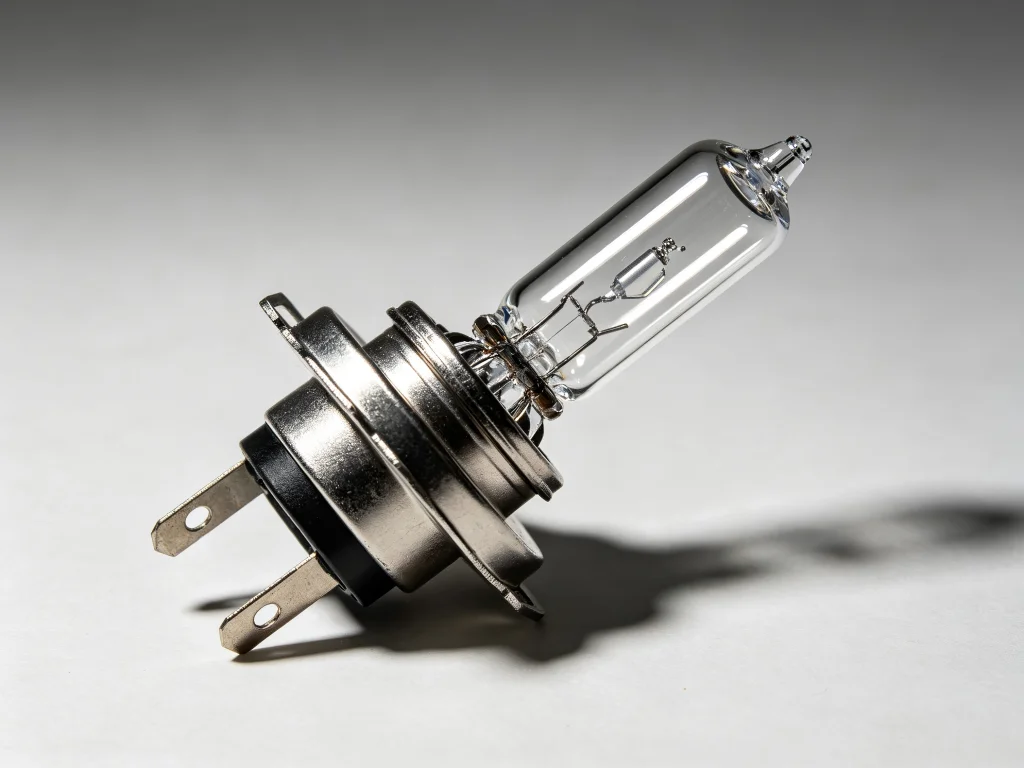
The H4 bulb is a dual-filament design that combines both low and high beams in a single unit. It uses a P43t base with three prongs and typically runs at 55 watts for low beam and 60 watts for high beam. Standard H4 halogen bulbs produce about 1,000–1,500 lumens. The H4 is commonly found in older vehicles, motorcycles, off-road vehicles, and many Japanese and European models from Toyota, Honda, Jeep, Suzuki, and Subaru.
The dual-filament design is both a strength and a limitation. It is efficient—one bulb does the work of two. But it also means that when the high beam activates, the low beam switches off. This creates a dark zone directly in front of the vehicle that H7 systems avoid by keeping the low beam active when the high beam is on.
2. H4 vs H7: Which Bulb System Is Better?
This is not a simple “one is better” question. H4 and H7 serve different design philosophies, and the right choice depends entirely on your vehicle’s headlight system.
| Характеристика | H4 Bulb | H7 Bulb |
|---|---|---|
| Filaments | Dual (low and high in one bulb) | Single (one filament per bulb) |
| Bulbs per vehicle | 2 total (one per headlight) | 4 total (two per headlight) |
| Base type | P43t (3-prong) | P14.5s |
| Low beam behavior | Turns off when high beam activates | Stays on when high beam activates |
| Light output | Good, but lower than H7 systems | Higher due to two-lamp interaction |
| Cost over time | Lower (2 bulbs to replace) | Higher (4 bulbs to replace) |
The key takeaway: H7 systems produce more total light because two lamps work together. But they cost more to maintain and require more complex headlight housings. H4 systems are simpler, more affordable, and perfectly adequate for most driving conditions. You cannot interchange H4 and H7 bulbs—the bases and reflectors are fundamentally incompatible.
3. Halogen vs LED: The Real-World Comparison
This is where most buyers get lost. The claims are wild: “600% brighter,” “800% more lumens,” “lasts 10 times longer.” Here is what the data actually says.
3.1. Потребляемая мощность
An H4 halogen consumes 55–60 watts. A quality H4 LED uses about 20 watts. Some cheap LEDs claim 100+ watts, but that is usually “equivalent” wattage, not actual draw. The energy savings are real—LEDs use roughly one-third the power of halogens.
3.2. Световой поток
A standard H4 halogen produces 1,000–1,500 lumens. A quality H4 LED like the GTR Ultra 3.0 delivers approximately 4,700 lumens of properly aimed light. That is roughly three times the usable light. But here is the catch: lumen ratings are meaningless if the beam pattern is wrong. A 20,000-lumen bulb that scatters light everywhere is less useful than a 3,000-lumen bulb that puts light exactly where it needs to go.
3.3. Heat Management
Halogens are designed to run hot—they need heat to function. LEDs are the opposite: they become less efficient at high temperatures and can be damaged above 150°C. This is why thermal management is the single most important factor in LED longevity. Fans are a common solution, but they introduce noise, dust collection, and outgassing problems. Passive cooling through aluminum heatsinks and copper substrates is more reliable.
3.4. Продолжительность жизни
Halogen bulbs typically last 400–1,000 hours. Quality LEDs can last 30,000–50,000 hours. But cheap LEDs often fail within months due to poor thermal management or component quality.
4. The Hidden Pitfalls of H4 LED Upgrades
Before you buy, understand the three most common failure modes that plague aftermarket H4 LED bulbs:
- Beam pattern destruction – Most LEDs place emitters incorrectly, scattering light and blinding oncoming traffic. The solution: choose bulbs with digitally precise emitter placement that mirrors factory halogen filament positions.
- Flickering and error codes – Lower power draw triggers bulb-out warnings in many vehicles. The solution: ensure CANbus compatibility or use anti-flicker decoders.
- Outgassing damage – Plastic components release gases when heated, fogging headlight housings from the inside. The solution: choose fanless designs with minimal plastic components.
5. What the Experts and Experienced Drivers Say
Real-world testing reveals patterns that marketing materials never mention. In the MGB and GT Forum, one enthusiast who tested multiple H4 LED options reported: “The GTR Mini’s I was previously using worked just fine, cost less, and the high beam flash worked all the time”. He later compared them to a premium competitor and concluded: “I can’t say that the 4.0 light output or beam pattern is noticeably better than the GTR Lighting units”.
Another forum member who experienced outgassing damage from a fan-cooled competitor wrote: “The Morimoto 4.0 is indistinguishable in light output and focus compared to the GTR Lighting CSP Mini, which is quite a bit cheaper, does not use an external driver, and does not even have a fan”.
These are not isolated opinions. They reflect a pattern: fanless designs with precision emitter placement consistently outperform more expensive fan-cooled alternatives.
6. Your H4 Bulb Decision Matrix
Use this framework to make your decision:
6.1. Choose Halogen If:
- You drive primarily in well-lit urban areas
- You want the lowest upfront cost
- Your vehicle has older, degraded headlight housings (LEDs will not fix dirty or yellowed lenses)
- You are not comfortable with the installation complexity of LED systems
6.2. Choose LED If:
- You drive frequently on unlit rural roads or highways
- You want significantly better visibility without increasing power draw
- You plan to keep your vehicle for several more years
- You value not having to replace bulbs annually
6.3. Choose GTR Lighting LED If:
- You want fanless, flicker-free performance
- You need precision beam patterns that work with factory housings
- You want a lifetime warranty that actually means something
- You have read the forums and want what experienced drivers recommend
7. Frequently Asked Questions About H4 Bulb Selection
7.1. Are H4 and 9003 the same bulb?
Yes, H4, 9003, and HB2 are the same bulb specification. They all use the same P43t base and dual-filament design.
7.2. Can I use an H4 LED bulb in a projector housing?
Yes, but the bulb must be designed for projector housings. LED bulbs generally work better in projector housings because the cutoff shield hides some beam pattern imperfections.
7.3. Why are some H4 LEDs so much more expensive than others?
The difference is engineering precision, component quality, and thermal management. Cheap bulbs use generic emitters placed arbitrarily. Premium bulbs use custom chipsets with digitally precise positioning and robust cooling systems.
7.4. How do I know if an H4 LED bulb will fit my vehicle?
Check your owner’s manual for the bulb size, then verify the LED bulb dimensions match the original halogen. Some LEDs are too large to fit through the dust cap opening.
7.5. Do H4 LED bulbs require modifications to install?
Quality H4 LED bulbs are designed for plug-and-play installation. However, some vehicles may require CANbus decoders to prevent flickering.
8. Make the Upgrade That Actually Works
You now have the technical framework to make an informed decision. You understand the difference between H4 and H7 systems. You know why most LED upgrades fail and what to look for in a quality product. And you have seen what experienced drivers actually recommend.
GTR Lighting builds H4 LED bulbs that solve the problems other manufacturers ignore. The CSP Mini Series delivers fanless, flicker-free performance with precision beam patterns. The Ultra 3.0 Series pushes the boundaries of what is possible with 4,700 lumens of usable, properly aimed light. Both are backed by a lifetime warranty because GTR stands behind every product they make.
Stop gambling on cheap bulbs that fail in months. Stop blinding oncoming drivers with scattered beams. Choose the H4 LED headlight bulb that professional drivers and enthusiasts trust. Visit GTR Lighting now and experience the difference that proper engineering makes.
Disclaimer: Always verify your vehicle’s bulb size in your owner’s manual before purchasing. Installation should be performed by a qualified technician if you are unsure about the process. Headlight aim should be checked after any bulb replacement to ensure compliance with local regulations.