
The market for LED H11 headlight bulbs has a strange problem: products that look almost identical online can perform completely differently on the road. One may produce an excellent low-beam hotspot and clean cutoff. Another may advertise twice the lumens yet scatter much of its light above, below, and outside the useful driving zone.
For buyers, installers, wholesalers, and automotive lighting distributors, the challenge is therefore not finding an H11 LED bulb.
The challenge is separating engineering from marketing.
This guide gives you a practical framework for doing exactly that.
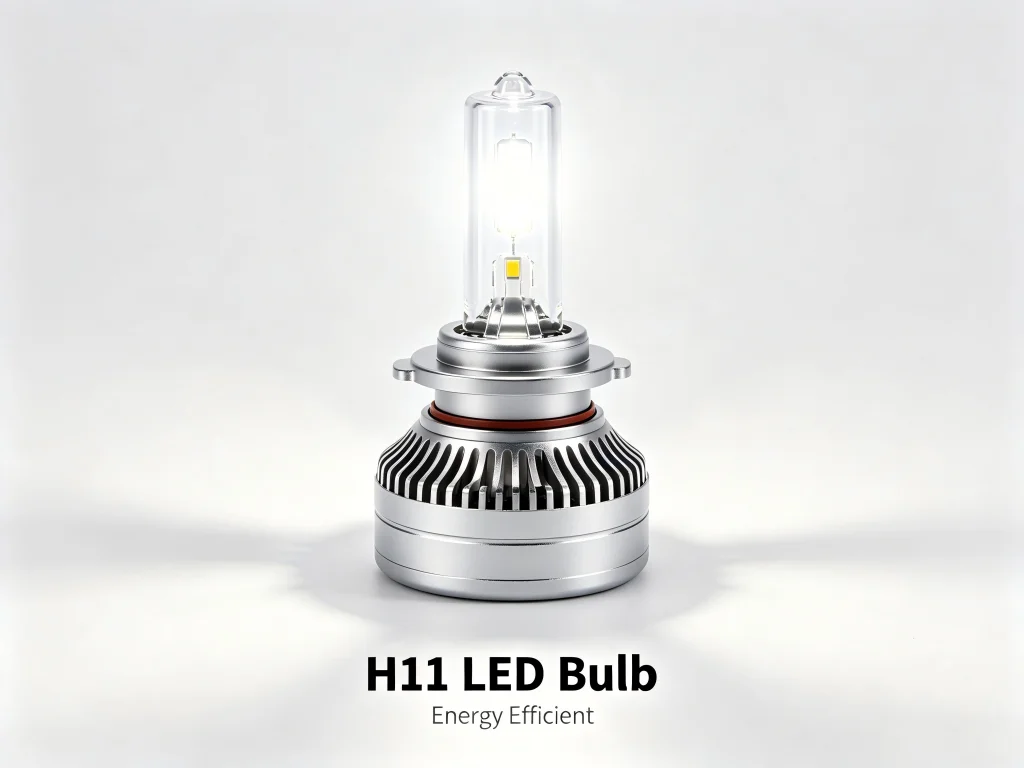
1. What Are the Best LED H11 Headlight Bulbs?
The best LED H11 headlight bulbs combine accurate emitter positioning, controlled beam geometry, strong usable illuminance, stable thermal performance, reliable driver electronics, correct physical fit, and vehicle compatibility. Do not rank H11 LEDs by advertised lumens alone. Evaluate how much stable, controlled light reaches the road after the bulb reaches operating temperature.
That definition immediately removes one of the biggest traps in the market.
There is no single specification that defines the best bulb.
Headlights are systems.
Changing the light source changes the behavior of that system.
2. H11 Halogen vs. Budget LED vs. Premium LED
| Factor | H11 Halogen | Budget H11 LED | Engineered H11 LED |
|---|---|---|---|
| Light color | Warm | Often very white or blue-white | Controlled white output |
| Emitter geometry | Original filament geometry | Often oversized LED surface | Designed to approximate filament position |
| Beam compatibility | Native to housing | Highly variable | Optical geometry prioritized |
| Initial brightness | Умеренная | Often high | High but controlled |
| Thermal management | Heat radiated from filament system | Basic heatsink/fan | Engineered thermal path |
| Electrical complexity | Низкая | Variable driver quality | Regulated driver design |
| CANbus compatibility | Usually native | May require decoder | Compatibility considered during design |
| Rear clearance | OEM fit | Can be oversized | Compact fit prioritized |
| Long-term output | Predictable | Highly variable | Thermal stability prioritized |
3. Buyer Test #1: Ignore Lumens Until You Understand the Beam
Lumens measure total light output, but they do not show where that light lands. For an H11 low beam, optical focus is critical. A bulb producing fewer total lumens may provide better driving visibility when its emitter position allows the headlamp to concentrate more light into the correct hotspot and road zones.
This is the first specification we would challenge when evaluating an unfamiliar supplier.
Suppose Product A claims 20,000 lumens and Product B claims considerably less.
Which is better?
You cannot answer from those figures.
You need to install both bulbs in the same headlamp assembly and examine the resulting beam.
3.1. Look at Lux, Distribution, and Cutoff
Lumens describe luminous flux. Lux describes illuminance reaching a surface.
For an explanation of the distinction, see the technical definition of lux.
For a headlight buyer, the practical question is:
How much useful illumination reaches the important road zones?
A good comparison therefore examines:
- central hotspot intensity;
- distance illumination;
- horizontal distribution;
- foreground intensity;
- light above the cutoff;
- dark spots or irregular zones;
- left-right consistency between bulbs.
This is much harder to manipulate than a large lumen number printed on retail packaging.
4. Buyer Test #2: Examine LED Chip Position
Inside an H11 halogen bulb is a compact filament.
The reflector or projector was engineered around that filament’s location.
An LED replacement needs to approximate the functional geometry of that original source.
This is why thin emitter boards and compact LED packages can be valuable.
If the LED emitting surfaces become too wide or sit too far from the intended focal location, optical precision can deteriorate.
4.1. The "1:1" Claim Needs Evidence
Many products now use terms such as “1:1 halogen design.”
Do not accept the phrase by itself.
Ask for evidence.
- Compare the LED emitter position with an H11 halogen filament.
- Request beam photos from the same headlamp assembly.
- Check whether the hotspot remains concentrated.
- Inspect light above the cutoff.
- Test more than one headlamp design where possible.
A supplier that understands optics should be able to discuss these points without returning immediately to lumen claims.
5. Buyer Test #3: Check Brightness After Heat Soak
LED specifications measured immediately after startup tell only part of the story.
As the LED junction, substrate, heatsink, driver, and surrounding air warm, the system reaches a different thermal condition.
A poorly managed bulb may lose output or accelerate component aging.
For distributors, this matters because customers do not use headlights for five minutes on a test bench. Some drive for hours.
5.1. Fanless vs. Fan-Cooled H11 LEDs
| Cooling type | Main Advantage | Main Limitation | Best Evaluation Question |
|---|---|---|---|
| Passive heatsink | No moving fan | Heat dissipation capacity may be limited | Can it maintain output at operating temperature? |
| Flexible braided heatsink | Can fit tight spaces | Installation affects heat transfer | Is there enough airflow around the braid? |
| Active fan | Higher cooling potential | Adds a moving component | What fan quality and thermal architecture are used? |
| Integrated thermal design | Balances compact size and heat transfer | Requires stronger engineering | What happens during extended operation? |
There is no universal rule saying fanless is always superior or fan-cooled is always superior.
The correct question is whether the complete thermal system can keep the LEDs and driver within a stable operating range.
6. Buyer Test #4: Verify the Driver, Not Just the LED Chip
The visible LED package gets most of the marketing attention.
The driver often determines whether the product behaves properly after installation.
A good driver regulates electrical current and protects the LED from unstable operating conditions.
It can also influence:
- startup behavior;
- flicker resistance;
- PWM compatibility;
- electromagnetic behavior;
- thermal protection;
- voltage tolerance;
- vehicle error messages.
When sourcing H11 bulbs for multiple vehicle platforms, driver quality becomes especially important because electrical systems differ.
7. Buyer Test #5: CANbus Ready Does Not Mean Universal
One of the easiest purchasing mistakes is assuming “CANbus ready” means “works perfectly in every vehicle.”
It does not.
Different vehicles use different monitoring strategies and electrical behavior.
A bulb may operate normally in one platform while producing a warning, flicker, or startup issue in another.
For professional buyers, request an application compatibility process instead of relying on a universal claim.
8. Buyer Test #6: Check Whether It Physically Fits
A bulb can pass every electrical test and still be useless if the dust cap will not close.
This sounds obvious, yet physical dimensions remain one of the most common weaknesses of LED retrofit products.
The original H11 halogen bulb is compact.
An LED replacement may add:
- a heatsink;
- a cooling fan;
- a larger base;
- an external driver;
- additional wiring;
- a CANbus module.
Every added component consumes space.
8.1. Why Compact H11 Architecture Matters
A more compact bulb can reduce installation problems, especially in vehicles with limited clearance behind the headlamp.
This matters even more for installers.
If installation requires cutting a dust cover or modifying the housing, installation time increases and the risk of moisture ingress may also increase.
For B2B buyers, installation complexity eventually becomes customer-support cost.
9. Buyer Test #7: Choose Color Temperature for Driving, Not Instagram
Extremely blue headlights can look dramatic in photographs.
That does not mean they provide the best road visibility.
For most street applications, a practical white LED output tends to provide a good compromise between modern appearance and visual performance.
Color consistency also matters.
If one bulb looks noticeably warmer or cooler than the other, customers perceive the pair as defective even when both bulbs technically function.
For wholesalers, bin consistency should therefore be part of quality control.
10. How Should You Compare H11 LED Headlight Bulbs on Amazon?
Someone searching for H11 LED headlight bulbs Amazon will encounter hundreds of products with aggressive brightness claims.
Instead of sorting only by star rating, use reviews diagnostically.
Search within reviews for terms such as:
- “flicker”
- “beam pattern”
- “glare”
- “dust cap”
- “fan noise”
- “dim after”
- “dashboard error”
- “one bulb failed”
Patterns are more valuable than individual comments.
If many unrelated buyers describe the same failure mode, investigate it before purchasing.
11. AutoZone vs. Walmart vs. Specialist H11 Suppliers
Searches for H11 LED headlight bulbs AutoZone и H11 LED headlight bulbs Walmart often come from drivers who want a fast replacement.
Retail availability has obvious advantages.
You may get the product quickly and returns can be convenient.
Specialist automotive lighting suppliers, however, may offer deeper technical information about optical design, compatibility, beam behavior, and application-specific performance.
The right channel depends on your objective.
If a bulb has failed tonight and you need a replacement immediately, local availability may dominate the decision.
If you are selecting a platform for repeated installation, wholesale distribution, or private-label sales, engineering support becomes far more valuable.
12. What Should Peterbilt 579 Owners Check?
Buyers searching for H11 LED headlight bulbs Peterbilt 579 should verify the exact model year and headlamp configuration before ordering.
Commercial vehicle applications deserve additional attention because operating hours may be far higher than in passenger cars.
For fleet or truck applications, we would evaluate:
- exact bulb fitment;
- vibration resistance;
- thermal stability during long operating periods;
- driver reliability;
- connector security;
- beam control;
- replacement consistency across batches.
Fleet economics are different from consumer economics.
A slightly cheaper bulb that requires more replacements can become the more expensive solution.
13. How Should Buyers in South Africa Choose H11 LEDs?
For searches such as H11 LED headlight bulbs South Africa, application conditions should influence purchasing criteria.
Long-distance routes and areas with limited road lighting make distance visibility particularly valuable. High ambient temperature may also increase thermal stress inside the headlamp.
Dust, vibration, rain, and extended operation add further demands.
That makes thermal stability, sealing, mechanical construction, and beam quality especially relevant.
14. The B2B H11 LED Supplier Scorecard
| Supplier Criterion | Weight | What to Request |
|---|---|---|
| Beam performance | 25% | Beam images, lux data, application tests |
| Thermal stability | 20% | Long-duration output and temperature testing |
| Electrical compatibility | 15% | Driver specs and vehicle compatibility information |
| Physical fit | 10% | Technical drawings and dimensions |
| Production stability | 10% | Batch QC process |
| Failure control | 10% | Aging and reliability testing procedures |
| Supplier support | 10% | Application, packaging, OEM/ODM and after-sales support |
This framework changes the purchasing conversation.
Instead of asking, “How many lumens?” you begin asking, “How consistently can this supplier deliver a complete lighting solution?”
15. Where GTR Fits in the H11 LED Market
GTR approaches automotive LED lighting from the perspective of a manufacturer serving the aftermarket rather than simply a seller listing generic bulbs.
That matters because an H11 product must balance competing engineering requirements.
More output creates additional thermal load.
More cooling can increase physical size.
Larger emitters can affect optical precision.
Additional electronics can create installation challenges.
Our development approach therefore considers emitter geometry, heat transfer, driver electronics, housing dimensions, and application performance as parts of the same system.
15.1. For Distributors and Wholesalers
The strongest H11 product is not necessarily the one that generates the most impressive specification sheet.
It is the one that can generate repeat orders without generating an equally impressive number of returns.
That means consistency matters.
One sample performing well is not enough. Production batches need controlled LED characteristics, assembly accuracy, thermal interfaces, driver quality, and final inspection.
15.2. For Automotive Lighting Chains
Installers need products that fit predictably.
A few extra minutes spent fighting an oversized bulb becomes significant across hundreds or thousands of installations.
Compact dimensions and clear fitment guidance therefore have measurable commercial value.
15.3. For Private-Label Buyers
A serious private-label H11 program should go beyond printing a logo on an existing box.
Market positioning, target vehicle applications, packaging, specification strategy, product tier, warranty expectations, and local driving conditions should influence the product configuration.
This is where direct cooperation with an automotive lighting manufacturer can provide more value than purchasing anonymous marketplace inventory.
16. Часто задаваемые вопросы
16.1. What should I look for when buying LED H11 headlight bulbs?
Prioritize beam pattern, emitter position, usable road illumination, thermal management, physical dimensions, driver quality, electrical compatibility, and manufacturing consistency. Treat advertised lumens as only one data point.
16.2. What are the best H11 LED headlight bulbs for low beams?
The best H11 LED headlight bulbs low beam applications are those that work correctly with the vehicle’s headlamp optics and create controlled forward illumination without excessive glare. Vehicle and housing compatibility matter as much as bulb output.
16.3. Are H11 LEDs suitable for projector headlights?
They can be, but projector performance depends heavily on emitter geometry and focal positioning. A projector does not automatically correct a poorly designed LED source.
16.4. Should I choose fanless or fan-cooled H11 LED bulbs?
Neither design is automatically superior. Compare thermal performance after extended operation. A high-quality active cooling system may support greater output, while a properly engineered passive system removes the fan as a moving component.
16.5. How many lumens should an H11 LED have?
Do not choose an H11 bulb from lumen output alone. Compare usable illuminance, beam distribution, thermal stability, and glare. Extremely high advertised lumen figures should be treated cautiously when the manufacturer provides little supporting optical data.
16.6. Why does my car show an error after installing H11 LEDs?
The vehicle may interpret the LED’s electrical characteristics differently from the original halogen bulb. Depending on the vehicle, compatible driver electronics or an additional CANbus solution may be required.
16.7. Can I search for LED H11 headlight bulbs near me and install them myself?
Many H11 replacements are designed for straightforward installation, but always verify fitment, rear clearance, electrical compatibility, beam alignment, and local regulations. If installation requires modifying the headlamp housing, professional help may be preferable.
16.8. Are H11 LED bulbs road legal?
Legality depends on the jurisdiction and the approved combination of light source and headlamp. Physical H11 compatibility alone does not establish road legality. Check the regulations that apply in your market before converting an on-road vehicle.
17. Your Next H11 Order Should Be Based on Evidence
If you are buying one pair, a poor choice costs the price of a bulb.
If you are buying 5,000 pairs, a poor choice creates something much larger: warranty claims, installer complaints, negative reviews, inventory pressure, and damage to your brand.
That is why professional H11 sourcing should begin with optical performance, thermal stability, electrical compatibility, fitment, and manufacturing consistency rather than the largest lumen figure on a quotation sheet.
If you are an automotive lighting distributor, headlight retrofit chain, wholesaler, fleet supplier, or private-label buyer, visit www.rhgtr.com to explore GTR automotive lighting solutions. Bring us your target vehicles, market requirements, price segment, and application problems. We can start the conversation where serious H11 sourcing should start: with the road, not the packaging.