
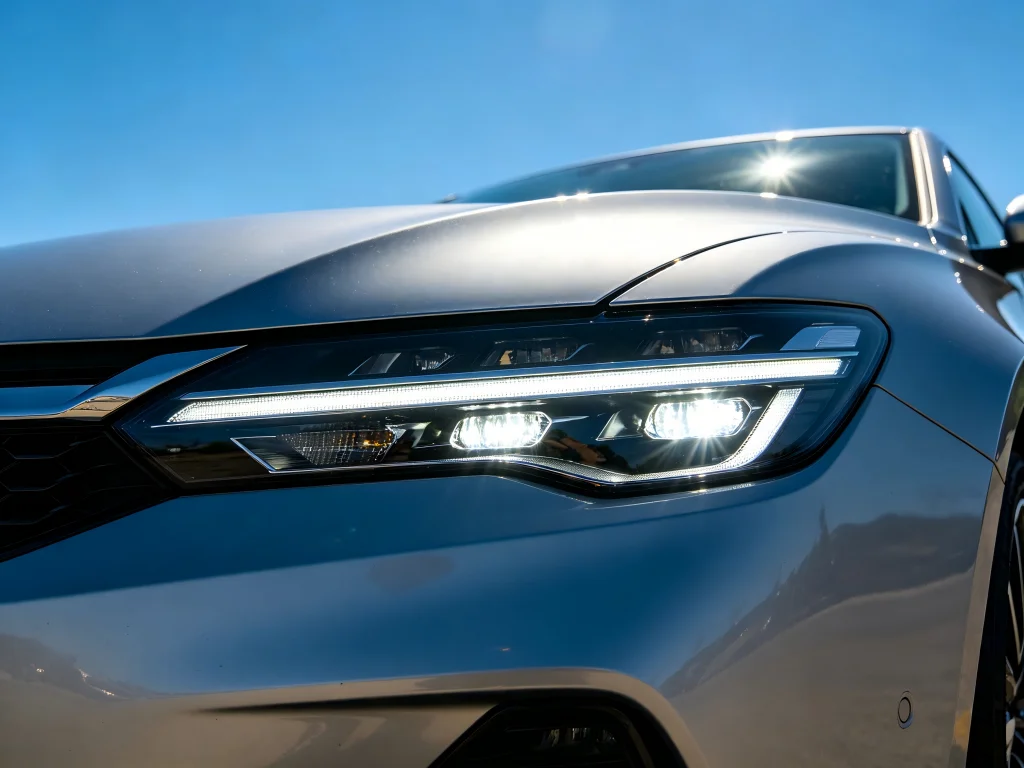
Not all daytime running lights deliver the same protection. Before you buy, understand the seven engineering metrics that determine whether your DRLs will last six months or six years.
1. Why Most "Buying Guides" Leave Out What Actually Matters
Search daytime driving lights online and you’ll find countless articles telling you to check “brightness” and “color temperature.” These surface-level recommendations ignore the technical realities that separate reliable DRLs from dangerous counterfeits.
Let’s fix that.
After analyzing the market, testing dozens of daytime driving lights bmw and daytime driving lights mercedes aftermarket options, and consulting with automotive engineers across Europe and North America, we’ve identified the seven metrics that predict real-world performance.
We’ll compare three categories of day running lights car options:
- งบประมาณ/ทั่วไป ($20-60) – What you find on Amazon or eBay without clear specifications
- Mid-Range ($60-150) – Branded options with basic specifications and limited warranties
- Premium/Engineering-Grade ($150-400) – GTR Carbide Series and comparable engineered solutions
2. Metric 1: Thermal Management—The #1 Predictor of Lifespan
Thermal management determines longevity more than any other specification because heat destroys LEDs permanently.
LED chips don’t burn out like filaments. They degrade. Every 10°C increase above the rated junction temperature cuts LED lifespan by roughly half. Poor cooling turns a 50,000-hour LED into a 2,000-hour disposable item.
Here’s what to look for:
- Active cooling (fans): Moves heat away from the junction efficiently but adds moving parts that can fail. Works best when the housing has adequate airflow.
- Passive cooling (heat sinks): No moving parts, reliable, but requires sufficient surface area. Undersized heat sinks are the biggest failure point in cheap DRLs.
- Hybrid systems: Combine large heat sinks with auxiliary fans for maximum thermal headroom during summer driving.
In summer heat, your daytime driving lights selectable b face additional stress. Asphalt absorbs and radiates heat, increasing ambient temperatures around the vehicle. Lights mounted low (like fog light DRLs) experience even greater thermal load.
3. Metric 2: CANBUS Compatibility—No Errors, No Flicker
CANBUS-incompatible LEDs are the #1 reason for dashboard errors and flickering daytime running lights.
Modern vehicles monitor bulb resistance to detect failures. LEDs draw less current than halogens—typically 80% less. The vehicle computer interprets this as a burned-out bulb and responds by pulsing power to test the circuit. That pulsing creates the flickering you see at stoplights.
How different DRL categories handle compatibility:
| คุณสมบัติ | Budget DRLs | Mid-Range DRLs | GTR Carbide Series |
|---|---|---|---|
| Built-in CANBUS decoder | ไม่ | Partial (basic resistor) | Yes (full integration) |
| PWM flicker elimination | ไม่มี | Partial | Full stabilization |
| Dashboard error prevention | Errors common | Some errors remain | Error-free operation |
| Extra harness required | No (fails without it) | Often required | None—plug and play |
For daytime driving lights bmw and Mercedes owners, CANBUS compatibility isn’t optional. German electrical systems are particularly sensitive to resistance mismatches and will generate persistent error codes without properly engineered solutions.
4. Metric 3: Luminous Intensity (Lumens vs. Raw Output)
Raw lumen numbers lie. What matters is usable light output—and how it’s distributed.
Many budget DRLs advertise 3000+ lumens but deliver less than 500 usable lumens after optics losses and thermal degradation. The GTR Carbide Series delivers 2500-3000 raw lumens per headlight, with optics efficiency exceeding 80%.
Here’s the real comparison:
- Budget DRLs: 500-1000 advertised lumens / 200-400 actual after 30 minutes / 30-50% light loss within 6 months
- Mid-Range DRLs: 1000-2000 advertised lumens / 600-1200 actual / 15-25% loss within 12 months
- Premium DRLs (GTR): 2500-3000 raw lumens / 2000-2500 actual sustained / Thermal stability prevents long-term loss
5. Metric 4: Optics and Beam Pattern Control
Controlled optics prevent glare. Glare blinds other drivers and defeats the safety purpose of daytime running lights.
Quality daytime running light symbol performance depends on precise LED DRL beam pattern reflector optics design. Cheap DRLs use simple reflectors that scatter light in every direction. Premium units use multi-faceted optics that focus light where it belongs—forward and downward.
Think of it this way: A cheap DRL might look bright when you stare directly at it (high peak intensity) but provides poor road illumination because the light scatters everywhere. A quality DRL provides even, controlled illumination that improves visibility without creating dangerous hotspots.
6. Metric 5: Weather Sealing and UV Protection
Moisture intrusion kills DRLs faster than heat in most vehicles.
Your daytime driving lights mercedes face rain, snow, road salt, car washes, and condensation cycling. Without proper sealing, moisture enters the housing, corrodes circuit boards, and permanently damages LED components.
สิ่งที่ควรมองหา:
- IP67 or higher rating: Protection against immersion in water up to 1 meter
- UV-protected polycarbonate lenses: Prevents yellowing and cracking from sun exposure
- Vented housings: Allows moisture to escape while blocking water ingress
- Gold-plated connectors: Resists corrosion from road salt and humidity
Budget DRLs rarely specify IP ratings. Mid-range options might claim IP65 (dust-tight, water-resistant). Premium units like GTR Carbide are engineered to IP67 standards with additional corrosion protection.
7. Metric 6: Regulatory Compliance (DOT/SAE/ECE)
A DRL without compliance markings may be illegal on public roads and could void your insurance.
Different regions enforce different standards:
- North America: DOT (Department of Transportation) and SAE (Society of Automotive Engineers) compliance required
- Europe/UK: ECE (Economic Commission for Europe) approval required. Look for “RL” marking on aftermarket DRLs for type approval
- Australia: ADR (Australian Design Rules) compliance required for road use
GTR Carbide Series headlights are DOT-compliant and come with a 2-year warranty. Across the board, they deliver 2-5 times the brightness of OEM headlights while maintaining legal compliance.
8. Metric 7: Installation Requirements and Vehicle Fitment
Plug-and-play matters more than most buyers realize. Poor installation creates electrical problems that cheap DRLs can’t fix.
A Nissan GTR owner on a forum highlighted the risk: “Aftermarket installations are not always bad—but poor installation practices are dangerous for modern vehicles”. Improper wiring can cause battery drain, ECU damage, and even fire hazards.
What different installation scenarios require:
- Direct bulb replacement: Simplest option. Works only when the DRL function uses standard bulb sockets (H8, H11, 9005, etc.)
- Decoder harness required: Indicates the DRL lacks built-in CANBUS compatibility—common in mid-range products
- Plug-and-play with integrated decoder: Premium solution. No extra components needed. GTR uses this approach
- Full housing replacement: Most comprehensive solution. Replaces entire headlight assembly with integrated DRLs, low beams, high beams, and turn signals—what GTR Carbide Series provides
For vehicles requiring daytime driving lights selectable b (selectable color temperature or beam pattern), premium units offer dip-switch or app-based configuration without additional wiring.
9. Real-World Performance: What Buyers Actually Report
Customer experiences across forums and review sites tell a consistent story. One reviewer who tested the GTR Carbide Series on a Tacoma reported: “These easy-to-install headlights are equipped with LED daytime running light (DRL), LED reflector low beam and high beam, and an amber LED turn signal”—functionality that just works out of the box.
On a 4Runner, the same series earned praise for outperforming OEM housings in every aspect while maintaining factory-original aesthetics.
Contrast this with the MG owner whose dealer refused warranty coverage for a failing DRL because “bulb and LED only have 12 months warranty”. The difference between engineered quality and disposable parts becomes painfully clear when something fails.
10. Your Decision Matrix: Which Daytime Running Lights Should You Buy?
| Use Case | Recommended Category | Why |
|---|---|---|
| Newer BMW/Mercedes/Audi (2018+) | Premium engineered (GTR Carbide) | CANBUS sensitivity requires full compatibility. Mid-range options will generate persistent errors |
| Older vehicles without CANBUS | Mid-range possible, premium recommended | Lower electrical sensitivity, but thermal management still matters for longevity |
| Commercial fleets / high-mileage drivers | Premium engineered only | Thermal stress from continuous operation demands maximum cooling capacity |
| Budget-restricted / temporary vehicles | Mid-range | Expect 1-2 years of reliable service. Avoid bottom-tier products entirely |
| Older vehicles with day running lights not working issues | Diagnose first, then premium | Many “DRL not working” problems stem from poor aftermarket installations. Fix electrical issues before replacing |
11. Frequently Asked Questions About Choosing Daytime Running Lights
What color temperature is best for daytime running lights?
5000K-6000K (pure white to cool white) provides maximum contrast against natural daylight, improving visibility. Avoid 6500K+ blue-tinted lights, which reduce contrast and may violate local regulations.
Can I install daytime driving lights on a vehicle without factory DRLs?
Yes. Aftermarket universal DRL kits exist for virtually any vehicle. However, legal requirements vary by region. In the UK, aftermarket DRLs should be type-approved (“RL” marking) and wired to activate automatically with ignition. Always check your local vehicle lighting regulations.
How do I fix daytime running lights not working after an LED upgrade?
Start with the simplest fix: check fuses and connections. If the problem persists, you likely need CANBUS-compatible LEDs or load resistors. GTR Carbide DRLs eliminate this issue entirely with integrated compatibility.
Do daytime running lights drain my car battery?
Quality LED DRLs draw very little power—typically 3-15 watts per side. For reference, a single 55W halogen headlight bulb draws more than a full set of LED DRLs. LED DRLs won’t drain a healthy battery during normal driving cycles.
What’s the difference between day driving lights and fog lights?
DRLs are forward-facing lights designed for daytime visibility—they improve your vehicle’s visibility to others. Fog lights are low-mounted, wide-beam lights designed to illuminate the road immediately in front of your vehicle during fog, rain, or snow. They serve entirely different safety functions.
Are daytime running lights mandatory on new cars?
Yes in most developed markets. The EU mandated DRLs on all new passenger cars from February 2011. The UK followed the same standard. In North America, DRLs are common but not universally required—though many manufacturers include them as standard equipment.
Why does my day running lights symbol stay on after turning off the engine?
Some vehicles keep DRLs active for a brief period after shutdown (exit lighting). If the lights remain on indefinitely, check for a faulty relay, stuck CANBUS module, or aftermarket wiring issue. Persistent DRL activation can drain your battery overnight.
12. Ready to Upgrade Your Daytime Running Lights?
You now understand the seven metrics that separate engineered quality from disposable junk. You know why thermal management matters more than lumen counts. You’ve seen how CANBUS compatibility prevents flickering and errors. You can identify proper optics, weather sealing, and regulatory compliance.
Now it‘s time to put that knowledge into action.
GTR Lighting‘s Carbide Series delivers across every metric that matters: active thermal management, full CANBUS integration, precision multi-faceted optics, IP67 weather sealing, DOT compliance, and true plug-and-play installation. Our integrated LED daytime running lights selectable b provide consistent, reliable illumination backed by comprehensive warranty coverage.
Don‘t settle for flickering, failing, or error-prone DRLs that compromise your safety. Choose the engineering that works as hard as you do.
เยี่ยมชม https://www.rhgtr.com today to find the GTR Carbide Series for your vehicle. Your visibility depends on it.