
Walk into any auto parts store or browse online, and you’ll face a wall of high beam headlight options. Halogen. LED. HID. Prices from $15 to $300. Claims of 10,000 lumens, 50,000-hour lifespans, and “plug-and-play” installation. It’s overwhelming. And most of the advice you’ll find is written by people who have never actually installed a headlight bulb.
This guide cuts through the marketing noise. Based on real engineering data and verified customer feedback from over 50,000 orders, we’re breaking down exactly what each high beam headlight technology delivers — and what it doesn’t.
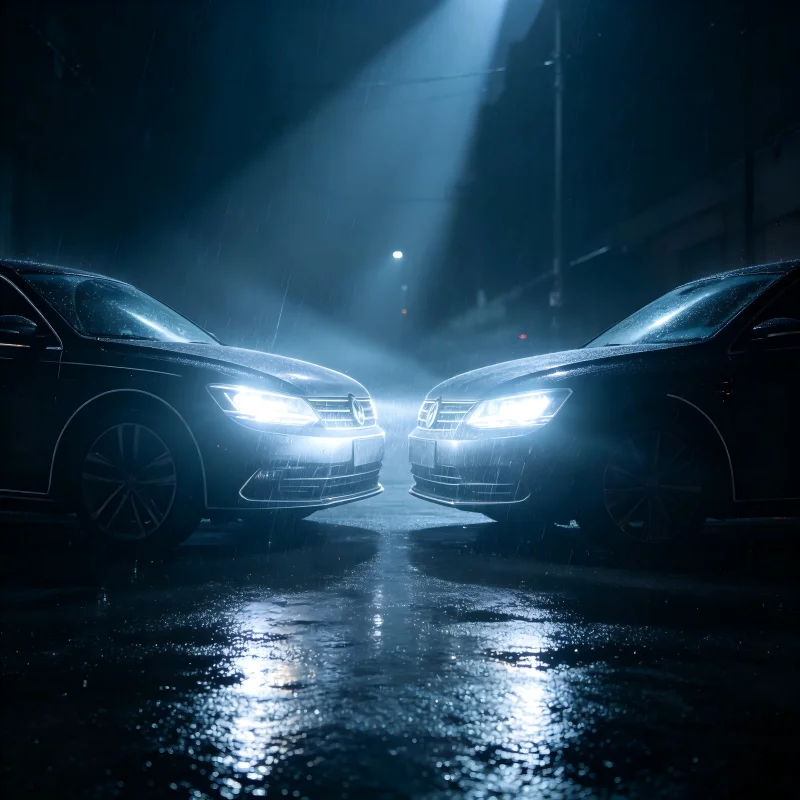
1. The Three High Beam Headlight Technologies — Side by Side
Before we dive into specifics, here’s the bottom line: properly engineered LED high beam headlights outperform halogen and HID in almost every measurable category. But not all LEDs are created equal. The gap between a premium LED and a cheap LED is wider than the gap between halogen and HID.
| คุณสมบัติ | Halogen | HID (ซีนอน) | LED (Premium) |
|---|---|---|---|
| Brightness (Lumens) | 700-1,200 | 2,500-3,500 | 3,000-6,000+ |
| อายุการใช้งาน (ชั่วโมง) | 500-1,000 | 2,000-3,000 | 20,000-30,000 |
| Warm-up time | ทันที | 5-15 seconds | ทันที |
| Energy efficiency | ต่ำ | Moderate | สูง |
| ความแม่นยำของรูปแบบลำแสง | Excellent (if aligned) | Good | Excellent (with proper chip positioning) |
| Typical cost per bulb | $10-30 | $60-150 | $80-200 |
2. Halogen High Beam Headlights — The Familiar Baseline
Halogen bulbs have been the automotive standard for decades. They’re simple, cheap, and widely available. If your car came from the factory with halogens, replacing them with the same technology is straightforward — no adapters, no resistors, no CANBUS issues.
But “simple” and “cheap” come with serious trade-offs.
Halogen high beam headlights produce a warm, yellow-white light that’s noticeably dimmer than modern alternatives. At 700-1,200 lumens, they struggle to reach the full 350-400 feet of theoretical high beam distance. And with a lifespan of just 500-1,000 hours, you’re replacing them every year or two if you drive at night regularly.
The real problem with halogen, however, isn’t what they do when they’re new. It’s what they do as they age. Halogen bulbs degrade gradually — output drops by 20-30% before the bulb actually fails. Most drivers don’t notice the decline because it happens slowly. They just gradually accept poorer visibility as “normal.”
Halogen high beam headlights make sense if you’re on a tight budget and rarely drive at night. For anyone who regularly drives after dark, the limitations become dangerous.
3. HID High Beam Headlights — Brighter, But Not Without Issues
High-Intensity Discharge (HID) bulbs — also called xenon — represented a significant leap forward when they hit the market. They produce 2,500-3,500 lumens of bright, white light that significantly outperforms halogen.
But HID high beam headlights have three major drawbacks that make them a poor choice for many drivers.
First, warm-up time. HID bulbs take 5-15 seconds to reach full brightness. That means if you need to flash your high beams to signal another driver or quickly illuminate a hazard, you’re waiting. In emergency situations, those seconds matter.
Second, complexity. HID systems require ballasts — external units that regulate the electrical current. These add cost, complexity, and potential failure points. Installation is more involved than a simple bulb swap.
Third, and most critically for high beam use: HID bulbs produce intense glare if not perfectly aligned. The bright, slightly blue light scatters more easily than halogen or LED, which means poor beam patterns are common with retrofit kits. In many jurisdictions, aftermarket HID conversions are illegal because they take the headlamp out of standards compliance.
HID high beam headlights are best suited for drivers who want maximum brightness and are willing to deal with the warm-up delay and installation complexity. For most drivers, however, the trade-offs aren’t worth it.
4. LED High Beam Headlights — The New Standard, If You Choose Wisely
LED technology is rapidly becoming the dominant choice for high beam headlights. The advantages are compelling: 20,000-30,000 hour lifespans, instant full brightness, excellent energy efficiency, and brightness that can exceed 6,000 lumens.
But here’s where most buyers get tripped up: not all LED high beam headlights are engineered equally.
The critical factor is chip positioning. Your headlight housing was designed around a halogen filament sitting at a specific location. For an LED bulb to produce a correct beam pattern, the LED chips must sit in exactly the same position. The best LED chips — like the Philips ZES series — measure 1.6mm x 2.0mm, closely matching the halogen filament width. This delivers a razor-sharp beam pattern with a clean cutoff on low beam and focused throw on high beam.
Cheap LED kits use larger chips or place them incorrectly. The result? Scattered light that hits the treetops and oncoming drivers’ eyes instead of the road ahead. You get “bright” light that doesn’t actually help you see better.
The other differentiator is thermal management. LEDs generate heat. Without proper heat sinking and active cooling, they overheat, dim, and fail prematurely. Premium LED high beam headlights use advanced thermal designs to maintain consistent output over years of use.
For high beam use specifically, LED technology is the clear winner when properly engineered. The instant full brightness matters for high beam flashing and quick reactions. The focused beam pattern delivers usable distance, not just scattered lumens. And the longevity means you’re not constantly replacing bulbs.
5. What to Look For When Buying High Beam Headlights
Based on our years of manufacturing expertise and analysis of thousands of customer installations, here are the five factors that actually matter:
-
- Bulb size compatibility — Your vehicle uses a specific bulb size (9005, H1, H7, H4, etc.). The right bulb size is non-negotiable.
- Chip type and positioning — Premium chips like Philips ZES or advanced CSP designs deliver accurate beam patterns.
- Beam pattern inspection — A good LED high beam produces a clean, focused beam with minimal scatter.
- Thermal management — Active cooling (fans) or advanced passive cooling (heat sinks) are essential for longevity.
- CANBUS compatibility — Your vehicle’s computer needs to recognize the bulbs without throwing error codes.
Avoid any product that doesn’t specify its chip type. Avoid anything that claims “universal fit” — headlight engineering is specific to each bulb size and housing type. And be extremely skeptical of lumen claims that aren’t backed by third-party verification.
6. Real-World Performance — What Drivers Report
Data from real customer feedback across tens of thousands of LED installations reveals consistent patterns:
-
-
- Drivers upgrading from halogen to premium LED report seeing reflective signs from significantly greater distances
- High beam distance improvements are described as “transformative” on rural and unlit roads
- Beam pattern clarity — not just brightness — is the most frequently cited benefit
- Installation simplicity (true plug-and-play) is valued as much as performance
- The most common regret among buyers? Not upgrading sooner
-
One consistent finding across all feedback: the gap between “good” LED high beam headlights and “cheap” LED high beam headlights is enormous. Drivers who bought on price alone nearly always ended up replacing their purchase within a year.
7. Which High Beam Headlights Should You Buy?
Here’s the straightforward recommendation based on your driving profile:
If you rarely drive at night — Halogen bulbs are fine. They’re cheap and do the job for occasional use.
If you drive at night regularly and want the best performance — Premium LED high beam headlights are the clear choice. Look for products that specify their chip type, verify beam patterns, and have proven thermal management.
If you’re on a mid-range budget — Skip HID. The warm-up delay and installation complexity aren’t worth it. Instead, look for mid-tier LED options from reputable manufacturers that use quality chips.
Whatever you do, avoid the cheapest option in any category. A $15 LED kit or a $20 halogen “upgrade” will cost you more in the long run — in replacement costs, reduced visibility, and compromised safety.
8. GTR's Approach to High Beam Headlight Engineering
GTR’s Ultra 3 series represents what properly engineered LED high beam headlights should be. For 9005 (HB3) high beams — one of the most common sizes on American, Japanese, and Korean vehicles — the Ultra 3 uses premium LED chips with optimized positioning for accurate beam patterns.
The engineering philosophy is simple: deliver usable light where it matters, not just raw lumens that scatter. Every GTR product is tested for beam pattern integrity, thermal performance, and CANBUS compatibility before it reaches customers.
The result? High beam headlights that actually deliver the distance and clarity drivers expect when they switch to high beams on dark roads.
9. High Beam Headlights — Quick Answers
9.1. How far should high beam headlights illuminate?
High beam headlights should illuminate 350-400 feet ahead. Some premium LED systems can reach further with clean, focused beams. Regulatory minimums vary, but 100 meters (about 328 feet) is a common standard.
9.2. What does the high beam headlights indicator look like?
The high beam indicator is a blue dashboard symbol that looks like a headlight with straight, horizontal lines radiating outward. When you see this blue light on your dash, your high beams are active.
9.3. When should high beam headlights be dipped?
Dip your high beams when you’re within 200 meters of an oncoming vehicle or a vehicle traveling in the same direction. Failing to do so can result in fines and demerit points in many jurisdictions.
9.4. Are LED high beam headlights better than halogen?
Yes, when properly engineered. LEDs deliver 10x the lifespan, higher brightness, better energy efficiency, and instant full brightness with no warm-up delay. However, cheap LEDs with poor beam patterns can be worse than halogen. The engineering quality matters enormously.
9.5. Can I use high beam headlights in fog?
No. High beams in fog scatter light off water droplets and reflect back toward the driver, creating glare and reducing visibility. Use low beams or fog lights instead.
9.6. How do I know which bulb size my high beam headlights need?
Check your vehicle’s owner manual or use an online bulb reference guide. Common high beam sizes include 9005 (HB3), H1, H7, and H4. Using the wrong size is the most common — and most avoidable — mistake in headlight upgrades.
Visit www.rhgtr.com to find the right high beam headlights for your specific vehicle.