
0.1. Identify the Correct Base and Voltage (Before You Buy Anything)
There is no universal bi-pin bulb. The number after the “G” tells you the pin spacing in millimeters:
- G4: 4mm pin spacing. Almost always 12V low-voltage systems (landscape lights, cabinet puck lights, RV ceiling fixtures). Use a 2 pin led bulb holder designed for G4 capsules.
- GY6.35: 6.35mm pin spacing, typically 12V. Often found in desk lamps and some track lighting.
- G8: 8mm pin spacing. Can be 12V or 120V — check the fixture label.
- G9: 9mm pin spacing, looped pins. Typically 120V line voltage. Common in European-style chandeliers, bathroom vanity bars, and under-cabinet lights.
- G13: Medium bi-pin, 13mm spacing. Found on T8 and T12 linear tubes, typically 120–277V, used in garages, workshops, and commercial spaces. If you shop at bi pin led bulb canadian tire หรือ 2 pin led bulb bunnings, you will see these sold as LED tube replacements.
Before ordering, pull the old bulb and read the stamp on the base or the fixture label. Never guess the voltage based on what “looks right.”
0.2. Match the Driver to the Infrastructure
For 12V systems, check what type of transformer feeds the circuit. Magnetic (iron-core) transformers output AC with a rough waveform that many LED drivers cannot process cleanly. Electronic (switch-mode) transformers are generally more LED-friendly, but some still have minimum load requirements. If you are replacing halogen G4 capsules with 2 pin led bulb equivalents, and the total wattage of your new LEDs falls below the transformer’s minimum load threshold, you have two choices: leave one halogen bulb in the circuit to maintain the minimum load (a wasteful but functional workaround), or replace the transformer with an LED-compatible driver. The second option costs more upfront but pays back in bulb lifespan and energy efficiency.
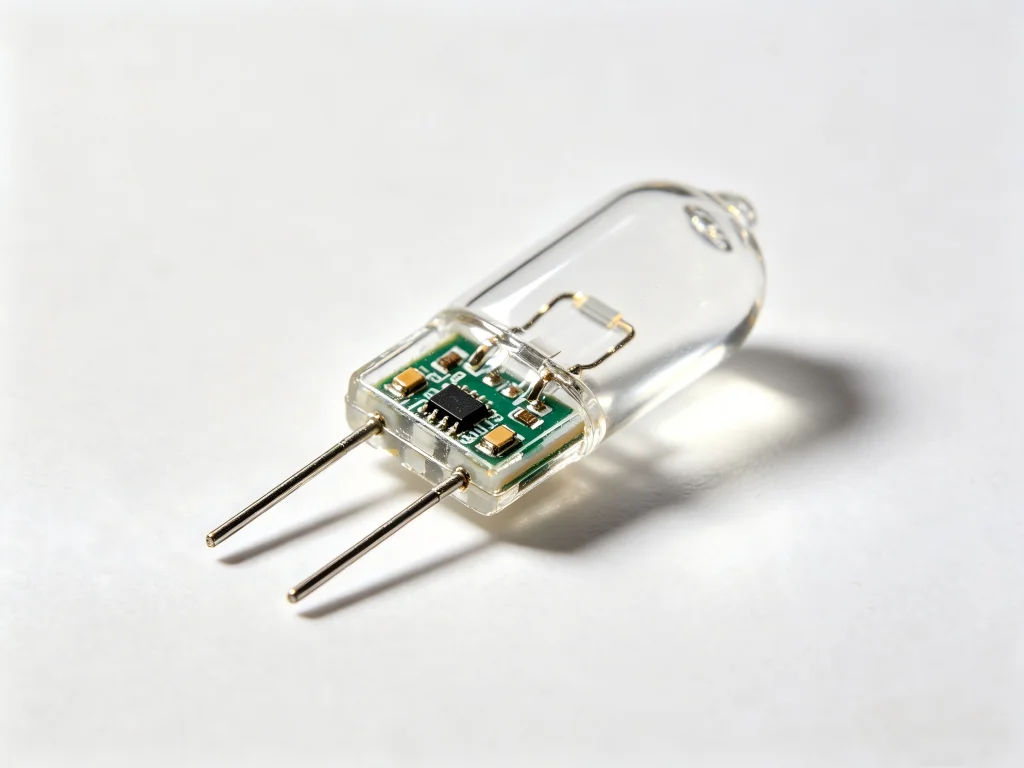
For 120V G9 applications, the driver is built into each bulb’s base. The quality of that miniature driver matters enormously. Look for bulbs that specify “flicker-free driver” or “constant-current driver” in their specifications. If the manufacturer is proud of their driver design, they will tell you about it. If the spec sheet is silent on the driver type, assume it is the cheapest rectifier circuit that can pass a QC bench test at room temperature. Based on years of manufacturing experience, we recommend checking whether the internal driver uses constant-current topology rather than simple resistive current limiting, as the former protects the LED chips from current spikes and extends lifespan significantly in fluctuating-voltage environments like RV and marine 12V systems.
0.3. Demand Real Thermal Engineering
A bi-pin LED bulb that survives must move heat away from both the LED chips and the driver electronics. Here is what to look for:
- Metal body, not plastic: The bulb housing should be aluminum or another thermally conductive material that acts as a passive heat sink. Plastic bodies trap heat and are a red flag for early failure.
- Thermal protection circuit: A well-designed bulb includes a thermistor-based protection loop that reduces power output if internal temperatures climb too high, rather than letting the chips cook themselves to death. This feature alone can triple the bulb’s service life in enclosed fixtures.
- Chip quality matters: Genuine CSP (Chip-Scale Package) LEDs from manufacturers like Philips (the Z ES series) or Seoul Semiconductor have significantly higher heat-resistance ratings than generic no-name chips. They also produce a tighter optical source, which matters for beam pattern if you are replacing a halogen capsule in a reflector fixture.
1. Questions We Hear Every Week About Bi-Pin LED Bulbs
1.1. Can I use a 12V bi-pin LED bulb in a 120V fixture?
No, and attempting to do so can cause the bulb to fail instantly and catastrophically. The internal driver in a 12V-rated bulb is not designed to handle 120V mains voltage. In some cases, the pin spacing also differs between 12V and 120V form factors, providing a mechanical safety barrier, but not all standards enforce this. Always match the bulb voltage exactly to the fixture rating. If you have a 120V fixture that originally used a halogen G9 capsule, you must use a 120V-rated LED G9 replacement.
1.2. Why does my dimmable bi-pin LED flicker on my old dimmer switch?
Most older dimmer switches use TRIAC (forward-phase) dimming, which was designed for the resistive load of incandescent filaments. LED drivers present a capacitive load that confuses TRIAC dimmers, causing them to misfire — that is the flicker you see. The fix is either to replace the dimmer with an ELV (reverse-phase) model specifically rated for LED loads, or to use LED bulbs that explicitly list TRIAC compatibility on their packaging. Even then, test one bulb before buying a full set, because compatibility varies by specific dimmer-bulb combination.
1.3. What is the difference between a G4 and G9 bi-pin LED bulb?
The G number indicates pin spacing in millimeters: G4 has 4mm between pins, G9 has 9mm. But the bigger practical difference is voltage. G4 bulbs are almost universally 12V low-voltage systems requiring an external transformer or driver. G9 bulbs are typically 120V line-voltage, with the driver integrated into the bulb base. They are not interchangeable — a G4 bulb will not fit a G9 socket, and vice versa. Measurement before ordering is essential.
1.4. How many lumens do I need to replace a halogen bi-pin capsule?
As a general rule, LEDs produce about 5–7 times more lumens per watt than halogen. A 20W G4 halogen capsule producing roughly 200–250 lumens can be replaced by a 3W–4W LED producing the same light output. A 40W G9 halogen producing about 500 lumens can be replaced by a 5W–6W LED. However, pay attention to beam angle. Halogen capsules emit light in all directions (roughly 300–360°), while some LED replacements have a narrower beam. If your fixture relies on omnidirectional light — such as a pendant globe — choose an LED replacement specifically labeled as “omnidirectional” or with a beam angle above 270°.
1.5. Why do my LED bi-pin bulbs buzz?
Buzzing or humming usually originates from the driver circuit inside the bulb. When the driver receives unstable or “dirty” AC power — from an incompatible transformer, a noisy dimmer, or voltage fluctuations on the line — the magnetic components in the driver vibrate at audible frequencies. This is more common with cheaply built bulbs that lack adequate filtering components. Replacing the transformer with an LED-compatible model or switching to a higher-quality bulb with better input filtering typically resolves the issue. In our experience, the buzzing is a warning sign: the same electrical stress causing the noise is also degrading the driver components faster than normal.
2. How GTR Engineers Its Bi-Pin Bulbs to Survive the Conditions That Kill Cheap Alternatives
After dissecting the failure modes of dozens of competitor products in our in-house quality laboratory, we approached bi-pin LED design differently. Our engineering philosophy is straightforward: if a bulb fails in an enclosed fixture at 90°C ambient, it was not designed for the real world.
Our LED modules use genuine CSP chip technology with junction temperature ratings that significantly exceed industry averages. Rather than relying on noisy cooling fans — which introduce a mechanical point of failure and are impractical in sealed bi-pin fixtures anyway — we use the bulb body itself as a thermal pathway. Machined aluminum housings with integrated heat-dissipation structures draw heat away from both the chips and the driver, keeping internal temperatures within safe operating ranges even in enclosed glass fixtures with zero ventilation.
Every bulb incorporates an intelligent thermal protection circuit. When internal temperatures approach critical thresholds, the driver reduces output power slightly rather than allowing the chips to be damaged. This is not a marketing feature — it is the difference between a bulb that survives a hot summer in an RV ceiling fixture and one that fails on the third day of a camping trip. Based on our years of manufacturing expertise, we have verified that this foldback circuit activates seamlessly and recovers full brightness once temperatures normalize, with no visible flicker or interruption.
We also build our drivers with headroom. Capacitors are rated for 125°C, not the 85°C we commonly find in failed competitor units. The constant-current topology actively regulates output rather than passively hoping input voltage stays stable. This matters whether you are powering the bulb from a pristine 12V DC battery bank in a yacht or from a decades-old 120V AC circuit in a Victorian home. Our products carry CE, FCC, RoHS, and ISO9001 certifications, reflecting a manufacturing discipline that underpins every component decision.
For distributors and B2B buyers sourcing bi pin led bulb g4, bi pin led bulb g9, or custom bi-pin LED solutions, we offer OEM and ODM services backed by 18 years of automotive-grade lighting manufacturing experience. Our 30,000-square-meter production facility includes an automotive-grade dust-free SMT workshop, and we ship to over 80 countries with regional protection policies for distribution partners.
3. Your Next Step: Stop Replacing and Start Fixing
If you have been cycling through bi-pin LED bulbs like disposable batteries — buying another pack at the hardware store, swapping them out every few months, wondering if LED technology is simply overhyped — it is time to break the cycle. The problem is not LEDs. The problem is that most off-the-shelf bulbs are built to a price point, not to an operating environment. They survive on a test bench at room temperature and fail in your 120°F attic fixture because nobody designed them for that reality.
Whether you need reliable G4 capsules for a hotel chain’s landscape lighting retrofit, G9 replacements that actually survive in enclosed bathroom fixtures, or a custom bi-pin LED module engineered to your exact specifications, we can help. Our engineering team works directly with distributors, contractors, and OEM partners to match the right bulb to the real operating conditions — voltage, dimming protocol, thermal environment, and duty cycle. No guesswork. No recurring failures. Just lighting that works as long as the specification says it will.
Request a consultation and product samples from GTR Lighting today. Tell us about your application, and we will recommend — or build — the bi-pin LED solution that actually fits.