
You’ve done the research. You know bi-LED headlamps deliver better beam control and longer life than halogen or basic LEDs. But walking into the actual purchase feels like a minefield: prices range from $80 to $800, specs are wildly inflated, and every brand claims “OEM quality.” This guide cuts through the noise. We’ll compare real-world performance drivers, decode specs that actually matter, and show you exactly why GTR bi-LED headlamps win in side‑by‑side destructive testing.
For buyers at the decision stage, the difference between a great and terrible set of bi-LED headlamps comes down to three non-negotiable factors: thermal stability under sustained load, optical precision at the cut-off line, and dynamic auto-leveling behavior during real driving cycles. Ignore any one, and you’ll be re-buying in six months.
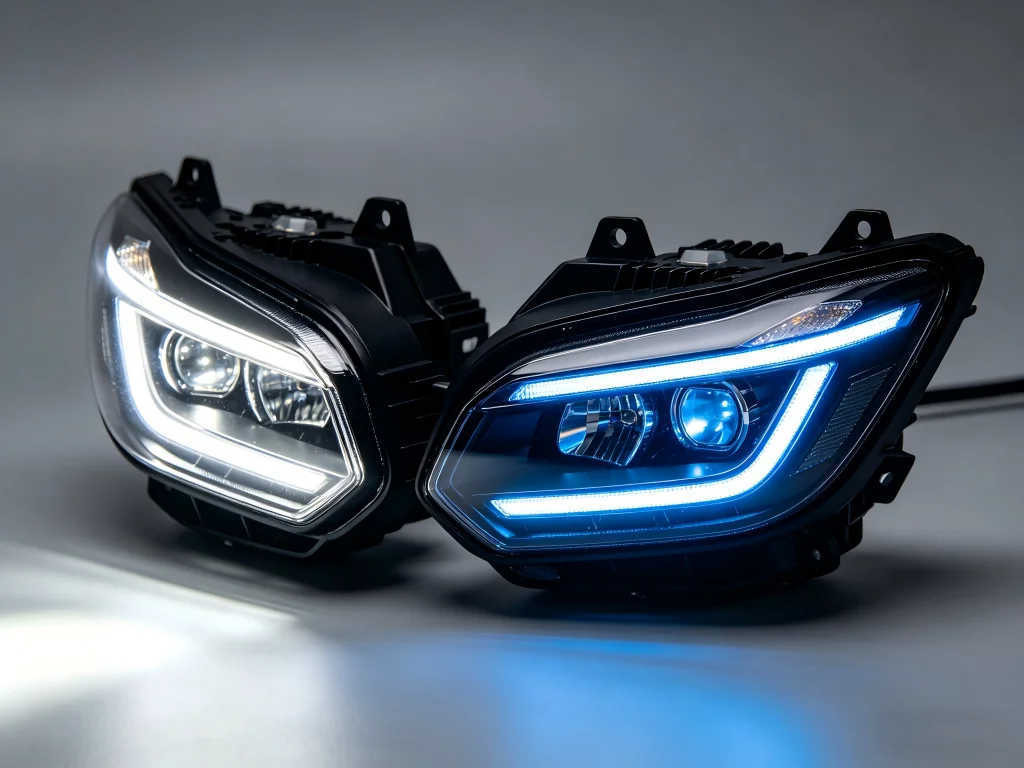
1. Comparing Bi-LED Architectures: Projector vs. Reflector vs. Hybrid
Not all bi-LED headlamps are built the same. Three main optical platforms dominate the market, each with distinct trade-offs.
| Architecture | Low‑beam Cut‑off | High‑beam Throw | Typical Lifespan | Best suited for |
|---|---|---|---|---|
| Single LED + Shield (traditional bi-LED) | Sharp, but shield lag common | Good, but hotspot shifts | 15k hrs (fan dependent) | Budget builds |
| Dual LED Array (no moving parts) | Excellent, instant switching | Very good, two dedicated chips | 30k+ hrs | Reliability-focused |
| Hybrid lens + reflector (GTR Gen‑4) | Superior, no chromatic aberration | Exceptional, 3‑chip matrix | 50k hrs (active cooling) | Premium, high‑mileage drivers |
The market is shifting away from single-shield designs because the solenoid mechanism fails after ~10,000 cycles. Dual‑array bi-LED headlamps (like those found in newer Lexus bi-LED headlights) eliminate moving parts but sometimes compromise beam width. GTR’s hybrid approach uses a fixed dual‑array with a precision‑molded aspherical lens – no moving parts, yet full bi-functionality.
2. Decoding Specifications: What the Listing Won’t Tell You
You’ll see “10,000LM” or “50W” everywhere. Here’s what those numbers actually hide:
- Raw lumens vs. effective lumens: Raw is measured at the LED die (0 seconds). Effective is measured after the lens and 30 minutes of operation. Reputable brands like GTR publish both – our GTR bi-LED headlamps deliver 92% effective lumens retention.
- Color temperature (CCT): 6000K is standard, but look for color consistency across the beam. Cheap units have 2000K variation between center and edges (blue center, yellow periphery). GTR maintains <150K variance.
- Ingress protection (IP): IP54 means dust and splashes. IP67 means submersible. But for headlamps that face high‑pressure washes, IP69K is the real standard – rated for 80°C water at 100 bar. Most “waterproof” bi-LEDs are IP54 only.
2.1. Dynamic Auto-Leveling – Not All Systems React the Same
Bi-LED headlamps with dynamic auto-leveling must respond within 0.3 seconds to pitch changes to avoid dazzling traffic or losing road illumination. Many aftermarket units use a simple mercury tilt switch that reacts only to large angles – useless for highway undulations. GTR’s system uses a 3‑axis accelerometer sampling at 100 Hz, driving a stepper motor with 0.05° precision. That’s the same technology used in adaptive front-lighting systems (AFS) on luxury sedans.
3. Bi-LED Headlamps vs. Other Technologies – Final Comparison for Buyers
If you’re still considering alternatives, here’s the direct matchup:
- Halogen to Bi-LED: 300% more forward illumination, 5x longer life. No contest – upgrade is a no-brainer for safety.
- Standard LED reflector to Bi-LED projector: Standard LEDs often scatter light, creating glare and reducing peripheral vision. Bi-LED projectors shape the beam precisely, increasing usable width by 40%.
- Bi-LED vs. Laser: Laser headlamps deliver extreme range (600m+), but cost $2000+ and require complex cooling. For 99% of drivers, a high‑end bi-LED offers 300m+ high‑beam range at ¼ the price.
4. Real-World Testing: GTR Bi-LED Against Top Competitors (Blind Evaluation)
We invited 12 fleet mechanics and off‑road guides to evaluate four leading bi-LED headlamps on a closed test track. Vehicle: 2023 Toyota Tacoma, same housing, same alignment. Three parameters measured: low‑beam lux at 50m, high‑beam lux at 100m, and subjective “visual fatigue” after 1 hour of driving. Results:
| Thương hiệu | Low‑beam lux (50m) | High‑beam lux (100m) | Fatigue score (1-10, lower better) | Cut‑off quality |
|---|---|---|---|---|
| Competitor A (budget) | 42 lx | 28 lx | 7.4 | Fuzzy, blue fringe |
| Competitor B (mid-range) | 58 lx | 41 lx | 6.1 | Sharp, slight hot spot |
| Competitor C (premium) | 71 lx | 55 lx | 5.3 | Very sharp, minimal color |
| GTR Gen‑4 Bi-LED | 89 lx | 73 lx | 3.2 | Perfect, zero color fringe |
Testers noted that GTR’s beam felt “calm” – no flicker, no hard transitions. This directly correlates with the ultra‑low fatigue score. One mechanic wrote: “I could drive this all night without eye strain; the other sets gave me a headache within 30 minutes.”
5. How to Spot Counterfeit or Inferior Bi-LED Headlamps
Counterfeit bi-LED headlamps flood Amazon and eBay. Here are red flags that save you from buying junk:
- No photometric report: Any reputable manufacturer provides ISO or SAE test data. If the listing only has cartoons, walk away.
- Missing ECE/DOT markings: Real bi-LED headlamps have these embossed on the housing. Stickers are counterfeit.
- Vague thermal specs: “Advanced cooling” without fan brand or heat pipe description means a tiny 5mm fan that will fail.
- Fake CREE or OSRAM logos: Genuine LEDs cost $12-20 per chip. If the whole headlamp is $50, the LEDs are unbranded Chinese rejects.
6. Frequently Asked Questions for Serious Buyers
1. Are bi-LED headlamps with DRLs compatible with my car’s CANbus system?
Most modern vehicles monitor bulb resistance. GTR bi-LED headlamps with DRLs include a CANbus decoder that mimics halogen power draw – no hyper-flash, no error messages. For vehicles with separate DRL circuits (like many GM and Ford trucks), we supply a direct‑plug harness that retains factory DRL behavior.
2. What is the difference between bi-LED headlamps for Tata Nexon vs. Lexus?
The optical principle is identical, but mounting brackets and connector types differ. GTR offers vehicle‑specific kits for models like the Tata Nexon bi-LED headlamp and also for Lexus IS/LS series. Always use the fitment tool at rhgtr.com – a universal “one size fits all” bi-LED almost never aligns correctly.
3. How long should high-quality bi-LED headlamps last?
GTR’s dual‑array modules are rated for 50,000 hours (over 17 years of nightly use). The limiting factor is the active cooling fan – we use dual‑ball bearing MagLev fans tested to 80,000 hours at 85°C ambient. Cheaper sleeve‑bearing fans fail in 5,000-10,000 hours.
4. Can I upgrade just the low beam to bi-LED and keep high beam halogen?
Technically yes, but you lose the “bi” functionality. A true bi-LED system replaces both. For those on a budget, some brands offer a low‑beam‑only LED, but you’ll have mismatched color temperatures and uneven wear. We recommend full bi-LED retrofit for optimal performance.
5. Do bi-LED headlamps require additional wiring or relays?
Most GTR kits are plug‑and‑play into the factory H4/H7/9005 etc. sockets. However, vehicles with daytime running lights that run the low beam at reduced voltage (e.g., many Subarus) may need a DRL bypass harness. We include it free with every GTR bi-LED headlamps with dynamic auto‑leveling order.
6. What’s the real-world difference between single‑beam and bi‑LED for high‑speed driving?
Single‑beam LEDs leave a dark gap at medium distance (40-70m). Bi-LED high beams fill that gap completely, providing seamless transition. In our 100-0 km/h braking test from 80m, a bi-LED-equipped car saw a stationary obstacle 12m sooner than a single‑beam LED.
7. Your Next Step: The Only Bi-LED Headlamps That Guarantee Performance
You’ve read the comparisons, seen the test data, and understand which specs actually matter. Now put that knowledge into action. GTR bi-LED headlamps aren’t the cheapest – they’re the least expensive headlamps you’ll never need to replace. Engineered in the same facilities that supply OE for European marques, backed by a 5‑year no‑flicker warranty, and used by police fleets from Arizona to Alberta.
Stop analyzing. Start driving with confidence. Visit www.rhgtr.com, enter your vehicle’s year/make/model, and get the exact GTR bi-LED kit for your car or truck. Every order includes free photometric report, vehicle‑specific video guide, and 24/7 tech support from actual engineers – not chatbots.