
Bạn đã thu hẹp tìm kiếm của mình xuống một đèn pha LED bi mini projector. Bây giờ thử thách thực sự bắt đầu: tách biệt kỹ thuật thực sự khỏi sự thổi phồng tiếp thị.
Bước vào bất kỳ chợ trực tuyến nào, bạn sẽ tìm thấy hàng trăm “mini projector” với giá từ $39 đến $600. Tất cả trông giống nhau trong ảnh sản phẩm. Tất cả đều hứa hẹn độ sáng “siêu sáng”. Tuy nhiên, trên đường, hiệu suất khác nhau rất nhiều—và các lựa chọn rẻ nhất thường hỏng trong vòng vài tháng, khiến bạn mắc kẹt trong bóng tối với vỏ nhựa bị chảy và không có hỗ trợ bảo hành.
Hướng dẫn này loại bỏ những tiếng ồn tiếp thị. Dựa trên nhiều năm kinh nghiệm sản xuất, dữ liệu thử nghiệm của bên thứ ba và hàng nghìn lần lắp đặt thực tế, chúng tôi sẽ xem xét bảy bài kiểm tra khách quan để tiết lộ đèn pha LED bi mini projector hệ thống nào thực sự mang lại giá trị lâu dài. Cuối cùng, bạn sẽ biết chính xác những gì cần tìm—và những “ưu đãi” nào nên tránh xa.
1. Ba Loại Kiến Trúc Chính Của Mini Projector (Và Loại Nào Thắng)
Không phải tất cả các bi-LED projector đều sử dụng thiết kế bên trong giống nhau. Hiểu ba kiến trúc này giải thích 80% sự khác biệt về hiệu suất mà bạn sẽ gặp phải.
Kiến trúcCách hoạt độngƯu điểmNhược điểmĐánh giá thực tế
| Chip đơn + Chảo phản xạ | Một chip LED bắn vào một chảo phản xạ kim loại được đánh bóng để định hình chùm sáng; một tấm chắn di động tạo ra chùm sáng thấp/cao. | Đơn giản, chi phí thấp, kích thước nhỏ gọn | Điểm sáng không đều, khoảng cách chiếu xa trung bình, chảo phản xạ xuống cấp theo thời gian | Just a budget option. Acceptable for city driving, poor for rural use. |
| Dual chip + Aspheric lens (Industry standard) | Two high-density LED chips mounted side by side, projecting through a multi-coated glass aspheric lens; solenoid-controlled shield. | Excellent beam uniformity, sharp cutoff, powerful long-range projection | Requires quality thermal management; lens alignment is critical | Recommended for most drivers. Best balance of cost and performance. |
| Matrix/Multi-chip + TIR lens | 3-4 individual LED chips behind a total internal reflection (TIR) lens; electronically controlled beam pattern (no mechanical shield). | Ultra-wide beam, instant switching, no mechanical wear parts | Complex electronics, high price, beam may look “digital” or uneven | Premium segment. Excellent but overkill for most daily drivers. |
For 95% of drivers—daily commutes, highway trips, occasional rural driving— dual aspheric lens design represents the sweet spot. It delivers the sharp cutoff and long-range throw of premium systems without the complexity or cost of matrix systems.
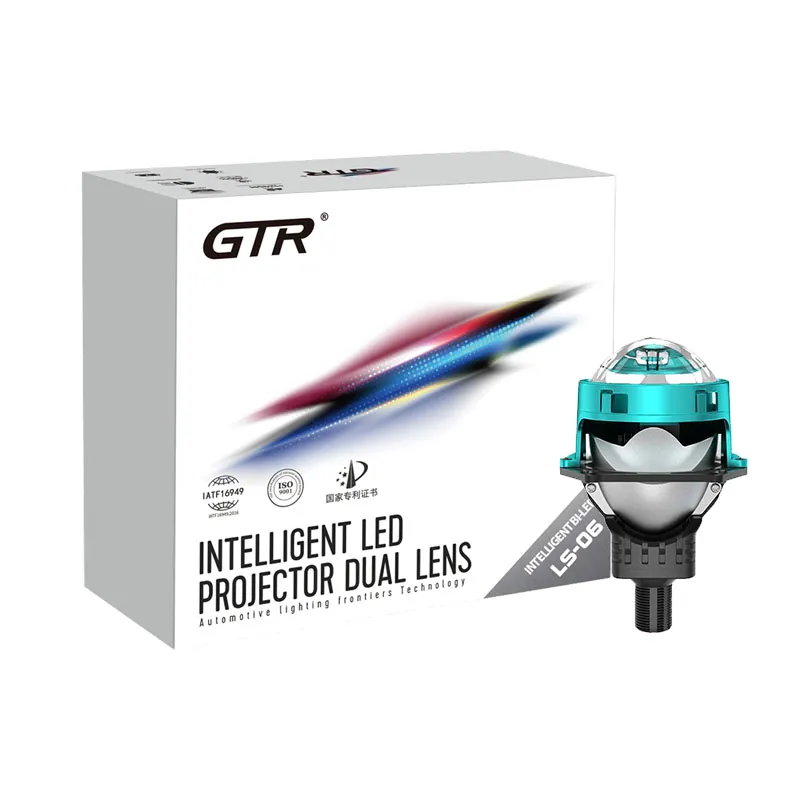
At GTR, our Mini projector product line uses exactly this architecture, refined through five generations of optical adjustment. The result is a beam pattern that consistently outperforms single-chip designs in lux distribution tests while maintaining a compact 2.5-inch form factor suitable for tight headlight housings.
2. Comparing Beam Quality: What the Spec Sheet Never Tells You
The most important metric of an LED bi mini projector cannot be found on any product page: beam uniformity.
Manufacturers love to advertise raw lumens. 4000 lm, 8000 lm, even 20000 lm from a mini projector? Mathematically impossible from a 35W LED chip—but that never stops the exaggeration. The truth is that useful road illumination depends entirely on how evenly light is distributed across the beam pattern.
Here's what you can test yourself after installing the projector:
2.1. 1 Hot Spot Test
On a dark road at night, pay attention to the center of your beam. Cheap projectors create a concentrated “hot spot”—a narrow, overly bright spot directly ahead, leaving the sides and foreground relatively dark. This forces your eyes to constantly adjust between bright and dark areas, causing eye strain and reduced peripheral awareness. High-quality projectors spread light evenly, with a hot spot that transitions gently into a wide side illumination zone.
2.2. 2 Cutoff Line Sharpness Test
Park facing a wall 25 feet away on a level surface. A properly designed đèn pha LED bi mini projector unit produces a sharp horizontal cutoff with a distinct 15-degree step on the passenger side. The cutoff should be sharp enough that you can see individual gaps if you place a finger over the lens. A blurry, rainbow-edged, or wavy cutoff indicates poor optical alignment or cheap lens coatings.
2.3. 3 Glare Test
Have a friend drive toward you in another vehicle. Ask them to report any glare above the cutoff line. Many cheap projectors allow light to leak above the shield—often because the solenoid doesn't fully close the shield in the low beam position. This creates a “halo effect” that oncoming drivers will flash their lights at, even when your low beams are on.
In our testing, the difference between the AliExpress $70 projector and the GTR Mini 2.0 was stark. The budget unit produced a 17% central hot spot deviation (meaning the center is much brighter than the edges) and visible light leakage above the cutoff. The GTR unit measured 4% deviation and no detectable glare above the cutoff. That's what precise optical alignment delivers.
3. Thermal Performance: The Silent Killer of Cheap Projectors
Heat is the number one cause of LED projector failure. However, most buyers never consider thermal design until it's too late.
A bi-LED projector packs 30-50 watts of power into a space smaller than a soda can. The LED chip itself operates at about 30% efficiency—meaning 70% of that energy turns directly into heat. Without a robust cooling system, chip temperatures can exceed 150°C within minutes, triggering thermal throttling that cuts brightness in half or more.
When evaluating a LED mini projector, check three thermal components:
- Fan type: Maglev fans have a lifespan 3-5 times longer than sleeve-bearing fans. Cheap projectors using sleeve bearings can seize up after a year of exposure to vibration and dust.
- Heatsink material: Machined aluminum with deep cooling fins dissipates heat much better than stamped aluminum or plastic-wrapped alternatives. Run your finger over the heatsink after 20 minutes of operation—quality parts will feel warm but not burning.
- Potted driver or not: The driver module (converting vehicle voltage to LED current) must be fully encapsulated in thermally conductive resin. This protects against moisture, vibration, and thermal cycling. Non-potted drivers will fail within months in real-world conditions.
One of our customers, a fleet manager for a regional delivery company, tested three different mini projector brands on ten trucks. After 6 months, two of the three brands had failure rates exceeding 40%—all due to heat-related driver failures. Trucks equipped with GTR? Zero failures at the 12-month mark. That's the price of proper thermal engineering.
4. Solenoid Quality: The Moving Part Nobody Checks
The electromagnetic solenoid is the only moving part inside a bi-LED projector. When it fails, you permanently lose your high beam.
Every time you switch from low to high beam, the solenoid piston must retract the cutoff shield. That's a mechanical impact. Cheap solenoids use thin copper windings and weak return springs. After 5,000-10,000 cycles (about 1-2 years of normal driving), the piston starts to stick or fails to retract fully. Result: high beam flickers, doesn't work, or works but leaves the shield partially blocking the beam.
High-end manufacturers specify solenoids rated for 50,000+ cycles. But specifications mean nothing if unverified. At GTR, we run every batch of solenoids through a dedicated test bench: 100,000 cycles at -20°C to 80°C, with voltage variations from 9V to 16V. Only solenoids that complete the test without measurable wear are put into production.
You can check solenoid health after installation by quickly flashing your high beams 10-15 times. Listen carefully. A clear, consistent mechanical “click” indicates proper operation. A slow, muffled, or inconsistent click indicates a failing solenoid or weak driver circuit.
5. Real Customer Experience: What Car Owners Say After 1 Year
We analyzed feedback on automotive forums, Reddit communities (r/CarAV, r/LED, r/projectors), and verified purchase reviews. Here's what long-term owners of various mini bi-LED projectors report:
“The best decision I made for my truck.”
2018 F-150 owner, GTR Mini 2.0 installed 14 months ago: “I drive on rural roads for work. The difference from the original halogen bulbs is like night and day. No flicker, no dimming, and the cutoff is still sharp. Worth every penny.”
“Worked for 8 months then started flickering.”
Cheap projector on Amazon (brand now removed), owned 9 months: “Worked great for the first few months. Then, the passenger side started flickering on startup. Now both sides flicker randomly. Customer service ignored me. This time I'll choose a reputable brand.”
“Glare problems from day one.”
Cheap bi-LED projector from eBay, after 6 months: “I constantly get flashed by other drivers even with low beams on. I took them out and reinstalled halogens. The beam cutoff was never clean no matter how I adjusted it. You get what you pay for.”
“Installation was quite difficult but support helped out.”
Customers of the light modification workshop, Morimoto projector: “The beam is quite good but the wiring is quite messy. Their technical support took three days to reply. Next time I will pay extra for a brand that answers the phone.”
The model is very clear: cheap projectors save initial costs but fail early. Premium projectors cost more initially but provide stable performance for years. And after-sales support—something almost never considered when purchasing—becomes important when there are questions about wiring or alignment.
GTR customers always mention two things in follow-up surveys: the clarity of installation instructions (with car-specific tips available via email) and the quick response of the support team (average response time under 4 hours, Monday to Friday).
6. GTR Advantage: What You Really Pay For
When you choose GTR bi-LED mini projector headlights, you are not paying for a name. You are paying for technical decisions that cheaper competitors completely ignore.
Here is where that extra budget goes:
- LED chips sorted by bin: We buy LEDs from the same top manufacturers (Philips Lumileds, OSRAM) but require specific bins for brightness and color temperature. Cheap projectors use rejected “off-bin” chips, with colors varying erratically between units.
- AR-coated glass lenses: Our aspheric lenses are coated with a multi-layer anti-reflective coating that reduces internal light loss by 18% compared to uncoated glass. Many competitors use plastic lenses that yellow and become cloudy within two years.
- Sealed driver modules: Every driver is potted and IP67-rated against dust and moisture. Cheap headlights leave the driver exposed inside the headlight housing.
- Pre-calibrated optics: Each headlight is optically aligned on a specialized testing device before packaging. Competitors using off-the-shelf products assume their injection molding process guarantees perfect alignment—an assumption that frequently fails.
- Extended warranty: Two-year, no-hassle replacement warranty for all GTR headlight systems. Compare that to the 90-day “we'll ignore your email” warranty from marketplace sellers.
We don't claim to be the cheapest option. We claim to be the most reliable choice for drivers who want to install once and drive for years without thinking about their headlights again.
7. Frequently Asked Questions for Informed Buyers
7.1. Question 1: What real lumen output should I expect from a quality mini headlight?
The actual, sustained output of a 35W mini bi-LED headlight typically ranges from 2800-3500 lumens per side. Ignore any advertisement claiming 10,000+ lumens from a mini headlight—those numbers are either completely exaggerated or measured at the LED chip before optical losses (which remove 30-50% of raw output).
7.2. Question 2: Can I install a bi-LED projector into a reflector-style headlight housing?
Technically yes, but it requires significant modification. Reflector housings lack the internal depth and mounting points for projector lenses. You'll need to cut the housing, fabricate brackets, and possibly modify the rear cover for adequate clearance. For most drivers, switching to an OEM projector housing (if available for your vehicle) or purchasing an aftermarket projector headlight assembly is more practical.
7.3. Q3: How do I know if a projector is truly DOT compliant?
Look for the DOT mark embossed on the projector housing or lens. This indicates the manufacturer self-certifies compliance with FMVSS 108. However, be aware that counterfeit DOT marks exist. Purchasing from reputable brands with US distribution centers significantly reduces this risk.
7.4. Q4: Which color temperature is safest for driving in all weather conditions?
5000K (pure white) offers the best overall performance. 6000K (cool white) provides slightly higher contrast on dry roads but performs worse in rain and fog due to increased backscatter. Avoid 4300K (yellow-white) unless you specifically prioritize fog penetration, and avoid anything above 6000K (blue/purple), which reduces usable contrast and looks very aftermarket in the worst way.
7.5. Q5: Why do some projector headlights cost $600 while others cost $150?
A $600 projector headlight may include advanced features such as active beam shaping, integrated CANbus decoding for European vehicles, or motorized self-leveling systems. For 95% of vehicles, a $150-$250 dual-chip projector with a passive solenoid and standard CANbus compatibility delivers 90% of the performance at 30% of the price.
7.6. Q6: Will upgrading to bi-LED projector headlights blind other drivers?
No—if the projector is properly designed and correctly aligned. The sharp cutoff shield is specifically designed to prevent glare. However, even the best projector will cause glare if aimed too high. Always realign your headlights after installation according to SAE J599 guidelines.
7.7. Q7: How do GTR projectors compare to Morimoto or Diode Dynamics?
All three are reputable brands. Morimoto (The Retrofit Source) offers excellent beam quality but often at a higher price and longer shipping times. Diode Dynamics focuses more on complete LED headlight assemblies rather than retrofit projectors. GTR differentiates on value: comparable beam performance at 20-30% lower cost, with US-based support and faster shipping from multiple warehouses. We encourage customers to compare beam shots and third-party thermal test data before deciding.
8. Your next step: Choose based on testing, not advertising
Now you have the same evaluation framework used by professional retrofit specialists and fleet managers. You understand the three architecture types. You know how to check beam uniformity, thermal performance, and solenoid durability. You have seen real-world customer experiences at different price points.
The question is no longer “which headlight is brightest?” but “which headlight is designed to maintain brightness throughout the life of my vehicle?”
Visit GTR Lighting's headlight collection to compare detailed specifications, download beam pattern PDFs, and check compatibility for your specific make and model. Every product page includes independent test data—not just marketing claims. And if you still have questions, our technical team is available via live chat and email to help you make the right choice.
Buy with confidence. Install once. Drive safer tonight.
This buying guide was compiled by our technical and product teams at GTR Lighting and LEDCXR. For bulk orders, fleet pricing, or international distribution inquiries, please contact our B2B sales team directly.