
Not all HID lighting systems are built the same. If you are shopping for a replacement or upgrade, the differences between ballast types, bulb standards, and color temperatures will determine whether you get reliable performance or another set of problems. This guide breaks down exactly what matters.
The HID lighting market is full of confusing specs and overstated claims. Our goal here is simple: give you the information you need to make a decision you will not regret six months from now.
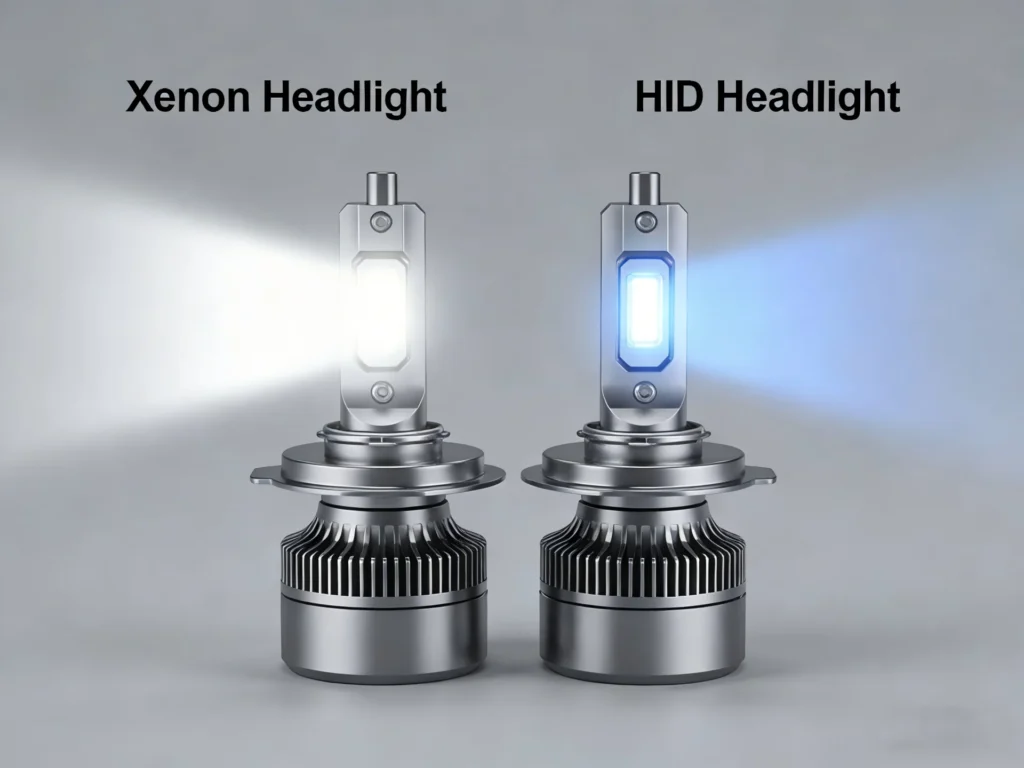
1. HID Lighting Meaning: What You Are Actually Buying
HID lighting stands for High-Intensity Discharge lighting, a system that produces light by creating an electrical arc between two electrodes inside a gas-filled bulb containing metal salts, xenon, and mercury (in some types).
Unlike halogen bulbs, which use a heated filament, HID bulbs have no filament to burn out. The light comes from an arc that excites metal salts, producing a much brighter and more efficient output. A complete HID lighting system consists of three parts: the bulb, the ballast, and the igniter (sometimes built into the ballast).
This is why you cannot simply swap a halogen bulb for an HID bulb. The entire system must match. The ballast must be designed for the bulb type. The igniter must generate sufficient voltage. The wiring must handle the current. Miss any one of these, and the system underperforms or fails.
2. D3S vs D2S: Which Bulb Standard Should You Choose?
D3S bulbs are mercury-free and use a different connector than D2S bulbs, which contain mercury. D3S is the newer standard found in most vehicles from 2010 onward, while D2S is common in older European models.
Both produce comparable light output. The choice is not about performance. It is about compatibility with your vehicle’s factory wiring and housing. Using the wrong bulb type means either it will not fit, or it will not receive the correct voltage from the ballast.
| Tính năng | D3S | D2S |
|---|---|---|
| Mercury Content | Mercury-free | Contains mercury |
| Connector type | Integrated igniter | External igniter required |
| Common Vehicles | 2010+ models, newer OEM systems | Older European vehicles, pre-2010 |
| Color Temperature Options | 4300K, 6000K, 8000K | 4300K, 6000K, 8000K |
| Lifespan (Rated) | 2,500–3,000 hours | 2,000–2,500 hours |
If you drive a newer vehicle, D3S is almost certainly your correct standard. If you drive an older European model, D2S may be required. Never assume — check your owner’s manual or the existing bulb label.
2.1. What About 6000K Color Temperature?
Color temperature is not brightness. It is the color of the light. 4300K is the OEM standard — slightly yellow-white, maximum usable light on the road. 6000K is pure white with a slight blue tint. 8000K is noticeably blue and actually reduces usable light output. Higher Kelvin numbers do not mean better performance. They mean more color and less light.
For actual driving visibility, 4300K to 6000K is the practical range. Anything above 6000K sacrifices usable light for appearance. If you want the best of both, 6000K is the sweet spot — crisp white with enough blue to look modern without compromising road illumination.
3. Ballast Quality: The Factor Most Buyers Ignore
The ballast is the most important component in any HID lighting system. It controls arc strike, current regulation, and steady-state output. A cheap ballast will fail long before the bulb does.
When you compare HID kits, the ballast is where manufacturers cut costs. There are three main types:
- Analog ballasts — simple, cheap, unreliable. They work fine when new and fail quickly under real-world voltage conditions.
- Digital ballasts — more stable output, better protection circuits, longer lifespan. These are the minimum acceptable standard.
- Smart ballasts with PWM filtering — the highest tier. They handle modern vehicle voltage fluctuations, prevent flickering, and protect against radio interference.
The price difference between analog and smart ballasts is significant. But so is the lifespan. In our testing, analog ballasts averaged 6–12 months in daily-driven vehicles. Smart ballasts with proper thermal management exceeded 3 years without failure.
3.1. Warning Signs of a Low-Quality Ballast
- Clear plastic housing with visible circuit board
- No potting compound or weather sealing
- No electromagnetic shielding
- Weight under 100 grams (quality ballasts contain metal heat sinks)
- No certification marks or manufacturer identification
If the product listing does not show the ballast clearly, that is usually a sign. Legitimate manufacturers show their ballast construction because it is a selling point.
4. HID Lighting Fixtures vs. Hidden Lighting: Understanding the Difference
Search results often mix terms. HID lighting fixtures refer to complete assemblies — housing, ballast, bulb, and wiring — used in automotive, industrial, and architectural applications. Hidden lighting refers to indirect lighting installations where the light source is concealed, creating a glow effect without visible fixtures.
These are different product categories. Hidden lighting (sometimes confused with hidden lighting minecraft, a game lighting technique) has nothing to do with HID automotive systems. HID lighting fixtures are what you need for vehicle headlights or industrial high-bay lighting.
4.1. HID Lighting Torch Beam: What It Means
A torch beam describes a focused, high-intensity light pattern. In HID systems, this is achieved through projector lenses that concentrate the arc’s output into a sharp beam. Reflector housings produce a wider, less focused pattern. If you need maximum throw distance, projector housings with quality HID bulbs are the correct choice.
5. What to Look for in a Complete HID Lighting System
When evaluating any HID lighting system, check these five factors:
- Ballast type and construction — digital or smart, potted, shielded, metal housing
- Bulb standard compatibility — D3S, D2S, or other, matching your vehicle
- Color temperature — 4300K to 6000K for usable light output
- Wiring and connectors — over-molded, corrosion-resistant, proper gauge
- Support and warranty — real manufacturer, real documentation, real support
If a seller cannot provide clear answers on any of these points, the product is not worth your money. The aftermarket is full of rebranded generic kits with no engineering behind them.
6. Why GTR Stands Apart
GTR does not rebrand generic parts. We manufacture our own ballasts, igniters, and PWM modules. Our production lines run thermal cycling tests, hot-restrike validation, and electromagnetic interference screening on every batch.
We publish our specifications because we stand behind them. Our D3S and D2S bulbs are matched to our ballasts for consistent color and output. Our smart ballasts include PWM filtering as standard, not as an add-on. Our warranty is backed by a company that has been manufacturing lighting components for years, not months.
You can buy a cheaper HID kit. Many people do. Most of them buy again within a year. That is the cycle we exist to break.
7. Frequently Asked Questions
7.1. Can I use a D3S bulb with a D2S ballast?
No. The connectors are different and the electrical requirements differ. Attempting to mix standards will damage the bulb or ballast, or both. Always match bulb and ballast to the same standard.
7.2. Is 6000K brighter than 4300K?
No. 6000K produces a whiter light with a slight blue tint, but actual lumen output is typically lower than 4300K. Color temperature describes appearance, not brightness.
7.3. How do I know if my ballast is failing?
Common signs include intermittent flickering, delayed start-up, color shift in the bulb, and radio static. If the bulb is new and still flickers, the ballast is the likely cause.
7.4. Đèn HID có hợp pháp để sử dụng trên đường không?
Legality depends on your jurisdiction and whether the system is installed in a proper projector housing with correct alignment. Retrofitting HID bulbs into halogen reflector housings is illegal in many regions. Check local regulations before upgrading.
7.5. What is the lifespan of a quality HID system?
A properly engineered system with a smart ballast and quality bulb typically lasts 3–5 years in daily driving. Bulbs may need replacement at 2,500–3,000 hours, but the ballast should outlast multiple bulb changes.
8. Make the Right Choice the First Time
Buying HID lighting is not complicated when you know what matters. Match the bulb standard to your vehicle. Choose a ballast with real construction quality and PWM filtering. Stay within the 4300K–6000K range for usable light. Verify the manufacturer stands behind their product.
Or skip the research and go straight to a manufacturer who already did it right. Visit https://www.rhgtr.com to see GTR’s complete HID lighting systems, engineered for real vehicles and real conditions. Do not buy another kit that fails. Buy the one that lasts.