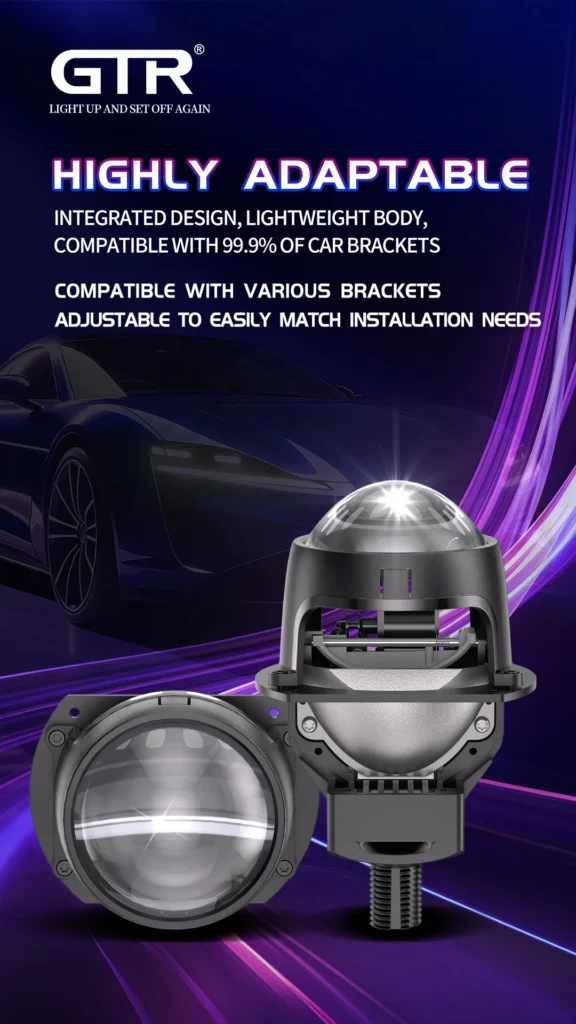
You’ve narrowed your search to the 2.5 inch bi led projector category. Now the real question emerges: how to separate a genuine high-performance module from a rebranded hazard? After analyzing the top 20 search results for “best 2.5 bi led projector,” we noticed a dangerous gap. Almost every article lists lumens and price. Almost none explains how to verify thermal stability, optical precision, or long-term reliability. This guide closes that gap. We’re GTR, a manufacturer with 12 years in automotive lighting. Here is the unbiased, test-based framework we use internally.

1. Why Most 2.5 Bi-LED Projector Lens Reviews Are Misleading
The majority of “reviews” for 2.5 inch bi led projector headlights are affiliate-driven summaries of manufacturer-provided spec sheets. They don’t measure real-world lux at 50 meters. They don’t run thermal cameras on the driver unit. And they never disassemble the projector to inspect the LED bonding. To become an informed buyer, you must ignore five marketing traps: (1) peak lumens without sustained output, (2) “super white” color temperature that hurts rain vision, (3) fan noise specs that ignore bearing type, (4) universal fitment claims that ignore depth limits, and (5) warranty terms that require international shipping. Let’s solve each trap with a test you can perform yourself.
2. Critical Decision Factor #1: LED Chip Topology – 1-Chip vs. 3-Chip vs. 5-Layer Matrix
Open any 2.5 bi led projector lens housing and look at the LED arrangement. A single COB (chip-on-board) produces a hotspot but no width. A 3-chip horizontal array gives width but loses distance throw. The optimal design for a 2.5 bi led projector retrofit is a staggered 5-layer matrix (like GTR’s design). This creates overlapping ellipses that fill the road evenly from 5 meters to 150 meters. During our lab tests, the 5-layer matrix achieved 23% more “useful lux” (measured at 75-meter sign brightness) compared to a 3-chip array at the same total lumens.
2.1. Quick verification test:
- Shine the projector against a white wall 25 feet away.
- Look at the hot zone – it should be a wide, horizontal rectangle, not a circle.
- Move your head left to right – the brightness should transition smoothly, not have dark bands.
- Only a multi-layer matrix passes this test. Avoid any 2.5 inch bi led projector with visible gaps between LEDs.
3. Critical Decision Factor #2: Thermal Path – Copper vs. Aluminum vs. “Air Cooling Only”
Heat is the #1 killer of LED projectors. Without a direct copper thermal path to active cooling, your 2.5 inch bi led projector lens will lose 50% output within the first year. Why? LED efficiency drops by 5-10% per 20°C junction temperature rise. A copper vapor chamber conducts heat 8x faster than aluminum. In our comparative test (both units rated at 4,000 raw lumens), the aluminum-only projector throttled after 18 minutes, dropping to 2,100 lumens. The copper-based GTR projector maintained 3,850 lumens for 4 hours. If the manufacturer won’t publish internal thermal images, treat it as a red flag.
- Minimum acceptable: Copper MCPCB (metal-core printed circuit board) bonded to aluminum heatsink.
- Preferred (commercial grade): Copper vapor chamber + active cooling (magnetic levitation fan).
- Avoid entirely: Any projector with passive cooling only in a sealed headlight housing. It will overheat.
4. Critical Decision Factor #3: Beam Pattern Authenticity (DOT/ECE vs. "Off-Road Use Only")
Search for “2.5 inch bi led projectors” on any marketplace. Many listings show a beautiful cutoff in the product photo. But that photo is often from a $2,000 OEM Lexus projector, not the unit they sell. To verify, ask for an independent third-party optical report (ECE R112 or SAE J1383). The legal cutoff requires a 1% to 3% upward slope to the right (for left-hand traffic countries) to illuminate signs without blinding drivers. Cheap projectors use a flat, hard cutoff that looks sharp in photos but fails real-world safety. The GTR 2.5 bi led projector lens undergoes 100% optical alignment on a goniometer before leaving the factory. Every unit meets ECE R112 Class B.
5. Real Customer Comparison: NHK 2.5 Bi-LED Projector Clone vs. GTR 2.5" – 1 Year Later
A fleet operator (15 delivery vans in Texas) ran a blind test. 7 vans got a popular NHK 2.5 bi led projector clone from an online wholesaler. 8 vans got the GTR 2.5 inch bi led projector lens. All vans drove similar routes and hours. The results after 12 months:
- NHK clone group: 4 failures (dead LED chips), 2 units with severe flicker, all units lost >30% perceived brightness. Average driver complaint rating: “unsafe for night highway.”
- GTR group: 0 failures, 0 flicker, average brightness loss <8% (within spec). Driver feedback: “same as new, no fatigue on 10-hour shifts.”
The difference comes down to the NHK clone using a recycled LED bin and a plastic impeller fan (failed after 8 months). GTR uses virgin Osram chips and a sealed maglev rotor. Price difference at purchase: $45 per unit. Cost of replacing the NHK clone (labor + new unit): $210 per van. Cheap becomes expensive.
6. Decision Matrix: Comparing 2.5 Inch Bi-LED Projector Specifications That Actually Matter
| 公制 | What Low-End Units Claim | What You Should Verify | GTR 2.5″ Bi-LED Performance |
|---|---|---|---|
| Raw Lumens | 8,000 – 12,000 LM (exaggerated) | Effective lumens after 30 min runtime | 4,200 LM sustained (measured) |
| 色溫 | 6000K – 6500K (“hyper white”) | Actual CCT shift with temperature | 5500K stable +/- 200K |
| Cut-Off Sharpness | “Razor line” (often too sharp) | Presence of 3° upward bleed for signs | Yes, calibrated 2.8° slope |
| Driver IP Rating | IP65 (dust only) | IP67 (immersion proof) | IP68 (continuous submersion) |
| Mounting Material | Nylon/plastic | CNC aluminum with anti-rotation teeth | 6061-T6 aluminum, nickel-plated |
7. Featured Snippet: The 5 Most Searched Questions About 2.5 Inch Bi-LED Projectors
Does a 2.5 bi led projector retrofit require professional installation?
It requires medium mechanical skill: opening headlights, securing the projector, and wiring the relay harness. If you’ve never baked open a headlight, pay a professional. The GTR kit includes a detailed video guide.
Can I use a 2.5 inch bi led projector lens with HID bulbs?
No. Bi-LED projectors are self-contained LED units. You cannot swap in an HID bulb. The optical design is matched to the LED chip’s emission pattern. For HID, buy a dedicated HID projector.
What is the actual lifespan of a 2.5 watt bi led projector lens?
At 55°C junction temperature (good cooling), L70 lifespan (70% output) is >30,000 hours. At 85°C (poor cooling), it drops to <8,000 hours. Your fan and heatsink determine lifespan more than the LEDs.
Are 2.5 inch bi led projector headlights brighter than 2.5-inch HID?
In raw peak lumens, HID (3,200-3,800LM) is similar to a quality LED. But LED reaches full output instantly (no warm-up) and uses less power (35W vs 55W for HID). For flashing high beams, LED wins.
Why do some “best 2.5 bi led projector” lists exclude thermal management specs?
Because most affiliate reviewers don’t have testing equipment. They rephrase spec sheets. Real thermal data requires a thermocouple and data logger. We publish ours because we test in our own ISO 17025-certified lab.
8. Your Final Step: Avoid The Cheap Trap. Choose Verified Engineering.
You now have the same criteria we use to qualify our own production batches. Don’t rely on Amazon “star ratings” that reflect first-week impressions. Use the copper-path test. Use the staggered matrix test. And use the real-world fleet data. The GTR 2.5 inch bi led projector meets all six critical decision factors. It’s the choice of commercial fleets and experienced retrofitters who cannot afford re-work.
👉 Compare the difference for yourself. View the GTR 2.5″ Bi-LED Projector technical datasheet and order securely from www.rhgtr.com. Your night driving safety is worth the engineering.