
1. مقدمة: صعود مصباح الشارع LED بقدرة 50 واط
شهدت إضاءة الشوارع ثورة هادئة. لعقود من الزمن، حدد التوهج البرتقالي لمصابيح الصوديوم عالية الضغط (HPS) مشاهدنا الليلية، مستهلكةً طاقة كبيرة وتتطلب صيانة متكررة. وعد التحول إلى تقنية LED بمستقبل أكثر إشراقاً وكفاءة، لكن التبني المبكر كان غالباً لعبة إفراط في الإضاءة أو ضعف في الأداء. وهنا ظهر مصباح الشارع LED بقدرة 50 واط— وهي فئة منتجات برزت كنقطة التوازن الحديثة المثالية لمجموعة واسعة من التطبيقات البلدية والتجارية والسكنية. صعوده ليس مصادفة؛ بل يمثل التقاءً مثالياً بين النضج التكنولوجي، ومتطلبات كفاءة الطاقة، وتصميم الإضاءة العملي. يوفر هذا الجهاز الإضاءة الدقيقة اللازمة للسلامة والرؤية دون هدر الطاقة الذي تسببه الأجهزة السابقة، ليحل فعلياً محل أجهزة HID بقدرة 150-250 واط. وبينما تعطي المدن والبلدات في جميع أنحاء العالم الأولوية للاستدامة وخفض التكاليف، أصبح مصباح LED بقدرة 50 واط المعيار المفضل لإضاءة الطرق الثانوية والشوارع السكنية ومواقف السيارات والممرات، مما يمثل خطوة حاسمة نحو بنية تحتية حضرية أكثر ذكاءً ومسؤولية.
2. ما هو مصباح الشارع LED بقدرة 50 واط؟ تعريف المعيار الحديث
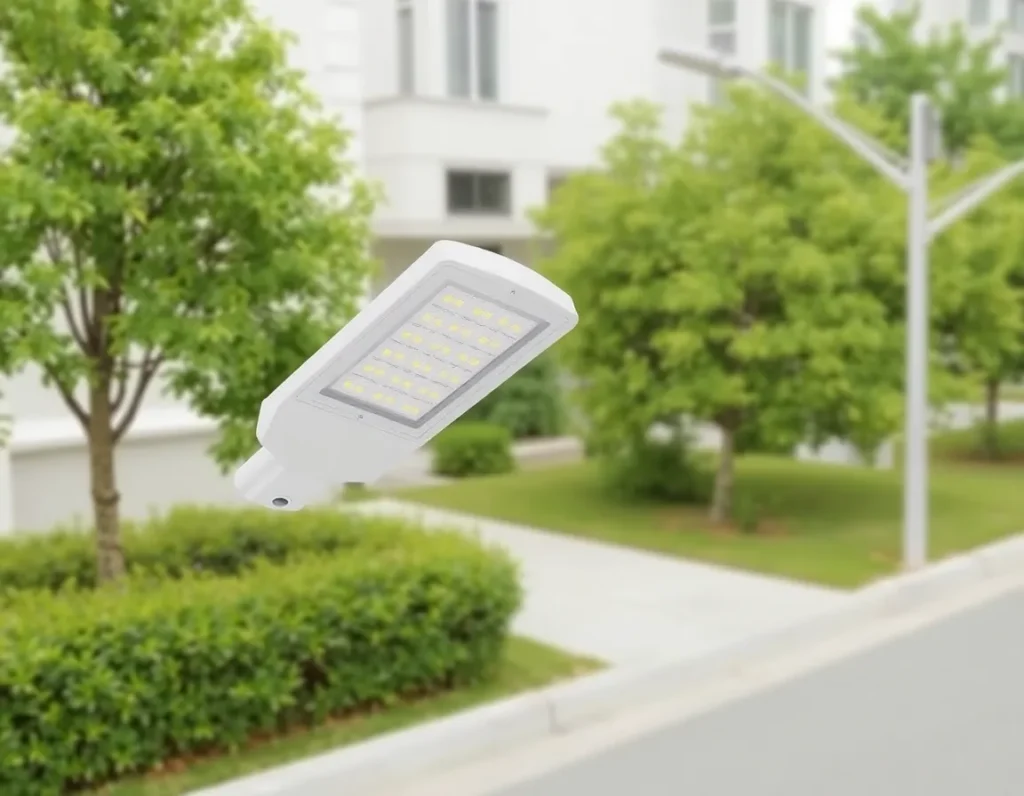
مصباح الشارع LED بقدرة 50 واط هو جهاز إضاءة صلبة مصمم لإضاءة الطرق والمناطق الخارجية، يستهلك حوالي 50 واط من الطاقة الكهربائية. لكن رقم القدرة البسيط هذا لا يروي سوى جزء من القصة. فـ”المعيار الحديث” لا يُعرَّف بمقدار استهلاك الطاقة وحده، بل بمخرجات أدائه وتصميمه الذكي. وخلافاً للإضاءة التقليدية حيث ارتبطت القدرة بشكل غير دقيق بالسطوع، تفصل تقنية LED بين هذين المفهومين. تم تصميم جهاز LED بقدرة 50 واط لإنتاج مخرجات ضوئية عالية الكفاءة، تتراوح عادةً من 4,500 إلى 8,500 لومن، حسب الطراز والتصميم البصري. وقد اختير هذا النطاق بشكل استراتيجي لتلبية متطلبات الإضاءة لمجموعة واسعة من المساحات العامة والخاصة دون الإفراط في الإضاءة، الذي يسبب الوهج والتلوث الضوئي، أو نقص الإضاءة، الذي يقوض السلامة.
في جوهره، هذا الجهاز هو نظام متكامل. فهو يدمج شرائح LED عالية الفعالية، وإدارة حرارية متقدمة لضمان طول العمر، وبصريات دقيقة للتحكم في توزيع الضوء، وهيكل متين مصنف للبيئات الخارجية القاسية (عادةً IP65 أو IP66). والأهم من ذلك، غالباً ما يكون مصباح الشارع LED الحديث بقدرة 50 واط “قابلاً للاختيار” أو “قابلاً للضبط”، مما يعني أن القائمين على التركيب يمكنهم تهيئة قدرته ودرجة حرارة لونه، وأحياناً حتى نمط شعاعه في الموقع لتتناسب مع الاحتياجات الدقيقة للمشروع. هذا المرونة، مقترنة بعمر افتراضي يتجاوز 70,000 ساعة، تحوله من مجرد بديل بسيط للمصباح إلى أصل بنيوي طويل الأجل. إنه الحل النهائي للمشاريع الساعية لتحقيق إضاءة عالية الجودة وموثوقة ومستقبلية دون الاستهلاك المفرط للطاقة في الأنظمة القديمة.
3. الفوائد الرئيسية: لماذا تُعد مصابيح الشارع LED بقدرة 50 واط استثماراً ذكياً
اختيار مصباح الشارع LED بقدرة 50 واط هو قرار استراتيجي يعود بالنفع على عدة جبهات. تمتد الفوائد إلى ما هو أبعد بكثير من فاتورة الكهرباء المنخفضة، لتؤثر على ميزانيات الصيانة والأهداف البيئية والسلامة العامة.
3.1. توفير كبير في الطاقة والتكاليف
هذه هي الميزة الأكثر فورية وقابلية للقياس. من خلال استهلاك طاقة أقل بنسبة تصل إلى 70% مقارنة بمصابيح الصوديوم عالية الضغط أو الهاليد المعدني التي تحل محلها، تقلل مصابيح LED بقدرة 50 واط نفقات التشغيل بشكل كبير. بالنسبة لبلدية أو شركة لديها مئات الأجهزة، يترجم هذا إلى عشرات الآلاف من الدولارات في التوفير السنوي. كما تقلل القدرة المنخفضة الطلب على البنية التحتية الكهربائية، مما قد يؤجل الترقيات المكلفة.
3.2. جودة إضاءة وسلامة فائقة
توفر مصابيح LED ضوءاً أبيض ناصعاً مع تجسيد ممتاز للألوان مقارنة باللون الأصفر أحادي اللون لمصابيح HPS. وهذا يحسن الرؤية، مما يسمح للسائقين والمشاة بتمييز الألوان والتباينات والتفاصيل بشكل أفضل ليلاً، وهو أمر بالغ الأهمية للسلامة. تضمن البصريات الدقيقة لأجهزة LED توجيه الضوء نحو الطريق والأرصفة، مما يقلل من الوهج المهدر والخطير وتسرب الضوء إلى الممتلكات المجاورة.
3.3. صيانة دنيا وعمر افتراضي طويل
مع عمر افتراضي مقدر بـ 70,000 ساعة أو أكثر، يمكن لمصباح شارع LED عالي الجودة بقدرة 50 واط أن يعمل لأكثر من 15 عاماً قبل الحاجة إلى الاستبدال. وهذا يلغي دورات استبدال المصابيح المتكررة المرتبطة بالإضاءة التقليدية، مما يقلل بشكل كبير من تكاليف العمالة والمواد لفرق الصيانة. كما أن البناء المتين وعدم وجود خيوط أو زجاج هش يجعلها شديدة المقاومة للاهتزاز والصدمات.
3.4. الاستدامة البيئية
يؤدي الانخفاض الكبير في استهلاك الطاقة إلى خفض الانبعاثات الكربونية المرتبطة بتوليد الكهرباء بشكل مباشر. علاوة على ذلك، لا تحتوي مصابيح LED على الزئبق أو أي مواد خطرة أخرى شائعة في مصابيح HID، مما يجعل التخلص منها أكثر أمانًا وسهولة. كما يعني عمرها الطويل تقليل هدر المواد بمرور الوقت.
3.5. المتانة والموثوقية
صُممت هذه التركيبات للاستخدام الخارجي، وتتميز بأجسام من الألومنيوم المصبوب بالقالب لتبديد الحرارة بشكل مثالي، وهي محكمة الإغلاق وفق معايير IP65/66، مما يجعلها مقاومة للغبار ومقاومة لنفاثات المياه القوية. وهي تعمل بشكل موثوق في درجات حرارة قصوى تتراوح من -40°ف إلى 122°ف، مما يضمن أداءً ثابتًا على مدار العام.
4. شرح المواصفات الفنية: اللومن، ودرجة حرارة اللون المرتبطة (CCT)، والجهد، والمزيد
لاتخاذ قرار مدروس، من الضروري فهم المواصفات الفنية الرئيسية لمصباح شارع LED بقدرة 50 واط. تحدد هذه الأرقام أداءه وتوافقه ومدى ملاءمته لمشروعك.
4.1. اللومن: مقياس خرج الضوء
يقيس اللومن (lm) الكمية الإجمالية للضوء المرئي المنبعث. بالنسبة لمصباح شارع LED بقدرة 50 واط، يتراوح خرج اللومن عادةً من 4,000 إلى 8,500 لومن. والمعيار الشائع هو حوالي 6,500 لومن، مما يوفر إضاءة كافية لمعظم التطبيقات السكنية والطرق الثانوية. أعطِ الأولوية دائمًا للومن على الواط عند تقييم السطوع.
4.2. درجة حرارة اللون المرتبطة (CCT)
تُقاس بالكلفن (K)، وتصف درجة حرارة اللون المرتبطة (CCT) المظهر اللوني للضوء. بالنسبة لإضاءة الشوارع، فإن الخيارات الأكثر شيوعًا هي:
- 3000K (أبيض دافئ): يوفر ضوءًا أكثر نعومة بدرجة عنبرية. غالبًا ما يُفضَّل في المناطق التاريخية أو المناطق السكنية لما يتميز به من إحساس مريح وأقل تدخلاً.
- 4000K (أبيض محايد): ضوء أبيض متوازن ونقي. حل وسط شائع يوفر رؤية جيدة دون أن يكون قاسيًا للغاية.
- 5000K (أبيض بارد): ضوء أبيض ساطع يحاكي ضوء النهار. يزيد من حدة الرؤية البصرية ويُحدَّد غالبًا للطرق والساحات وأماكن انتظار السيارات والمناطق الحساسة أمنيًا.
توفر تركيبات CCT القابلة للاختيار مرونة الاختيار بعد الشراء.
4.3. الجهد وطاقة الإدخال
مشغلات LED الحديثة قابلة للتكيف بدرجة عالية. تدعم معظم مصابيح الشوارع LED التجارية بقدرة 50 واط نطاق جهد إدخال واسعًا، مثل 120-277 فولت تيار متردد أو حتى 100-480 فولت. تعمل هذه التوافقية الشاملة على تبسيط المخزون والتركيب عبر الأنظمة الكهربائية المختلفة، سواء لدائرة قياسية 120 فولت أو شبكة تجارية 277 فولت.
4.4. التوزيع البصري (أنواع IESNA)
يحدد هذا شكل شعاع الضوء وانتشاره. تشمل التوزيعات الشائعة لمصابيح الشوارع ما يلي:
- النوع II: رمي قصير إلى متوسط، مثالي للطرق الأوسع أو إضاءة المناطق.
- النوع III: رمي متوسط، نمط مستطيل، مثالي للتركيب على جانب الطريق.
- النوع IV: نمط رمي أمامي، مناسب للتركيب في منتصف ممر أو طريق ضيق.
- النوع V: توزيع دائري متماثل لإضاءة التقاطعات أو التطبيقات المثبتة في المنتصف.
4.5. مواصفات حرجة إضافية
- CRI (مؤشر تجسيد اللون): مقياس لمدى دقة ظهور الألوان تحت الضوء. يُعد مؤشر تجسيد اللون (CRI) بقيمة 70+ معيارًا قياسيًا، لكن يتوفر 80+ للمناطق التي يكون فيها تمييز الألوان مهمًا.
- تصنيف الحماية من الدخول (IP): رمز مكوّن من رقمين مثل IP65. يشير الرقم الأول (6) إلى حماية كاملة من الغبار. يحمي الرقم الثاني (5) من نفاثات المياه منخفضة الضغط. يوفر IP66 حماية من النفاثات القوية.
- معامل القدرة (PF): تشير قيمة أعلى من 0.90 إلى استخدام فعّال للطاقة الكهربائية، مما يقلل الضغط على الشبكة.
- التعتيم: تدعم العديد من الطُرز التعتيم 0-10 فولت، مما يتيح التحكم الذكي وزيادة توفير الطاقة خلال ساعات انخفاض الحركة.
5. التصميم والميزات: من مصابيح رأس الكوبرا إلى مصابيح المناطق
تتوفر منصة LED بقدرة 50 واط بأشكال متنوعة، كل منها مصمم خصيصًا لسيناريوهات تركيب محددة وتفضيلات جمالية. إن فهم هذه التصاميم يضمن اختيارك لتركيبة لا تؤدي أداءً جيدًا فحسب، بل تندمج أيضًا بسلاسة في بيئتها.
5.1. مصابيح الشوارع رأس الكوبرا
وحدة الإضاءة المثالية للطرق. سُميت بهذا الاسم بسبب شكلها المميز، وقد صُمم تصميم رأس الكوبرا للتركيب على جانب العمود فوق الطرق. تتميز بهيكل انسيابي، غالبًا غير متماثل، يوجّه الضوء بنمط مستطيل محكوم (عادةً النوع III أو النوع V) على الشارع، مما يقلل الإضاءة العلوية. أصبحت مصابيح رأس الكوبرا الحديثة بتقنية LED أكثر انسيابية بكثير من أسلافها بتقنية HID، مع زعانف حرارية محسّنة وغالبًا تصميم “مقلل للتوهج” أو “قطع كامل” لتقليل الوهج. هذا هو الخيار القياسي لمشاريع إضاءة الشوارع البلدية.
5.2. مصابيح المناطق وساحات الانتظار
صُممت وحدات الإضاءة هذه لتوفير إضاءة واسعة وموحدة للمساحات المفتوحة. غالبًا ما يكون لها شكل مربع أو مستطيل مع عدسة زجاجية أو من البولي كربونات، وتوفر توزيعًا متماثلًا (النوع V) أو غير متماثل قليلًا (النوع II). تُستخدم مصابيح المناطق عادةً في ساحات الانتظار والساحات المخصصة للمشاة وأرصفة التحميل وحول المباني التجارية. يعطي تصميمها الأولوية للتغطية الواسعة مع إضاءة رأسية عالية لتعزيز السلامة والأمن في المساحات ثلاثية الأبعاد.
5.3. الأنماط الزخرفية والمعمارية
بالنسبة للبيئات التي تكون فيها الجماليات ذات أهمية قصوى—مثل مناطق وسط المدينة والحدائق والحرم الجامعية والمجتمعات السكنية—تتوفر مصابيح LED بقدرة 50 واط الزخرفية. تشمل هذه مصابيح الجرس ووحدات الإضاءة بنمط الفانوس وكرات البلوط. وهي تدمج محرك LED الفعّال بقدرة 50 واط في هياكل تكمّل العمارة التقليدية أو التاريخية مع تقديم أداء حديث. وعلى الرغم من مظهرها الزخرفي، فإنها تحافظ على تصنيفات IP اللازمة والتحكم البصري.
5.4. Key Physical Features
- الإدارة الحرارية: Effective heat sinking is critical for LED longevity. Look for fixtures with extensive, extruded or die-cast aluminum heat sinks that passively dissipate heat.
- Mounting Options: Standard mounting includes slipfitter (for mounting directly onto a tenon), yoke (arm mount for extended reach), and trunnion mounts. Ensure compatibility with your existing poles.
- Materials: High-quality aluminum housing with a corrosion-resistant powder-coat finish is standard. Lenses are made from impact-resistant tempered glass or polycarbonate.
- Smart Ready: Increasingly, fixtures are being designed with built-in ports or drivers compatible with networked lighting controls for adaptive dimming and monitoring.
6. How to Choose the Right 50W LED Street Light for Your Project
Selecting the optimal fixture requires a methodical approach that balances technical requirements, site conditions, and long-term value.
6.1. Assess the Application and Lighting Requirements
Begin by defining the space. Is it a local residential street, a commercial parking lot, a bike path, or a downtown sidewalk? Each application has different illuminance (measured in footcandles) and uniformity standards. Consult IESNA (Illuminating Engineering Society) guidelines or local ordinances. The required light level will dictate the necessary lumen output and beam distribution (Type II, III, IV, or V).
6.2. Determine the Optimal Color Temperature (CCT)
Consider the surrounding environment and community preferences. For general roadways and security, 4000K or 5000K offers excellent visibility. For residential areas or historic zones, 3000K may be mandated or preferred to reduce blue light emission and create a warmer ambiance. Selectable-CCT fixtures provide valuable future-proofing.
6.3. Verify Electrical Compatibility
Check the voltage of your existing infrastructure. Choose a fixture with a driver that matches your supply (e.g., 120V, 277V, or the versatile 120-277V). Also, confirm if dimming capabilities are needed for integration with smart city systems or dusk-to-dawn photocells.
6.4. Prioritize Quality and Certifications
Do not compromise on build quality. Look for independent certifications that validate performance and safety:
- UL Listed: Ensures electrical safety.
- DLC Premium: A certification for high efficiency and quality; often required for utility rebates.
- IP65/IP66: Guarantees weatherproof durability.
- LM-79 & LM-80 Reports: Provide verified data on lumen output, efficacy, and lumen depreciation over time.
6.5. Evaluate Total Cost of Ownership (TCO)
Look beyond the initial purchase price. Calculate the TCO by factoring in:
- Energy savings over the fixture’s lifespan.
- Reduced maintenance costs (fewer replacements, lower labor).
- Potential utility rebates for DLC-qualified products.
- Warranty length and coverage (a 7-year or longer warranty is a strong indicator of manufacturer confidence).
6.6. Consider Future-Proofing and Flexibility
Opt for fixtures with selectable wattage and CCT. This allows you to fine-tune the installation or adapt to changing needs without replacing the entire unit. Also, consider if the design allows for easy retrofitting onto existing poles to minimize installation costs.
By systematically working through these criteria, you can confidently specify a مصباح الشارع LED بقدرة 50 واط that delivers optimal performance, reliability, and return on investment for your specific project, ensuring well-lit, safe, and sustainable spaces for years to come.
7. Installation, Maintenance, and Lifespan Considerations
Once you’ve selected the ideal مصباح الشارع LED بقدرة 50 واط for your project, proper installation and an understanding of long-term care are crucial to realizing its full benefits. While these fixtures are designed for durability, attention to detail during setup and a proactive maintenance plan will ensure decades of reliable, cost-effective illumination.
7.1. أفضل ممارسات التركيب
Installation typically involves mounting the fixture to an existing or new pole via a slipfitter, arm, or yoke mount. Key considerations include:
- Voltage Verification: Confirm the fixture’s input voltage (e.g., 120-277V AC, 480V) matches your site’s electrical supply. Many modern 50W LED street lights feature universal voltage drivers (120-277V), simplifying retrofits.
- Pole Compatibility: Ensure the mounting bracket fits the pole’s diameter. A secure fit is vital for wind resistance and long-term stability.
- Photocontrol/Dimming Integration: If using photocells for dusk-to-dawn operation or 0-10V dimming systems for adaptive lighting, follow the manufacturer’s wiring diagram precisely. Proper grounding and surge protection (often built-in to 4-5KV standards) are non-negotiable for protecting the electronics from voltage spikes.
- Aiming and Spacing: Adhere to the fixture’s photometric report (IES file) to determine optimal mounting height, spacing, and tilt. A Type III optical distribution, common for roadways, throws light in a long, rectangular pattern. Correct aiming prevents dark spots and light trespass onto adjacent properties.
7.2. Maintenance and Lifespan
A primary advantage of LED technology is its dramatically reduced maintenance burden. A quality 50W LED street light boasts a rated lifespan of 70,000 hours or more. In practical terms, operating 12 hours per night, this translates to over 15 years of service before significant lumen depreciation (often defined as L70, when output falls to 70% of initial lumens).
Maintenance is largely passive but should include periodic visual inspections. Check for:
- Dirt Accumulation: While fixtures are rated IP65 or IP66 for dust and water ingress, lenses can accumulate dirt, insects, or salt spray in coastal areas, reducing light output. A simple cleaning every 1-2 years can restore full performance.
- Physical Damage: Inspect for cracks in the housing or lens, which could compromise the IP rating.
- الإدارة الحرارية: Ensure vents or heat sinks are not obstructed by debris, nests, or snow, as proper heat dissipation is critical to LED longevity.
Unlike traditional HID lamps that fail catastrophically, LEDs gradually dim. This predictable performance allows for planned, group relamping cycles rather than costly emergency call-outs for individual failures, a significant operational savings.
8. Solar-Powered 50W LED Street Lights: An Off-Grid Solution
For locations where grid connection is impractical, prohibitively expensive, or where sustainability goals are paramount, solar-powered 50W LED street lights offer a compelling off-grid alternative. These integrated systems combine a high-efficiency photovoltaic (PV) panel, a battery storage unit, a charge controller, and the LED fixture into a standalone lighting solution.
8.1. How They Work
During daylight hours, the solar panel converts sunlight into electricity, which is stored in a deep-cycle lithium or lead-acid battery. An intelligent charge controller manages this process, preventing overcharging. At dusk, a photocell or timer activates the 50W LED module, drawing power from the battery to provide illumination throughout the night. Advanced models feature motion sensors to boost brightness to full power (e.g., 8,500 lumens) when activity is detected, conserving battery life by operating at a lower output during idle periods.
8.2. Key Advantages and Considerations
The benefits are substantial: zero electricity bills, no trenching for power lines, rapid deployment, and complete immunity to grid outages. They are ideal for rural roads, pathways, parks, parking lots in remote areas, and disaster relief zones.
However, successful deployment requires careful planning:
- Solar Insolation: Site assessment is critical. The panel must receive direct, unobstructed sunlight for most of the day. Shading from trees or buildings drastically reduces charging efficiency.
- Autonomy Days: The system must be sized to provide sufficient light during consecutive cloudy or rainy days (typically 3-5 days of autonomy). This often means a larger PV panel and battery capacity than the nominal 50W load would suggest.
- Battery Life and Environment: Batteries are the system’s lifespan-limiting component. Lithium-ion batteries offer longer life, better performance in temperature extremes, and smaller size than lead-acid but at a higher upfront cost. Proper thermal management for the battery compartment is essential.
- Fixture Integration: Many solar street lights use an integrated “all-in-one” design. Ensure the LED component itself maintains the high-quality specifications—such as proper thermal management, optical control, and robust surge protection—expected from a grid-tied 50 watt LED street light.
9. Cost Analysis: Price, ROI, and Energy Savings
The decision to upgrade to or install new 50W LED street lights is heavily influenced by financials. A comprehensive cost analysis reveals that while the initial investment is higher than traditional options, the long-term savings are transformative.
9.1. سعر الشراء الأولي
The price for a single commercial-grade 50W LED street light fixture typically ranges from $175 to $450. This variance depends on features like selectable wattage/CCT, optical precision, brand, certifications (DLC Premium listings command a premium but often qualify for rebates), and housing material. Integrated solar-powered units have a higher upfront cost, often between $500 and $1,200 per unit, as they include the PV panel, battery, and controller.
9.2. Energy Savings: The Core of ROI
This is where LED technology shines. A 50W LED fixture producing 6,500 lumens typically replaces a 250-400W high-pressure sodium (HPS) or metal halide lamp. The energy savings are immediate and substantial.
Example Calculation: Consider replacing a 250W HPS fixture operating 4,000 hours annually (approx. 11 hours/night).
- HPS Annual Energy Use: 250W 4,000 hrs = 1,000,000 Wh = 1,000 kWh.
- 50W LED Annual Energy Use: 50W 4,000 hrs = 200,000 Wh = 200 kWh.
- Annual Energy Savings: 800 kWh.
At an average commercial electricity rate of $0.12/kWh, this saves $96 per fixture, per year. For a municipality or developer with hundreds of fixtures, the annual savings escalate rapidly into tens of thousands of dollars.
9.3. Maintenance and Relamping Savings
Traditional HPS lamps require relamping every 3-5 years (12,000-24,000-hour lifespan). Each service call involves labor, equipment (bucket trucks), and the cost of the lamp and ballast. With a 70,000-hour LED lifespan, these recurring costs are virtually eliminated for 15+ years. The reduction in maintenance logistics and costs is a major component of the total return on investment.
9.4. Calculating Return on Investment (ROI)
ROI is calculated by considering total savings versus the net installed cost. The formula is straightforward:
ROI (%) = (Total Savings – Net Project Cost) / Net Project Cost * 100
Total Savings include cumulative energy savings and avoided maintenance costs over the analysis period.
Net Project Cost is the installed cost minus any utility or government rebates for energy-efficient lighting.
For a grid-tied project, a simple payback period (initial cost divided by annual savings) is often between 2 to 5 years. Given a 15+ year lifespan, the subsequent 10+ years represent almost pure financial gain and risk mitigation against rising energy costs.
For solar projects, the ROI calculation differs as it avoids ongoing energy costs entirely. The payback is benchmarked against the cost of trenching and connecting to the grid, which can be astronomical in remote areas, making solar the cost-effective choice from day one.
10. ملخص النقاط الرئيسية
The 50 watt LED street light has established itself as the modern standard for efficient, effective, and sustainable outdoor illumination. Its adoption represents a smart, forward-thinking investment for municipalities, commercial properties, and residential communities alike.
- Efficiency & Performance: Delivering 6,500+ lumens, a 50W LED effectively replaces legacy 250W+ fixtures, offering superior light quality with better color rendering and uniform distribution while slashing energy consumption by 70-80%.
- Technical Flexibility: Available in various CCTs (3000K-6000K), voltages, and optical distributions (Type II-V), with advanced features like selectable wattage and CCT, dimming capabilities, and robust IP65/IP66 ratings for durability.
- Informed Selection: Choosing the right fixture requires analyzing lumens and uniformity (not just wattage), understanding CCT and CRI for the application, verifying electrical compatibility, and prioritizing quality certifications (DLC, UL, IP rating).
- Long-Term Value: With a lifespan exceeding 70,000 hours and minimal maintenance needs, these lights offer dramatic savings in both energy and operational costs. The total cost of ownership is significantly lower than traditional technologies.
- Off-Grid Potential: Solar-powered versions provide a viable, zero-energy-cost solution for remote or environmentally sensitive areas, though they require careful site-specific sizing and planning.
- Strong Financial Case: The compelling ROI, driven by direct energy savings and reduced maintenance, often yields a payback period of just a few years, followed by over a decade of net positive cash flow.
By upgrading to a well-specified 50W LED street light system, stakeholders achieve more than just brightened streets—they invest in enhanced safety, environmental responsibility, and long-term fiscal health.
11. الأسئلة الشائعة (FAQ)
11.1. What area can a single 50W LED street light effectively cover?
Coverage depends heavily on the fixture’s optical distribution (IES Type), mounting height, and desired light level (measured in foot-candles or lux). As a general guideline, a 50W LED with a Type III medium distribution mounted at 15-20 feet can adequately illuminate a two-lane residential street or a parking lot aisle, with poles spaced approximately 60-80 feet apart. For precise spacing and layout, always consult the manufacturer’s photometric data or request a lighting simulation.
11.2. Are 50W LED street lights bright enough to replace my existing 150W HPS lights?
In almost all cases, yes—and often with improved visibility. While wattage measures power consumption, lumens measure light output. A 50W LED producing 6,500 lumens can easily match or exceed the useful light output of a 150W HPS lamp (which may produce 10,000+ lumens but loses significant output due to fixture degradation and poor color rendering). The whiter, more uniform light of the LED often creates a perceptibly brighter and safer environment at a fraction of the energy use.
11.3. What does "selectable wattage and CCT" mean, and why is it useful?
This feature allows you to configure the fixture’s power output (e.g., 30W/50W/80W) and correlated color temperature (e.g., 3000K/4000K/5000K) via dip switches or a simple controller after installation. This is incredibly useful for inventory standardization, future-proofing, and fine-tuning. You can order one fixture model and adjust it on-site to prevent over-lighting, match adjacent fixtures, or adapt to changing community preferences for light color.
11.4. How do I know if my existing poles can support a new 50W LED fixture?
Most 50W LED street lights are designed for easy retrofit. The primary considerations are: 1) Electrical: Ensure the existing wiring and photocontrol are compatible with the LED’s voltage input. 2) التركيب: Check that the new fixture’s mounting bracket (slipfitter, arm, etc.) matches the pole’s top diameter and bolt pattern. 3) Weight & Wind Load: LED fixtures are often lighter than the HID fixtures they replace, so structural load is rarely an issue. However, for areas with extreme wind, verify the fixture’s wind resistance rating.
11.5. What is the difference between IP65 and IP66 ratings?
Both are high ingress protection ratings. IP65 means the fixture is “dust-tight” and protected against low-pressure water jets from any direction. IP66 offers a higher level of water protection, being resistant to powerful water jets. For most street lighting applications exposed to rain and wind-blown dust, IP65 is perfectly adequate. IP66 may be specified for harsher environments like coastal areas with salt spray or locations subject to frequent high-pressure cleaning.
11.6. Can I connect a 50W LED street light to a traditional photocell?
Yes, in most cases. Ensure the photocell is rated for the LED’s low wattage load (a 50W load is fine for most photocells). Some LEDs have built-in drivers compatible with 3-wire (line, load, neutral) photocell setups. For 0-10V dimming or smart controls, you will need a compatible photocell/driver and proper wiring.
11.7. Do solar-powered 50W LED street lights work in winter or cloudy climates?
They can, but the system must be specifically engineered for such conditions. This requires oversizing the solar panel and battery bank to account for shorter daylight hours, lower sun angles, and consecutive cloudy days (“autonomy days”). In regions with very long, dark winters, a hybrid system or a grid-tied connection may be a more reliable solution than a purely off-grid solar light.