
Most bi led projector for car buying guides read like spec sheets with adjectives attached. They list lumens, mention color temperature, and call it a day. What they skip is everything that determines whether you’ll actually be satisfied six months after the install — or whether you’ll be back on the forums troubleshooting beam pattern problems, moisture in the housing, or a shutter that stopped working. This guide is different. We’re going to walk through every decision point that matters, compare technologies side by side, and help you avoid the expensive mistakes we see installers and shop owners fixing every week.
GTR has been engineering bi led projector headlights for car applications for years, serving distributors, installers, and OEM partners across multiple continents. The insights in this guide come from thousands of installs, hundreds of photometric tests, and the kind of hard-won knowledge you only get when you manufacture the product yourself.
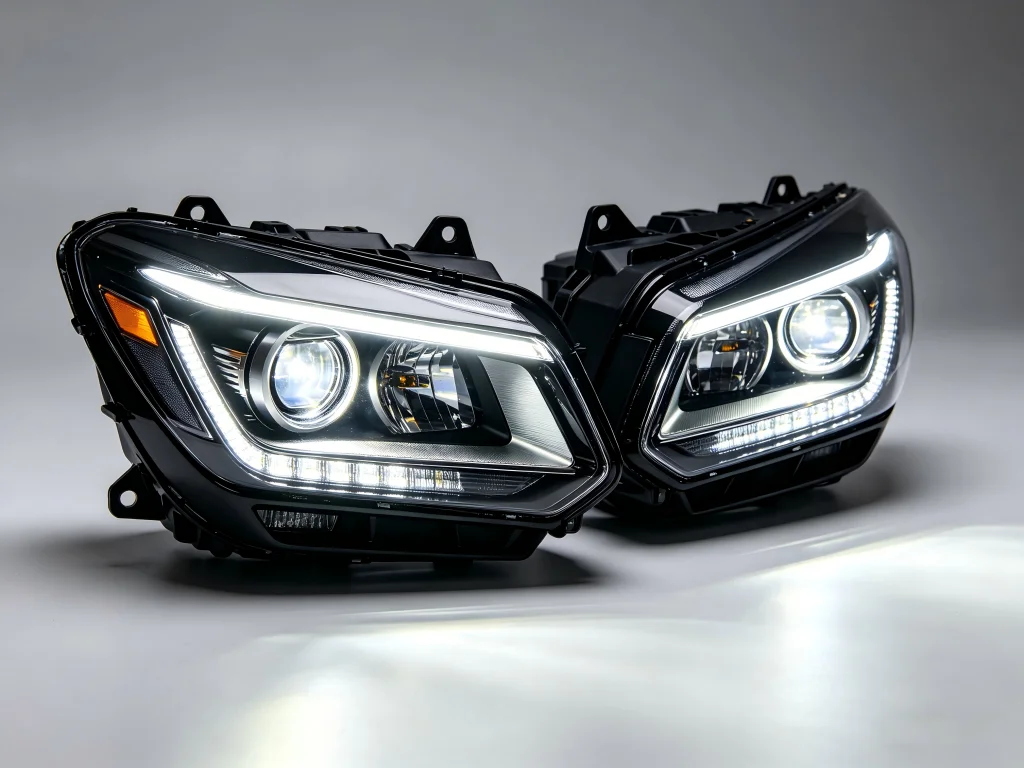
1. The Technology Landscape: What’s Actually on the Market
A bi led projector for car is not a single product category — it’s a family of optical systems that share core engineering principles but diverge significantly in performance, build quality, and price. Understanding the landscape before you buy is the single most effective way to avoid disappointment.
1.1. Bi LED Projector vs. Halogen Reflector: The Baseline Comparison
The halogen reflector is the default starting point for most vehicles on the road. It works by placing a halogen bulb at the focal point of a mirrored bowl, which reflects light forward in a broad pattern. There’s no lens, no shutter, and very little beam control beyond the shape of the reflector itself.
A bi LED projector replaces this entire system. Light from a high-output LED chip passes through a precision reflector bowl, then through a mechanical shutter that shapes the cutoff, then through a convex glass lens that focuses the beam onto the road. Each element in the chain plays a role, and weakness in any one of them degrades the final output.
Here’s how the two systems compare across the metrics that actually affect your driving experience:
| Performance Metric | Halogen Reflector | Bi LED Projector |
|---|---|---|
| Low Beam Lux @ 25 ft | 250–700 lux (depending on bulb age) | 1,500–3,200+ lux |
| Low Beam Throw Distance | 120–180 ft | 200–350 ft |
| Beam Cutoff Quality | Soft, scattered — no defined cutoff | Razor-sharp horizontal line |
| Glare to Oncoming Traffic | Significant spill above cutoff | Minimal — light stops at cutoff |
| Color Temperature | 2,800–3,200K (warm yellow) | 5,500–6,500K (daylight white) |
| Power Consumption | 55–65W per bulb | 35–70W per projector (both beams) |
| Bulb/Unit Lifespan | 500–1,000 hours | 30,000+ hours |
| High/Low Beam Integration | Separate bulbs or dual-filament | Single unit, shutter-controlled |
Source: GTR internal test data and industry benchmarks. Lux readings measured at hotspot center, 25-foot distance, calibrated meter. Actual performance varies by specific product model.
1.2. Bi LED Projector vs. HID (Bi-Xenon): The Upgrade Path Debate
Before LEDs dominated the retrofit conversation, HID (high-intensity discharge) projectors — often called “bi-xenon” — were the premium upgrade. They’re still widely available, and in some applications, they remain a viable choice. Understanding where each technology shines (and where it doesn’t) will help you make a decision based on your actual needs, not marketing hype.
HID projectors produce light by striking an electrical arc through xenon gas, creating a plasma that emits intense light. The process requires a ballast to generate the high-voltage strike pulse and regulate current. It also requires a warm-up period — typically 5–15 seconds to reach full brightness — and the bulbs degrade measurably over 2,000–3,000 hours, shifting color temperature and losing output.
Bi LED projectors produce light from solid-state emitters. There’s no warm-up: full brightness is instantaneous. There’s no ballast: just a compact driver circuit integrated into the projector body. And the emitters lose output very gradually over tens of thousands of hours rather than burning out suddenly.
| Feature | Bi LED Projector | Bi-Xenon HID Projector |
|---|---|---|
| Startup Time | Instant (0 seconds) | 5–15 seconds to full brightness |
| Bulb/Unit Lifespan | 30,000–50,000 hrs | 2,000–3,000 hrs (bulbs); ballast may fail separately |
| External Components | None (integrated driver) | External ballast, igniter, relay harness |
| Installation Complexity | Moderate — projector + wiring | Higher — projector + ballast mounting + high-voltage wiring |
| Color Shift Over Life | Minimal (solid-state) | Noticeable — bulbs shift bluer with age |
| Cold Weather Performance | Excellent — no warm-up penalty | Slower warm-up, but operates fine once lit |
| Efficiency (lm/W) | Higher — typically 80–100 lm/W | Lower — typically 60–75 lm/W including ballast losses |
For most passenger vehicle applications, bi LED projectors have become the default recommendation — and it’s not close. The only scenario where HID may still merit consideration is a high-speed, long-distance highway application where budget constraints are severe and the installer has experience with HID wiring. Even then, the gap is narrowing as quality bi LED projectors become more affordable.
1.3. Projector vs. Reflector (Both LED): Why the Optic Matters
It’s tempting to assume that “LED headlight” means good headlight. It doesn’t. There are LED reflector headlights on the market — some factory-installed, some aftermarket — that produce impressive lumen numbers on paper but deliver mediocre real-world beam patterns.
The difference comes down to optical control. A reflector relies on the shape of a mirrored bowl to direct light. It’s inherently a broad-distribution device. A projector uses a combination of reflector bowl, shutter, and lens — three optical elements that can each be independently optimized. The result is more precise beam shaping: a clean cutoff, tight hotspot control, and even illumination across the full width of the beam pattern.
In practical terms, if you’re choosing between an LED reflector assembly and a bi LED projector assembly from the same brand, take the projector. The lux numbers at the hotspot will be higher, the glare will be lower, and the beam will feel more “premium” in use. There’s a reason virtually every luxury OEM — BMW, Mercedes, Audi, Lexus — uses projector optics for their flagship lighting systems.
2. How to Read Specs Without Getting Fooled
2.1. The Lumen Trap: Why Brightness Numbers Lie
Manufacturers love to print huge lumen numbers on the box. 20,000 lumens! 30,000 lumens! Here’s the uncomfortable truth: raw lumens measure total light output at the source, not light on the road. A poorly designed projector with a 10,000-lumen LED chip can put less usable light in your lane than a precision-engineered unit with a 3,000-lumen emitter.
Lux is the measurement that matters for driving. Lux measures light intensity on a surface at a specific distance — in other words, how brightly the road is illuminated where you’re actually looking. At GTR, we test every projector variant at a standardized 25-foot distance and measure peak lux in the hotspot (the brightest part of the beam, centered just below the cutoff). A reading of 2,000+ lux at 25 feet is the mark of a serious projector. Readings below 1,000 lux at that distance indicate budget optics regardless of what the lumen specs claim.
Why do some projectors produce high lumens but low lux? Because the optics are inefficient. Light scatters inside the housing, misses the lens, or gets absorbed by poorly machined reflector surfaces. You’re paying for photons that never reach the road.
2.2. Color Temperature: 6,000K vs. 5,500K and Why It Matters
Color temperature describes the tint of the light, measured in Kelvin. Halogen sits at 2,800–3,200K — warm and yellow. Most aftermarket LED projectors fall in the 5,500–6,500K range — cool white to slightly blue.
There’s a persistent myth that “bluer is better.” It’s not. Here’s the physics: shorter wavelengths (blue light) scatter more when they hit water droplets, dust, or fog. This means that in rain or mist, a 6,500K beam will produce more backscatter — light reflecting off moisture in the air back into your eyes — than a 5,500K beam. The effect is subtle in light rain but becomes noticeable in heavy fog or snowfall.
For all-weather performance, 5,500K is the practical sweet spot: white enough to activate your eyes’ photopic (daylight) vision for better detail recognition, warm enough to cut through moisture without excessive scatter. GTR’s laser-assisted projectors, including the G45 series, use 5,500K as their default color temperature for precisely this reason. In clear conditions, the difference between 5,500K and 6,000K is nearly imperceptible to the human eye.
2.3. Wattage: Higher Isn’t Always Better
You’ll see bi LED projectors rated anywhere from 35W to 140W. Tempting as it may be to grab the highest number, wattage alone doesn’t determine brightness or quality. It determines heat.
LEDs become less efficient as they heat up — a phenomenon called thermal droop. A projector with poor thermal management that draws 100W might actually produce less usable light than a well-cooled unit at 60W, because the LED chip is cooking itself. The excess energy becomes heat, which shortens emitter lifespan and can eventually damage the driver electronics.
When comparing wattage between projectors, ask: where is the heat going? Quality units use an aviation-grade aluminum body (typically 6063 alloy) with integrated fin structures, sometimes augmented by a small cooling fan. The body itself acts as a heatsink. Budget units use thinner castings with less thermal mass, and they run hotter for it.
3. The Construction Checklist: What to Look for Before You Buy
Not all bi LED projectors are built to the same standard. After handling warranty returns and failed units from across the market, we’ve identified the construction details that separate projectors that last from projectors that fail within a year:
3.1. Reflector Bowl Material: Metal vs. Plastic
This was once the single biggest quality differentiator in the industry. Early plastic reflector bowls could warp or deform under the sustained heat of HID bulbs. With LED sources producing less radiant heat forward, the concern has diminished — but not disappeared entirely. High-output bi LED projectors still generate significant heat at the LED junction, and some of that heat conducts to the reflector bowl.
Metal reflector bowls (aluminum or zinc alloy) offer three advantages: they never warp, they contribute to thermal dissipation by acting as an additional heatsink surface, and they can be machined to tighter tolerances for more precise beam shaping. Plastic bowls in modern projectors use heat-resistant polymers and are generally adequate for projectors below 50W. Above that threshold, we strongly prefer metal.
GTR projectors use CNC-machined metal reflector bowls across all models, including entry-level units. It’s one of those invisible quality choices that customers never see but absolutely feel in the consistency of the beam pattern over years of use.
3.2. Lens Material: Glass vs. Plastic — Settled Science
We touched on this in the first article, but it bears repeating with more technical detail. The projector lens sits directly in the focused light path. All the lumens your LED produces pass through this single component. The material choice determines optical clarity, heat tolerance, and long-term durability.
High-clarity optical glass (borosilicate or similar) offers 90–92% light transmission, zero thermal warping risk at automotive temperatures, and indefinite optical stability. The downside is weight and cost.
Optical-grade polycarbonate offers 85–88% transmission, lower weight, and lower cost — but softening temperatures are significantly lower. Under sustained high-beam operation on a hot summer night, a plastic lens in a high-output projector can begin to deform microscopically. The cutoff line becomes slightly fuzzy, then progressively worse over months.
Premium projectors use glass. Budget projectors use plastic. Mid-range projectors sometimes use a glass-plastic hybrid or a plastic lens with a hard coating. For a purchase you expect to last the life of the vehicle, glass is the only material we recommend for the primary projector lens.
3.3. Driver Electronics: Sealed, Potted, and Protected
The LED driver is the brain of the projector. It regulates current to the LED chip, manages thermal protection, and handles the solenoid trigger for high/low switching. When drivers fail, it’s usually because moisture got in, vibration shook a solder joint loose, or a voltage spike from the vehicle’s electrical system overwhelmed the input protection.
Look for projectors with fully sealed, epoxy-potted driver circuits. The potting compound encapsulates the electronics, protecting against moisture, vibration, and thermal cycling. An IP68 rating on the projector body means the entire unit — optics, driver, and housing — is dust-tight and can withstand continuous immersion in water beyond 1 meter. This level of sealing is overkill for normal driving but means the projector will shrug off pressure-washing, deep water crossings, and years of humidity cycling.
4. Size, Fitment, and Install: Matching the Projector to the Vehicle
Bi led projector installation success depends more on fitment than on any other single factor. A projector that’s too deep for the housing, too wide for the reflector opening, or incompatible with the factory bulb mount will turn a weekend project into a frustrating ordeal.
Here’s a practical sizing guide based on headlight housing dimensions:
| Housing Depth (Lens to Rear) | Recommended Projector Size | Typical Applications |
|---|---|---|
| ≥ 150mm | 3.0-inch | Full-size sedans, SUVs, trucks, most H4 headlights |
| 110–150mm | 2.5-inch | Compact cars, motorcycles, fog light retrofits, tight housings |
| ≤ 110mm | 1.8-inch or 2.0-inch | Motorcycle headlights, quad-projector setups, specialty applications |
Measure twice, order once. The internal depth from the front lens to the rear bulb cover (with the cover installed) is the critical dimension. If your housing uses a rubber dust boot, measure with the boot compressed to its installed position. Add 5mm of clearance beyond the projector’s spec depth to account for the locking nut and wiring bend radius at the rear.
4.1. Mounting Style: Threaded-Shaft vs. Bracket
Threaded-shaft mounting (sometimes called “universal mount”) is the most common retrofit method for vehicles with standard bulb bases like H4, H7, or 9005/9006. The projector has a threaded barrel that passes through the factory bulb opening. A locking nut secures it from the rear. This method is fast, non-destructive, and reversible. The GTR S35 and G45 series both use threaded-shaft mounting.
Bracket mounting is used for projector-specific housings or custom retrofits. The projector bolts to a bracket inside the housing. This method allows more precise alignment but requires fabrication or vehicle-specific adapter brackets. It’s common on high-end custom retrofits where the installer wants absolute control over projector positioning and rotational alignment.
For most DIY installers, a threaded-shaft projector matched to the vehicle’s bulb base type (e.g., bi led projector h4 for H4-equipped cars) is the practical choice. It preserves the factory housing, requires no modification beyond opening and resealing the lens, and can be completed in an afternoon.
5. Bi LED Projector Laser: Worth the Premium?
The addition of a laser element to a bi LED projector changes the performance equation in one specific area: high-beam throw distance. A standard bi LED projector high beam is powerful and wide, but the intensity drops off with distance — inverse square law applies. A laser spot supplements the LED high beam with an extremely concentrated pencil of light that reaches far beyond the LED beam’s effective range.
In controlled testing, GTR’s G45 laser-assisted projector delivers a measurable lux reading at 300+ meters where the standard bi LED high beam has already fallen off significantly. For drivers who regularly navigate unlit rural highways at speed, this extra reach is genuinely useful. For city and suburban drivers who rarely use high beams at all, the laser adds cost without adding practical value.
The decision tree is straightforward:
- If you drive unlit highways or mountain roads more than twice a month at night → consider the bi led projector laser variant.
- If 95% of your night driving is on roads with at least some ambient lighting → the standard bi LED projector will exceed your needs.
- If you frequently drive in fog, rain, or snow → skip the laser. The intense pencil beam will backscatter in moisture and work against you.
6. Common Pitfalls: The Mistakes That Send Buyers Back to the Forums
6.1. Pitfall 1: Buying the Cheapest Projector You Can Find
We see this constantly. A customer buys a no-name bi LED projector for $35, installs it, and discovers the beam pattern has dark blotches, the cutoff is fuzzy, or the whole unit failed after three months. The money they saved is consumed by the cost of doing the job twice.
Budget projectors cut corners on three things: reflector bowl precision (producing uneven beams), lens quality (producing soft cutoffs), and driver electronics (producing premature failures). The economics of manufacturing mean you cannot produce a quality bi LED projector at the $35–50 retail price point. The materials alone — aluminum body, glass lens, quality LED emitters, potted driver — cost more than that before you factor in labor, tooling, and quality control.
A reasonable entry-level price for an acceptable bi LED projector is $80–120. The sweet spot for consistent quality with strong performance is $120–200. Above $200, you’re paying for laser supplementation, premium emitter binning, or vehicle-specific custom engineering.
6.2. Pitfall 2: Ignoring the Reflector Bowl Material
Already covered in detail above, but the short version: plastic bowls in high-wattage projectors are a long-term reliability risk. If you’re spending over $100 on a projector, insist on a metal reflector bowl. It’s one of the easiest quality checks you can make before purchase.
6.3. Pitfall 3: Skipping the Alignment Step
Even the best bi LED projector will perform terribly if it’s aimed wrong. A projector aimed too high creates glare for everyone ahead of you. Aimed too low, it undercuts your seeing distance and makes the upgrade feel underwhelming.
After installation, park the vehicle on level ground facing a wall at exactly 25 feet. Measure the height from the ground to the center of the projector lens. The cutoff line on the wall should sit 1–2 inches below that height. Most projectors have a rotational adjustment — use it to ensure the cutoff is perfectly horizontal, with the step-up on the appropriate side for your traffic direction (right side for LHD, left side for RHD).
6.4. Pitfall 4: Forgetting About Moisture Management
Headlight housings breathe. As they warm up during use and cool down afterward, the air inside expands and contracts, drawing in ambient moisture. Without a vent or desiccant, that moisture condenses on the inside of the lens. Over time, it fogs the lens, corrodes connections, and eventually kills the electronics.
When you reseal the headlight after a retrofit, include either a Gore-Tex breather patch (which allows pressure equalization while blocking liquid water) or several silica gel desiccant packs secured inside the housing. Replace the desiccant packs annually. This one step prevents the vast majority of post-installation failures we see in warranty returns.
7. Questions from the Bottom of the Funnel
7.1. Which GTR bi LED projector should I buy for my car?
Our product line is structured by performance tier and application, not by vehicle model — this is deliberate, because fitment is determined by housing dimensions and bulb base type, not by make and model. Here’s a quick matching guide:
- GTR S35: 3.0-inch bi LED projector, threaded-shaft mount for H4/H7/9005/9006 housings. This is the general-purpose workhorse. Sharp cutoff, wide beam, metal reflector bowl, glass lens. Best choice for most passenger cars, SUVs, and light trucks.
- GTR G45 Laser: 3.0-inch bi LED projector laser, same mounting system as S35. Adds a laser spot for extended high-beam reach. Best choice for rural and highway drivers who regularly use high beams in unlit conditions.
- GTR WS03: 2.0-inch bi LED fog projector, compact form factor for fog light housings. Flat cutoff, wide spread, IP68 build. Best for auxiliary fog or cornering light upgrades.
- GTR ES6: 3.0-inch bi LED projector with dual color temperature option (6,000K low beam / 4,000K high beam) for applications requiring warmer high-beam light for reduced backscatter.
Not sure which fits? Measure your housing depth and bulb base type, then reach out through our contact form at https://www.rhgtr.com. Our team matches projectors to vehicles every day and can confirm fitment within 24 hours.
7.2. Are GTR projectors truly plug-and-play?
For vehicles with standard H4, H7, 9005, 9006, or H11 bulb bases, yes — the electrical side is plug-and-play. The projector’s input harness connects directly to the factory bulb socket. The high-beam solenoid trigger wire taps into the vehicle’s high-beam circuit, which is typically a single wire that can be connected with a posi-tap or spade connector in under five minutes.
The physical installation — opening the headlight, mounting the projector, and resealing the lens — requires time and care but no permanent modifications to the housing with our threaded-shaft system. We provide detailed installation documentation with every unit, and our support team is available for questions during your install.
7.3. What warranty and support does GTR offer?
Every GTR projector lens comes with an 18-month direct replacement warranty. If a unit fails within the warranty period, we ship a replacement — no need to return the defective unit first. This policy is backed by our manufacturing defect rate below 0.1%, achieved through an 8-gate quality control process that tests every projector for beam pattern, shutter function, electrical draw, and waterproofing before it leaves the factory floor.
For bulk buyers — distributors, installers, and OEM partners — we offer extended warranty terms and priority support. Discuss your requirements with our sales team through the contact channels on https://www.rhgtr.com.
8. The Bottom Line: A Decision Framework
By now, you’ve absorbed a lot of information. Let’s distill it into a simple decision framework you can use right now:
- Measure your headlight housing depth and identify your bulb base type. This determines which projector sizes and mounting options are available to you.
- Decide between standard bi LED and bi LED laser based on your actual driving patterns. Be honest with yourself. Don’t pay for a laser you’ll use twice a year.
- Set a realistic budget. $120–200 gets you into quality territory. Below $80, you’re in the danger zone of inconsistent optics and questionable driver electronics.
- Check the construction details. Glass lens, metal reflector bowl, sealed driver — three boxes that should all be ticked.
- Choose a brand that stands behind the product. Warranty length, support responsiveness, and real-world reputation matter more than spec sheet numbers.
- Install carefully, align properly, and manage moisture. The best projector in the world won’t save a rushed installation with a fogged housing and a crooked beam.
If you’ve made it this far, you’re already ahead of 95% of buyers. You know what to measure, which specs to ignore, and where the real quality differences lie. Now it’s a matter of matching the right projector to your vehicle and your driving reality.
Explore the full GTR product lineup — projectors, fog lights, and complete headlight assemblies — at https://www.rhgtr.com. Need help narrowing it down? Our engineering support team handles fitment questions daily. Reach out, tell us what you drive and where you drive it, and we’ll point you to the projector that makes sense for your situation. No upsells. No guesswork. Just the right light for the road ahead.
References & Further Reading
1. SAE International. (2022). SAE J1383: Performance Requirements for Motor Vehicle Headlamps. https://www.sae.org/standards/content/j1383_202206/
2. Royalin-Lighting. (2025). How to Measure a Bi-LED Projector Lens’s Brightness Correctly? — Reference for lux-based photometric testing methodology.
3. Royalin-Lighting. (2025). Why Do Premium Bi-LED Projectors Still Use Glass Lenses? — Technical comparison of glass vs. plastic lens materials under automotive thermal loads.
4. Headlight Revolution. (2025). Are GTR Lighting Carbide Series LED Headlights Any Good? — Third-party independent review and performance assessment.
5. Conpex Group. (2025). Ordinary Car LED Headlights vs. Bi-LED Projector Lens Headlights: Which Is Better and How to Choose? — Comparative analysis of LED reflector vs. projector technologies.