
Choosing the right H7 LED headlight bulb means looking past inflated lumen claims and understanding five critical factors: CANBUS compatibility, physical fitment, beam pattern accuracy, thermal management, and build quality.
The H7 is one of the most common single-filament bulb sizes in European and Asian vehicles — found in thousands of models from Volkswagen, BMW, Mercedes-Benz, Audi, Hyundai, and Ford. Unlike dual-beam H4 bulbs, the H7 serves one purpose per unit: either low beam or high beam. This single-purpose design allows for better optical focus in reflector or projector housings — but only if the replacement bulb matches the original specifications.
Here is the problem: the H7 LED headlight bulb market is flooded with products that look identical on paper but perform radically differently in real-world conditions. Based on our engineering testing across dozens of H7 LED bulbs and thousands of real-world installations, we have identified exactly what separates a genuine upgrade from a disappointing purchase.
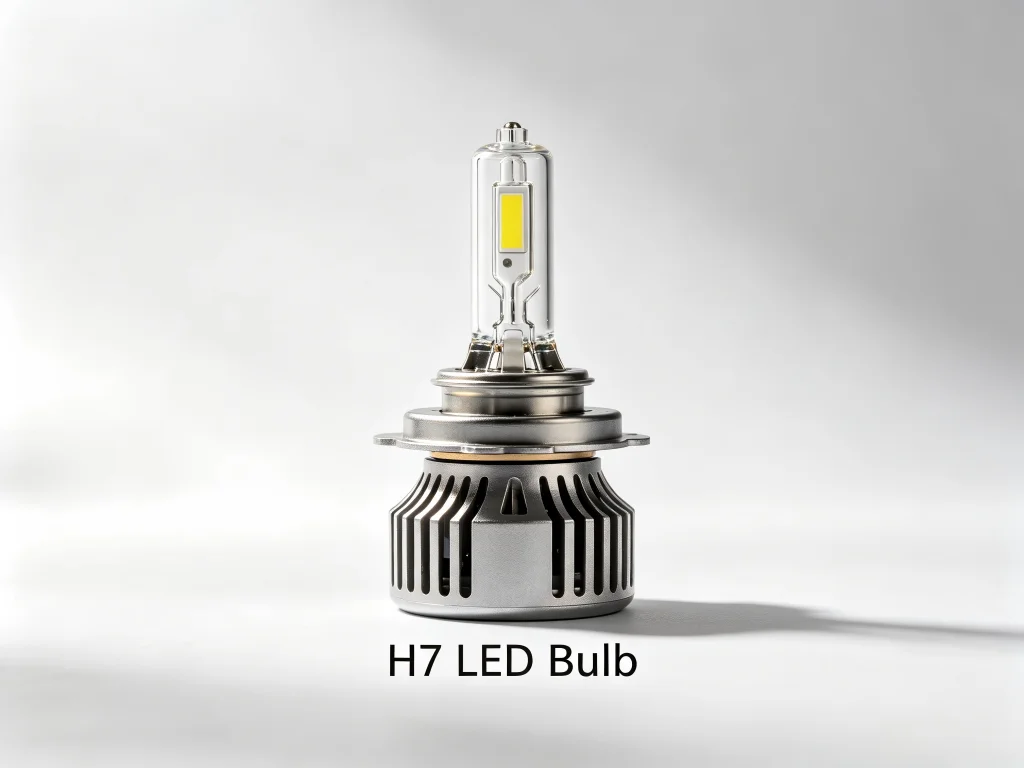
1. H7 LED vs. Halogen vs. HID: The Real Data
Before diving into what makes a great H7 LED bulb, understand what you are upgrading from and what is actually possible.
| Parameter | Halogen H7 | HID (Xenon) H7 | LED H7 |
|---|---|---|---|
| Lumens | ~1,200–1,550 lm | ~3,000–5,000+ lm | ~3,000–6,000+ lm |
| Lifespan | 300–500 hrs | 2,000–3,000 hrs | 30,000–50,000 hrs |
| Color Temperature | 3,200K–3,500K (yellow) | 4,300K–6,000K | 5,000K–6,500K (white) |
| Power Draw | 55W | 35W | 20–40W |
| Warm-Up Time | 0.1–0.2 s | 3–5 s | Instant |
| Plug & Play? | Yes | No (needs ballast, wiring) | Yes (most cases) |
The data is clear: LED offers superior brightness, dramatically longer lifespan, instant warm-up, and lower power consumption compared to both halogen and HID. But these benefits are only realized when the bulb is properly engineered. A poorly designed LED can actually perform worse than a standard halogen.
2. Five Critical Factors That Determine H7 LED Success or Failure
Most buyers focus on brightness and price. The smart buyer focuses on compatibility and engineering — because brightness means nothing if the bulb does not work in your vehicle.
2.1. CANBUS Compatibility: The Make-or-Break Factor
If your vehicle has a CANBUS system — and most European and Asian vehicles do — you need an H7 LED bulb with integrated decoding or you will face dashboard error warnings.
Modern vehicles monitor bulb resistance to detect failures. LEDs draw far less power than halogens, so the computer thinks a bulb is out and triggers a warning or hyper-flash. A built-in CANBUS driver tricks the system into thinking the correct current is flowing.
Some manufacturers advertise “CANBUS error free” but deliver products that still cause errors. External resistors can work, but they generate significant heat — up to 50 watts of wasted energy that turns into heat inside your headlight housing. For genuine error-free operation, choose H7 LED headlight bulbs with integrated decoding rather than external resistor kits.
Vehicles most sensitive to CANBUS issues: German brands (BMW, Mercedes-Benz, Audi, VW), premium Japanese brands, and many Korean vehicles. If you drive one of these, CANBUS compatibility is mandatory, not optional.
2.2. Physical Fitment: 1:1 Design vs. Bulky Alternatives
H7 headlight housings have limited space. The dust cover clearance is often just a few centimeters. Many LED bulbs use large heat sinks or external driver boxes that simply do not fit.
The ideal H7 LED headlight bulb uses a 1:1 mini design that replicates the original halogen dimensions. The driver should be integrated into the bulb base, eliminating external boxes. Installation should take five minutes with no tools required.
Common fitment issues reported by real users include bulbs that are too thick to fit through the socket, bulbs that are too long for the locking mechanism, and bulbs with oversized heat sinks that cannot clear the dust cover. These problems turn a simple upgrade into a frustrating modification project.
2.3. Beam Pattern Accuracy: Where Light Actually Goes
This is the single most overlooked factor in H7 LED selection — and the most important for both your safety and the safety of others on the road.
The halogen filament in your original H7 bulb sits at a precise position — 27.5mm from the base. If your LED chips are not in the exact same location, the optics cannot focus the light. The result is scattered light that creates dark spots in your field of view and dangerous glare for oncoming traffic.
A high-quality H7 LED replicates the halogen filament position with an ultra-thin board (0.03 to 0.05 inches) so the light source sits at the exact same focal point as the original bulb. This preserves the manufacturer’s cutoff line and prevents glare. Bulbs with thick boards or incorrectly positioned chips cast scattered light that reduces your own visibility while annoying every driver ahead.
In projector headlights specifically, well-designed LEDs can outperform the original halogen entirely. But only if the chip geometry matches the halogen filament’s light source geometry.
Look for H7 LED bulbs with 360° rotational adjustability that allow you to rotate the LED chip array to match your specific housing. This feature is essential for achieving the correct beam pattern in both reflector and projector headlights.
2.4. Thermal Management: The Silent Performance Killer
LEDs generate heat at the semiconductor junction where the chip meets the board. If that heat is not pulled away rapidly, the bulb permanently dims within weeks.
Look for an aluminum or copper base with a specified fan speed — 12,000 RPM is the baseline, while premium units reach 23,000 RPM. A bulb that advertises 50,000+ hours without disclosing the cooling mechanism is almost certainly cutting corners.
Aviation-grade aluminum heat sinks and high-speed cooling fans are the hallmarks of proper thermal engineering. Passive cooling (fanless designs) may work for lower-output bulbs but typically cannot handle the heat generated by high-lumen H7 LEDs without significant lumen depreciation over time.
2.5. Build Quality: What You Cannot See Matters Most
Automotive-grade multi-core LED chips, non-plastic connectors, and robust driver circuitry separate premium H7 LED bulbs from budget alternatives that fail within months.
The connectors matter more than you might think. One Mercedes owner reported: “The H7 adapters buyers must buy separately from a 3rd party vendor, were poor quality soft metal which bent easily and were impossible to install”. Premium bulbs use durable materials that withstand vibration, temperature extremes, and repeated handling.
IP68 waterproof rating is another indicator of build quality. Your headlight housing is exposed to moisture, road spray, and temperature swings. A bulb that cannot handle these conditions will fail prematurely.
3. H7 LED Headlight Bulb Comparison: What the Market Offers
Here is how leading H7 LED options stack up against each other across the critical factors that actually matter.
| Feature | Budget H7 LED | Mid-Range H7 LED | Premium H7 LED (GTR Ultra) |
|---|---|---|---|
| CANBUS Integration | External resistor required | Basic decoding (may still error) | Integrated, error-free |
| Physical Design | Bulky, often requires modification | 1:1 design, no external driver | 1:1 mini, fully integrated |
| Beam Adjustment | Fixed position | Fixed or limited adjustment | 360° rotational adjustability |
| Thermal System | Basic heat sink, no fan specs | Aluminum heat sink, 12,000 RPM fan | Aviation-grade aluminum, high-speed fan |
| Raw Lumens (per bulb) | Claims inflated, actual ~1,500-2,000 | ~3,000-3,500 | 4,700 |
| Lifespan | Unspecified or exaggerated | ~30,000 hours | 30,000+ hours with consistent output |
| Installation Time | 30+ minutes (modifications often needed) | ~10 minutes | ~5 minutes, tool-free |
4. Five Mistakes to Avoid When Buying H7 LED Headlight Bulbs
- Chasing inflated lumen numbers: A single H7 LED bulb physically cannot produce 50,000 raw lumens. These numbers are either calculated per set, measured at the chip before optics, or fabricated. What matters is usable lumens — light that actually reaches the road in a focused beam.
- Ignoring beam pattern: If your LED chips are not where the halogen filament was, the optics fail. Scattered light creates glare and dark spots. Look for bulbs with adjustable collars that let you rotate the chip array.
- Overlooking thermal management: Heat degrades LED chips. Without proper cooling, your “50,000-hour” bulbs will dim within weeks. Check the cooling mechanism — fan speed and materials matter.
- Assuming “plug and play” means “fits everything”: H7 headlight housings vary significantly. Verify the physical dimensions of any bulb against your housing’s dust cover clearance and socket depth. A bulb that fits one vehicle may not fit another.
- Ignoring CANBUS compatibility: If your vehicle has a CANBUS system, you need integrated decoding. External resistors generate heat and can fail. Built-in decoding is the only reliable long-term solution.
5. Why GTR Ultra Series H7 LED Stands Above the Competition
GTR occupies the high-performance tier of H7 LED headlight bulbs. We provide the “sweet spot” of extreme brightness without the reliability issues of unbranded units. Here is why:
- Real, verifiable output: GTR Ultra 3.0 produces 4,700 raw lumens per bulb — not inflated marketing numbers. GTR’s Ultra 3.0 produces 4,700 raw lumens per bulb — a real, verifiable number that translates to exceptional road illumination when properly focused.
- Integrated CANBUS decoding: No external resistors. No dashboard warnings. No heat-generating boxes inside your headlight housing.
- 360° rotational adjustability: Full control over beam pattern alignment for any housing — reflector or projector.
- Premium thermal engineering: Automotive-grade multi-core LED chips with aviation-grade aluminum heat sinks. Consistent brightness that lasts — not a gradual fade to dimness.
- 1:1 mini design: Fits where bulky alternatives cannot. Five-minute installation, no tools required.
GTR distinguishes itself by offering H7 LED bulb CANBUS decoder technology across both product lines. Whether you need a direct replacement for your factory halogens or a complete retrofit solution, GTR provides the engineering that makes the upgrade work.
6. Frequently Asked Questions About H7 LED Headlight Bulbs
6.1. What is the difference between H7 and H4 headlight bulbs?
An H7 bulb is a single-beam bulb with one filament, designed for either low beam or high beam. An H4 bulb is a dual-beam bulb with two filaments that provide both high and low beam functions in a single bulb. They are not interchangeable.
6.2. How many lumens do I actually need in an H7 LED bulb?
Quality H7 LED replacements produce 3,000–5,000+ raw lumens per bulb. Ignore inflated numbers above this range. GTR Ultra 3.0 produces 4,700 raw lumens per bulb with exceptional beam focus — more than enough for superior road illumination without the reliability issues of over-driven chips.
6.3. Will H7 LED bulbs work in my reflector headlights?
Yes, but only if the bulb is designed to replicate the halogen filament position precisely. Poorly designed LEDs in reflector housings cause glare and are non-compliant with federal standards. Look for bulbs with 360° rotational adjustability to dial in the correct beam pattern.
6.4. Do I need a CANBUS decoder for H7 LED bulbs?
If your vehicle has a CANBUS system — most European and Asian vehicles do — you need either integrated decoding or external load resistors. Integrated decoding is the better solution; external resistors generate heat and can fail. GTR Ultra Series bulbs include integrated decoding.
6.5. How long do H7 LED headlight bulbs really last?
Quality LED replacements last 30,000–50,000 hours — that is 30-50 times longer than halogen. But this lifespan is only achievable with proper thermal management. Poorly cooled LEDs can dim or fail within weeks.
6.6. What vehicles use H7 headlight bulbs?
H7 bulbs are common in European and Asian vehicles including Volkswagen, BMW, Mercedes-Benz, Audi, Hyundai, Kia, and Ford. They are used for low beams, high beams, or fog lights depending on the vehicle.
6.7. Are H7 LED headlight bulbs legal in the US?
FMVSS 108 does not approve LEDs as a light source in replaceable-bulb headlamps, making aftermarket LED retrofit bulbs technically non-compliant at the federal level. Enforcement varies by state. Complete certified LED headlight assemblies are the fully compliant solution for OEM applications. For B2B and aftermarket applications, GTR provides products that meet rigorous international standards.
7. Make the Right Choice for Your H7 LED Upgrade
Choosing an H7 LED headlight bulb is not about picking the highest lumen count or the lowest price. It is about understanding what actually works in your vehicle — and investing in engineering that delivers real, reliable performance.
GTR Ultra Series H7 LED bulbs are engineered for professionals who demand performance, reliability, and compatibility. Whether you are a fleet manager upgrading multiple vehicles, a workshop owner recommending products to customers, or an individual driver who simply wants to see the road clearly at night, GTR provides the solution that works.
Visit www.rhgtr.com to explore our full range of H7 LED headlight bulb solutions. Contact our technical team for compatibility verification, installation support, or B2B partnership inquiries.
Because the road ahead deserves more than guesswork. It deserves engineering you can trust.