
Si estás comprando una bombilla HID D3S de repuesto, probablemente hayas notado algo frustrante: cada marca afirma ser la mejor. Los listados dicen “más brillante”, “mayor duración” y “calidad OEM”. Pero los precios van desde $25 hasta $200 por lo que parece el mismo producto. Entonces, ¿qué vale realmente tu dinero? Esta guía atraviesa el marketing y te dice exactamente qué importa—y qué no—al comprar bombillas HID D3S.
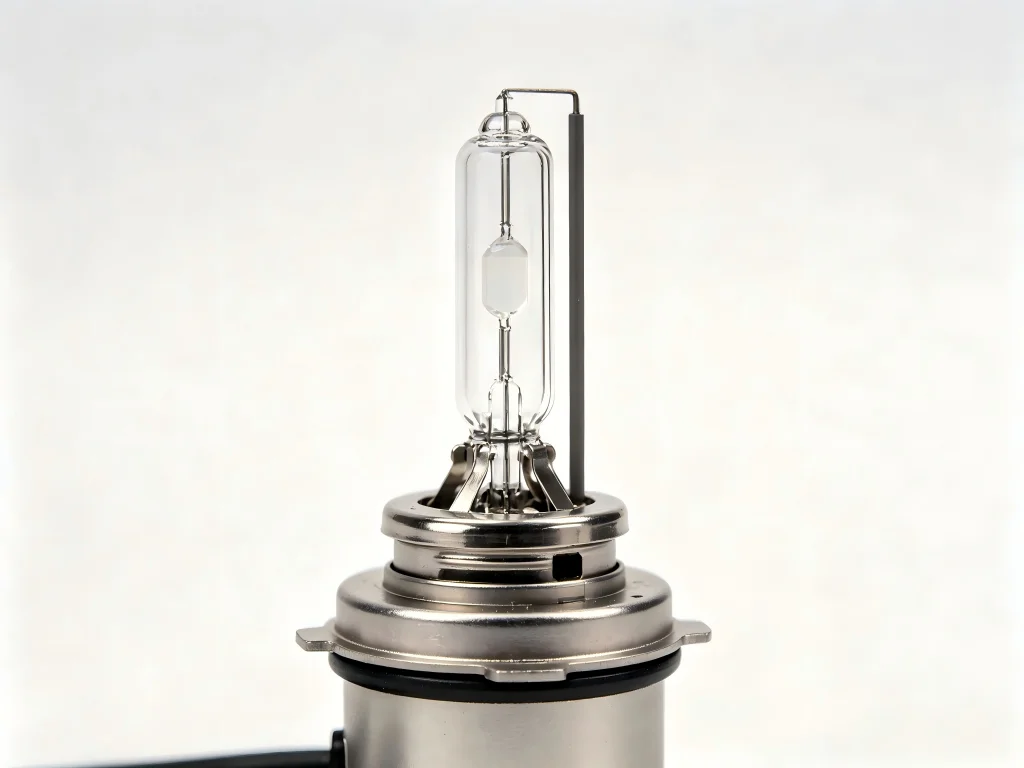
1. What exactly is a D3S HID bulb? (And why "D3S" matters)
D3S is an international standard designation (IEC 60061) for a specific type of HID bulb that operates at 42V DC with an integrated igniter and PK32d-5 base. Unlike D1S bulbs that run at 85V AC, D3S bulbs are mercury-free and designed for newer vehicle electrical systems.
The “D” stands for discharge (HID), the “3” indicates the electrical architecture (42V DC with integrated igniter), and the “S” means shielded—designed for projector-type headlights with a cutoff shield. D3R, on the other hand, is for reflector housings and has a painted section to block part of the light output.
Here's the critical takeaway: D3S bulbs are not interchangeable with D1S, D2S, or D4S. Even if the base looks similar, the voltage requirements and igniter configurations are completely different. Installing the wrong bulb can damage your ballast—a repair that can cost $300 or more.
2. D3S HID vs LED: Which should you choose?
This is the biggest decision you'll make. Here's the honest breakdown:
| Factor | D3S HID (OEM Replacement) | D3S LED Conversion |
|---|---|---|
| Brillo | 2,800–3,800 lúmenes por bombilla | 4,000–10,000+ lúmenes reclamados (varía enormemente) |
| Tiempo de calentamiento | 3–5 segundos para brillo completo | Encendido instantáneo |
| Vida útil | 2,500–5,000 horas | 30,000–60,000 horas |
| Patrón de haz | Diseñado para la carcasa de su proyector—emisión de luz de 360° | Puede ser inconsistente; algunos LED no coinciden con la óptica de la carcasa |
| Consistencia de color | Cambia con el tiempo (rosa/púrpura cerca del fallo) | Estable durante toda la vida útil |
| Clima frío | Puede tener dificultades y tardar más en calentarse | Rendimiento consistente en todas las condiciones |
| Instalación | Direct 1:1 replacement | Plug-and-play into existing ballast |
This is the reality that few sellers will tell you: LED conversion bulbs may not perform as well in your specific housing. A Jeep owner reported that although the LEDs were better for short and medium distances, they lost “a bit of reach on high beams.” Another forum member warned that even if you could physically install an LED, “it is unlikely that an LED will be brighter, particularly within the same housing.”.
Our recommendation at GTR? Stick with HID if you want predictable and housing-optimized performance. Consider LED only if you are willing to accept potential drawbacks in beam pattern and range distance.
3. How to choose the correct color temperature for the HID D3S bulb
Color temperature is measured in Kelvin (K). Higher numbers look “cooler” (bluer), but they do not necessarily mean better visibility.
| Kelvin | Appearance | Mejor para | Trade-offs |
|---|---|---|---|
| 4300K | Warm white, OEM standard | General visibility, wet roads, fog | Less “modern” appearance” |
| 5000K | Pure white | Balance between brightness and style | Slightly less rain penetration than 4300K |
| 6000K | Ice white (cold bluish white) | Style, combination with LED daytime running lights | Reduced visibility in fog and rain |
| 8000K+ | Ice blue to purple | Cosmetic only | Significantly reduced useful light output |
According to Diode Dynamics, who measure color temperatures in their photometric testing lab, 6000K is the most popular aftermarket choice because it matches most LEDs best. But if you drive in areas with frequent rain or fog, 4300K or 5000K will serve you better.
One thing to keep in mind: cheap bulbs often claim a color temperature they don't actually deliver. At GTR, we verify the color temperature of every bulb in our testing lab—what you ask for is what you get.
4. What the best brands don't tell you
This is what we've learned from years of manufacturing and testing D3S HID bulbs:
4.1. The "lumens" problem"
Many brands advertise flashy lumen figures—8,000, 10,000, even 20,000 lumens. But here's the catch: these numbers are often theoretical or measured at the emitter, not what actually reaches the road. A properly designed D3S HID bulb produces 2,800–3,800 lumens of useful light. Anything claiming significantly more should be viewed with skepticism.
4.2. The "German" claim"
Some budget brands claim “German xenon gas” or “German engineering” to justify higher prices. While German-sourced materials may indicate quality, the real difference comes from manufacturing precision—arc alignment, glass quality, and electrode materials. A bulb with “German gas” but sloppy assembly will still underperform.
4.3. El mito del OEM
No todas las bombillas “grado OEM” son iguales. Philips y Osram son los proveedores OEM reales para la mayoría de los principales fabricantes de automóviles. Cuando compra una bombilla Philips D3S, obtiene la misma calidad que venía en su automóvil de fábrica. Cuando compra una marca sin nombre que afirma “grado OEM,” está arriesgándose en el control de calidad.
5. Rendimiento real de las bombillas HID D3S: lo que los conductores realmente dicen
Hemos revisado miles de publicaciones en foros, reseñas y comentarios de clientes para entender lo que los conductores reales experimentan con los reemplazos de bombillas HID D3S.
“Instalé faros HID en mi coche y la diferencia es enorme. La luz es mucho más brillante y más blanca en comparación con las bombillas halógenas estándar, lo que hace que conducir de noche sea mucho más claro y seguro. Proyectan la luz más lejos en la carretera, por lo que la visibilidad es mejor en áreas oscuras.”
“HE ESTADO USANDO ESTOS DURANTE CASI 6 MESES Y SIGUEN BRILLANDO INTENSAMENTE.”
“Encontré estas bombillas HID de la marca DMEX en Amazon por alrededor de $35ish por DOS bombillas… Las bombillas DMEX son más brillantes y más blancas, mucho mejores para conducir de noche y en mal tiempo. No puedo hablar de la longevidad, las tengo desde hace dos meses y siguen funcionando muy bien, el tiempo lo dirá.”
El patrón es claro: las bombillas más baratas a menudo funcionan bien inicialmente pero pueden no durar más de uno o dos años. Las bombillas premium cuestan más por adelantado pero ofrecen un rendimiento constante durante años de uso.
Un cliente de Philips lo expresó sin rodeos: “Compre una vez, llore una vez. Estas bombillas durarán seis años o más en comparación con las marcas baratas de posventa que duran desde unos pocos meses hasta uno o dos años. Haga los cálculos.”
6. Compatibilidad de bombillas HID D3S: ¿Se adaptarán a su vehículo?
Las bombillas HID D3S se utilizan en una amplia gama de vehículos desde finales de la década de 2000 hasta la actualidad. Las aplicaciones comunes incluyen:
- Audi: A3, A4, A5, A6, A7, A8, Q3, Q5, Q7 (2009–2018)
- BMW: Varios modelos con sistemas HID de fábrica
- Cadillac: ATS, CTS, XTS (2013–2018)
- Chevrolet: Camaro, Corvette (2014–2018)
- Dodge: Charger, Challenger, Dart
- Ford: Fusión (2013–2020 con opción HID), F-150 King Ranch
- Jeep: Grand Cherokee (2014–2021), Cherokee (2014–2018)
- Lincoln: MKZ, MKX
Antes de comprar, verifique que su vehículo tenga faros HID de fábrica, no halógenos. Las bombillas D3S no caben en ensamblajes halógenos. Consulte el manual del propietario o busque la designación “D3S” en su bombilla actual.
7. Frequently Asked Questions About D3S HID Bulbs
7.1. What is the difference between D3S and D3R?
D3S bulbs are shielded (designed for projector housings) with no painted section on the glass. D3R bulbs have a painted section that blocks part of the light output for use in reflector housings. They are not interchangeable: using a D3S in a reflector housing will scatter light and glare oncoming traffic.
7.2. How do I know if my D3S HID bulb needs replacement?
Signs include headlights that dim, color shift to pink or purple, flickering, delayed ignition, or complete failure. If one bulb fails, replace both: the other is likely near the end of its life.
7.3. Can I install a D3S HID bulb myself?
Yes: D3S HID bulbs are designed for a direct 1:1 replacement. Installation typically involves removing the headlight access cover, twisting the old bulb out, and inserting the new one. Always wear gloves to avoid oil contamination on the glass.
7.4. Why are D3S HID bulbs so expensive?
Quality D3S HID bulbs use premium materials—quartz glass, precision electrodes, and complex gas mixtures—that cost more to manufacture. Cheap bulbs cut corners on these materials, resulting in shorter lifespan and inconsistent performance.
7.5. Are D3S HID bulbs legal?
D3S HID bulbs with proper ECE certification are legal for use in vehicles that come factory-equipped with HID systems. Aftermarket installations in halogen housings may not be road-legal in your jurisdiction.
7.6. What wattage should I choose?
D3S HID bulbs are standardized at 35W. There are some 55W aftermarket options, but they can stress your ballast and wiring, and typically shift the color temperature down.
7.7. How do I prevent premature failure of D3S HID bulbs?
Handle bulbs only by the base: skin oils on the glass create hot spots that can cause cracking. Replace in pairs. Ensure your ballast is functioning properly, as voltage issues can shorten bulb life.
8. Why GTR D3S HID Bulbs Are Different
We've been manufacturing automotive lighting for years. We know the difference between a bulb that looks good on paper and one that performs on the road.
GTR D3S HID bulbs are engineered with:
- Precision arc alignment—our bulbs put the light where it belongs: on the road, not in the eyes of oncoming drivers
- UV-reduced quartz glass—protects your headlight lenses from hazing and cracking
- True color temperature—verified in our photometric testing lab
- Ceramic bases—withstand the intense heat of continuous operation
- Full vehicle compatibility—designed to fit all factory D3S HID applications
Every GTR D3S HID bulb is tested before it leaves our facility. We do not ship products we would not put in our own vehicles.
9. Your D3S HID Bulb Replacement: The Bottom Line
You have three options when your D3S HID bulb fails:
- Buy the cheapest bulb you can find—save money now, replace it again in 6 to 18 months, and hope it doesn't fail at the worst possible moment
- Buy a premium brand bulb—pay more upfront, get 3 to 6 years of consistent performance, and drive with confidence
- Convert to LED—potentially gain instant ignition and longer lifespan, but risk an inconsistent beam pattern and reduced projection distance
At GTR, we believe in option number two. Premium D3S HID bulbs are not an expense; they are an investment in your safety and peace of mind.
Ready to upgrade your D3S HID bulbs? Visit www.rhgtr.com today. Explore our full selection of D3S HID bulbs in 4300K, 5000K, 6000K, and more. Free technical support. Fast shipping. And the confidence that comes from driving with lighting you can trust.