
Bombilla HID la tecnología ha sido el estándar de oro para la iluminación automotriz desde que BMW la introdujo en el Serie 7 de 1991. Pero en 2026, el panorama es diferente. Los faros LED son ahora estándar en muchos vehículos nuevos, y el halógeno sigue siendo la opción económica por defecto. Si estás comprando bombillas de repuesto—o considerando una actualización—necesitas un marco claro para la toma de decisiones. Esta guía te proporciona ese marco.
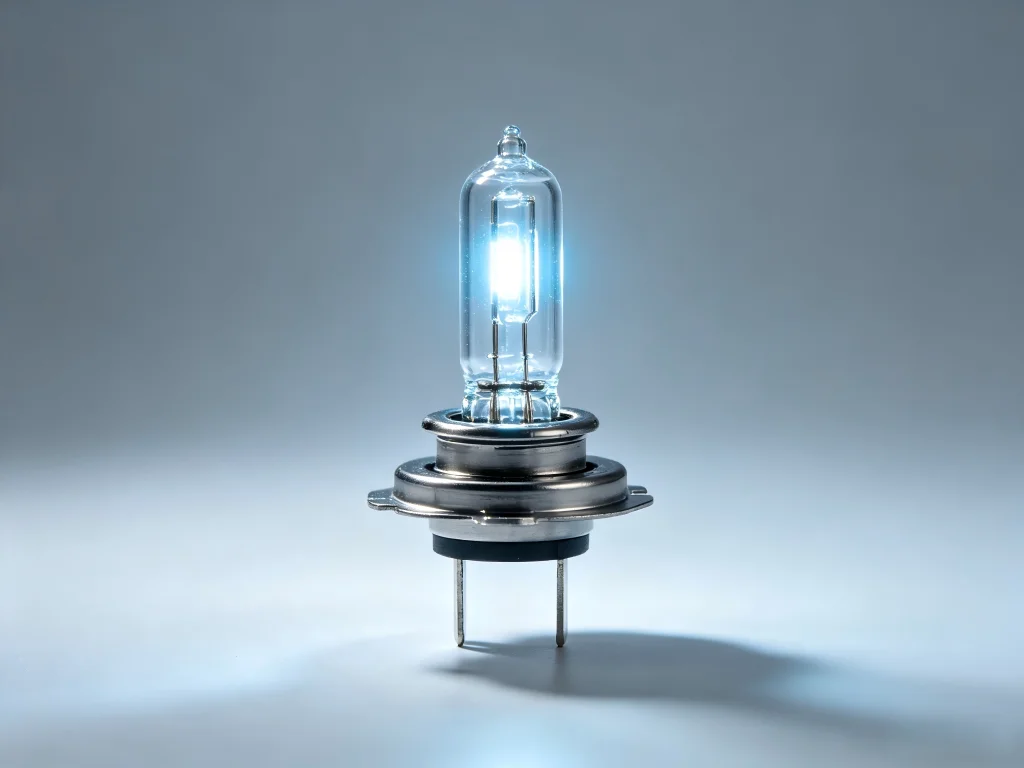
1. Las Tres Tecnologías: Lo Que Realmente Estás Comprando
1.1. Halógeno: La Línea Base Familiar
Las bombillas halógenas producen luz al pasar corriente a través de un filamento de tungsteno dentro de una envoltura de cuarzo llena de gas halógeno. El filamento se calienta hasta la incandescencia, produciendo una luz cálida y amarillenta.
Pros: Economical ($10–$30 per bulb), widely available, easy to replace
Cons: Short lifespan (450–1,000 hours), inefficient (most energy converted to heat), yellow light with poor color rendering
1.2. HID (High-Intensity Discharge): The King of Brightness
HID bulbs produce light via an electric arc between two electrodes inside a quartz capsule filled with xenon gas and metal salts. An igniter provides a high-voltage pulse (up to 23,000 volts) to start the arc, after which the ballast regulates power to approximately 85 volts.
Pros: Three times more light than halogen, lifespan of 2,000–3,000 hours, efficient (70–80% of energy converted to light), available in multiple color temperatures
Cons: Higher initial cost ($50–$200 per bulb), requires ballast, warm-up time of 2–5 seconds
1.3. LED: The Modern Champion of Efficiency
LEDs are semiconductors that emit light when fed with an electric current. No filament, no gas, no arc—just solid-state efficiency.
Pros: Extremely long lifespan (25,000+ hours), instant on, highly efficient, compact
Cons: Higher cost ($100–$200+ per bulb), performance varies greatly in aftermarket adaptations, often incompatible with existing HID housings
2. Head-to-Head Comparison
| Métrica | Halogen | HID | LED |
|---|---|---|---|
| Brightness (lumens) | ~1,000–1,500 | ~3,000–3,800 per bulb | ~2,000–4,000 (varies widely) |
| Vida útil (horas) | 450–1,000 | 2,000–3,000 | 25,000–50,000 |
| Tiempo de calentamiento | Instantaneous | 2–5 seconds | Instantaneous |
| Costo por bombilla | $10–$30 | $50–$200 | $100–$200+ |
| Efficacy | Baja (~20% T3P) | Buena (~70–80% T3P) | Muy alta (~90% T3P+) |
| Mejor para | Reemplazos económicos | Máxima visibilidad, conducción de larga distancia | Longevidad, eficiencia |
Respuesta Directa: Por su brillo puro y visibilidad de larga distancia, HID bulbs superan tanto a las alternativas halógenas como a las LED de posventa. Los HID producen aproximadamente tres veces más luz útil que los halógenos y mantienen patrones de haz consistentes en carcasas de proyector diseñadas para ellos.
3. El factor de decisión crítico: su carcasa
Aquí está el detalle que la mayoría de las guías omiten: la mejor tecnología de bombilla del mundo no funcionará bien en la carcasa incorrecta.
Las carcasas de los faros están diseñadas en torno a geometrías específicas de fuente de luz. Una carcasa reflectora está formada para dirigir la luz desde una posición específica del filamento. Una carcasa de proyector enfoca la luz a través de una lente desde una posición específica de arco o emisor.
Cuando instala un Bombilla HID en una carcasa diseñada para halógenos, la geometría del punto de arco no coincide con lo que espera la óptica. El resultado es luz dispersa, corte de haz deficiente y deslumbramiento que ciega a los conductores que vienen en sentido contrario.
So here's the rule:
- If your car comes with factory HID: Replace them with OEM-spec HID bulbs from a quality manufacturer. This is your best option.
- If your car comes with halogens: Do not install aftermarket HID bulbs in halogen housings. It's illegal in many jurisdictions and dangerous for everyone on the road.
- If you want to upgrade from halogens: Consider a full projector retrofit with proper HID projectors, or stick with high-quality halogen replacements that match the housing design.
4. HID Bulb Types: Decoding the D-Series
Not all HID bulbs are interchangeable. Understanding the D-series code is essential before buying.
The naming convention follows a simple pattern: “D” stands for discharge. The number (1, 2, 3, or 4) indicates the generation. The suffix (S or R) indicates the application:
- D1S / D1R: Integrated ignitor in the base. Used in many European vehicles. Operating voltage: 85V.
- D2S / D2R: No integrated ignitor: relies on external ignitor in the ballast. D2S = projector housing, D2R = reflector housing. Operating voltage: 85V.
- D3S / D3R: Mercury-free, requires less power to start. Operating voltage: 42V. Green connector color.
- D4S / D4R: Mercury-free like D3, but with different ballast compatibility. Operating voltage: 42V.
Critical note: D1/D2 bulbs (85V systems) are not interchangeable with D3/D4 bulbs (42V systems). Using the wrong bulb with your existing ballast will damage components or create a fire hazard.
5. Color temperature: what Kelvin really means
HID bulbs are available in color temperatures ranging from 3000K (yellow) to 10,000K+ (deep blue). But a higher Kelvin does not mean more brightness; in fact, light output decreases significantly above 6000K.
| Kelvin | Color | Best use case |
|---|---|---|
| 3000K | Yellow | Fog lights, bad weather |
| 4300K | Pure white (OEM specification) | Visibility in all weather conditions, maximum lumens |
| 5000K | Crisp white | Excellent color rendering, good visibility |
| 6000K | Ice white (slightly blue) | Sleek appearance, good visibility |
| 8000K+ | Blue to purple | Show cars only: poor visibility |
Respuesta Directa: The optimal color temperature of the HID bulb for safe night driving is between 4300K and 5000K. These temperatures deliver maximum usable lumens with excellent color rendering. 6000K is acceptable for drivers who prefer a cooler white, but 8000K and above significantly reduce visibility on the road.
6. Common HID issues and what they mean
If your Bombilla HID is experiencing problems, here's how to diagnose them:
- Flickering: Generally a voltage issue: weak battery, faulty alternator, or incompatible DRL system. Try a relay harness or a warning canceller.
- Color shift (pink/purple): The bulb is nearing the end of its lifespan. The salts inside the capsule are depleting. Replace both bulbs.
- One side not turning on: Could be the bulb or the ballast. Swap the bulbs side to side to test. If the problem moves, it's the bulb. If it stays, it's the ballast.
- Dim output: Gradual degradation is normal after more than 2,000 hours. Replace both bulbs.
7. Why GTR HID bulbs offer superior value
Based on years of manufacturing experience in automotive lighting, GTR has designed its Bombilla HID line to address the shortcomings of both cheap replacements and overpriced premium brands.
AC ballast compatibility: Unlike cheap DC kits that erode one electrode faster, GTR bulbs are designed for AC operation, matching OEM specifications and extending bulb life.
Ceramic base with laser alignment: The arc capsule in GTR bulbs is individually laser-aligned and supported by a ceramic base that resists heat deformation. This ensures the beam pattern remains tight and focused, without hot spots or scatter.
True color accuracy: GTR measures color temperature in a photometric testing laboratory to ensure accurate Kelvin ratings. What you order is what you get: no guesswork, no surprises.
Comprehensive size coverage: GTR offers D1S, D2S, D3S, D4S and other D-series sizes, as well as replacement sizes for halogens in vehicles with factory HID systems.
8. Final decision framework
Here's how to decide which Bombilla HID is right for you:
- What does your vehicle currently have? If it's factory HID, replace with HID. If it's halogen, don't retrofit HID into halogen housings: it's unsafe and often illegal.
- What is your priority? Maximum visibility? Choose 4300K–5000K HID. Longevity and efficiency? Consider LED, but only if your housing is compatible.
- What is your budget? HID bulbs cost $50–$200 per bulb. LED replacements for HID systems can cost more and may not match the beam pattern.
- Replace in pairs: Always replace both bulbs simultaneously to ensure consistent color and output.
The bottom line: If your vehicle came with factory HID lighting, replacing with a quality OEM specification Bombilla HID from GTR is the safest and most effective option to restore—or improve—your nighttime visibility. HID remains the king of brightness for long-distance driving, and when combined with the right projector housing, nothing else comes close.
Explore GTR's complete collection of HID bulbs at https://www.rhgtr.com. Find your bulb size, choose your color temperature, and get back on the road with confidence.