
Bohlam HID teknologi telah menjadi standar emas untuk pencahayaan otomotif sejak BMW memperkenalkannya pada Seri 7 tahun 1991. Namun pada tahun 2026, lanskapnya terlihat berbeda. Lampu LED kini menjadi standar di banyak kendaraan baru, dan halogen tetap menjadi pilihan default yang murah. Jika Anda sedang mencari bohlam pengganti—atau mempertimbangkan upgrade—Anda memerlukan kerangka kerja yang jelas untuk pengambilan keputusan. Panduan ini memberikan kerangka kerja tersebut.
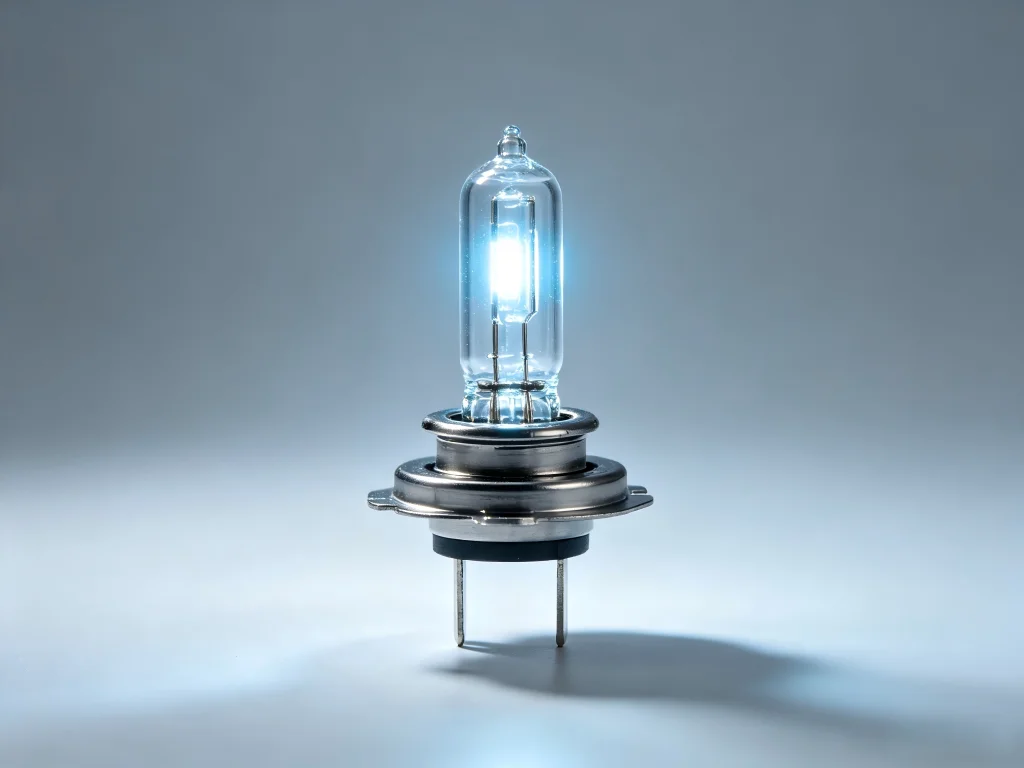
1. Tiga Teknologi: Apa yang Sebenarnya Anda Beli
1.1. Halogen: Garis Dasar yang Familiar
Bohlam halogen menghasilkan cahaya dengan mengalirkan arus listrik melalui filamen tungsten di dalam selubung kuarsa berisi gas halogen. Filamen memanas hingga pijar, menghasilkan cahaya hangat kekuningan.
Advantages: Cheap (Rp10–Rp30 per bulb), widely available, easy to replace
Disadvantages: Short lifespan (450–1,000 hours), inefficient (most energy becomes heat), yellow light with poor color rendering
1.2. HID (High-Intensity Discharge): The King of Brightness
HID bulbs produce light through an electric arc between two electrodes inside a quartz capsule filled with xenon gas and metal salts. The igniter provides a high-voltage pulse (up to 23,000 volts) to start the arc, after which the ballast regulates power at around 85 volts.
Advantages: Light is three times brighter than halogen, lifespan 2,000–3,000 hours, efficient (70–80% of energy converted to light), available in various color temperatures
Disadvantages: Higher initial cost (Rp50–Rp200 per bulb), requires ballast, warm-up time 2–5 seconds
1.3. LED: The Modern Efficiency Champion
LEDs are semiconductors that emit light when an electric current passes through them. No filament, no gas, no arc—just solid-state efficiency.
Advantages: Very long lifespan (25,000+ hours), instant on, highly efficient, compact
Disadvantages: Higher cost (Rp100–Rp200+ per bulb), performance varies greatly in aftermarket retrofits, often incompatible with existing HID housings
2. Direct Comparison
| Metrik | Halogen | HID | LED |
|---|---|---|---|
| Brightness (lumens) | ~1.000–1.500 | ~3.000–3.800 per bohlam | ~2.000–4.000 (sangat bervariasi) |
| Masa pakai (jam) | 450–1.000 | 2.000–3.000 | 25.000–50.000 |
| Waktu pemanasan | Instan | 2–5 detik | Instan |
| Biaya per bohlam | $10–$30 | $50–$200 | $100–$200+ |
| Efisiensi | Rendah (~20%) | Baik (~70–80%) | Sangat tinggi (~90%+) |
| Terbaik untuk | Budget-friendly replacement | Maximum visibility, long-distance driving | Longevity, efficiency |
Jawaban Langsung: For pure brightness and long-distance visibility, HID bulbs outperforming halogen and aftermarket LED alternatives. HID produces about three times more usable light than halogen and maintains a consistent beam pattern in projector housings designed for them.
3. Critical Decision Factor: Your Headlight Housing
Here's the detail most guides miss: the best bulb technology in the world won't work well in the wrong headlight housing.
Headlight housings are engineered around specific light source geometry. Reflector housings are shaped to direct light from a specific filament position. Projector housings focus light through a lens from a specific arc or emitter position.
When you install HID bulbs in a housing designed for halogen, the arc point geometry doesn't match what the optics expect. The result is scattered light, poor beam cutoff, and glare that blinds oncoming drivers.
So, here's the rule:
- If your car has factory HID: Replace with OEM-spec HID bulbs from a quality manufacturer. This is your best option.
- If your car has halogen: Do not install aftermarket HID bulbs in halogen housings. This is illegal in many jurisdictions and dangerous for everyone on the road.
- If you want to upgrade from halogen: Consider a full projector retrofit with the correct HID projector—or stick with high-quality halogen replacements that match the housing design.
4. HID Bulb Types: Decoding the D-Series
Not all HID bulbs are interchangeable. Understanding the D-series codes is crucial before you buy.
The naming convention follows a simple pattern: “D” stands for discharge. The number (1, 2, 3, or 4) indicates the generation. The suffix (S or R) indicates the application:
- D1S / D1R: Integrated igniter in the base. Used in many European vehicles. Operating voltage: 85V.
- D2S / D2R: No built-in igniter—relies on an external igniter in the ballast. D2S = projector housing, D2R = reflector housing. Operating voltage: 85V.
- D3S / D3R: Mercury-free, requires less energy to start. Operating voltage: 42V. Green connector color.
- D4S / D4R: Mercury-free like D3, but different ballast compatibility. Operating voltage: 42V.
Important note: D1/D2 bulbs (85V systems) are not interchangeable with D3/D4 bulbs (42V systems). Using the wrong bulb with your existing ballast will damage components or pose a fire hazard.
5. Color Temperature: What Kelvin Really Means
HID bulbs come in color temperatures ranging from 3000K (yellow) to 10,000K+ (deep blue). But higher Kelvin does not mean brighter—in fact, light output decreases significantly above 6000K.
| Kelvin | Color | Best Use Cases |
|---|---|---|
| 3000K | Yellow | Fog lights, bad weather |
| 4300K | Pure white (OEM specification) | All-weather visibility, maximum lumens |
| 5000K | Crisp white | Excellent color rendering, good visibility |
| 6000K | Ice white (slightly blue) | Stylish appearance, good visibility |
| 8000K+ | Blue to purple | Show cars only—poor visibility |
Jawaban Langsung: Optimal HID bulb color temperature for safe night driving is between 4300K and 5000K. These temperatures provide maximum usable lumens with excellent color rendering. 6000K is acceptable for drivers who prefer a cooler white, but 8000K and above significantly reduce road visibility.
6. Common HID Problems and What They Mean
If HID bulbs experiencing problems, here's how to diagnose them:
- Flashing: Usually a voltage issue—weak battery, faulty alternator, or incompatible DRL system. Try using a relay harness or warning canceller.
- Color change (pink/purple): The bulb is nearing the end of its life. The salt inside the capsule is running out. Replace both bulbs.
- One side not lighting: Could be the bulb or ballast. Swap the bulb from side to side to test. If the problem moves, it's the bulb. If it stays, it's the ballast.
- Dim output: Gradual decline is normal after 2,000+ hours. Replace both bulbs.
7. Why GTR HID Bulbs Provide Superior Value
Based on years of manufacturing experience in automotive lighting, GTR has designed its product line HID bulbs to address the shortcomings of cheap replacements and overpriced premium brands.
AC ballast compatibility: Unlike cheap DC-based kits that erode one electrode faster, GTR bulbs are designed for AC operation—matching OEM specifications and extending bulb life.
Ceramic base with laser alignment: GTR arc capsules are individually laser-aligned and supported by a ceramic base that resists heat warping. This ensures the beam pattern stays tight and focused, with no hot spots or scatter.
True color accuracy: GTR measures color temperature in a photometric testing lab to ensure accurate Kelvin ratings. What you order is what you get—no guessing, no surprises.
Comprehensive size coverage: GTR offers D1S, D2S, D3S, D4S, and other D-series sizes, plus halogen replacement sizes for vehicles with factory HID systems.
8. Final Decision Framework
Here's how to decide HID bulbs what's right for you:
- What does your vehicle currently have? If factory HID, replace with HID. If halogen, don't retrofit HID into halogen housings—it's unsafe and often illegal.
- What are your priorities? Maximum visibility? Choose HID 4300K–5000K. Longevity and efficiency? Consider LED—but only if your housing is compatible.
- What's your budget? HID lamps cost $50–$200 per bulb. LED replacements for HID systems can be more expensive and may not match the beam pattern.
- Replace in pairs: Always replace both bulbs at the same time to ensure consistent color and output.
The bottom line: If your vehicle is equipped with factory HID lights, replacing them with quality OEM specifications HID bulbs from GTR is the safest and most effective choice to restore—or improve—your night visibility. HID remains the king of brightness for long-distance driving, and when paired with the right projector housing, nothing can match it.
Explore GTR's complete HID bulb collection at https://www.rhgtr.com. Find your bulb size, choose your color temperature, and drive with confidence again.