
Memilih bohlam H7 yang tepat berarti memahami tiga teknologi, empat kesalahan pemasangan, dan satu persyaratan hukum yang tidak bisa ditawar – dan sebagian besar panduan salah pada setidaknya dua hal ini. Inilah yang sebenarnya penting.
H7 is a single-filament bulb base, one of the most common in European and Asian vehicles. It is used for low beam and high beam applications depending on the vehicle design. But the base is just the beginning. The real question is: which technology delivers the performance you actually need?
We have analyzed the data, tested the products, and compiled everything you need to make an informed decision. No hype. No exaggeration. Just the facts.
1. H7 Bulb Technology: Three Candidates
1.1. Halogen H7 – The Baseline
Halogen H7 bulbs are standard equipment in most vehicles. They are cheap, universally compatible, and legal in all applications – but they are also the dimmest and shortest-lived option.
Standard halogen H7 bulbs run at 55W and produce about 1,200-1,500 lumens. They last 400-1,000 hours in normal use. Premium halogen upgrades like Philips RacingVision GT200 (up to 200% brighter) and OSRAM Night Breaker 220 (up to 220% brighter, 150m beam distance) offer significant improvements while remaining road-legal.
Who should choose halogen: Drivers who want a simple, legal, affordable replacement without compatibility issues. Premium halogens are a genuine upgrade over standard bulbs.
The drawbacks: Even premium halogens cannot match LED output. They consume more power, generate more heat, and need more frequent replacement.
1.2. LED H7 – The Modern Upgrade
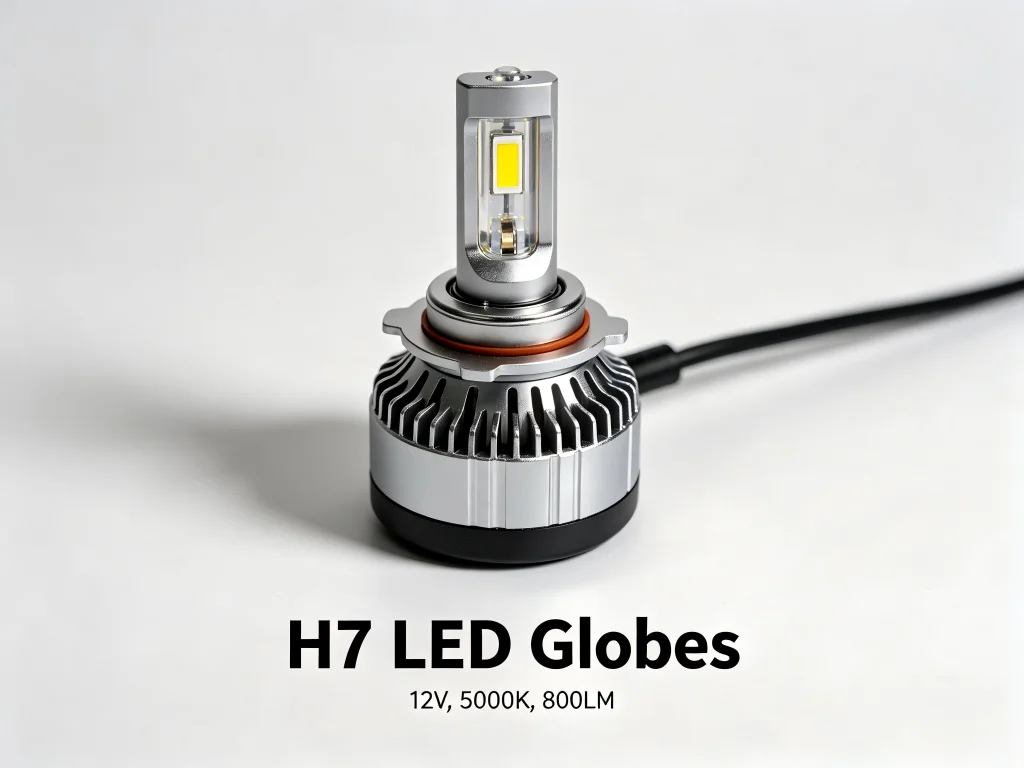
H7 LED bulbs can provide much more light – 400% to 700% brighter than standard halogen – with a lifespan of 20,000-50,000 hours and much lower power consumption.
But here's where it gets tricky. Not all H7 LED bulbs are created equal – and many are not legal for road use.
| Fitur | Halogen H7 | H7 LED (Quality) | H7 LED (Economical) |
|---|---|---|---|
| Kecerahan | 1,200-1,500 lm | 6,000+ lm | High claims, low actual |
| Umur | 400-1,000 hours | 30,000-50,000 hours | Tak terduga |
| Electrical power | 55 W | 15-30W | Varies widely |
| Kompatibilitas | Always fits | 1:1 design required | Often too large |
| CANBUS | Always compatible | Requires built-in driver | Often triggers errors |
| Legal (halogen housing) | Yes. | Only with E-mark approval | Usually not |
Who should choose LED: Drivers who want maximum brightness, minimal power consumption, and are willing to invest in quality products that meet legal requirements.
The drawbacks: In many countries, LED bulbs are not legal on the road when used in halogen headlight housings unless they have specific ECE/E-mark approval. Differences in beam patterns can cause glare and dark spots.
1.3. HID (Xenon) H7 – Specialist Option
HID H7 bulbs produce 3,000-5,000 lumens from only 35W, lasting 2,000-3,000 hours. They are brighter than halogen and more efficient, but require ballasts and professional installation.
Who should choose HID: Drivers who want bright light and don't mind the complexity of installation. However, for most applications, quality LEDs have surpassed HID in terms of performance and simplicity.
The drawbacks: HID systems are more complex, more expensive to install, and still face the same legal beam pattern issues as LEDs.
2. Four Critical Fitment Factors Most Guides Ignore
2.1. Dimensional Accuracy – 1:1 Requirement
The H7 standard specifies exact dimensions for the bulb base, filament position, and overall size. When a replacement bulb deviates from these specifications – even by 2-3mm – the bulb will not seat correctly. The retaining clip will not close, the seal will not fit, and the beam pattern will be wrong.
Hal-hal yang perlu diperhatikan: “Claims of ”1:1 design“ or ”exact fit” are backed by actual ECE R37 compliance. If a manufacturer can't confirm dimensional compliance, walk away.
2.2. Beam Pattern Integrity – The Glare Problem
The most common complaint after an H7 replacement is poor lighting or glare for oncoming vehicles. This happens when the LED chip or HID arc tube does not occupy the same position as the original halogen filament.
HELLA, a major automotive lighting manufacturer, notes that incorrect H7 bulb installation – or bulbs that allow a different installation position – causes uncontrolled light scatter.
Hal-hal yang perlu diperhatikan: Products that specify “filament-matching” LED placement. Independent testing that verifies beam pattern integrity. Avoid anything that only advertises “lumens” without addressing beam quality.
2.3. CANBUS Compatibility – The Warning Light Trap
LED bulbs draw less current than halogens. Many vehicle computers interpret this as a burned-out bulb and trigger a dashboard warning. Some vehicles also experience flickering or strobing due to pulse-width modulation (PWM) systems.
Quality H7 LED bulbs include built-in CANBUS drivers that simulate the correct electrical load. Cheap options often skip this, leaving you with a fault light you cannot clear.
Hal-hal yang perlu diperhatikan: “CANBUS-ready” or “error-free” with vehicle-specific compatibility information. If a manufacturer can't tell you whether it works with your car, it probably doesn't.
2.4. Thermal Management – The Silent Performance Killer
LED chips degrade when they overheat. Many cheap bulbs use inadequate cooling – small heat sinks, low-quality fans, or passive cooling that cannot keep up in a sealed headlight housing. The result: brightness drops drastically within weeks or months.
Quality bulbs use aerospace-grade aluminum housings, advanced heat sink designs, and efficient cooling systems. Some use fanless designs with intelligent temperature control. The specific approach matters less than the outcome: stable output for thousands of hours.
Hal-hal yang perlu diperhatikan: Verified lifespan testing. Independent reviews that measure output over time. Avoid products that only advertise peak brightness without addressing sustained performance.
3. Why GTR Lighting H7 Bulbs Lead the Category
In independent testing, GTR Lighting Ultra 2 achieved outstanding results: nearly 40% brighter than standard halogen in one test, and 70% brighter in another. These bulbs were rated 4.8 on the brightness/distance scale and maintained output above 75% beyond 5,000 hours of continuous operation.
What sets GTR apart is not just the brightness numbers – but the combination of factors that truly matter:
- 1:1 precision fit that exactly matches ECE R37 specifications
- Superior thermal management that maintains performance over time
- Built-in CANBUS compatibility that eliminates warning lights
- Road-legal beam pattern designed for halogen housings
As one professional driver noted: “I have used GTR Ultra2 LED bulbs in several different halogen reflector housings with excellent results. This includes the 2020 Freightliner I spent one hundred thousand miles driving in the dark.”
4. Frequently Asked Questions About H7 Bulbs
4.1. Is H7 a high beam or low beam bulb?
H7 is a bulb type, not a beam indicator. It can be used for low beam or high beam depending on the vehicle's headlight design. The H7 bulb itself is single filament – producing one beam pattern, and the vehicle's housing determines whether it is used as low beam or high beam.
4.2. Are H7 and H11 bulbs interchangeable?
No. H7 and H11 have different bases, connectors, and optical designs. An H7 bulb will not fit in an H11 socket, and vice versa. Always use the bulb type specified for your vehicle.
4.3. How many watts is a standard H7 bulb?
A standard H7 halogen bulb runs at 55W. This is the specification set by ECE R37 for road-legal H7 halogen bulbs. H7 LED replacements typically draw 15-30W while producing more light.
4.4. How long do H7 LED bulbs last?
Quality H7 LED bulbs last 30,000-50,000 hours. Cheap options may fail within months due to poor thermal management. Lifespan heavily depends on heat dissipation – bulbs that overheat will degrade quickly.
4.5. Are H7 LED bulbs legal?
In many countries, LED bulbs are not legal for road use when installed in halogen housings unless they have specific ECE/E-mark approval. Always check local regulations and look for bulbs with documented ECE R37 compliance.
4.6. Why do my H7 bulbs keep blowing?
Frequently blowing H7 bulbs usually indicates one of three issues: poor quality bulbs, improper installation (touching the glass with bare fingers, which creates hot spots), or electrical problems in the vehicle. Premium bulbs and proper installation techniques significantly extend lifespan.
4.7. What is the brightest H7 bulb available?
In independent testing, GTR Lighting Ultra 2 measured 709% brighter than standard halogen. Among road-legal halogen options, OSRAM Night Breaker 220 offers up to 220% more brightness and Philips RacingVision GT200 offers up to 200%.
5. Your Next Step: Choose Wisely, Drive Safely
You now know what separates quality H7 bulbs from dangerous disappointments. The data is clear: installation, beam pattern, thermal management, and legal compliance matter more than any lumen claim on the box.