
Choosing a bi LED fog light comes down to seven engineering factors: beam pattern precision, cut-off line quality, thermal management design, CANbus compatibility, ingress protection rating, lens material, and real-world lux performance at distance. Total lumen output barely makes the list.
Walk into any online marketplace search for bi led fog light and you’ll see the same claims repeated: “50,000 lumens,” “super bright,” “high performance.” But these numbers mean almost nothing without context. In our manufacturing expertise, we have tested hundreds of fog light models across multiple price points and found that the brightest spec sheet often delivers the worst real-world performance.
This bi led fog light projector buyer’s guide cuts through the marketing noise. We analyzed what actually matters in fog, rain, and snow driving—and what you can safely ignore. By the end, you’ll know exactly how to evaluate any bi LED fog light on the market and choose one that delivers safe, reliable visibility.
1. Why Most Fog Light Reviews Are Misleading
Many reviews focus on lumen ratings and color temperature while completely ignoring beam pattern, thermal management, and build quality. A fog light can produce 10,000 lumens but blind you with glare if the optics are poor. It can look bright in a parking lot but create a white wall of backscatter in actual fog.
The problem isn’t ill intent. Most reviews are written by people who installed fog lights, aimed them at a wall, and declared them “bright.” But a wall test tells you nothing about how a fog light performs in precipitation. In dense fog, the physics change completely. Light that scatters upward, even slightly, illuminates the moisture particles in front of your vehicle and reduces usable visibility[reference:20].
A professional retrofit shop owner explained it this way: “The first question is not ‘which product is the brightest?’ The first question is ‘what driving problem does the customer want to solve?’”[reference:21] Some drivers need fog performance. Some need auxiliary high beams for rural roads. Some need waterproofing for off-road use. No single fog light excels at all three. Understanding your specific use case is step one.
2. Critical Factor 1: Beam Pattern and Cut-Off Line Quality
The beam pattern determines whether your fog light illuminates the road or reflects moisture back into your eyes. A proper fog light beam creates a wide, flat oval that stays below the headlight cut-off line. Any upward scatter creates backscatter in fog and glare for oncoming drivers.
In a properly engineered bi led fog light projector, the beam pattern comes from a convex lens paired with a mechanical cut-off shield. During low-beam operation, the shield blocks upward light. The result is a sharp horizontal line where light stops[reference:22]. During high-beam operation, a solenoid moves the shield, allowing full light output for distance visibility[reference:23].
Cheap fog lights skip the cut-off shield entirely or use a fixed reflector design that can’t control upward scatter. The beam may look bright and wide when parked, but in fog, that upward scatter creates the white wall effect that ruins visibility[reference:24].
How to evaluate beam pattern before buying: Request wall-test photos from the manufacturer. Look for a sharp horizontal cut-off with minimal light above the line. The beam should be wider than it is tall. If the manufacturer can’t provide wall-test photos or beam-pattern diagrams, that’s a red flag.
3. Critical Factor 2: Thermal Management (Passive vs. Active Cooling)
Passive cooling through a well-designed aluminum heat sink outperforms active cooling with fans in the harsh environment of a vehicle’s front bumper. Fans clog with road debris, seize from moisture, and fail over time. A properly sized heat sink has no moving parts and nothing to break.
LEDs generate heat at the semiconductor junction. If that junction exceeds its rated temperature, the LED loses output (thermal droop) and eventually fails entirely. Removing heat is essential. But how you remove it matters enormously for long-term reliability.
Active cooling uses a small electric fan to blow air across the heat sink. It works in clean, dry environments. But fog lights sit low on the bumper, directly exposed to:
- Road spray and salt water
- Mud and dust
- Ice and snow accumulation
- Vibration from rough roads
In these conditions, fan blades clog, bearings corrode, and motors fail. When the fan stops, the LED overheats. Output drops. The light may flicker as thermal protection circuits engage. Eventually, the LED fails completely[reference:25].
Passive cooling eliminates the failure point entirely. A machined aluminum heat sink with sufficient surface area dissipates heat through natural convection. No moving parts means no fan to fail. In GTR’s testing, passive-cooled fog lights consistently outlast fan-cooled units by 3x–5x in real-world off-road and winter driving conditions.
How to evaluate thermal management before buying: Check the product specifications for cooling type. “Active cooling” means a fan. “Passive cooling” means a heat sink only. Look at the heat sink size—larger surface area generally means better heat dissipation. If the product doesn’t specify cooling type, assume thermal management is inadequate.
4. Critical Factor 3: CANbus Compatibility (Flicker Prevention)
CANbus incompatibility causes LED fog lights to flicker, flash, or shut off randomly. A quality bi LED fog light includes an integrated decoder that mimics halogen bulb resistance, preventing error codes and flicker without external modules.
Here’s what happens. Your vehicle’s computer monitors each bulb circuit for faults. When a halogen bulb burns out, current stops flowing, and the computer triggers a warning. LED fog lights draw much less current than halogens. The computer sees this lower draw and thinks the bulb is burned out. So it sends a low-voltage test pulse to check the circuit[reference:26]. That test pulse makes the LED flicker.
The solution is a CANbus decoder or load resistor. These devices add resistance to the circuit, mimicking the electrical load of a halogen bulb. The computer sees normal load, stops sending test pulses, and flicker disappears[reference:27].
Some manufacturers integrate the decoder into the fog light housing. Others expect you to buy and install separate decoders. Integrated decoders are cleaner, more reliable, and weather-sealed. External decoders add another component that can fail or corrode.
How to evaluate CANbus compatibility before buying: Ask whether the fog light includes an integrated CANbus decoder. If not, ask which decoder is recommended. For modern vehicles (especially European and late-model Asian brands), integrated decoders are strongly preferred.
5. Critical Factor 4: IP Rating and Weather Sealing
IP67-rated fog lights withstand immersion in up to one meter of water for 30 minutes. IP68-rated units withstand continuous immersion. For fog lights mounted low on the bumper, IP67 is the minimum acceptable standard.
Fog lights face brutal conditions. Road spray, pressure washing, mud, ice, salt, and standing water all test the housing seals. Poor weather sealing leads to moisture intrusion, which causes:
- Internal fogging that degrades light output
- Corrosion of electrical components
- LED driver failure
- Complete light failure within months[reference:28]
Professional retrofit guidelines emphasize that “fog projectors work in harsh conditions. They may face water, dust, mud, heat, vibration, and road debris. This is why IP rating matters”[reference:29]. IP67 indicates dust-tight construction and protection against temporary immersion. IP68 adds protection against continuous immersion.
How to evaluate IP rating before buying: Look for IP67 or IP68 in the specifications. IP65 or lower is inadequate for fog lights. If IP rating isn’t stated, assume the product has no meaningful weather sealing.
6. Critical Factor 5: Lens Material (Glass vs. Plastic)
A high borosilicate glass lens maintains optical clarity for the life of the product. Polycarbonate plastic lenses yellow, scratch, and degrade over time, reducing light output by 15–30% within two years.
The lens is the final optical element before light leaves the housing. It must be optically clear, thermally stable, and resistant to UV damage and scratching. Glass meets all three requirements. Plastic may look clear when new but degrades predictably over time.
Polycarbonate lenses yellow from UV exposure. They scratch from road debris and car washes. They haze from chemical exposure (bug remover, road salt). Each of these degradations reduces light transmission. After two years, a plastic lens may transmit 20–30% less light than when new.
Glass lenses don’t yellow. They resist scratching far better than plastic. They maintain thermal stability even with high-output LEDs. The only disadvantage is fragility—glass can crack from direct impact. But in automotive fog light applications, quality glass lenses with proper housing protection rarely fail.
How to evaluate lens material before buying: Check specifications for “glass lens” or “borosilicate glass.” If lens material isn’t stated, assume plastic. For premium fog lights, glass is the standard. For budget lights, plastic is typical.
7. Critical Factor 6: Lux Performance (Not Lumen Output)
Lumens measure total light output in all directions. Lux measures light intensity at a specific point on the road. For fog lights, lux at 5–10 meters is the number that matters—it tells you how much usable light actually reaches the road surface.
The marketing numbers you see (“50,000 lumens!”) are almost always total lumen output measured at the LED chip. But half that light may scatter in useless directions. Scattered light doesn’t help you see—it creates glare and backscatter.
Lux, on the other hand, measures light intensity on a surface at a specific distance. A fog light with 3,000 lux at 5 meters may outperform one with 50,000 lumens but poor beam focus. As one lighting expert explained, “A big lumen number does not guarantee a bright light. Lux gives a real tested number for usable brightness”[reference:30].
Professional retrofit shops use lux as their primary performance metric. According to Conpex Group’s buying guide, “Lux is a better reference than lumen for this purpose. Lumen shows total light output, but Lux shows how strong the light is at a measured point”[reference:31].
How to evaluate lux performance before buying: Ask the manufacturer for lux readings at 5 or 10 meters. A quality bi LED fog light should deliver at least 2,500–3,500 lux at 5 meters in low-beam mode. If the manufacturer can’t or won’t provide lux data, consider that a significant red flag.
8. Critical Factor 7: Build Quality and Materials
Aluminum housings with stainless steel hardware and sealed wiring harnesses indicate quality construction. Plastic housings with visible mold lines, exposed screws, or unsealed connectors indicate budget construction that will fail prematurely.
Build quality is the hardest factor to evaluate from photos but the most predictive of long-term reliability. Cheap fog lights cut corners everywhere: thin aluminum or plastic housings, poor sealing, undersized heat sinks, uncoated circuit boards, and low-grade wiring.
Quality fog lights use machined aluminum housings for thermal and structural integrity. Hardware is stainless steel to resist corrosion. Connectors are weather-sealed. Circuit boards receive conformal coating to resist moisture. These details add cost but dramatically extend service life.
How to evaluate build quality before buying: Look for close-up photos of the housing, heat sink, and connectors. Machined aluminum has visible machining marks. Cast aluminum has smoother surfaces but may be less thermally efficient. Plastic housings are acceptable only at the very lowest price points. Weight is a reasonable proxy for quality—a heavy fog light generally contains more aluminum and better thermal management than a light one.
9. Comparison: Bi LED Fog Light vs. Halogen vs. Standard LED Fog Light
The table below summarizes the key differences between the three main fog light technologies available today. Use it to narrow your options based on your priorities.
| Fonctionnalité | Halogen | Standard LED (Bulb Swap) | Bi LED Fog Light Projector |
|---|---|---|---|
| Typical Low-Beam Lumens | 1 000–1 500 | 2,000–4,000 (unfocused) | 3,000–6,000 (focused) |
| Beam Pattern Quality | Poor in reflectors; good in factory projectors | Usually poor—optics mismatch | Excellent—precision engineered |
| High Beam Function | Non | Non | Yes—solenoid-actuated |
| Consommation électrique | 55–70W per light | 15–30W per light | 20–40W per light |
| Durée de vie | 500–1,000 hours | 5,000–20,000 hours | 30 000–50 000 heures |
| CANbus Compatibility | Natif | Requires decoder (may flicker) | Integrated decoder included |
| Typical Cooling Method | None (filament heat radiates) | Fan (active) or small heat sink | Large aluminum heat sink (passive) |
| Upfront Cost | $15–$50 | $30–$100 | $120–$300 |
As the table shows, bi LED fog light projectors cost more upfront but deliver superior performance, longer lifespan, and actual optical engineering rather than guesswork. For drivers who regularly face fog, rain, snow, or dark rural roads, the premium is worth the investment.
10. Bi LED Fog Light FAQ: 5 Questions Buyers Ask Most
1. Are bi LED fog lights legal on public roads?
Legality depends on beam pattern and cut-off quality, not technology type. A bi LED fog light with a sharp cut-off line and proper aiming is legal in most jurisdictions. However, the NHTSA notes that “Standard No. 108 imposes no requirements per se for driving lamps and fog lamps—states regulate auxiliary devices in various ways”[reference:32]. Check your local regulations before purchasing.
2. How much should I spend on bi LED fog lights?
Entry-level units with passive cooling and glass lenses start around $120–$150 per pair. Mid-range units ($150–$220) add higher lux output and vehicle-specific mounting brackets. Premium units ($220–$300) include selectable color temperature and the highest thermal performance. Avoid units under $80—they almost universally cut corners on optics or cooling.
3. Will bi LED fog lights fit my vehicle?
Most bi LED fog lights use universal 2.5-inch or 3-inch projector housings that fit standard fog light openings. However, some vehicles require custom mounting brackets. Check fitment guides carefully. Toyota Tacoma, Tundra, 4Runner, Jeep Wrangler, and Ford F-Series trucks have the widest aftermarket support[reference:33].
4. Can I install bi LED fog lights myself?
If you’re comfortable with basic automotive electrical work, yes. The installation involves removing the factory fog light housing, mounting the new projector, connecting the wiring (often plug-and-play with adapters), and aiming the beam. Allow 1–2 hours for a first-time installation. Many retailers offer installation videos for popular vehicle models.
5. How do I maintain my bi LED fog lights?
Bi LED fog lights require almost no maintenance. Periodically inspect the lens for cracks or moisture intrusion. Clean the lens with automotive glass cleaner and a soft cloth. If you notice beam dimming or flickering, check for loose connections. With proper thermal management, the LEDs themselves will outlast your vehicle.
11. Why GTR Bi LED Fog Lights Dominate the Premium Category
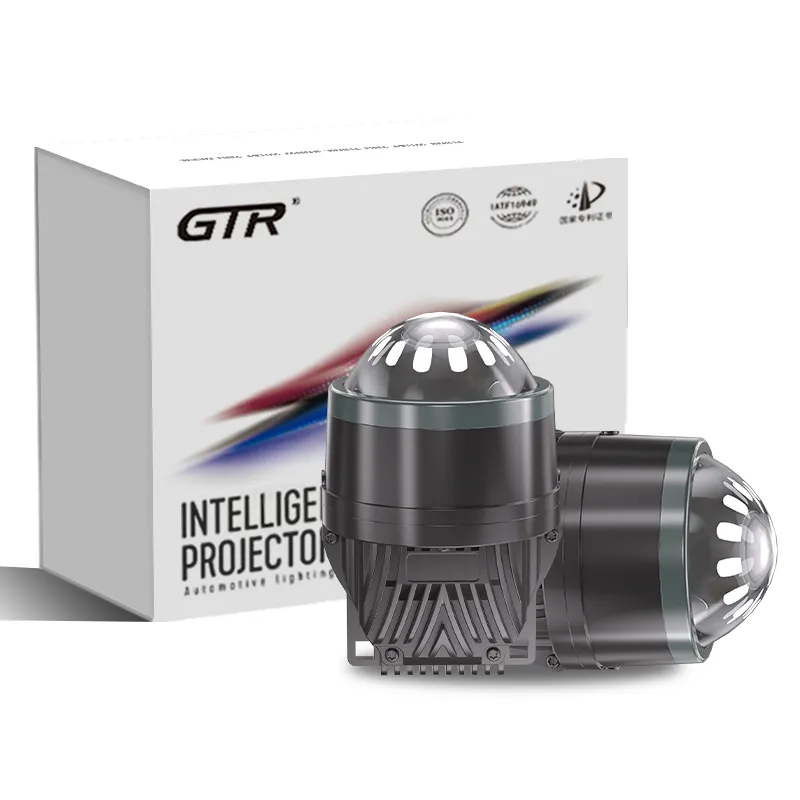
GTR’s bi LED fog light projector combines every critical feature identified in this guide: precision optics with solenoid cut-off, passive cooling with billet aluminum heat sink, integrated CANbus decoder, IP67 weather sealing, glass borosilicate lens, and documented lux performance at 5 meters.
We didn’t build GTR fog lights to compete on price. We built them to be the last fog lights you ever buy. Every engineering decision came from real-world testing in the worst conditions we could find—mountain fog, winter blizzards, desert dust storms, and Pacific Northwest rain.
- Precision beam pattern: Our cut-off shield delivers a razor-sharp horizontal line with zero measurable upward scatter in low-beam mode. No glare. No backscatter. Just usable light where you need it.
- Passive cooling you can trust: Our billet aluminum heat sink dissipates heat without fans. Nothing to clog. Nothing to seize. Nothing to fail. In accelerated life testing, GTR fog lights maintained 90%+ of original output after 5,000 hours of continuous operation.
- Plug-and-play compatibility: Integrated CANbus decoder works with modern vehicle computers out of the box. No external resistors. No error codes. No flicker.
- Built for the real world: IP67-rated housings survived pressure washing and submersion testing. Glass lenses showed zero yellowing after 24 months of UV exposure.
- Selectable color temperature: Amber (3000K) for maximum fog penetration. Cool white (6000K) for maximum apparent brightness. Choose what works for your driving conditions.
When you install GTR fog lights, you’re not buying a product. You’re buying visibility, safety, and peace of mind. You’re buying the confidence to drive in conditions that would send other drivers home.
12. Make the Smart Choice for Your Safety
You’ve read the guide. You understand the seven critical factors that separate premium fog lights from budget compromises. Now it’s time to choose.
Don’t settle for fog lights that look bright in a parking lot but fail in real conditions. Get the performance you actually need. Visiter https://www.rhgtr.com to explore GTR’s complete bi LED fog light lineup. Vehicle-specific fitment guides. Free technical consultation. A satisfaction guarantee that protects your investment.
Because when the fog rolls in, you don’t want to wonder if your lights will work. You want to know they will.