
Choisir le bon kit de conversion de phares LED ne consiste pas à trouver le nombre de lumens le plus élevé ou le prix le plus bas. Il s’agit de comprendre les compromis d’ingénierie qui déterminent si votre mise à niveau offre de réels gains de visibilité ou devient une erreur frustrante et coûteuse. Ce guide passe au crible les affirmations marketing et vous montre exactement ce qu’il faut rechercher — et ce qu’il faut éviter.
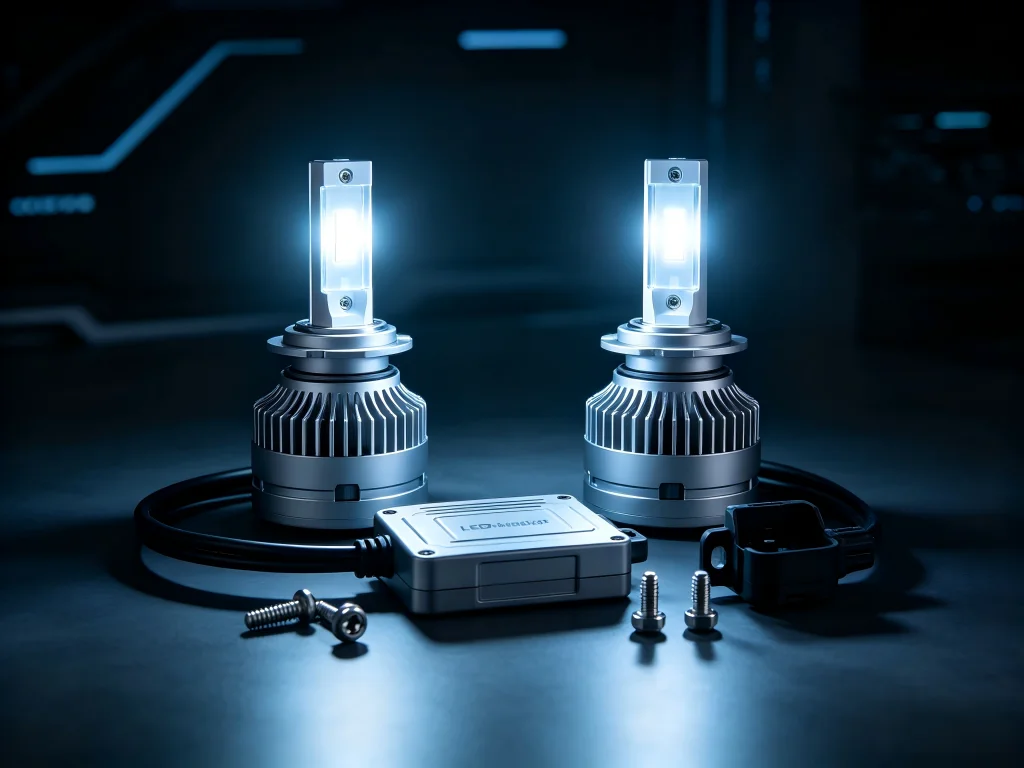
1. Why most reviews of LED headlight conversion kits are useless
The truth: most online reviews evaluate LED conversion kits based on first impressions — brightness out of the box, ease of installation, and initial color temperature. None of these criteria tell you whether the kit will still work after three months of thermal cycling, or whether the beam pattern actually matches your specific optics.
Consumer reviews on Amazon and eBay are filled with contradictory comments. One buyer describes a kit as ”super bright” and ”perfect fit.“ Another buyer of the same kit reports that they ”don't even fit properly in the headlight housing” and ”not bright at all.“ Both are telling the truth — their vehicles, optics, and expectations are different. Generic reviews do not account for these variables.
This guide focuses on the factors that truly determine long-term performance, regardless of your vehicle or optics type.
2. Factor 1: LED chip placement — The most important specification
Your headlight optic — whether reflector or projector — was designed around a specific light source geometry. The halogen filament is located at a precise point, and the reflector or lens directs light from that point.
When an LED conversion kit places the emitter at a different position, the beam pattern breaks. Light scatters. Range decreases. Glare increases. This is not a minor issue — it is the main reason early LED conversion kits had such a bad reputation for blinding oncoming traffic.
What to look for: Kits that explicitly state chip placement matching 1:1 with the filament. The LED chips must be positioned to replicate the location and orientation of the original halogen filament. Some manufacturers achieve this through vertically aligned LED component design. Others use precision-machined bases that lock the emitter into the correct position.
What to avoid: Kits that do not discuss chip placement at all. If a manufacturer does not understand why optical positioning is important, the kit almost certainly has suboptimal beam performance.
3. Factor 2: Thermal Management — The Difference Between 30,000 Hours and 3,000
LEDs generate heat at the semiconductor junction. As temperature increases, light output decreases and lifespan shortens — a phenomenon called thermal decay. Proper thermal management is not optional. It is the biggest determining factor in whether a kit actually reaches its rated lifespan.
There are three approaches to LED cooling, ranked from worst to best:
| Type de refroidissement | How it works | Advantages | Disadvantages |
|---|---|---|---|
| Passive (fins / cooling fins) | Heat dissipates through metal fins without airflow | Silent, no moving parts | Heats up quickly, output decreases with prolonged use |
| Active (fan + heat sink) | The fan draws air through the heat sink to remove heat | Maintains stable temperatures, consistent output | Fan noise, risk of fan failure |
| Active heat pipe + copper | The copper PCB conducts heat to heat pipes with coolant, the fan distributes | Superior heat transfer, stable output, longer lifespan | Higher manufacturing cost |
What to look for: Copper PCB and active cooling systems. Some high-end kits use dual copper heat pipes with a high-performance fan. These systems maintain stable temperatures even during long night drives.
What to avoid: Kits that rely solely on passive cooling (thermal tape without a fan). These heat up within 15 to 20 minutes of continuous use, causing a significant drop in brightness.
4. Factor 3: Stable Output Power — The Hidden Performance Killer
Many LED kits advertise high peak powers — 100 W, 200 W, or even 300 W per bulb. These figures are often measured at startup, before thermal throttling occurs. Within minutes, the actual power drops by 30 to 50% as the LEDs heat up.
Some manufacturers use a practice called ”thermal sag” — the LED driver reduces power to prevent overheating, sacrificing brightness to survive. The result is a kit that looks impressive in the garage but disappoints on the road.
What to look for: Kits that specify stable power output, not peak power. Real powers — stable 32 W, stable 45 W, or stable 52 W — indicate that the driver is designed to maintain constant power.
What to avoid: Kits that only advertise peak power or do not specify whether the power is stable or peak.
5. Factor 4: CAN-Bus Compatibility — No Errors, No Flicker, No Resistors
Modern vehicles use CAN-Bus (Controller Area Network) systems to monitor electrical loads. When you replace a 55 W halogen bulb with a 20 W LED, the system detects the lower current draw and assumes the bulb is burned out. The result: dashboard error messages, flickering, hyperflash, or lights that turn off completely.
Some kits solve this problem with external load resistors or CAN-Bus decoders. These additions introduce extra failure points, generate heat, and complicate installation. Other kits — including GTR — integrate CAN-Bus compatibility directly into the driver circuit.
What to look for: Kits that indicate built-in CAN-Bus compatibility without requiring external resistors.
What to avoid: Kits that require separate load resistors or decoders. These add cost, complexity, and failure points.
6. Factor 5: Color Temperature — The Right White for Visibility
Color temperature is measured in Kelvin (K). Halogen bulbs produce a warm yellow light around 3,000 K. LED kits typically range from 5,000 K to 6,500 K.
5,000-5,500 K (pure white): Closest to natural daylight. Offers the best contrast and color recognition. Reduces eye fatigue during prolonged night driving.
5,500-6,000 K (cool white): Slightly blue-white. Popular for its modern appearance. Still offers good visibility.
6,000-6,500 K (blue-white): Clearly blue. Can reduce contrast in wet conditions. Often associated with cheaper, lower-quality kits that prioritize appearance over performance.
What to look for: 5,000-6,000 K for optimal visibility. Higher is not better — above 6,000 K, light output in the visible spectrum actually decreases.
What to avoid: Kits above 6,500 K. These produce more blue light, which scatters more in rain and fog, reducing effective visibility.
7. Factor 6: Fit and Clearance — The Installation Reality
Les kits de conversion LED sont physiquement plus grands que les ampoules halogènes. Le dissipateur thermique, le ventilateur et le driver ajoutent du volume derrière le boîtier du phare. De nombreux véhicules ont un espace limité — le soufflet anti-poussière peut ne pas se fermer, ou l’ampoule peut ne pas s’adapter du tout.
Some kits solve this with compact designs that integrate the driver into the bulb housing. Others use low-profile heat sinks for installations in tight spaces.
What to look for: Compact designs that fit standard halogen bulb dimensions. Check the physical dimensions of the kit against the available space in your vehicle's headlight.
What to avoid: Kits qui nécessitent une modification des soufflets anti-poussière, des supports ou des boîtiers. Si le kit ne s’adapte pas sans modification, il n’est peut-être pas le bon choix pour votre véhicule.
8. Factor 7: Legal Compliance — Know Your Local Regulations
This is the factor most buyers ignore until it's too late. In many jurisdictions, aftermarket LED conversions are simply illegal for road use.
United States: Most LED conversion kits are not DOT compliant and are explicitly labeled ”off-road use only.“ Amazon restricted the sale of non-compliant LED headlight conversion kits as of December 31, 2023.
Australia: Bulb-only conversions are illegal under ADR 13 standards. Only certified complete LED headlight assemblies are legal for road use.
New Zealand: Follows Australian ADR rules — aftermarket LED bulbs in halogen housings are prohibited.
United Kingdom and Europe: ECE-certified kits can be legal if they maintain proper beam and cutoff. However, many aftermarket kits still do not meet these standards.
What to look for: ECE-certified kits or those explicitly stating beam compliance.
What to avoid: Kits that do not discuss legality at all, or make unfounded claims regarding DOT or ADR approval.
9. Comparison: How LED conversion kits compare
| Fonctionnalité | Budget kit | Mid-range kit | Premium kit (GTR standard) |
|---|---|---|---|
| LED chip placement | Generic, not filament-adapted | Approximate match | 1:1 filament match |
| Système de refroidissement | Passive (thermal pads) | Active fan + aluminum heatsink | Copper PCB + heat pipes + fan |
| Output power | Peak power only, thermal sag | Stable output, slight sag | Stable power, no sag |
| CAN-Bus compatibility | External resistors required | Integrated, some vehicles only | Integrated, universal |
| Température de couleur | 6,500 K+ (blue-white) | 6 000 K (blanc froid) | 5 000-6 000 K (blanc optimal) |
| Adaptation | Encombrant, peut nécessiter une modification | Compact, la plupart des véhicules | Compact, adaptation universelle |
| Conformité légale | Hors route uniquement, sans certification | Peut prétendre à la conformité | Motif de faisceau conforme ECE/SAE |
| Durée de vie (réelle) | 3 000 à 5 000 heures | 10 000 à 20 000 heures | 30 000+ heures |
10. Pourquoi les kits de conversion LED GTR se démarquent
Fort de plusieurs années d’expertise en fabrication d’éclairage automobile, GTR a conçu ses kits de conversion LED en fonction des facteurs qui déterminent réellement les performances dans le monde réel — et non des chiffres marketing.
Optical precision: 1:1 chip placement matching the filament to ensure a correct beam in reflector and projector housings.
Thermal stability: Copper PCB with active cooling maintains stable temperatures and consistent brightness.
CAN-Bus compatibility: Integrated control circuit eliminates the need for external resistors or decoders.
Compact design: Fits vehicles with limited headlight space without modification.
Real power: Stable wattage output, no inflated spikes.
GTR does not aim for the highest lumen count. We aim for the best real-world performance — a beam that works, brightness that stays high, and compatibility that actually works.
11. Frequently asked questions about LED headlight conversion kits
11.1. What is the best LED headlight conversion kit for my vehicle?
The best kit depends on your bulb type (H4, H7, 9005, 9006, etc.), your headlight housing (reflector or projector), and the space available in your vehicle. Choose kits with 1:1 filament-matching chip placement, active cooling with copper components, and built-in CAN-Bus compatibility.
11.2. Why do some LED conversion kits cost $30 while others cost $200?
The difference lies in the engineering — the precision of chip placement, the quality of thermal management, CAN-Bus compatibility, and the stability of the power supply. Cheap kits cut corners on these factors, resulting in poor-quality beams, rapid brightness drop, and shorter lifespan.
11.3. Can I install an LED conversion kit myself?
Most plug-and-play kits can be installed in 30 minutes or less with basic hand tools. However, some vehicles require removal of the front bumper or the entire headlight assembly for access. Always disconnect the battery before installation.
11.4. Will LED conversion kits work with my vehicle's daytime running lights?
Some vehicles use the headlight bulb at reduced power for the daytime running light function. LEDs may flicker or behave unpredictably in this mode. Kits with built-in CAN-Bus compatibility typically handle daytime running light operation correctly.
11.5. Do LED headlights consume less energy than halogen ones?
Yes. A halogen bulb typically consumes 55W. A quality LED kit consumes 20-52W while producing three to four times more light. This reduces the load on your vehicle's electrical system.
11.6. How do I know if an LED conversion kit is legal in my country?
Check local regulations. In the US, look for DOT compliance. In Europe, look for ECE certification. In Australia and New Zealand, be aware that bulb-only retrofits are generally illegal. If a kit is labeled ”off-road use only,“ it is not legal for on-road use.
11.7. What is the difference between an LED conversion kit and replacing the entire headlight assembly?
A conversion kit only replaces the bulb — it's cheaper and easier, but may be subject to legal restrictions. Replacing the entire headlight assembly with an LED-specific unit is more expensive but is generally road-legal and offers optimal optical performance.
11.8. How long should an LED headlight conversion kit last?
Quality kits are designed for 30,000 hours or more. However, actual lifespan depends heavily on thermal management — kits with poor cooling can fail much earlier.
12. Make your upgrade count
An LED headlight conversion kit is only as good as its engineering. Optical precision, thermal stability, and vehicle compatibility determine whether your upgrade delivers real visibility gains or becomes another frustrating compromise.
GTR designed its kits to excel in these three areas. Visit https://www.rhgtr.com to find the right LED headlight conversion kit for your vehicle. See the difference proper engineering makes — and drive with the confidence you deserve.