
Elegir el kit de conversión de faros LED adecuado no se trata de encontrar el mayor número de lúmenes ni el precio más bajo. Se trata de comprender las compensaciones de ingeniería que determinan si tu mejora ofrece ganancias reales de visibilidad o se convierte en un error frustrante y costoso. Esta guía elimina las afirmaciones de marketing y te muestra exactamente qué buscar — y qué evitar.
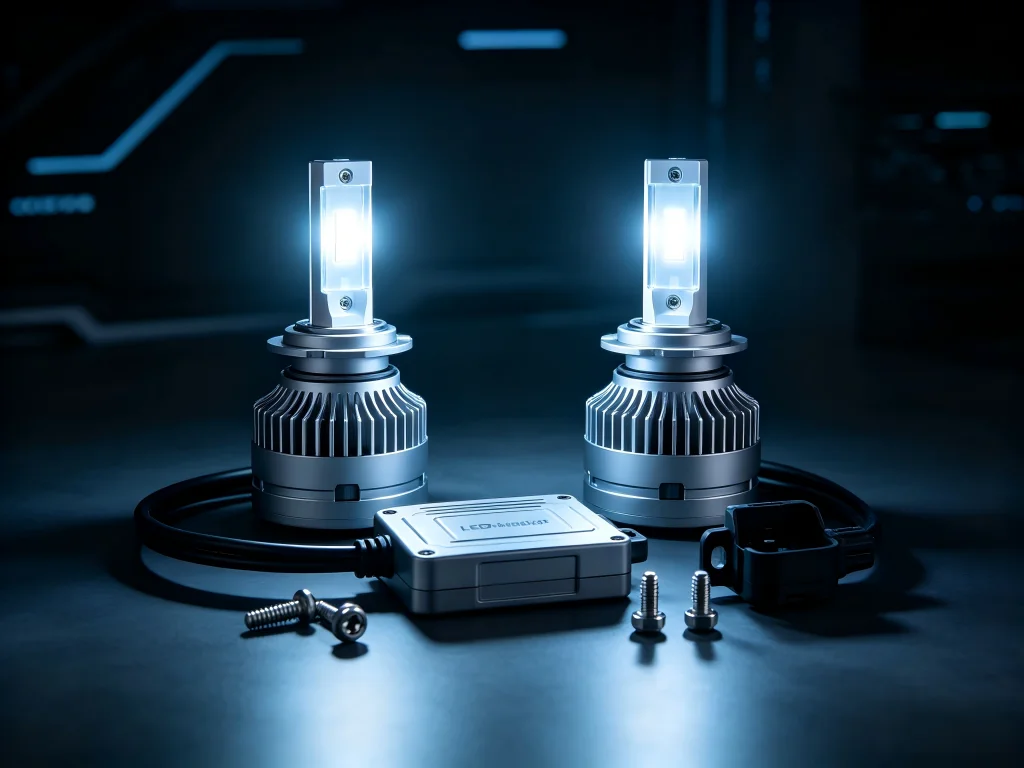
1. Why most LED headlight conversion kit reviews are useless
The truth: most online reviews evaluate LED conversion kits based on first impressions — brightness straight out of the box, ease of installation, and initial color temperature. None of these tell you whether the kit will still be working after three months of heat cycles, or whether the beam pattern actually works with your specific housing.
Consumer reviews on Amazon and eBay are full of contradictory comments. One buyer rates a kit as “super bright” and “perfect fit.” Another buyer of the same kit reports that they “don't even fit properly in the headlight housing unit” and “aren't bright at all.” Both are telling the truth — their vehicles, housings, and expectations are different. Generic reviews don't account for these variables.
This guide focuses on the factors that truly determine long-term performance, regardless of your vehicle or housing type.
2. Factor 1: LED chip placement — The most important specification
Your headlight housing — whether reflector or projector — was designed around a specific light source geometry. The halogen filament sits in a precise location, and the reflector or lens directs light from that point.
When an LED conversion kit places the emitter in a different position, the beam pattern breaks down. Light scatters. Forward reach decreases. Glare increases. This is not a minor issue — it is the main reason early LED conversion kits had such a bad reputation for blinding oncoming traffic.
Qué buscar: Kits that explicitly state 1:1 filament match chip placement. The LED chips must be positioned to replicate the location and orientation of the original halogen filament. Some manufacturers achieve this through a vertically aligned LED component design. Others use precision-machined bases that lock the emitter into the correct position.
What to avoid: Kits that don't mention chip placement at all. If a manufacturer doesn't understand why optical positioning matters, the kit almost certainly has suboptimal beam performance.
3. Factor 2: Gestión térmica — La diferencia entre 30.000 horas y 3.000
Los LED generan calor en la unión del semiconductor. A medida que aumenta la temperatura, la salida de luz disminuye y la vida útil se acorta — un fenómeno llamado degradación térmica. Una gestión térmica adecuada no es opcional. Es el mayor determinante de si un kit realmente ofrece su vida útil nominal.
Hay tres enfoques para la refrigeración LED, clasificados de peor a mejor:
| Tipo de enfriamiento | How it works | Pros | Cons |
|---|---|---|---|
| Pasivo (cintas/aletas de calor) | El calor se disipa a través de aletas metálicas sin flujo de aire | Silencioso, sin partes móviles | Se satura de calor rápidamente, la salida cae bajo uso prolongado |
| Activo (ventilador + disipador de calor) | El ventilador hace pasar aire por el disipador de calor para eliminar el calor | Mantiene temperaturas estables y una salida constante | Ruido del ventilador, posible fallo del ventilador |
| Activo + tubo de calor de cobre | La PCB de cobre lleva el calor a los tubos de calor con refrigerante líquido, el ventilador lo distribuye | Transferencia de calor superior, salida estable, mayor vida útil | Mayor costo de fabricación |
Qué buscar: PCB de cobre y sistemas de refrigeración activa. Algunos kits premium utilizan tubos de calor de cobre duales con un ventilador de alto rendimiento. Estos sistemas mantienen temperaturas estables incluso durante la conducción nocturna prolongada.
What to avoid: Kits que dependen únicamente de refrigeración pasiva (cintas térmicas sin ventilador). Estos se saturarán de calor en 15-20 minutos de uso continuo, causando una caída significativa del brillo.
4. Factor 3: Salida de energía estable — El asesino oculto del rendimiento
Muchos kits LED anuncian cifras de potencia máxima altas — 100W, 200W, incluso 300W por bombilla. Estas cifras a menudo se miden al arranque, antes de que entre en acción la limitación térmica. En pocos minutos, la salida de potencia real cae un 30-50% a medida que los LED se calientan.
Algunos fabricantes utilizan una práctica llamada “caída térmica” — el controlador LED reduce la potencia para evitar el sobrecalentamiento, sacrificando el brillo por la supervivencia. El resultado es un kit que parece impresionante en el garaje pero decepciona en la carretera.
Qué buscar: Kits que especifican una salida de vatios estable, no la potencia máxima. Las clasificaciones de potencia genuinas — 32W estables, 45W estables o 52W estables — indican que el controlador está diseñado para mantener una salida constante.
What to avoid: Kits que solo anuncian la potencia máxima o no especifican si la clasificación es estable o máxima.
5. Factor 4: Compatibilidad con CAN-Bus — Sin errores, sin parpadeos, sin resistencias
Los vehículos modernos utilizan sistemas CAN-Bus (Controller Area Network, red de área de controladores) para monitorear las cargas eléctricas. Cuando se reemplaza una halógena de 55W por una LED de 20W, el sistema detecta el menor consumo de corriente y asume que la bombilla está fundida. El resultado: mensajes de error en el tablero, parpadeo, hiperflash o que las luces se apaguen por completo.
Algunos kits solucionan esto con resistencias de carga externas o decodificadores CAN-Bus. Estos complementos introducen puntos de falla adicionales, generan calor y complican la instalación. Otros kits —incluido GTR— integran la compatibilidad con CAN-Bus directamente en el circuito del controlador.
Qué buscar: Kits que indican compatibilidad con CAN-Bus integrada sin necesidad de resistencias externas.
What to avoid: Kits que requieren resistencias de carga o decodificadores separados. Estos añaden costo, complejidad y puntos de falla.
6. Factor 5: Temperatura de color — El blanco adecuado para la visibilidad
La temperatura de color se mide en Kelvin (K). Las bombillas halógenas producen una luz amarilla cálida de alrededor de 3.000K. Los kits LED suelen oscilar entre 5.000K y 6.500K.
5.000-5.500K (blanco puro): Lo más cercano a la luz natural. Proporciona el mejor contraste y reconocimiento de color. Reduce la fatiga visual durante la conducción nocturna prolongada.
5.500-6.000K (blanco frío): Ligeramente blanco azulado. Popular por su apariencia moderna. Sigue proporcionando buena visibilidad.
6.000-6.500K (blanco azulado): Notablemente azul. Puede reducir el contraste en condiciones de humedad. A menudo se asocia con kits más baratos y de menor calidad que priorizan la apariencia sobre el rendimiento.
Qué buscar: 5.000-6.000K para una visibilidad óptima. Más no es mejor: por encima de 6.000K, la salida de luz en el espectro visible en realidad disminuye.
What to avoid: Kits por encima de 6.500K. Estos producen más luz azul, que se dispersa más en la lluvia y la niebla, reduciendo la visibilidad efectiva.
7. Factor 6: Ajuste y espacio libre — La realidad de la instalación
Los kits de conversión LED son físicamente más grandes que las bombillas halógenas. El disipador de calor, el ventilador y el controlador añaden volumen detrás del alojamiento del faro. Muchos vehículos tienen espacio libre limitado: la funda antipolvo puede no cerrar, o la bombilla puede no encajar en absoluto.
Algunos kits solucionan esto con diseños compactos que integran el controlador en el alojamiento de la bombilla. Otros utilizan disipadores de calor de perfil bajo para instalaciones ajustadas.
Qué buscar: Diseños compactos que se ajustan a las dimensiones estándar de las bombillas halógenas. Verifique las dimensiones físicas del kit con el espacio libre del faro de su vehículo.
What to avoid: Kits que requieren modificación de las cubiertas antipolvo, soportes o carcasas. Si el kit no se ajusta sin modificación, puede que no sea la opción adecuada para su vehículo.
8. Factor 7: Cumplimiento legal — Conozca las normativas locales
Este es el factor que la mayoría de los compradores ignora hasta que es demasiado tarde. En muchas jurisdicciones, las conversiones a LED de posventa son simplemente ilegales para uso en carretera.
Estados Unidos: La mayoría de los kits de conversión a LED no cumplen con la normativa DOT y están etiquetados explícitamente como “solo para uso fuera de carretera”. Amazon restringió la venta de kits de conversión de faros LED no conformes a partir del 31 de diciembre de 2023.
Australia: Las adaptaciones que solo cambian la bombilla son ilegales según las normas ADR 13. Solo los conjuntos de faros LED certificados completos son legales para uso en carretera.
Nueva Zelanda: Sigue las normas ADR australianas: las bombillas LED de posventa en carcasas halógenas están prohibidas.
Reino Unido y Europa: Los kits con certificación ECE pueden ser legales si mantienen un patrón de haz y un corte adecuados. Sin embargo, muchos kits de posventa siguen sin cumplir estas normas.
Qué buscar: Kits que cuentan con certificación ECE o que indican explícitamente el cumplimiento del patrón de haz.
What to avoid: Kits que no mencionan la legalidad en absoluto, o que hacen afirmaciones no respaldadas sobre la aprobación DOT o ADR.
9. Comparación: Cómo se posicionan los kits de conversión a LED
| Característica | Kit económico | Kit de gama media | Kit premium (estándar GTR) |
|---|---|---|---|
| Colocación del chip LED | Genérico, no coincidente con el filamento | Coincidencia aproximada | Coincidencia 1:1 con el filamento |
| Cooling system | Pasivo (cintas térmicas) | Ventilador activo + disipador de aluminio | PCB de cobre + tubos de calor + ventilador |
| Potencia de salida | Solo clasificación máxima, caída térmica | Salida estable, alguna caída | Vataje estable, sin caída |
| Compatibilidad con CAN-Bus | Se requieren resistencias externas | Integrado, solo algunos vehículos | Integrado, universal |
| Temperatura de color | 6.500K+ (blanco azulado) | 6.000K (blanco frío) | 5.000-6.000K (blanco óptimo) |
| Instalación | Voluminoso, puede requerir modificación | Compacto, la mayoría de vehículos | Compacto, ajuste universal |
| Cumplimiento legal | Solo para uso fuera de carretera, sin certificación | Puede declarar cumplimiento | Cumple con el patrón de haz ECE/SAE |
| Vida útil (real) | 3.000-5.000 horas | 10.000-20.000 horas | 30.000+ horas |
10. Por qué los kits de conversión a faros LED de GTR se distinguen
Basándose en años de experiencia en la fabricación de iluminación automotriz, GTR diseñó sus kits de conversión LED en torno a los factores que realmente determinan el rendimiento en el mundo real, no cifras de marketing.
Precisión óptica: La colocación del chip que iguala el filamento 1:1 garantiza un patrón de haz adecuado tanto en carcasas de reflector como de proyector.
Estabilidad térmica: PCB de cobre con refrigeración activa mantiene temperaturas estables y una salida de luz constante.
Compatibilidad con CAN-Bus: El circuito de control integrado elimina la necesidad de resistencias o decodificadores externos.
Diseño compacto: Se adapta a vehículos con espacio limitado para los faros sin necesidad de modificaciones.
Potencia real: Salida de vatios estable, no cifras máximas infladas.
GTR no persigue el número de lúmenes más alto. Perseguimos el mejor rendimiento en el mundo real: un patrón de haz que funcione, un brillo que se mantenga brillante y una compatibilidad que realmente funcione.
11. Preguntas frecuentes sobre kits de conversión de faros LED
11.1. ¿Cuál es el mejor kit de conversión de faros LED para mi vehículo?
El mejor kit depende del tipo de bombilla (H4, H7, 9005, 9006, etc.), la carcasa del faro (reflector vs. proyector) y el espacio disponible en el vehículo. Dé prioridad a los kits con colocación de chips que coincida 1:1 con el filamento, refrigeración activa con componentes de cobre y compatibilidad CAN-Bus integrada.
11.2. ¿Por qué algunos kits de conversión LED cuestan $30 mientras que otros cuestan $200?
La diferencia está en la ingeniería: precisión en la colocación del chip, calidad de la gestión térmica, compatibilidad CAN-Bus y suministro de energía estable. Los kits baratos escatiman en estos factores, lo que resulta en patrones de haz deficientes, caída rápida del brillo y una vida útil más corta.
11.3. ¿Puedo instalar yo mismo un kit de conversión LED?
La mayoría de los kits plug-and-play se pueden instalar en 30 minutos o menos con herramientas manuales básicas. Sin embargo, algunos vehículos requieren desmontar el parachoques delantero o el conjunto del faro para acceder. Desconecte siempre la batería antes de la instalación.
11.4. ¿Funcionarán los kits de conversión LED con las luces diurnas de mi vehículo?
Algunos vehículos utilizan la bombilla del faro a potencia reducida para la función de luz diurna. Los LED pueden parpadear o comportarse de forma impredecible en este modo. Los kits con compatibilidad CAN-Bus integrada normalmente gestionan correctamente el funcionamiento de las luces diurnas.
11.5. ¿Consumen menos energía los faros LED que los halógenos?
Sí. Una bombilla halógena normalmente consume 55 W. Un kit LED de calidad consume 20-52 W mientras produce de tres a cuatro veces más luz. Esto reduce la carga en el sistema eléctrico de su vehículo.
11.6. ¿Cómo sé si un kit de conversión LED es legal en mi país?
Consulte la normativa local. En EE. UU., busque el cumplimiento DOT. En Europa, busque la certificación ECE. En Australia y Nueva Zelanda, tenga en cuenta que las adaptaciones que solo cambian la bombilla son generalmente ilegales. Si un kit está etiquetado como “solo para uso fuera de carretera”, no es legal para uso en la vía pública.
11.7. ¿Cuál es la diferencia entre un kit de conversión LED y reemplazar todo el conjunto del faro?
Un kit de conversión reemplaza solo la bombilla: es más barato y más fácil, pero puede enfrentar restricciones legales. Reemplazar todo el conjunto del faro por una unidad específica para LED es más caro, pero generalmente es legal para circular y ofrece un rendimiento óptico óptimo.
11.8. ¿Cuánto debería durar un kit de conversión de faros LED?
Los kits de calidad están clasificados para 30.000 horas o más. Sin embargo, la vida útil real depende en gran medida de la gestión térmica; los kits con una refrigeración deficiente pueden fallar mucho antes.
12. Haz que tu mejora cuente
Un kit de conversión de faros LED es tan bueno como su ingeniería. La precisión óptica, la estabilidad térmica y la compatibilidad con el vehículo determinan si tu mejora ofrece ganancias reales de visibilidad o se convierte en otro compromiso frustrante.
GTR diseñó sus kits para sobresalir en las tres áreas. Visita https://www.rhgtr.com para encontrar el kit de conversión de faros LED adecuado para tu vehículo. Comprueba la diferencia que marca una ingeniería adecuada y conduce con la confianza que mereces.