
You are past the “should I upgrade” question. You know you want an H4 LED headlight bulb. Now you are staring at dozens of options with wildly different prices, lumen claims, and feature lists. Every brand says they are the brightest. Every listing promises plug-and-play installation. Every review seems contradictory.
This guide cuts through the noise. Based on our engineering analysis and real-world testing of H4 LED headlight bulbs across multiple vehicle platforms, we will show you exactly what separates a $40 bulb from a $150 bulb — and why the expensive one is often cheaper in the long run.
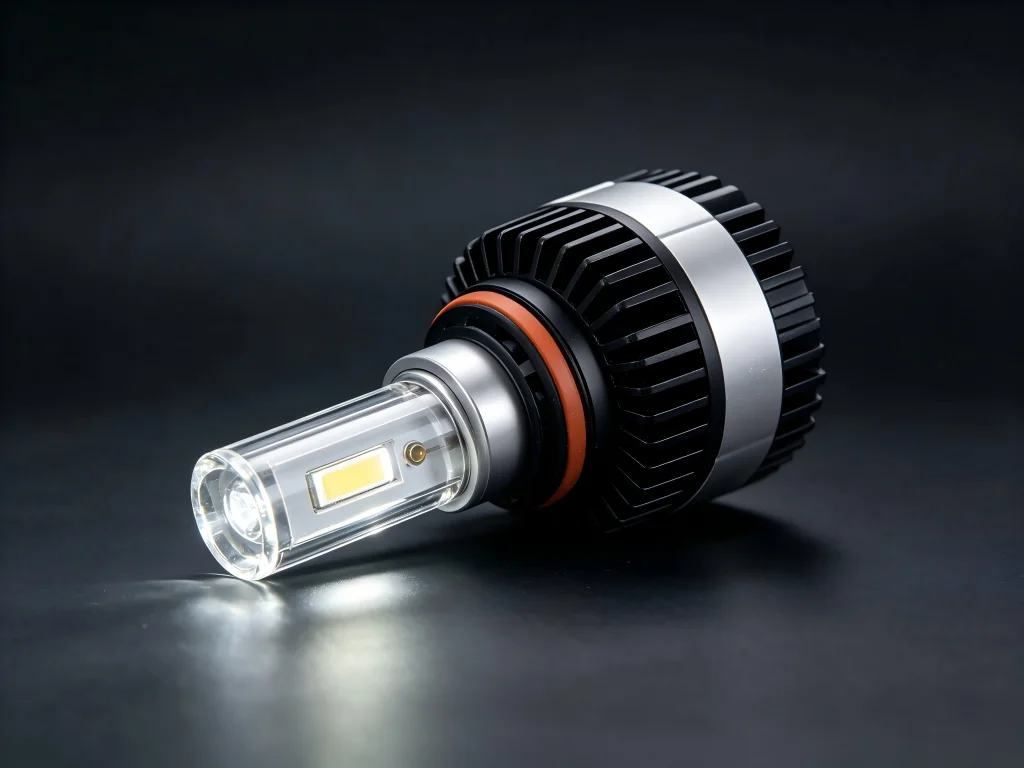
1. What Actually Matters in an H4 LED Headlight Bulb
Only four factors determine whether an H4 LED headlight bulb will perform well in your vehicle: beam pattern accuracy, thermal management, CANBUS compatibility, and physical fitment. Everything else is marketing noise.
Let us break down each factor so you can evaluate any H4 LED headlight bulb like a professional.
1.1. Beam Pattern Accuracy: The Non-Negotiable
The H4 bulb uses a dual-filament design. One filament for low beam, one for high beam. The reflector or projector housing in your headlight is engineered around the exact position of these filaments. Move the light source even slightly, and the beam pattern breaks.
LED chip placement is the single most important engineering decision in any H4 LED headlight bulb. Premium manufacturers use digitally precise placement that mirrors the halogen filament location. Cheap brands approximate — and the results are visible in scattered light, dark spots, and glare.
Qué buscar: Bulbs that explicitly mention “1:1 filament position” or “same beam pattern as halogen”. Avoid bulbs that only talk about lumen output without addressing beam quality.
1.2. Thermal Management: The Longevity Factor
LEDs generate heat at the chip junction. If that heat is not dissipated, the chips degrade. Brightness drops. Color shifts. Then the bulb fails.
There are two approaches to cooling H4 LED headlight bulbs:
- Active cooling (fans): Effective but introduces moving parts that can fail or become noisy. Quality fans use sealed bearings and run quietly. Cheap fans are loud and short-lived.
- Passive cooling (heat sinks): No moving parts, completely silent. Requires sufficient surface area to dissipate heat. Works well for lower-wattage bulbs.
Qué buscar: Bulbs that specify the cooling method and provide thermal data. Avoid bulbs where the cooling system looks like an afterthought.
1.3. CANBUS Compatibility: The Dashboard Peace
Modern vehicles monitor electrical loads to detect bulb failures. A halogen H4 draws about 55 watts. An H4 LED headlight bulb draws significantly less. If the vehicle’s computer sees the lower draw, it assumes the bulb is dead and throws a warning light.
Some bulbs solve this with built-in CANBUS drivers that mimic the halogen load. Others require external decoders or resistors. External solutions introduce additional failure points and complicate installation.
Qué buscar: Bulbs with “built-in CANBUS” or “error-free” capability. Avoid bulbs that require separate decoders unless you enjoy troubleshooting electrical gremlins.
1.4. Physical Fitment: The Installation Reality
Your headlight housing has limited space behind the bulb. Some H4 LED headlight bulbs have bulky heat sinks or fan assemblies that do not fit — requiring you to modify or remove dust covers.
Qué buscar: Bulbs that advertise “1:1 size” or “mini design”. Check the dimensions against your vehicle’s dust cover clearance before purchasing.
2. H4 LED Headlight Bulb Comparison: What the Market Offers
| Característica | Budget H4 LED (<$50) | Mid-Range H4 LED ($50–$100) | Premium H4 LED ($100+) |
|---|---|---|---|
| Patrón del haz | Approximated; often scattered | Improved; may still have dark spots | Digitally precise; matches halogen exactly |
| Gestión térmica | Basic fan or undersized heat sink | Decent fan or heat sink | Advanced active or passive cooling |
| CANBUS compatibility | Requires external decoders | May have basic built-in driver | Fully integrated; error-free |
| Physical Fitment | Bulky; may not fit all housings | Better; usually fits most | 1:1 mini design; fits virtually all |
| Vida útil típica | 6–12 months | 2–3 years | 5+ years (30,000–50,000 hours) |
| Real-World Value | Cheap upfront; costly over time | Decent balance | Highest long-term value |
3. Common H4 LED Headlight Bulb Pitfalls (And How to Avoid Them)
Here are the mistakes we see most often — and how you can avoid making them.
- Perseguir números de lúmenes. A 50,000-lumen claim means nothing if the light is scattered. Focus on beam pattern quality, not raw output.
- Ignoring color temperature. 6000K looks “cool” but performs poorly in fog and rain. 4300K to 5000K offers better visibility in adverse conditions.
- Buying without checking fitment. Measure your dust cover clearance before purchasing. A bulb that does not fit is a bulb you cannot use.
- Skipping CANBUS compatibility. If your vehicle uses CANBUS, buy a bulb with built-in compatibility. External decoders are a hassle.
- Believing “plug-and-play” marketing. Every H4 LED headlight bulb claims to be plug-and-play. Not all of them are. Check the installation process before buying.
4. Real Customer Experiences: What Works and What Does Not
We monitor automotive forums and customer feedback to understand how H4 LED headlight bulbs perform in the real world. Here is what actual drivers report.
One driver who installed premium H4 LEDs noted: “Much better cutoff, even light spread on the road and really quiet fans. My only concern is that there have been more reported LED chip failures for Novsight bulbs which isn’t ideal since their equivalent power rating bulbs to Auxleds cost 7-9k more.”
Another driver compared different brands: “The Novsight however have a much sharper cutoff but on the other hand, the Aux Pro just seem to be a bit brighter.” They also noted longevity differences: “I’ve had Auxleds lasting over 2 years. 1 pair of my Novsights gave up on the 11th month and the other in the 9th month.”
These experiences highlight a crucial point: the most expensive bulb is not always the best, but the cheapest is almost always the worst. The sweet spot is a bulb engineered for your specific application — not the one with the biggest lumen claim or the lowest price.
One driver upgrading from halogens to H4 LEDs described the difference: “Compared to my previous halogen bulbs, the difference is night and day. The LED headlights provide a much clearer and wider beam, enhancing visibility and safety while driving at night.”
But another warned: “The main disadvantage is the cooling fans — once they spin up they are noisy enough to be heard in the cabin when the car is turned off.”
The lesson? Read reviews for the specific bulb you are considering. Look for patterns in the complaints. If multiple people mention the same issue — loud fans, poor beam pattern, early failure — believe them.
5. Frequently Asked Questions About H4 LED Headlight Bulbs
5.1. ¿Son lo mismo las bombillas H4 y 9003?
Yes. H4, 9003, and HB2 are different designations for the same bulb base. They are interchangeable in most applications. Always verify compatibility with your specific vehicle.
5.2. What color temperature should I choose for my H4 LED headlight bulb?
6000K produces cool white light that looks modern but performs poorly in fog and rain. 4300K to 5000K offers better visibility in adverse conditions while still appearing white. 3000K produces warm yellow light similar to halogen — excellent in fog but less “modern” in appearance.
5.3. Will H4 LED headlight bulbs blind oncoming drivers?
Only if the beam pattern is incorrect. A properly designed H4 LED headlight bulb with accurate filament positioning produces a clean cutoff line that does not blind oncoming traffic. Poorly designed bulbs scatter light and create glare.
5.4. How do I know if my vehicle needs CANBUS-compatible H4 LED bulbs?
Most vehicles manufactured after 2005 use CANBUS or similar electrical monitoring systems. If your vehicle displays a warning light after installing LED bulbs, you need CANBUS-compatible bulbs.
5.5. Can I use H4 LED headlight bulbs in my motorcycle?
Yes. H4 is a common motorcycle headlight size. However, motorcycle electrical systems may have different requirements than cars. Check compatibility before purchasing.
5.6. How do I install H4 LED headlight bulbs?
Installation typically takes 5 to 10 minutes. Remove the old halogen bulb, insert the new LED bulb, and secure it. For CANBUS-compatible bulbs, no additional wiring or adapters are needed. Always align the bulb properly after installation.
5.7. What is the difference between active and passive cooling in H4 LED bulbs?
Active cooling uses a fan to pull heat away from the LED. Passive cooling uses a heat sink to dissipate heat through convection. Active cooling is more effective for high-wattage bulbs but introduces moving parts that can fail. Passive cooling is silent and more reliable but requires sufficient surface area.
6. Your Decision: Choose the H4 LED Headlight Bulb That Actually Works
You now know what matters in an H4 LED headlight bulb. You understand the pitfalls. You have seen real-world experiences from other drivers.
The decision is simple. You can buy a cheap H4 LED headlight bulb and hope it works — accepting the risk of poor beam pattern, flickering, early failure, and dashboard warnings. Or you can invest in a properly engineered bulb that delivers usable light, flawless compatibility, and years of reliable service.
GTR Lighting designs H4 LED headlight bulbs for drivers who refuse to compromise. Precision LED placement for perfect beam patterns. Advanced thermal management for long life. Built-in CANBUS compatibility for error-free installation. 1:1 physical dimensions for hassle-free fitment.
Every GTR Lighting H4 LED headlight bulb is engineered from the ground up — not assembled from generic components and sold with inflated claims.
Visita https://www.rhgtr.com to explore the GTR Lighting H4 LED headlight bulb lineup. Find the right bulb for your vehicle. Install it once. Drive with confidence every night.
Because the road ahead deserves better than a gamble.