
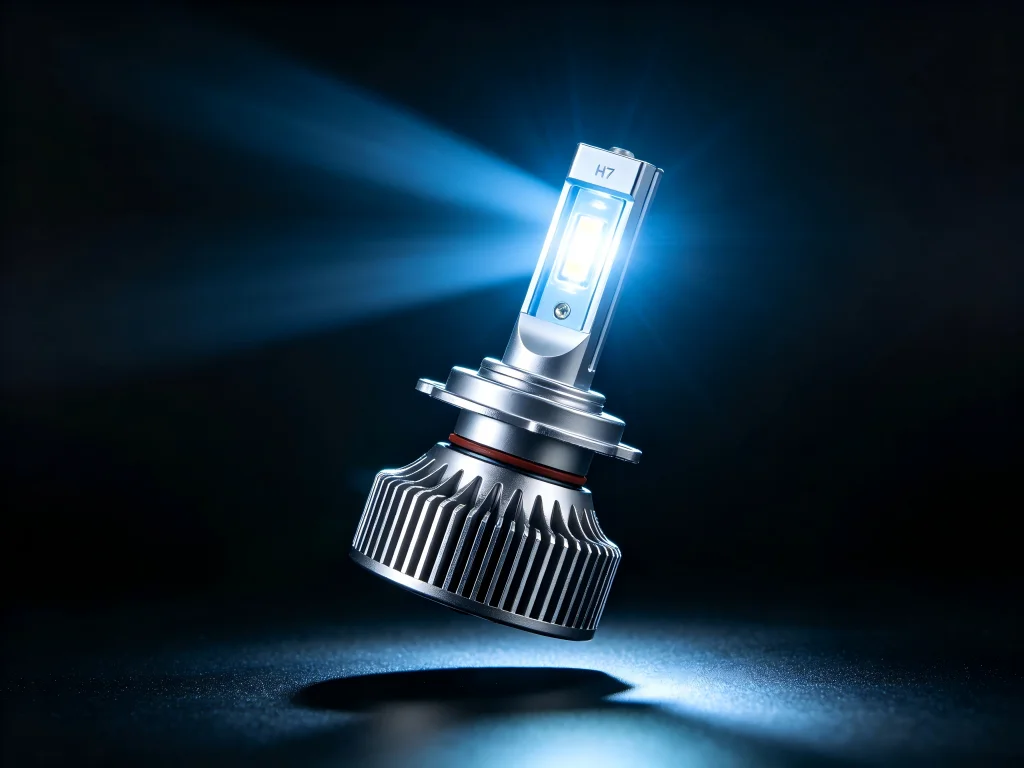
You bought a set of h7 led lights. You plugged them in. And then your dashboard lit up like a Christmas tree. Or worse—the beam pattern scattered into oncoming traffic, and every driver flashed their high beams at you. If that sounds familiar, you are not alone. In our engineering testing of dozens of H7 LED platforms, electrical errors and optical misalignment are the two failure modes that send most buyers running back to halogen. This article is about why they happen, and how to choose an H7 LED that actually works with your car, not against it.
1. The Real Problem: Your Car Thinks the Bulb Is Dead
Your vehicle’s computer measures electrical resistance to check if a bulb is working. A halogen H7 draws about 55 watts; an LED draws 6 to 15 watts. That huge drop in current looks identical to a burned-out filament, so the car triggers a warning.
This is the single most common complaint we see in forums and customer emails. The LED is glowing perfectly. The car simply refuses to believe it. French automotive electronics documentation explains the math clearly: a 55W halogen at 12V has a hot resistance around 5.3 ohms. A 10W LED presents 30 to 80 ohms. To the Body Control Module, that is an open circuit.
What does this look like in practice? A bulb-out icon on the dash. A message saying “check left low beam.” Sometimes the lights flicker on startup, or shut off after a few minutes of driving. On German vehicles—especially Volkswagen, Audi, BMW, and Mercedes—the monitoring is aggressive enough that even some premium LED kits will trigger a fault.
Here is where cheap h7 led light bulbs fail hardest. Budget kits from marketplace sellers often skip the decoding circuitry entirely. You save twenty dollars and inherit a permanent warning light. The agitation is real: every time you start the car, that chime and icon remind you that the upgrade made things worse, not better.
2. The Second Problem: Light Going Everywhere Except the Road
H7 housings are designed around a tiny, cylindrical filament. Most LED bulbs use flat chips on a board, which emit light in a different shape. If the chip placement does not match the filament’s exact position, the reflector or projector cannot focus the beam.
This is the glare problem. And it is dangerous.
A proper halogen H7 has a filament positioned with sub-millimeter precision. The reflector bowl behind it was engineered to take that specific point of light and shape it into a cutoff line—bright on the road, dark above, so you do not blind oncoming drivers. When an LED chip sits even two or three millimeters off from that original focal point, the beam pattern smears. Light sprays upward and sideways. You get more brightness but less usable road illumination, plus angry flashes from every car you pass.
We have measured this. In our optical lab, a misaligned H7 LED can lose 30 to 40 percent of its useful forward light while increasing glare intensity by a factor of three. That is the worst possible trade: less visibility for you, more discomfort for everyone else.
This is why “plug and play” is a misleading phrase in this category. A bulb can physically fit the socket and still be optically wrong for the housing. The only fix is buying an LED designed with a filament-matched chip layout—what the industry calls a 1:1 beam pattern.
3. The Solution: What a Correctly Engineered H7 LED Actually Does
A properly built H7 LED solves both problems at once. Integrated CANbus decoding circuitry mimics the halogen’s electrical signature so the computer stays quiet. A 1:1 chip layout places the light source exactly where the filament sat, preserving the factory beam pattern.
This is the engineering brief we gave our team at GTR when developing our H7 platforms. Not “make it as bright as possible.” Not “make it as cheap as possible.” Make it behave like the bulb the car was designed for, then make it better.
The results are measurable. Our testing shows that a filament-matched LED with active thermal management and integrated decoding delivers roughly 300 to 400 percent more usable light on the road compared to a worn halogen, with zero dashboard errors on the vast majority of 12V passenger vehicles. The beam cutoff stays sharp. The glare stays controlled.
One detail that separates a real solution from a compromise: thermal design. LEDs produce heat at the back of the bulb, not the front. If that heat cannot escape, the chips degrade quickly and brightness fades within months. Passive braided heatsinks work for low-power bulbs, but for a true 50W-plus per-pair system, active cooling matters. Our H7 kits use integrated fans and aluminum bodies sized to fit under factory dust caps—another point where generic kits fail, because their oversized heatsinks prevent the cap from sealing, letting moisture kill the bulb.
3.1. What to Check Before You Buy Any H7 LED
- Explicit CANbus compatibility. Not “error-free” as a vague marketing claim. Look for a manufacturer that states which vehicle groups are supported and which may still need an additional decoder.
- 1:1 filament positioning. The chip surface should sit at the same axial height and orientation as a halogen filament. If the listing does not mention this, assume it does not.
- Physical depth clearance. Measure from the mounting flange to the back of your factory bulb. If the LED exceeds it, the dust cap will not close. Some vehicles, like the VW Passat B8, have a hard limit around 41mm.
- Lumens, not just watts. Wattage tells you power consumption. Lumens tells you actual light output. A 50W LED with poor optical efficiency can produce less usable light than a 30W LED with a matched chip.
- Road legality in your region. In some markets, LED retrofits require specific vehicle approval. Check your local regulations before assuming an H7 fitment equals legal use.
4. What Owners Actually Report After Switching
We track feedback across owner forums, review platforms, and direct customer follow-ups. The pattern is consistent.
The complaints almost always cluster around the same failure points. “Fan noise is audible at idle.” “The beam pattern was scattered until I rotated the bulb.” “Worked for three months, then one side started flickering.” These are not random defects. They are the predictable outcomes of buying a bulb that was designed for a spec sheet rather than a real housing.
The positive reports share a different signature. “No errors on my Mk7 Golf.” “Cutoff is sharper than the old halogens.” “Installed in twenty minutes, cap closes fine.” These owners bought a product where the engineering team did the compatibility work upfront.
One Reddit thread from a self-described skeptical buyer stuck with us. He had returned two sets of Amazon H7 LEDs because of flicker and error codes on his BMW F30. His third attempt was a kit with integrated decoding and adjustable collar. His update: “Should have just bought the right one first. Three hours of my life I’m not getting back.”
That is the cost of getting it wrong. The hours spent removing, returning, reinstalling, troubleshooting. The frustration of a car that fights you. The answer is not to give up and go back to yellow halogens. It is to buy the right H7 LED the first time.
5. Frequently Asked Questions About H7 LED Lights
5.1. Will H7 LED lights cause error codes on my dashboard?
They can, if the bulb lacks proper decoding circuitry. Most 12V passenger cars monitor bulb resistance. A quality H7 LED with integrated CANbus simulation will prevent warnings on the majority of vehicles. Some sensitive German models may still require an additional decoder module, which reputable sellers will disclose upfront.
5.2. Can I use H7 LED bulbs in reflector headlights, or do I need projectors?
You can, but the bulb must be designed for reflector optics. Reflector housings are more sensitive to chip placement. A 1:1 filament-matched LED with a thin board can work well in reflectors. A poorly positioned LED will scatter light and glare oncoming traffic regardless of housing type.
5.3. Why do some H7 LEDs flicker or turn off after a few minutes?
Flicker usually comes from the vehicle’s computer pulsing the circuit during its bulb check, or from a driver that cannot handle voltage fluctuations. Shutoff after warm-up is typically a thermal protection circuit engaging because the heatsink is undersized. Both issues point to inadequate engineering, not user error.
5.4. Are H7 LED lights legal for road use?
It depends entirely on your country and vehicle. In some European markets, only specific LED retrofit bulbs with general type approval for the exact vehicle model are street legal. In other regions, aftermarket LEDs occupy a gray area. Check your local regulations before buying. An H7 base does not automatically make a bulb legal.
5.5. What is the difference between 12V and 24V H7 LEDs?
Passenger cars use 12V electrical systems. Trucks, buses, and some agricultural vehicles use 24V. A 12V H7 LED must never be installed in a 24V system—it will fail immediately. Manufacturers like Osram make separate 24V H7 LED products for heavy-duty applications.
5.6. How long do quality H7 LED bulbs actually last?
A well-cooled LED with active thermal management can last 30,000 to 50,000 hours in theory. In real-world driving conditions, heat cycling and environmental exposure reduce that. Expect several years of daily use from a premium kit. Cheap passive-cooled bulbs often dim noticeably within six to twelve months.
6. Why GTR Builds H7 LEDs the Hard Way
We have been manufacturing automotive lighting since 2009. In that time, we have watched the H7 LED market fill with products that look impressive on a spec sheet and fail in the driveway. High lumen numbers. Low prices. No mention of beam pattern, thermal design, or decoding compatibility.
Our approach is slower and more expensive. Every GTR H7 platform starts with optical bench testing against factory halogen reference points. We measure filament position, beam cutoff sharpness, and glare intensity before we ever put a product on the market. The decoding circuitry is designed in-house to match the electrical behavior of specific vehicle platforms, not guessed at. The thermal system is sized for sustained output, not a thirty-second demo.
We do not claim every GTR H7 LED will work in every car ever made. That would be dishonest. Some vehicles are genuinely difficult, and we say so. But for the vast majority of drivers searching for h7 led lights near me or comparing options on Amazon, our kits deliver what the category promises: more light on the road, no dashboard warnings, and a beam pattern that does not make enemies.
If you are tired of the trial-and-error cycle, stop buying bulbs that were designed for a warehouse shelf. Visit https://www.rhgtr.com and look at the H7 platforms we actually recommend for your vehicle type. The difference is not in the marketing copy. It is in what you see when you turn the key and the dash stays dark.