
You flip on your fog lights, expecting a wall of white light to cut through the mess ahead. Instead, you get a dull, yellowish glow that barely reaches past your bumper. Rain, fog, or snow turns the road into a grey blur. You squint. You slow down. You grip the wheel tighter. If this sounds familiar, the problem isn’t your driving—it’s your fog lights. LED lights fog lights solve this, but only if you pick the right ones. Most cheap LEDs actually make visibility worse. Here’s why, and how GTR fixes it.
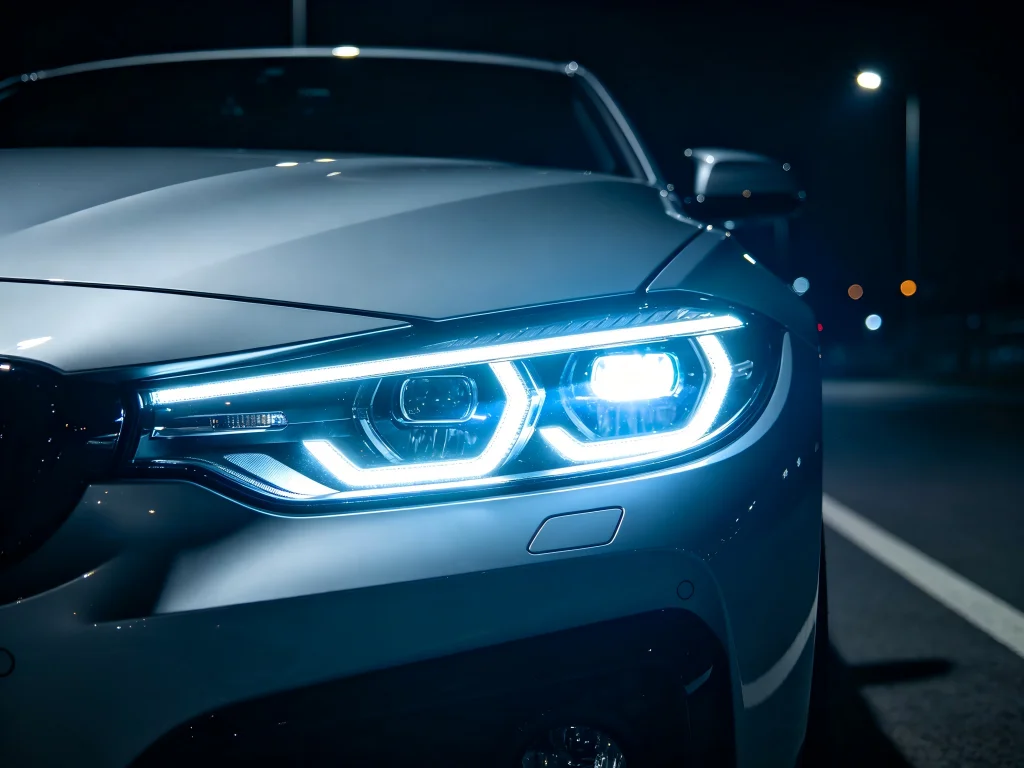
1. The Real Problem: Your Fog Lights Are Lying to You
Most factory halogen fog lights produce around 800 to 1,200 lumens of scattered, yellow-tinted light. They illuminate the fog itself rather than the road, creating glare that bounces back into your eyes. That’s the opposite of what fog lights are supposed to do. The purpose of a fog light is to project a low, wide beam under the fog layer, illuminating the road edges and immediate foreground. Halogen bulbs fail at this because they lack intensity and beam control.
Aftermarket LED fog lights promise a fix. But here’s what the listings don’t tell you: a bare LED bulb stuffed into a halogen reflector housing scatters light everywhere. It blinds oncoming drivers. It creates hot spots and dark voids. And in wet conditions, the blue-white color temperature (often 6000K or higher) reflects off water droplets and makes visibility worse than the halogens you replaced.
We’ve tested dozens of aftermarket LED fog setups in our engineering lab. The pattern is consistent: cheap LEDs fail in three ways. First, poor thermal management cooks the diode within months, dimming output or killing the light entirely. Second, inadequate sealing lets moisture in—you get fog inside the lens, then corrosion, then flickering, then death. Third, and most dangerously, the beam pattern is wrong. Too narrow, too scattered, or aimed too high.
2. The Agitation: What Poor Visibility Actually Costs You
Think about the last time you drove through heavy rain at night. Not a drizzle—real rain, the kind where wipers can’t keep up. Your headlights reflected off the wet asphalt. Your fog lights did almost nothing. You missed a pothole. You nearly clipped a curb. Or worse, you didn’t see the cyclist until they were ten feet away.
Now multiply that risk across every foggy morning commute, every mountain pass in winter, every sudden downpour on the highway. Poor fog lighting isn’t a minor inconvenience. It’s a compounding safety deficit. Reaction time drops. Fatigue rises. And the drivers around you are fighting the same battle with equally inadequate lights.
This is why fleet operators and off-road enthusiasts don’t buy “cheap” fog lights twice. They buy once, and they buy right. The cost of a proper LED fog light system is trivial compared to the cost of an accident—or the daily stress of driving half-blind.
3. The Solution: What Makes GTR’s LED Fog Lights Different
GTR’s LED fog lights use a projector-style lens with a sharp cutoff and a wide, low beam pattern. The result is maximum road illumination with zero upward glare—so you see the road, not the fog. Our 3-inch Bi-LED fog lamps deliver focused intensity where you need it, with a color temperature optimized for wet-weather contrast rather than showroom sparkle.
Here’s what matters when you’re actually driving:
- Beam control, not raw lumens. A 10,000-lumen bar aimed wrong is useless. A properly focused 3,000-lumen projector cuts through fog and rain because the light goes por la carretera, not into the atmosphere.
- Thermal design that survives. Our aluminum housings and copper heat paths keep the LED junction temperature stable. No dimming after twenty minutes. No premature failure.
- IP67 sealing. Condensation inside the lens is the number-one killer of aftermarket LED fog lights. GTR units are pressure-tested for water and dust ingress. If you submerge your bumper, the light survives.
- Plug-and-play compatibility where possible. For most popular platforms, our fog lamps mate to the factory harness. For custom builds, the wiring is straightforward—and we provide the diagrams.
4. What Real Drivers Say (And What the Forums Won’t Tell You)
We monitor owner forums because that’s where the truth lives. On a Jeep Wrangler thread, owners reported that a popular premium brand’s LED fog lights “keep filling up with water” and “absolutely flicker” without an anti-flicker harness. On a Honda Ridgeline forum, one owner traced a dead fog light to water intrusion through the housing seal—the assembly “super easy to unscrew” was the culprit.
These aren’t isolated complaints. They’re the predictable result of cutting corners on sealing and thermal design. Our engineering team has torn down competitor units after field failures. The patterns are always the same: cracked solder joints from heat cycling, corroded connectors from moisture, and reflectors that yellowed within a year.
GTR fog lights are built to avoid those failure modes from the first drawing. We don’t sell the cheapest option on the market. We sell the one you won’t have to replace next season.
5. Frequently Asked Questions
5.1. Are LED fog lights actually better than halogen?
Yes—when designed correctly. A proper LED projector fog light produces a wider, more controlled beam at lower power draw, with a lifespan measured in tens of thousands of hours rather than hundreds. A cheap LED retrofit bulb in a halogen housing is often worse than stock.
5.2. What color temperature is best for fog and rain?
Yellow or warm-white (3000K–4300K) cuts through fog and rain with less backscatter than cool white (6000K+). Cool white looks modern but reflects off water droplets and can worsen glare. GTR offers selectable-color fog lamps so you can switch based on conditions.
5.3. Can I wire LED fog lights to my factory switch?
Often, yes—if the current draw is within the factory circuit’s capacity. However, if you’re adding lights alongside the factory fogs, you’ll likely need a relay harness triggered by the factory switch rather than powering both sets from the same wire. GTR provides wiring guidance for common platforms.
5.4. Why do some LED fog lights flicker?
Flicker usually comes from PWM (pulse-width modulation) in the vehicle’s lighting circuit, which the LED driver interprets as a signal rather than steady power. A quality LED fog light with a stable driver and, where needed, an anti-flicker module eliminates this.
5.5. How much should I expect to spend?
Budget LED fog lights run $30–$60 per pair and typically last a season or two. Mid-range units with proper sealing and optics run $80–$150. GTR’s professional-grade fog lamps sit at the upper end because the components—LED bins, drivers, housings, seals—cost what they cost. The price difference is one replacement versus three.
6. Choose the Light That Ends the Guesswork
You don’t need brighter fog lights. You need correct fog lights. The next time fog swallows the road, or rain turns your windshield into a kaleidoscope, or snow drifts across the highway at dusk, you should see the lane lines. You should see the shoulder. You should see what’s ahead before it becomes an emergency.
GTR builds fog lights for the driver who is done experimenting with cheap imports and forum hype. Explore our Bi-LED fog light lineup and find the fitment for your vehicle. If you’re a distributor or fleet buyer, our team can walk you through specs, certifications, and bulk pricing.
Don’t wait for the next storm to find out your fog lights can’t handle it. Upgrade to GTR.