
You have read the reviews. You have compared the lumen numbers. You have watched the installation videos. And now you are staring at a checkout page with three tabs open, wondering why every brand claims to be “the brightest” while the return policies tell a different story. The truth is that the LED headlight market is designed to confuse you. Spec sheets are inflated, “plug-and-play” is a phrase without a legal definition, and the difference between a bulb that transforms your night driving and one that ruins it comes down to three engineering decisions most sellers never mention. This guide cuts through the noise.
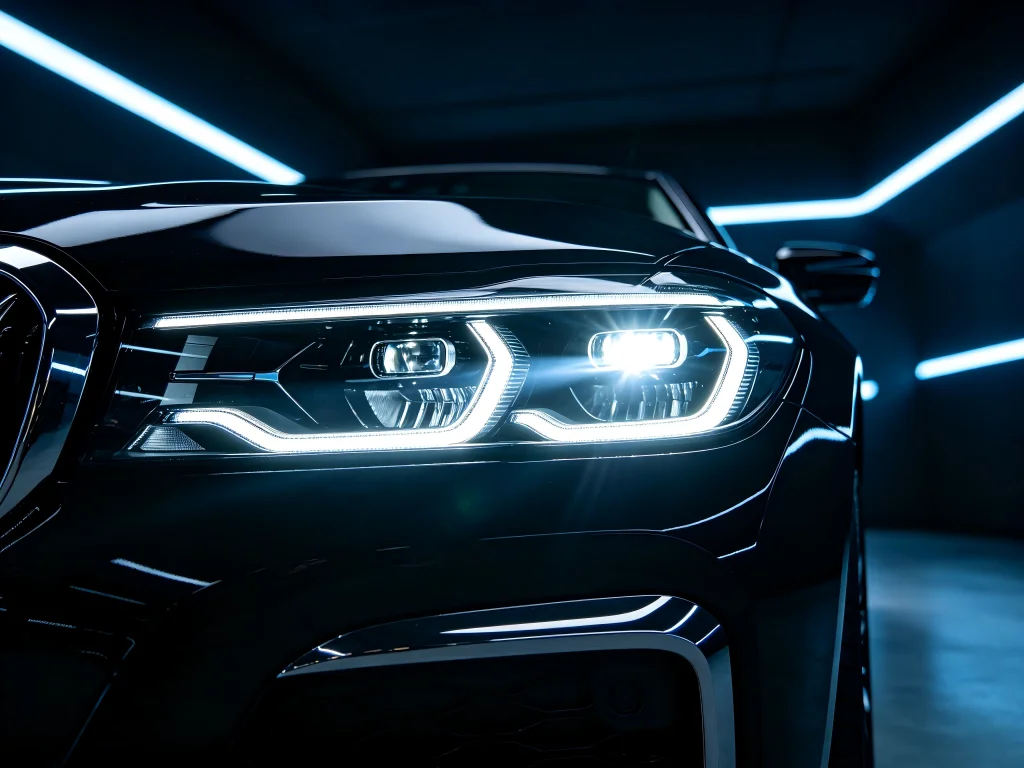
1. The Spec Sheet Lies: Lumens, Kelvin, and the Numbers That Actually Matter
The most important specification on an LED headlight bulb box is not lumens, wattage, or color temperature. It is emitter position accuracy relative to the original halogen filament. A bulb with perfect geometry at 3,000 lumens will outperform a misaligned bulb at 30,000 lumens every time.
Lumen ratings on aftermarket LED packaging are almost meaningless. They are measured in laboratory conditions with the LED chip driven at maximum current, often without the driver electronics or thermal constraints that exist inside a real headlight housing. One independent test found that a quality LED produced 2,524 lux on the road compared to 459 lux from a halogen—a 5.5x improvement in actual usable light. The lumen number on the box told a very different and far less useful story.
Color temperature is the second trap. A 6,500K bulb looks “modern” in photos and terrible in rain. Blue-shifted light scatters off water droplets and reduces contrast on dark asphalt. For markets with frequent rain or fog, something in the 4,300K to 5,000K range tends to serve drivers better than the harsh white most sellers push.
Wattage deserves a brief note. Halogen bulbs draw around 55W. A quality LED draws 20 to 30W. If an LED claims “100W equivalent” while drawing 60W, treat that as a warning sign, not a feature. Higher current draw generates more heat, and heat is the enemy of LED longevity.
2. Halogen vs. LED vs. HID: The Decision Table
| Factor | Halógeno (estándar) | HID (Retrofit) | Quality LED Upgrade | Cheap LED |
|---|---|---|---|---|
| Usable road illumination | Referencia | High, but slow warm-up | 2–5x halogen with proper geometry | Often worse than halogen despite “bright” appearance |
| Beam pattern control | Factory-engineered | Requires projector housing for proper cutoff | Good to excellent if emitter matches filament | Scattered, glare-prone, unpredictable |
| Vida útil | 500–1,000 horas | 2,000–3,000 hours, ballast dependent | 10,000–30,000+ hours with thermal stability | Months, sometimes weeks |
| Compatibilidad con CANbus | Native | Usually requires decoder | Vehicle-specific, decoder available | “Error-free” claim rarely verified |
| Legal risk (retrofit) | None | High in many jurisdictions | Moderate—check local rules | High—glare attracts enforcement |
| Real-world failure mode | Dim over time | Ballast failure, color shift | Rare if thermal design is sound | Flicker, overheating, dimming, code throwing |
HID retrofits deserve a caution. In Malaysia, JPJ enforcement operations specifically target non-compliant HID and LED headlights that produce excessive glare. The department has stated that replacing halogen bulbs with aftermarket HID or LED bulbs is generally not permitted unless the headlamp housing and components were designed for them. This is not a reason to avoid LED entirely. It is a reason to choose a product that respects beam geometry and to understand your local inspection reality before you buy.
3. The Three Engineering Decisions That Separate Good from Garbage
3.1. Decision One: Emitter Geometry
Your reflector or projector housing was designed around a filament that sits at one precise point in three-dimensional space. The LED chips must replicate that position within a fraction of a millimeter. Philips ZES chips measure 1.6mm by 2.0mm, which closely matches a halogen filament’s width. The best bulbs achieve what the industry calls “1:1 filament positioning,” with chip spacing tolerances measured in thousandths of an inch.
When this geometry is wrong, the consequences are not subtle. Light scatters upward into oncoming drivers’ eyes. The road ahead receives dark spots. The cutoff line that keeps your low beams from blinding traffic becomes a suggestion rather than a boundary. A forum reviewer described one popular bulb’s output as “two weakly lit lines in front of my car” because the chip gap was too wide.
3.2. Decision Two: Thermal Path, Not Fan Speed
Every LED generates heat at the junction where electricity becomes light. That heat must travel from the chip, through the substrate, into the heatsink, and out into the air inside your headlight housing. A fan can help move air, but a fan cannot compensate for a poorly designed thermal path. It can only delay the inevitable.
Surface temperatures above 100°C within ten minutes of operation are common in under-engineered bulbs. At those temperatures, light output drops by 20 percent or more, and the rated 30,000-hour lifespan becomes fiction. Passive cooling with a sufficiently large aluminum heatsink and copper substrate often outperforms a cheap fan that will eventually clog with dust or seize. When evaluating a bulb, ask not “does it have a fan?” but “how much metal is between the LED and the air, and does that metal have somewhere to send the heat?”
3.3. Decision Three: CANbus Honesty
“Error-free” and “CANbus compatible” are marketing phrases, not engineering certifications. Some vehicles accept LED bulbs without complaint. Others—particularly European platforms using PWM dimming—will flicker, throw bulb-out warnings, or shut the circuit down entirely regardless of what the box promised.
A reputable seller will tell you which vehicles need a decoder, not claim universal compatibility. If a listing says “fits all cars, no errors guaranteed,” treat that as evidence of either ignorance or dishonesty. The honest answer is: “Tell us your make, model, and year, and we will tell you what you need.”
4. What Real Buyers Discover After the Honeymoon Phase
Product reviews written on day one are nearly useless. The meaningful feedback comes months later, after heat cycles, rain, dust, and vibration have done their work.
Patterns emerge from forum threads and long-term owner reports. The bulbs that earn consistent praise share a common trait: the owner forgets they installed them. No flicker. No dimming. No warning lights. One eBay reviewer of a GTR bulb wrote simply: “Perfect beam placement onto the road”. Another described the output as “really sharp”. These are not dramatic claims. They are the absence of problems, which is exactly what a headlight upgrade should deliver.
The negative reports cluster around the same failures: a color tint that was not visible in product photos, flicker that appeared after a week, or a beam pattern that looked acceptable on a garage wall but proved useless on a wet highway. One reviewer returned to halogens because the LED color “was giving me a headache”. These are preventable outcomes, but only if the buyer asks the right questions before checkout.
5. Frequently Asked Questions
5.1. Can I put LED bulbs in my halogen headlights?
Physically, if the base matches (H11, H7, 9005, etc.), yes. Functionally, only if the LED emitter position replicates the halogen filament and the bulb addresses your vehicle’s CANbus monitoring. Many cheap bulbs fail one or both conditions, producing glare or error codes instead of usable light.
5.2. Are LED bulbs legal in headlights?
Rules vary significantly by country and region. Some jurisdictions have begun approving specific retrofit LEDs that meet technical standards, while others prohibit any non-factory LED in a halogen housing. Malaysia’s JPJ has actively enforced against non-compliant LED and HID retrofits that cause glare. Check your local vehicle inspection requirements before purchasing.
5.3. Why do some LED bulbs flicker while others do not?
Flicker usually comes from the vehicle’s PWM-based power delivery or its bulb-out detection circuit reacting to the LED’s lower current draw. A bulb with a properly designed driver and, where necessary, a decoder, will not flicker. The vehicle is not the problem. The bulb’s electronics are.
5.4. Do LED bulbs work in projector housings?
They can work very well, but projector housings are less forgiving of emitter misalignment than reflectors. A bulb that produces acceptable output in a reflector may create a distorted cutoff or a narrow hotspot in a projector. Look for products that explicitly state projector compatibility and provide geometry specifications, not just fitment charts.
5.5. How long do quality LED headlight bulbs actually last?
A well-cooled bulb with a stable driver can outlast the vehicle. The limiting factor is not the LED chip’s theoretical lifespan but the thermal design and the quality of the driver electronics. A bulb that runs cool and maintains consistent output after thirty minutes of operation is more likely to last than one that is brightest in the first five minutes.
5.6. What is the biggest mistake buyers make?
Buying on lumen claims alone. The second biggest mistake is assuming “plug-and-play” means the bulb will fit behind the dust cover, produce a correct beam pattern, and satisfy the vehicle’s computer without additional parts. None of those outcomes are guaranteed by a connector that matches.
6. Choose the Bulb You Will Forget You Installed
The best headlight upgrade is not the one that looks most dramatic on the product page. It is the one that disappears from your attention because it simply works. No flicker. No warning lights. No oncoming drivers flashing their high beams at you. Just a stretch of road, clearly lit, night after night.
At GTR, we build LED headlight bulbs around the variables that determine whether an upgrade succeeds or fails: emitter geometry that respects your housing’s optical design, thermal engineering that sustains output instead of fading after five minutes, and honest electrical compatibility instead of universal claims. Our Ultra series uses digitally optimized emitter positioning and Thermal Separation Technology to maintain performance in a compact package, backed by a lifetime warranty because we design for the long term, not the first review.
If you are ready to stop comparing inflated numbers and start choosing a bulb engineered for the road ahead, visit https://www.rhgtr.com. Tell us what you drive. We will tell you what actually works.