
Walk into any auto parts store or open any search results for the best LED headlights, and you will be buried in claims. “Brightest on the market.” “50,000 lumens.” “800% brighter than halogen.” Every box makes the same promises. Most of them break them.
After years in automotive lighting manufacturing and thousands of hours of bench testing, we have learned one thing: the best LED headlights are not defined by the biggest number on the box. They are defined by engineering decisions you cannot see until you install them — and by how they perform after 30 minutes of driving, not 30 seconds.
This guide cuts through the marketing noise. We will compare the technologies, expose the traps, and give you the framework to choose the best LED headlights for your specific vehicle — whether you drive a Jeep Wrangler JK or JL, a 2012 Honda Civic, a Ram 1500, a Toyota FJ Cruiser, or a Land Rover Defender.
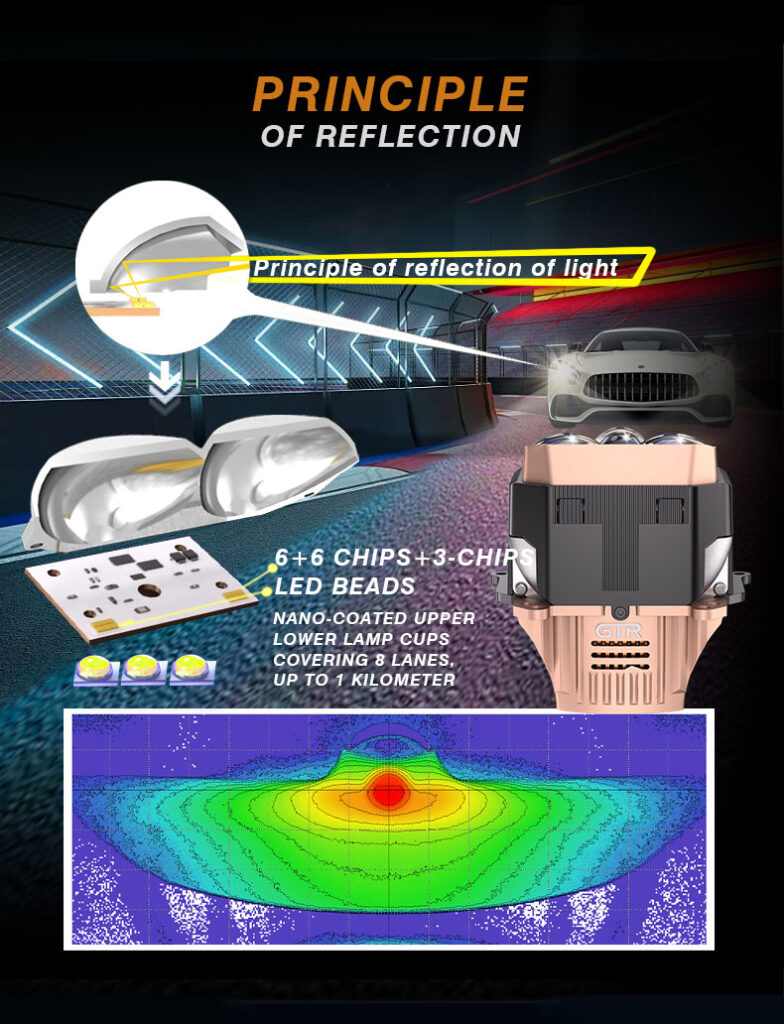
1. What Actually Makes the Best LED Headlights?
The best LED headlights balance four critical factors: chip quality and positioning, thermal management, beam pattern accuracy, and vehicle compatibility. Miss any one of these, and the bulb underperforms — regardless of how many lumens the box claims.
Let us break down each factor in detail.
1.1. LED Chip Type: The Heart of the Bulb
The LED chip determines brightness, beam pattern, and how well the bulb mimics the halogen filament position. Three chip types dominate the 2026 market:
| Chip Type | Terbaik untuk | Key Characteristics |
|---|---|---|
| Philips ZES (Luxeon Z ES) | Projector housing | 1.6mm x 2.0mm size matches halogen filament width; razor-sharp beam pattern; excellent color consistency at 6000K; moderate brightness per watt |
| CSP (Chip Scale Package) | Reflector housing | Higher brightness per watt than ZES; more compact; cheaper to manufacture; newer generations have closed beam quality gap significantly |
| Cree XHP / XPG Series | Specialty applications | Exceptional durability; XHP50 produces up to 19W per emitter; larger 5.0mm x 5.0mm package makes filament matching harder |
The GTR Lighting Ultra 3 uses a proprietary custom TST 7045 chip that employs thermal separation technology. This design places the LED die on a separate thermal plane from the driver circuit — a critical engineering choice that allows the bulb to run cooler than competitors drawing the same wattage.
1.2. Thermal Management: The Hidden Performance Killer
Heat is the enemy of LED performance. As temperatures rise, light output drops. This is called thermal throttling, and it is the single biggest reason cheap LED headlights underperform.
Consider this: a cheap LED bulb might advertise 50,000 lumens. But after five minutes of operation, heat buildup forces the driver circuitry to reduce power. The bulb dims. By 20 minutes, it may be delivering half its rated output.
Quality LED headlights solve this through:
- Active cooling — Precision fans that pull heat away from the chip
- Passive cooling — Large copper or aluminum heat sinks that dissipate heat through surface area
- Thermal separation — Physically isolating the LED die from the driver circuit, as seen in the GTR Lighting Ultra 3’s TST design
The Ultra 3 retains 87% of its initial brightness after a typical 27-minute drive. That is engineering that works in the real world, not just on a spec sheet.
1.3. Beam Pattern: Where the Light Actually Goes
Raw lumens tell you how much light a bulb produces. Beam pattern tells you where that light ends up. A bulb with perfect beam pattern and moderate lumens will outperform a high-lumen bulb with scattered light every time.
Your vehicle’s headlight housing — projector or reflector — was designed around the exact position of a halogen filament. The best LED headlights replicate that position with 1:1 precision. When the light source is misaligned, even by a few millimeters, the beam pattern breaks down. You get glare, dark spots, and reduced usable illumination.
In projector housings, look for a sharp cutoff line. In reflector housings, look for even light distribution across the beam pattern. The GTR Ultra 3 delivers both — forum users consistently praise its beam width and lack of dark spots.
1.4. Vehicle Compatibility: CANbus and Beyond
Modern vehicles monitor their lighting circuits. Install an LED bulb that draws less power than the original halogen, and the vehicle’s computer may interpret that as a burned-out bulb.
The symptoms:
- Pesan kesalahan di dasbor
- Flickering headlights
- Headlights that turn on and then shut off
- Hyper-flashing turn signals (if upgrading signal lights)
Quality LED headlights include built-in CANbus compatibility or come with CANbus resistors. The GTR Lighting Ultra 3 is designed to work with most vehicle electrical systems across its 9-40V DC operating range.
Always verify compatibility before purchasing. Some vehicles are more sensitive than others, and what works in a 2012 Honda Civic may not work in a 2023 Jeep Wrangler JL without additional components.
2. The Comparison: GTR Ultra 3 vs. The Competition
In independent testing by Headlight Revolution — which has tested over 250 LED bulbs — the GTR Lighting Ultra 3 produced the highest lux readings ever recorded in a Honda Civic reflector high-beam housing.
Here is how the Ultra 3 stacks up against other premium options:
| Fitur | GTR Lighting Ultra 3 | Morimoto 2Stroke 4.0 | SEALIGHT X4I |
|---|---|---|---|
| Raw Lumens | 4,700 lm | ~3,800 lm | ~4,500 lm |
| Suhu Warna | 5750K | ~5500K | 6500K |
| Power Consumption | 43W | ~40W | ~45W |
| Thermal Technology | TST thermal separation | Active fan | Turbo fan |
| Rentang Tegangan | 9-40V DC | 9-32V DC | 9-32V DC |
| Pola Balok | 1:1 filament match | 1:1 filament match | 1:1 filament match |
One forum user who tested both the Morimoto and GTR units noted: “I cannot say that the 4.0 light output or beam pattern is noticeably better than the GTR Lighting units. If I were sourcing a replacement, I would likely go back to the GTR Mini as they fit better without futzing inside the headlight mount.”
Another driver reported: “FWIW the GTR Ultra 3.0 are fantastic. I like the color, which seems even more reflective on road stripes than other LED I have used, beam width is broader than the Morimoto, cannot find any dark spots in the lighting.”
3. The Traps: What to Avoid When Buying LED Headlights
3.1. Trap 1: Buying the Cheapest Bulbs on Amazon
Low-cost bulbs often use minimal heat sinks, causing heat to accumulate during longer drives. They may look fine on the shelf but fail prematurely or underperform in real-world conditions. One industry expert noted: “A $70 LED kit lasts 5 years. A $15 kit dies in 6 months.”
3.2. Trap 2: Ignoring the Beam Pattern
Many buyers focus only on brightness. But poor beam patterns create glare, dark spots, and failed vehicle inspections. The best LED headlights produce a clean cutoff line with the beam rising appropriately while avoiding glare for oncoming traffic.
3.3. Trap 3: Choosing the Wrong Bulb Size
Different bulb sizes serve different applications. An H11 bulb is not built the same way as an H4 dual-beam bulb. Always check your vehicle’s handbook or confirm the correct bulb size before ordering.
3.4. Trap 4: Skipping CANbus Compatibility
If your vehicle was manufactured after approximately 2005, there is a good chance it monitors its lighting circuits. Skipping CANbus compatibility leads to flickering, error messages, or headlights that refuse to turn on.
3.5. Trap 5: Overlooking Color Temperature
Extremely high color temperatures (6500K and above) can create blue hues that scatter in foggy or rainy conditions. A clean white around 5000K-6000K is generally optimal for most driving conditions. The GTR Ultra 3’s 5750K strikes this balance perfectly.
4. Frequently Asked Questions About the Best LED Headlights
4.1. How do I know which LED headlights fit my vehicle?
Check your vehicle’s owner’s manual or the bulb size printed on your existing headlight bulbs. Common sizes include H11, 9005, 9006, H4, H13, and H7. The GTR Lighting Ultra 3 is available in most popular sizes.
4.2. Are more lumens always better?
No. Raw lumens measure total light output, but usable light on the road matters more. A bulb with excellent beam pattern and moderate lumens will outperform a high-lumen bulb with scattered light. Beam pattern accuracy is the priority.
4.3. What is the difference between projector and reflector housings?
Projector housings use a lens to focus light into a sharp beam with a distinct cutoff line. Reflector housings use a curved mirror surface to distribute light. Different housings may require different LED chip designs for optimal performance.
4.4. Do I need special tools to install LED headlights?
Most LED headlight upgrades are designed for DIY installation with basic hand tools. However, some vehicles may require removing the front bumper or wheel well liners for access. Always check installation requirements before purchasing.
4.5. Will LED headlights drain my battery?
No. LEDs draw significantly less power than halogen bulbs — typically 30-50 watts versus 55-60 watts for halogens. This lower power draw actually reduces strain on your vehicle’s electrical system.
4.6. Apakah lampu depan LED legal?
Factory-installed LEDs are legal everywhere. Aftermarket LED upgrades must comply with local regulations regarding beam pattern, brightness, and color temperature. Quality bulbs like the GTR Lighting Ultra 3 are designed to meet or exceed DOT and ECE requirements when properly installed and aimed.
4.7. What warranty should I expect from quality LED headlights?
Premium manufacturers typically offer warranties ranging from 2 years to lifetime coverage. The GTR Lighting line carries robust warranty protection. Always verify warranty terms before purchasing.
5. Your Decision Framework
When evaluating the best LED headlights for your vehicle, ask yourself these questions:
- What is my bulb size? — Confirm this before looking at any product.
- What housing type do I have? — Projector or reflector? This affects which chip design performs best.
- Does my vehicle need CANbus compatibility? — Most modern vehicles do.
- How important is thermal management? — If you take long drives or live in a hot climate, very important.
- What is my budget? — Quality LED headlights typically cost $100-$200 per pair. Anything significantly cheaper is likely cutting corners.
Based on our engineering testing and real-world validation, the GTR Lighting Ultra 3 consistently delivers across all five criteria. It is not the cheapest option, but it is the one that actually works — 742% brighter than stock in real-world testing, with thermal management that keeps it performing long after cheaper bulbs have dimmed.
6. Make the Smart Upgrade
The best LED headlights are an investment in safety. They are not a place to cut corners. When you choose the GTR Lighting Ultra 3, you are choosing:
- Proven performance — independently tested as the brightest LED bulb ever recorded in multiple housings
- Engineering excellence — thermal separation technology that prevents dimming
- Real-world reliability — retains 87% brightness after extended driving
- Vehicle compatibility — works across 9-40V DC systems with built-in CANbus
Your night driving should be confident. Your family deserves to be safe. And you deserve headlights that actually deliver what they promise.
Kunjungi https://www.rhgtr.com to find the right GTR Lighting Ultra 3 for your vehicle. No guesswork. No marketing hype. Just engineering that works.