
Memilih lampu mobil LED headlight lebih sulit daripada membandingkan watt dan harga. Hasil pencarian dipenuhi dengan produk 150W, 200W, 220W, dan 300W, klaim lumen yang besar, sistem pendingin yang berbeda, dan puluhan konfigurasi chip. Bagi distributor dan bisnis retrofit profesional, memilih secara salah dapat berarti retur, keluhan, dan rusaknya kepercayaan pelanggan.
This guide takes a different approach.
Instead of asking which LED looks the most powerful, we will examine which specifications actually predict useful headlight performance and which numbers need further scrutiny.
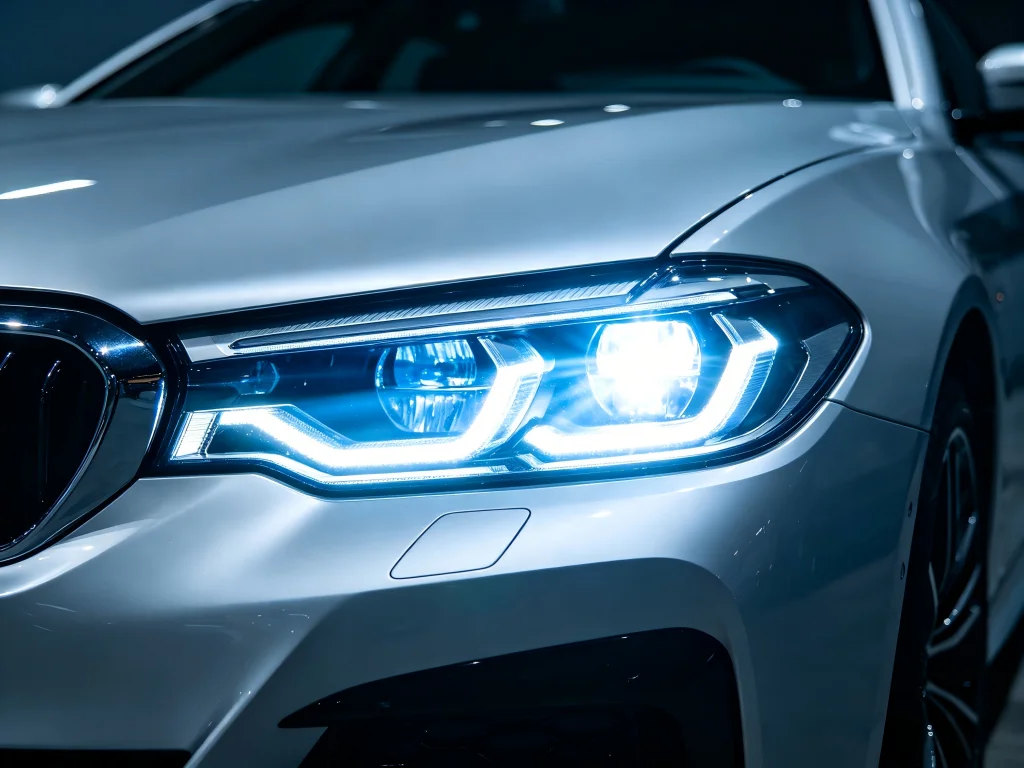
1. What Should You Look for When Buying LED Car Lights?
Choose car LED lights by evaluating beam pattern, LED chip geometry, sustained output, thermal design, electrical compatibility, physical mounting, and supplier consistency. Watt and lumen figures can support comparisons, but they should not replace optical testing in the reflector or projector actually used by the vehicle.
This creates seven key purchasing criteria:
- Optical compatibility
- Beam pattern
- Sustained brightness
- Thermal management
- Driver electronics
- Mechanical mounting
- Supplier and manufacturing capability
Note what is not at the top of the list: advertised wattage.
2. 150W vs 200W vs 220W vs 300W LED Lights
A 300W label does not automatically make an LED headlight better than a 150W or 200W product. Wattage describes electrical power only if measured consistently. Headlight effectiveness also depends on optical efficiency, LED placement, thermal stability, beam intensity, and how much of the generated light reaches useful road area.
| Search Category | Potential Appeal | Key Risks | Things B2B Buyers Must Verify |
|---|---|---|---|
| LED 150W | Performance-oriented improvement | Ratings may be misunderstood | Actual operating power per bulb |
| LED 200W | Strong marketing positioning | Heat and output reduction | Continuous output after heating |
| LED 220W | Premium specification positioning | Higher numbers may not improve optics | Light beam intensity and thermal design |
| LED 300W | Extreme performance positioning | Inflated or pair-based ratings | Measured electrical data and test conditions |
2.1. Trap #1: Comparing Different Wattage Definitions
Suppose Supplier A advertises 200W and Supplier B advertises 150W.
Supplier A sounds more powerful.
But Supplier A may quote theoretical combined power for a pair while Supplier B may publish a different measurement. Without knowing the test method, the comparison becomes meaningless.
Professional procurement teams should request measured operational data and clarify whether the specification refers to a single bulb or a pair.
2.2. Trap #2: Assuming More Power Means Longer Distance
A A 200-watt LED headlight bulb can consume more electrical power than another product without producing superior long-range illumination.
Why?
Because distance depends heavily on where the light is concentrated.
A lamp that spreads a large amount of light to the nearby area can appear brighter while producing weaker illumination on the farther road.
3. Lumens vs Lux: Which Number Matters?
Lumens describe luminous flux. Lux describes illumination reaching a surface. Neither number should be interpreted without understanding the test setup.
For buyers of headlights, the difference is very important.
Imagine two products that produce similar total luminous flux. Product A focuses light effectively onto the useful road zone. Product B spreads more light outside that zone.
Total light output may seem similar on paper, but the driving experience can be very different.
Readers who want the underlying photometric definition can review the technical concept of lux.
4. LED Chip Geometry: The Most Overlooked Specification by Buyers
This is one of the first areas our engineering team considers when evaluating replacement lamp performance.
Halogen reflectors are designed around a filament with a defined size and position. When an LED replaces that filament, the LED emitting surface must interact correctly with the existing optics.
If the light source becomes too large or moves away from the intended focal area, beam precision can degrade.
Results can include:
- blurred cut-off line;
- dark areas;
- excessive foreground brightness;
- uncontrolled upward light;
- reduced high beam concentration; and
- more glare for other road users.
5. LED Headlight H4 Needs Special Attention
A LED for H4 car headlights not just a bright LED that fits in an H4 socket.
H4 applications traditionally combine low beam and high beam functions in a single bulb architecture. This makes source geometry very important.
Before purchasing H4 LEDs in bulk, test:
- low beam cutoff line;
- high beam center intensity;
- transition between low and high beam;
- mounting orientation;
- reflector compatibility;
- rear mounting distance; and
- thermal behavior during continuous operation.
A product that performs well in one housing may not behave identically in another. This is why application testing provides more useful information than evaluating LED bulbs only on a test bench.
6. Fan Cooling vs Passive Cooling
| Factor | Active Fan Cooling | Passive Cooling |
|---|---|---|
| Heat dissipation potential | Can be high with good airflow | Highly dependent on heat-sink size |
| Compact high-power design | Often advantageous | May require larger structures |
| Moving parts | Yes. | No |
| Mounting considerations | Airflow must remain unobstructed | Space for heat dissipation is crucial |
| Buyer evaluation | Fan quality + complete thermal path | Material + luas + jalur termal |
Tidak ada arsitektur yang secara otomatis menang.
Desain kipas yang buruk tidak menjadi premium hanya karena menggunakan pendinginan aktif. Demikian pula, sistem pasif tidak secara otomatis lebih andal jika tidak dapat membuang panas yang cukup untuk daya operasinya.
Pertanyaan yang tepat adalah apakah sistem termal lengkap menjaga komponen-komponen penting dalam rentang operasi yang sesuai.
7. Cara Menguji Stabilitas Termal Sebelum Membeli dalam Jumlah Besar
Tes lampu LED yang berguna harus membandingkan output saat start dengan output setelah operasi berkelanjutan. Jika panas menyebabkan penurunan daya yang agresif, kecerahan awal dapat melebih-lebihkan kinerja berkendara yang sebenarnya. Pembeli B2B karena itu harus mengevaluasi suhu yang stabil, daya listrik, output cahaya, dan perilaku komponen daripada mengandalkan demonstrasi singkat.
Untuk distributor yang mengevaluasi sampel, tes pengadaan dasar dapat mengikuti urutan ini:
- Catat tegangan input, arus, dan daya segera setelah start.
- Pasang lampu dalam konfigurasi lampu depan yang representatif.
- Operasikan secara terus menerus dalam kondisi terkendali.
- Pantau perubahan daya listrik dan kinerja pencahayaan.
- Periksa berkas cahaya setelah sistem mencapai kondisi operasi yang stabil.
- Ulangi tes pada beberapa sampel daripada mengandalkan satu unit.
Langkah terakhir ini penting.
Pembeli B2B membeli konsistensi manufaktur, bukan sampel yang dipilih tangan.
8. Car LED Light Prices: Why the Cheapest Offer Can Be More Expensive
When buyers search for car LED light prices, unit cost naturally becomes the primary consideration.
But professional procurement must calculate broader costs.
Consider cheaper bulbs that generate more warranty claims. Distributors may have to pay for replacements, international shipping, customer support, technician time, and damaged dealer relationships.
These costs can exceed the initial savings.
For wholesale buyers, a more useful equation is:
Total Procurement Value = Product Performance + Consistency + Supplier Support + Market Fit – Failure Risk and After-Sales Service
This is one reason why experienced distributors often become more demanding about quality after several years in the market. They have learned what causes cheap failures.
9. What About 300W Car LED Lights?
The phrase 300 watt car LED lights attracts buyers looking for extreme performance. But the advertised numbers are very high and deserve careful technical verification.
Ask the supplier:
- Apakah 300W diukur atau teoretis?
- Apakah peringkat untuk satu lampu atau sepasang?
- Pada tegangan berapa daya diukur?
- Berapa daya operasi setelah stabilisasi termal?
- Bagaimana panas dihilangkan?
- Data sinar apa yang mendukung klaim kinerja tersebut?
Terapkan pertanyaan yang sama saat membandingkan lampu LED untuk lampu depan mobil 220 watt atau lampu LED untuk lampu depan mobil 150 watt.
Angka itu sendiri bukanlah masalahnya. Angka yang tidak dapat diverifikasi adalah masalahnya.
10. Apakah Lampu LED untuk Lampu Depan Mobil Legal di India?
Pembeli yang mencari lampu LED untuk lampu depan mobil legal di India harus memisahkan kompatibilitas fisik dari kepatuhan regulasi.
LED pengganti mungkin pas di soket dan beroperasi dengan benar dari perspektif kelistrikan, namun hal itu saja tidak menetapkan kepatuhan hukum dari sistem lampu depan yang dihasilkan.
Regulatory requirements may involve vehicle categories, approved lamp configurations, photometric performance, installation, and other factors. Regulations may also change, so businesses must verify current requirements before importing, selling, or installing specific lighting configurations.
For current Indian regulatory information, consult official sources such as the Ministry of Road Transport and Highways of India and applicable automotive standards rather than relying solely on seller claims.
11. Searching for “LED Lights for Car Headlights Near Me”?
For consumers, LED lights for car headlights near me usually indicate a strong purchase intent.
But choosing the nearest installer should not be the only criterion.
Professional retrofit workshops should understand beam alignment, bulb orientation, electrical compatibility, projector and reflector behavior, and post-installation testing.
Ask the installer to demonstrate the beam, not just show the bulb.
12. Supplier Comparison: What Should B2B Buyers Assess
| Purchasing Factors | Low-Cost Commodity Supplier | Professional Lamp Manufacturer | Why This Matters |
|---|---|---|---|
| Price | Often Highly Competitive | Based on Product Positioning | Affects Margin but Not Total Risk |
| Watt Claims | May Focus on Key Numbers | Must Support Technical Evaluation | Prevents Misleading Comparisons |
| Optical Development | May Be Limited | Application-Oriented | Controls Usable Road Illumination |
| Thermal Design | Cost-Driven | Performance and Durability Driven | Affecting continuous output |
| Batch Consistency | Must be carefully verified | Must be managed systematically | Reducing wholesale return risk |
| Customization | Often limited | Can support special market programs | Helps distributors differentiate themselves |
| Technical Support | Mainly focused on sales | Technical and application support | Useful for professional channels |
13. Why Professional Buyers Choose GTR
GTR positioned around professional automotive lighting rather than a race for the biggest numbers printed on the box.
Based on our manufacturing experience, successful aftermarket lighting requires several disciplines to work together: optics, electronics, thermal management, mechanical engineering, production control, and real-world application knowledge.
For wholesalers, distributors, importers, and retrofit chains, this also changes what the supplier relationship must provide.
You may need products tailored to the local vehicle population.
You may need different performance levels for good-better-best product positioning.
You may need packaging, branding, technical documentation, or other customization for your sales channels.
Most importantly, you need repeatable quality when initial samples become commercial orders.
That is where manufacturing capability becomes more valuable than spectacular specification sheets.
14. Practical Sample Evaluation Checklist
Before approving your next LED headlight supplier, use this checklist:
- Measure: Do not accept wattage and output claims without understanding the test conditions.
- Install: Evaluate samples in the actual representative headlight housing.
- Projection: Check cutoff, hotspot, width, dark zones, and high beam concentration.
- Heat: Run the product long enough to reveal thermal behavior.
- Fit: Check socket dimensions, rear clearance, dust cover, and wiring.
- Repeat: Compare multiple production samples for consistency.
- Verify: Review applicable regulations and documentation for your target market.
- Calculate: Compare warranty and after-sales risk along with purchase price.
15. FAQ: LED Car Headlight Purchasing Questions
15.1. Which LED car headlight is the best?
The best choice is one that matches the vehicle's optical system while providing controlled beam distribution, stable output, effective cooling, reliable electronics, and proper installation. There is no universal wattage that makes one LED best for every vehicle.
15.2. Should I buy a 200W or 300W LED headlight?
Compare verified operating power, sustained performance, beam quality, and thermal behavior first. Larger advertised wattage does not by itself prove superior road performance.
15.3. Is 220W enough for LED car headlights?
Wattage alone cannot answer this question. An efficient optical system can produce excellent illumination without chasing extreme power figures.
15.4. What makes a good H4 LED bulb?
Strong LED for H4 car headlights must provide accurate source positioning, effective high/low beam control, stable thermal performance, appropriate dimensions, and good electrical compatibility.
15.5. Why are some LED lights much cheaper?
Price differences may reflect LED components, driver design, thermal materials, manufacturing consistency, quality control, packaging, supplier support, and brand positioning. Evaluate total cost of ownership rather than just price.
15.6. Can LED lights cause glare?
Yes. Poor source positioning, incompatible optics, incorrect installation, or improper headlight aiming can send excessive light to unwanted areas. Optical compatibility and proper aiming are crucial.
15.7. Do LED lights lose brightness when hot?
Some designs may reduce output as operating temperature rises. The amount depends on thermal management and electronic control, making continuous testing useful when comparing products.
15.8. Where can wholesalers find professional LED lights?
B2B buyers should prioritize manufacturers that can support technical evaluation, stable production, application matching, quality control, customization, and after-sales needs rather than just choosing suppliers from a price list.
16. Your Next Light Order Should Start With Testing, Not Wattage
If you choose LED car headlight lamp next for wholesale business, distribution network, or professional retrofit chain, don't let 150W versus 200W versus 300W be the entire purchasing decision.
Your customers don't drive spec sheets.
They drive dark highways, wet city streets, mountain roads, and poorly lit rural routes. They will judge your product based on what they can actually see after sunset.
Kunjungi www.rhgtr.com to explore GTR automotive lighting solutions. Send us your target market, vehicle application, desired product positioning, and expected order program. Instead of choosing another LED from a spreadsheet, build a lighting lineup based on performance that dealers and your customers can see on the road.